2 - Organ transplantation
 Call Kai
 Learn
Learn Practice Test
 Spaced Repetition
 Match
Match Flashcards
 Knowt Play
1/19

There's no tags or description
Looks like no tags are added yet.
Name | Mastery | Learn | Test | Matching | Spaced | Call with Kai |
|---|
No analytics yet
Send a link to your students to track their progress
20 Terms
In 1954, there was the first …
1st successful (living donor) kidney transplant between two twins.
The reason they were able to do this so long ago was because they were identical twins.
In 1967, there was the first…
1st heart and 1st liver transplant
But they were not living a long time
In 1983, …
Anti-rejection medication: Cyclosporine FDA-approved, 1st successful lung transplant (TGH) done in Toronto.
In 1998, there was the first …
1st adult-to-adult living liver transplant
In 2010, there was the first…
1st FULL face transplant
High-level investment from health care, patient, families
A LOT required, and a lot of people.
If you think it is important, why have you not registered?
Aversive/unpleasant to think about our death
Knowledge
Time, logistics and not a priority
Religious beliefs
Family objections
Why the Donor Shortage?
Attitudes/beliefs
"if I want to be a donor, they wont try and save me"
General distrust in medical system
Emotional factors
Fear of disfigurement
Don’t want to think of own death
Social factors
Family objections (despite donor consent)
Lack of knowledge/education
How to donate, who can donate, what will it cost
Few deaths are “eligible” for organ donation
Organ quality
Organ preservation
Almost ____ of BC residents support organ donation, yet only _____ have registered their decision on BC's Organ Donor Registry
85%
28%
Presumed consent "opt out"
Organs automatically available unless registered objections
Family can still object
20-30% increase in donors
Quite a few countries who have this
NOVA SCOTIA is the only one is Canada that uses this system
Xenotransplantation
Transplantation of living cells, tissues or organs from one species to another
What are the 3 parts of the process psychology is involved in?
Pre-transplant psychosocial assessment
The Waiting Game
Post-transplantation
In the pre-transplant psychosocial assessment, the psychologist can
Screen people for a variety of surgeries
Interested in spinal cord stimulation, bariatric surgery, etc.
Medical urgency, blood type matching, size of the individual, time on list
But other factors…
Goals of Pre-transplant Psychosocial Assessment?
Is patient suitable from psychosocial perspective?
Any psychosocial factors that would be absolute contraindication? (i.e., no-go!)
Any psychosocial factors that would be relative contraindication? (i.e., can be waitlisted but factors that must be addressed before/during/after transplant to reduce risk and optimize outcomes)
There are standardized assessment tools used to be consistent across patients and transplant centres.
This includes the ______
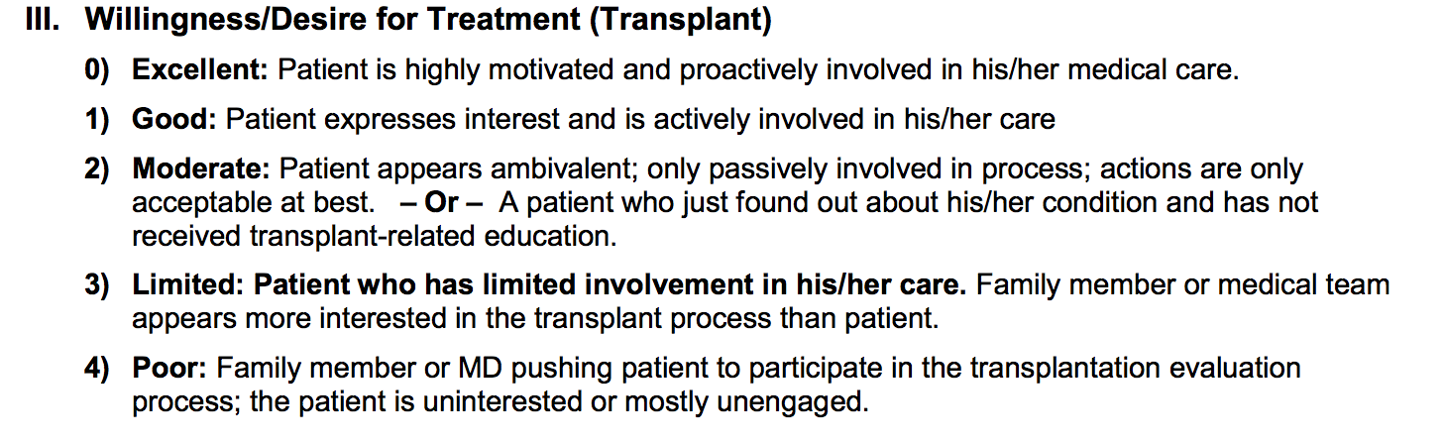
Stanford Integrated Psychosocial Assessment for Transplantation (SIPAT)
Is BMI a contraindication?
In a study of 430 patients transplanted during a 10 year period, BMI was NOT an independent predictor of mortality and “no level of BMI led to significantly worse survival”
research out that weight should not disqualify a candidate
Underweight may be more at risk
Is psychiatric disorder a contraindication?
Findings have been mixed for depression as risk factor for post-transplant mortality
“there is NO psychiatric disorder that is an absolute contraindication to transplantation and even the most psychiatrically complex patient, can have successful long—term outcomes.
Is medical nonadherence a contraindication?
IS an absolute contraindication for heart and lung transplant
“psychiatric conditions associated with the inability to cooperate with the medical/allied health care team and/or adhere with complex medical therapy”
Is lack of social support a contraindication?
Depends on organ
YES (absolute) --> heart and lung
NO (relative contraindication)--> kidney and liver
Liver --> “patients should have adequate social/caregiver support to provide the necessary assistance both while waitlisted and until independently functioning in the postoperative period.
Is alchohol use a contraindication?
Main point --> “There is no conclusive evidence to support the abstinence rule”
Typically therapy/rehab to address alcohol use (not outright rejection)
Study --> Meta-analysis of substance use post-tx
Relapse predicted by: poor social support, family history of alcohol abuse/dependence duration of pre-tx abstinence.
BUT: relapse does not appear to predict survival
Research has suggested we should not be using this rule (should be compassionate) --> discrimination associated with stigma of alcohol and cannabis use disorders.
Stigma increases health-related inequities.

