Ch. 12 - Helping
 Studied by 0 people
 Call Kai
 Learn
Learn Practice Test
 Spaced Repetition
 Match
Match Flashcards
 Knowt Play
1/20

There's no tags or description
Looks like no tags are added yet.
Name | Mastery | Learn | Test | Matching | Spaced | Call with Kai |
|---|
No analytics yet
Send a link to your students to track their progress
21 Terms
Altruism
a motive to increase another’s welfare without conscious regard for one’s own self-interests
Each view of altruism proposes two types of prosocial behavior
Tit-for-tat reciprocal exchange
More unconditional helpfulness
Each view is also vulnerable to charges of being speculative and after the fact
Each, however, offers a broad perspective that illuminates both enduring commitments and spontaneous help
paradox of altruism
behaviorism, freudianism, darwinism all viewed people as inherently egoistic
Ex: natural selection “will never produce anything in an organism that is injurious to itself, for natural selection acts solely by and for the good of each”
Social-exchange theory
the theory that human interactions are transactions that aim to maximize one’s rewards and minimize one’s costs
Does not contend that we consciously monitor costs and rewards, only that such considerations predict our behavior
Reciprocity norm
an expectation that people will help, not hurt, those who have helped them
Helps define the social capital—the mutual support and cooperation enabled by a social network—that keeps a community healthy
Social responsibility norm
An expectation that people will help those needing help
Women offer help equally to males and females, whereas men offer more help when the persons in need are females
Perhaps not surprisingly, men more frequently help attractive than unattractive women
Women receive more offers of help in certain situations and also seek more help
They more often welcome help from friends
Kin selection
the idea that evolution has selected altruism toward one’s close relatives to enhance the survival of mutually shared genes
Being nice to those who share one’s genetic material
cannot explain being nice to strangers (which does happen)
When will we help?
We do tend to help when someone else does so
Prosocial models promote altruism
Time pressures affect whether people help
When hurried, preoccupied, and rushing, people often do not take time to tune in to a person in need
Because similarity is conducive to liking, and liking is conducive to helping, we are more empathetic and helpful toward those who are similar to us
Where racial similarity is concerned, reactions may be affected by the desire to not appear prejudiced
Internal influences on the decision to help include guilt and mood
External influences includes social norms, number of bystanders, time pressures, and similarity
How do attributions matter for social norms?
Attributions (internal vs external reason for help needed) matter for social norms
External attribution → people more likely to be altruistic
Internal attributions → people less likely to be altruistic
Decision-tree model of bystander intervention (Latene & Darley, 1970)
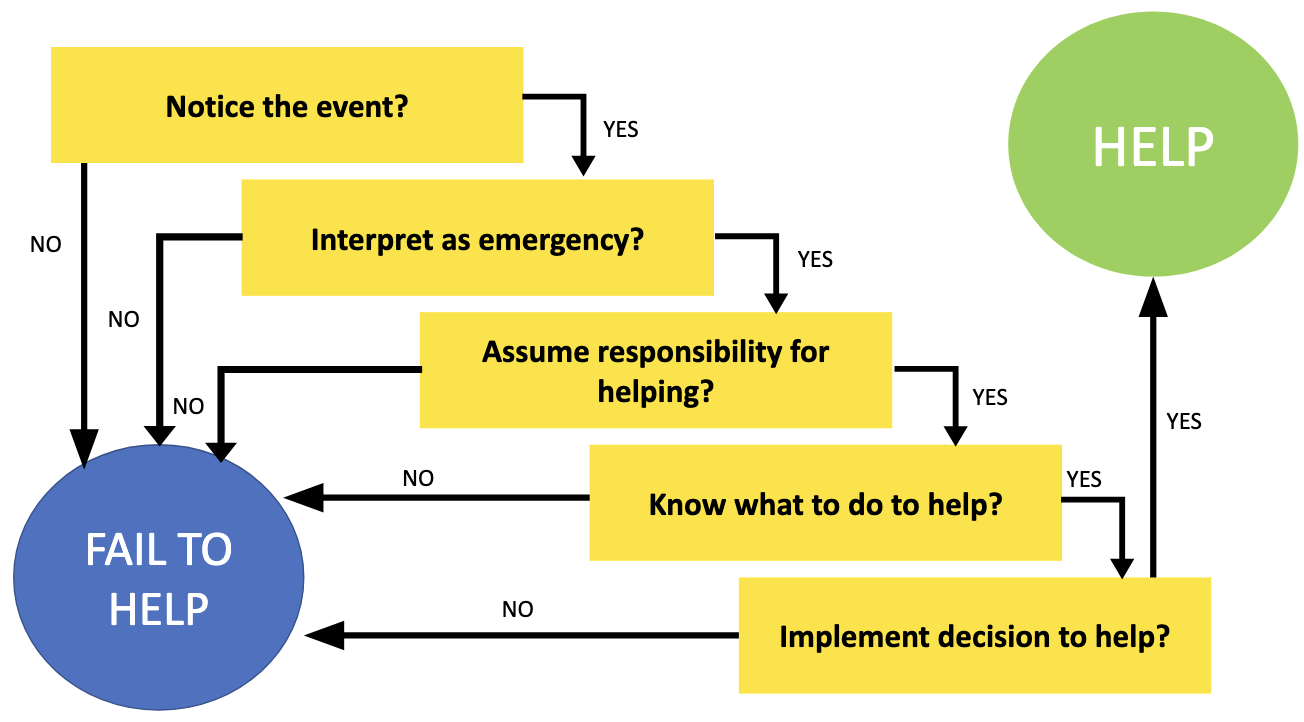
Steps 1 and 2: Noticing and Interpreting (Latane & Darley, 1968)
Normative influence - pressure not to “freak out” when others can see you; need clear proof it’s an emergency
Informational influence - pluralistic ignorance = everyone ignorant of others’ thoughts
More ppl = lower probability of noticing and interpreting emergencies → lower helping
Step 3: Assuming Responsibility (Moriarty, 1975)
Trip to the beach → confederate lays down towel and radio next to participant on beach → either just leaves or asks participant, “would you watch my things?”
Second confederate walks by and takes radio
DV = % stopping theft (when asked, more people stopped it)
First Aid Training Study (Schwartz & Clausen, 1970)
Epileptic seizure situation
Half given first aid training prior to emergency and half given no training
DV = % helping
When trained, more gave help than non-trained
From Jerusalem to Jericho (Darley & Batson, 1973)
Inspired by parable of the Good Samaritan
Seminary students asks to give lecture on either “careers for ministers” or “parable of the good samaritan”
Told either “you’re late” or “you have plenty of time”
On way to campus, come upon a man in distress
DV = % stopping to help
70% of those not in a hurry helped, only 10% in a hurry helped
Bystander effect
the finding that a person is less likely to provide help when there are other bystanders
Researchers’ twofold ethical obligation
Protect the participants
Enhance human welfare by discovering influences upon human behavior—altering us to unwanted influences and showing us how we might exert positive influences
Personality traits and status
Attitudes and trait measures seldom predict a specific act; but they can predict average behaviors
Individual differences in helpfulness persist over time and are noticed by one’s peers
Network of traits—positive emotionality, empathy, and self-efficacy—predisposes a person to helpfulness
Personality influences how people react to particular situations—such as whether they are attuned to others’ expectations
Status and social class also affect altruism
Gender differences in helping
When faced with potentially dangerous situations, men more often help
In safer situations, women are slightly more likely to help
Women are more likely to describe themselves as helpful
Faced with a friend’s problem, women respond with greater empathy and spend more time helping
Women tend to be more generous
Religious differences in helping
Although often associated with opposition to gov’t assistance such as support for the poor, religiosity also promotes prosocial values
Christianity, Islam, Hinduism, and Buddhism all teach compassion and charity
Highly religious people report markedly higher than averages rates of charitable giving, volunteerism, and helping a stranger
Prosocial effects of religiosity appear to be strongest in countries in which religious behavior is a matter of personal choice
How can we increase helping?
One way to promote altruism is to reverse those factors that inhibit it
Reduce ambiguity, increase responsibility
Awaken people’s guilt and concern for their self-image
Socialize altruism
Guilt and concern for self-image
People who feel guilty will act to reduce guilt and restore their self-worth
Guilt-inducing messages on signs
Asking for contributions so small that people can’t say no
Labeling people as helpful can also strengthen a helpful self-image and influence their willingness to contribute
Moral exclusion
the perception of certain individuals or groups as outside the boundary within which one applies moral values and rules of fairness
Moral inclusion is regarding others as within one’s circle of moral concern
First step in socializing altruism is therefore to counter people’s natural ingroup bias
 Note
Note  Flashcards (56)