protists
 Studied by 0 people
 Call Kai
 Learn
Learn Practice Test
 Spaced Repetition
 Match
Match Flashcards
 Knowt Play
1/16

There's no tags or description
Looks like no tags are added yet.
Name | Mastery | Learn | Test | Matching | Spaced | Call with Kai |
|---|
No analytics yet
Send a link to your students to track their progress
17 Terms
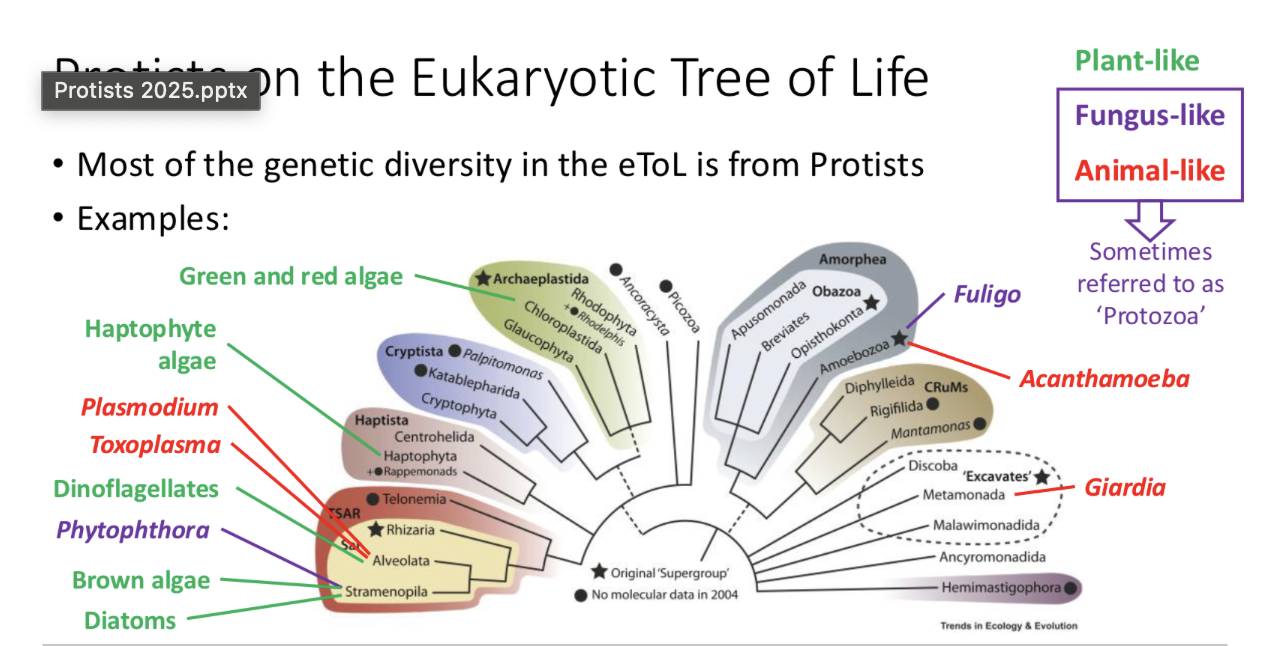
dotted line we aren’t sure where to group
these are all types of eukaryotes
what’s Protistology
s the study of protists
Parasitology
is the study of parasites, their hosts, and the
relationship between them
parasite
is an organism which lives briefly or permanently on or in,
a host organism, and gets its food from, or at the expense of, its host
Parasites can be viruses, bacteria, fungi, protozoa or metazoa
But microbiology, and particularly in medical microbiology is
commonly divided into four fields of study:
• “Virology” – viruses
• “Bacteriology” – bacteria
• “Mycology” – fungi
• “Parasitology” – protists and
metazo
50% of oxygen comes protists
plant like protists- algae
• Lack vascular tissue and other adaptations to live in
dry environments on land
• Significant ecological role – food-base in most marine
ecosystems
• Red and green algae evolved through primary
endosymbiotic events
• Red algae
• Chloroplasts contain chlorophyl a and phycobiliproteins
• Often multicellular – many are macroscopic seaweeds
• Green algae
• Phylogenetically closely related to plants
• Chloroplasts contain chlorophyl a and chlorophyl b
• Most are unicellular, but can be colonial or multicellular
• Some have potential to be used for biofuel productionThe good and bad of alga
The good and bad of algae
• Sargassum spp. brown algae are pelagic – they grow in
the open sea, floating on the surface and can form
large mats
• Once confined to the Sargasso Sea (part of the North
Atlantic off Florida), they are now spreading across
large parts of the tropical Atlantic from America to
Africa
• Particularly near coasts, this harms the underwater
flora and fauna, impacts the fishing industry, and
tourism and is dumped in landfill
• Methods have been developed to convert Sargassum
spp. into fertiliser, biofuel, soundproofing membranes
and eco-friendly building materials
Plant-Like Protists - Diatoms
• Mostly unicellular, ~100,000 species
• Oceans, freshwater, soil and damp surfaces
• Major component of phytoplankton
• Important primary producers –cphotosynthesis
45% of oceans’ primary production
• Encased within a unique cell wall – frustule
silicone dioxide cell walls so revive we’ll as fossils
Greek dia (“through”) and temnein (“to cut”)
• First evolved 185 million years ago
Plant-Like Protists - Dinoflagellates
• Greek dinos (“whirling”) and flagellum (“whip”)
• Diverse group of marine and freshwater
phototrophic alveolates
• Photosynthesis – secondary endosymbiosis
• Primary producers
• Some are toxin producers, e.g. Gonyaulax
• Flagella - transverse and longitudinal
• Free-living or symbiotic
• Bioluminescence
Fungus-Like Protists – Slime Moulds
• Despite the name, these are NOT fungi
• Fungi – do not move, have chitin in their cell walls, produce enzymes
then absorb nutrients
• Slime moulds – do move, do not have chitin in their cell walls, ingest
their food
• Two stages in life cycle – amoeba-like and fungus-like
• Saprotrophs – consume bacteria, fungi, protozoa and other
tiny organisms
• Myxomycota - true plasmodial (acellular) slime moulds e.g.
Fuligo
• Acrasiomycota - cellular slime moulds e.g
Fungus-Like Protists – plasmodial slime moulds
Fuligo septica (dog vomit fungus)
Fungus-Like Protists - Oomycetes
• Oomycetes (water moulds)
• Filamentous growth and multinucleate hyphae
• Cellulose not chitin cell walls
• Flagellated cells
• Saprotrophs
Phytophthora infestans
• Late blight disease of potatoes
• Massive famines in Ireland in the 19th century
• Asexual and sexual cycl
animal like protists
• Heterotrophic – obtain nutrients by consuming other microorganisms or
from larger organisms in parasitic or symbiotic relationships
• Historically divided into four (artificial) groups, based on movement:
• Amoebae
• Flagellates
• Ciliates
• Sporozoans
• Often have multi-stage life cycles
• Can include stages with different
mechanisms of movement!
• E.g. Naegleria fowler
Animal-Like Protists Causing Human Disease
Giardia lamblia (prev. G. intestinalis)
• Prevalence of 20-40% in low income
countries
• Toxoplasma – Toxoplasmosis
• 30 to 50% of world population
• Plasmodium - Malaria
• Top 3 globally important infective
diseases
• ~ 2000 cases per annum in UK
Animal-Like Protists – Giardia lamblia
• Global distribution – more common in tropical
regions.
• A disease of poverty – high burden in low-
income countries, especially in children
• Causes diarrhoea, flatulence, greasy stools,
abdominal cramps, sulphurous belching
• Chronic/recurrent infection in childhood can lead
to malnutrition and growth stunting
• Anaerobic
• Lack mitochondria – reductive evolution haws
resulted in mitososmes
• Anterior, posterolateral, and ventral flagella
Animal-Like Protists – Toxoplasma gondii
• Complicated lifecycle
• Cats – definitive, obligate hosts
• Birds/small mammals – secondary
hosts
• Humans/large mammals –
incidental hosts
• Parasites form tissue cysts
• Skeletal muscle, myocardium, brain, eyes
Animal-Like Protists - Plasmodium
Complex sexual and asexual lifecycle
• Obligate requirement for two hosts
• Five species infect man
• Plasmodium falciparum (severe disease)
• P. vivax
• P. ovale
• P. malariae
• P. knowlesi
• Female Anopheles mosquito: the transmission
vector
• Prevention of malaria often focuses on controlling
the mosquito vector – no successful vaccine
 Note
Note  Flashcards (223)