CH. 4, Part 2: Sociocultural learning, Education and Self Concept (The Preschool Years)
 Studied by 0 people
 Call Kai
 Learn
Learn Practice Test
 Spaced Repetition
 Match
Match Flashcards
 Knowt Play
1/73

There's no tags or description
Looks like no tags are added yet.
Name | Mastery | Learn | Test | Matching | Spaced | Call with Kai |
|---|
No analytics yet
Send a link to your students to track their progress
74 Terms
“Cognitive development is a result of social interactions.. through cultural institutions ” is what theory?
Vygotsky’s Sociocultural
The level at which children can complete a task with assistant from an experienced person is called what?
Zone of Proximal Development (ZPD)
The Size of ZPD is proportionate to what?
the extent of improvement that comes with help
physical items, conceptual frameworks that help in learning is called what
Cultural tools
The support for learning and problem solving that encourages independence and growth is called what?
Scaffolding
What are the General Principles (stages) of Vygotsky’s Theory?
Primitive, Naïve Psychology, Ingrowth
What is Primitive stage (0-2 yrs)?
Stage 1: Mental process similar to lower animals Conditioning and imitation
What is Naive psychology stage (2-6 yrs)?
Stage 2: Uses language to communicate but doesn’t understand symbolic character
What is Ingrowth stage (6+ yrs)?
Stage 3: Completely understand symbols and can internalize speech
Speaking to oneself to provide instructions or ask questions is called what?
Egocentric speech
What is the way in which an individual combines words and phrases to form sentences?
Syntax
What is the system of rules determining how thoughts can be expressed called?
Grammar
Grammatical markers attached to sentences to indicate number, tense, gender etc. is called?
Inflections
When is inflections missing in a child?
in early childhood language
The process of associating new words with their meaning only after a brief encounter is called what?
Fast mapping
What does Fast mapping lead to?
vocabulary increase
What language developments do 3 yr. olds learn?
Plurals, possessive nouns, tense, questions and statements, principles of grammar
Attaching regular inflections to irregular words is called?
Over-regularization
“I goed home" is an example of what?
Over-regularization
Speech that is spoken by children and directed towards themselves until 3 yrs is called what?
Private or Egocentric Speech
Speech that is spoken directed at others and meant to be understood by them after 3 yrs is called what?
Social Speech
The understanding of sound patterns in a language after 3 yrs is called what?
Phonological Awareness
the skill of communicating effectively and appropriately is called what?
pragmatics
Private speech could help improve what?
pragmatics
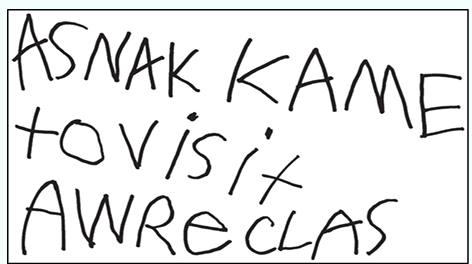
A strategy used by children with good phonological awareness is called what?
Invented spelling
Reading books during early childhood can do what?
improve vocabulary
Words that are understood when heard is called what?
Receptive vocabulary
Words that can be used correctly is called what?
Expressive vocabulary
Parental/caregiver influence can do what?
enhance number concept in children
Knowledge and skill of applying numbers/mathematical concepts is called what?
Numeracy
Children can learn information through what sources?
informal or formal
An average pre-schooler has how much screen time?
up to 4 hrs daily
What percent of pre-schoolers have used computers between ages 4 and 6 yrs?
70%
Children may not be able to distinguish between what in media?
fantasy and reality
What may young children fail to do in media?
fail to critically evaluate content
What is of high risk with increased screen time?
obesity
Educational programs could do what?
improve vocabulary, numeracy, general knowledge E.g: Sesame street
Primary purpose is social interactions is what kind of early childhood education?
Child-care centres
Intellectual and social stimulation is what kind of early childhood education?
Preschool
Sensorimotor learning and language is what kind of preschool?
Montessori
Collaborative effort and play is what kind of preschool?
Regio Emilia
What early childhood education is In local school systems with better trained staff?
School child-care
What kind of early childhood education is a Non-uniform quality in child-care?
Family centres
children enrolled in child-care show what?
better intellectual development
What’s a pro with child care?
Higher verbal fluency, comprehension, higher IQ scores in future, better social development.
What is a con with child care?
antisocial traits, externalizing behaviour, aggressiveness.
Childhood stressors ranging from day to day maltreatment to traumatic events that puts children at risk of negative physical and mental outcomes is called?
Adverse Childhood Experiences
Episodes of abuse mostly occur through what?
everyday interactions
Parents who themselves have been victims of abuse tend to what?
perpetuate that behaviour
Adverse Childhood Experiences face what?
high levels of constant stress and anxiety
What are the Adverse Childhood Experiences in Canada?
Neglect, exposure to intimate partner violence, physical abuse, emotional maltreatment, sexual abuse
Chronic stress can disrupt what?
brain function - cognitive and socioemotional issues - low academic achievement
Prevention measures to Adverse Childhood Experiences include what?
educating parents and providing at risk families with professional help.
Understanding self and other’s behaviours is what?
Erikson’s Psychosocial Development
Children who face conflict between desire to act independently and the guilt that comes if they fail is what interaction?
Initiative vs Guilt stage
The sense of self where children tend to focus on superficial characteristics to describe themselves is called?
Categorical Self
Awareness of oneself as a member of society is called?
Social Self
What Emphasizes personal identity and expression?
Individualistic orientation
What Promotes interdependence and belongingness?
Collectivistic orientation
A person’s identity or set of beliefs about what one is like as an individual is called what?
Self-Concept
Children who are from minority cultures indicate preferences for majority values or people is called what?
Race Dissonance
What does race dissonance not represent?
inferiority or low self-esteem, mainly to socialize based on the majority culture
Children from different cultures trick-or-treating during Halloween is an example of what?
Race Dissonance
Perception of oneself as male or female or both or neither is called what?
Gender identity
Boys tend to spend more time doing what kind of play?
Rough
Girls are more driven to do what kind of play?
Organized
Gendered behaviours are strengthened by what?
social expectations
Parental views on gender roles can do what?
impact children’s understanding of gender
What perspective is the following for Gender identity?
Androgens can lead to ‘typically male’ behaviours and choices. Evolutionary purpose of seeking out mates.
Biological perspective
What perspective is the following for Gender identity?
Child can mimic gender appropriate behaviour that receives praise Media could propagate stereotyped behaviour
Social-learning perspective
What perspective is the following for Gender identity?
Children need to develop a gender schema, cognitive framework that organized gender related information
Cognitive perspective
Kohlberg proposed what?
that young children base their understanding of gender on appearances.
Belief that gender identity is fixed and unchangeable is called what?
Gender constancy
The state in which gender roles encompass characteristics from both sexes is called what?
Androgynous
 Note
Note  Flashcards (169)