2) Facors affecting attriction: Self Disclosure
 Studied by 0 people
 Call Kai
 Learn
Learn Practice Test
 Spaced Repetition
 Match
Match Flashcards
 Knowt Play
1/10

There's no tags or description
Looks like no tags are added yet.
Name | Mastery | Learn | Test | Matching | Spaced | Call with Kai |
|---|
No analytics yet
Send a link to your students to track their progress
11 Terms
Self Disclosure
reveal more as relationship develop
Revealing personal information
Revelations strengthens the relationship - if used appropriately
Playas a vital role beyond the initial attraction, but we must be careful what we disclose (too little/too much) about ourselves
Altman and Taylor (73) - self disclosure
Relationships are a gradual process of revealing your inner self to someone.
Romantic relationships’ involve a reciprocal exchange of information between partners.
This leads to a deeper understanding of each other and is an important mechanism through which a relationship develops.
Onion Metaphor - Altman and Taylor
There are two elements to this idea - breadth and depth.
They use the onion metaphor (layers) to explain this - as they increasingly disclose more and more information romantic partners ‘penetrate’ more deeply into each others lives.
Breadth = Low risk information is revealed early on in a relationship (info we would reveal to anyone) - many topics are off limits early on, we should not reveal too much too soon
Depth = High risk information comes out as the relationship progresses, self-disclosure is deeper, revealing our true selves, intimate, high risk info such as painful memories and experiences, beliefs and secrets.
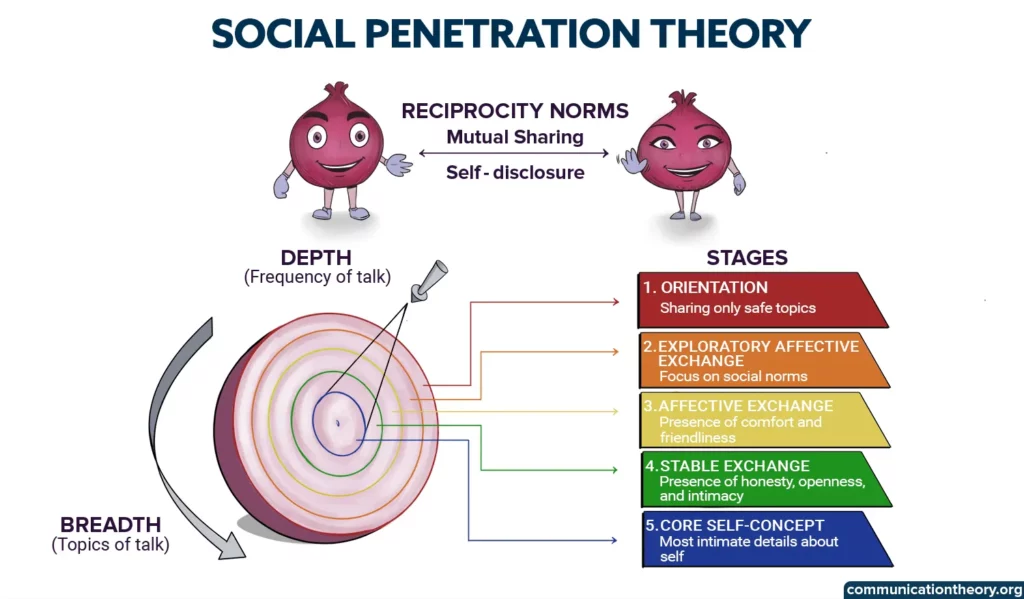
Self disclosure (SD) is limited at the start: Gradual process of revealing your inner self. A sign of trust, Reciprocation is required. Penetration leads to development of attraction -disclosing more info they ‘penetrate’ more deeply into each other lives. Leading to a greater understanding of each other.
Peeling the onion levels (Breadth - depth)
Superficial (Breadth)
Intimate
personal
core (depth)
Layers of onion metaphor
Shallow to deeper
Superficial → When first meet reveal superficial shell - hobbies, dislikes, likes. First impression
Intimate → Exploratory - personality shows through verbal and non-verbal communication. Become more intimate
Personal → Affective, entire personality revealed, develop an understanding of each other, discuss personal topics, can argue and criticise each other
Core → Stable, Expose what makes a person who they are, disclosure is open + comfortable. Can predict how they will react
Reciprocity of SD - Reiss and Shaver (1988)
Suggest there has to be a reciprocal element to self disclosure for the relationship to develop. Once you have disclosed something that reveals your true self, hopefully your partner will respond in a rewarding way (understanding, empathy) and will also reveal; their own intimate thoughts and feelings.
There tends to be a balance of self disclosure in successful romantic relationships.
Balance of SD → Feelings of intimacy → relationship deepens
AO3: +Research Support
Sprecher & Hendrick 2004; Heterosexual relationships- found strong correlations between SD and measures of satisfaction and commitment.
Laurenceau et al, 2005; Asked PPs to write a daily diary. Found that SD was linked to higher levels of intimacy in long term married couples.
These findings increase the validity of SD leading to more successful relationships
AO3: -Issues with the research
Much self-disclosure research is correlational.
Much of the research also fails to distinguish companionship from romantic relationships. making it difficult to assess the role of SD solely in romantic relationships.
Research also fails to recognise different type of romantic relationships e.g. passionate, intimate, SD may only make people more attractive in certain type of relationship.
This does not allow us to draw a valid conclusion that greater self-disclosure leads to more satisfaction in all romantic relationships
AO3: +RWA
Research into SD can help people who want to improve communication between partners.
Romantic partners probably use SD deliberately and skilfully to strengthen their bond
Hass and Stafford, 1998: 57% of gay men and women said that open and honest SD was the main way the maintained their relationships
This finding demonstrates the value of psychological insight (in other words, if people understand how important SD is, they may be more likely to do it!).
AO3: -Individual differences
Research has indicated differences in SD based on gender, personality and age
Dindia and Allen 1992 found women disclose more then men, though men are more likely to reveal personal information to people they do not know.
The personality of both discloser and recipient may be significant too - e.g. some recipients may see SD as a positive thing (having been carefully selected to receive such info) but this may not be the case or all as some may see it as a case of ‘too close, too soon’.
AO3: -Cultural differences
The prediction that increasing SD leads to a more satisfying and intimate romantic relationship is not true for all cultures
It depends on the type of SD
Tang et al (2013) → reviewed literature on sexual SD concluding men and women in the USA SD significantly more than men and women in China.
Both of these levels of SD are linked to relationship satisfaction in those cultures.
SD is therefore a limited explanation which is not generalisable beyond Western Cultures.
 Note
Note  Flashcards (81)