SPERMATOGENESIS CHAP 10
 Call Kai
 Learn
Learn Practice Test
 Spaced Repetition
 Match
Match Flashcards
 Knowt Play
1/43

There's no tags or description
Looks like no tags are added yet.
Name | Mastery | Learn | Test | Matching | Spaced | Call with Kai |
|---|
No analytics yet
Send a link to your students to track their progress
44 Terms
Certain requirements of spermatogenesis
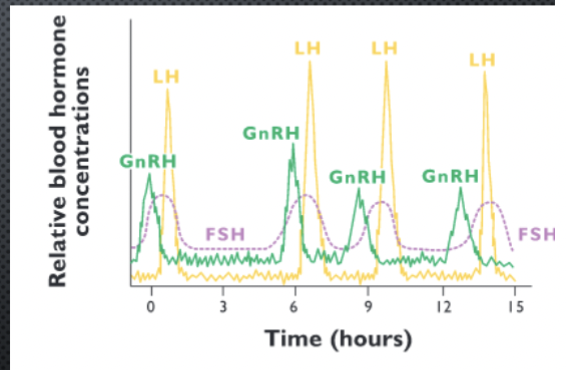
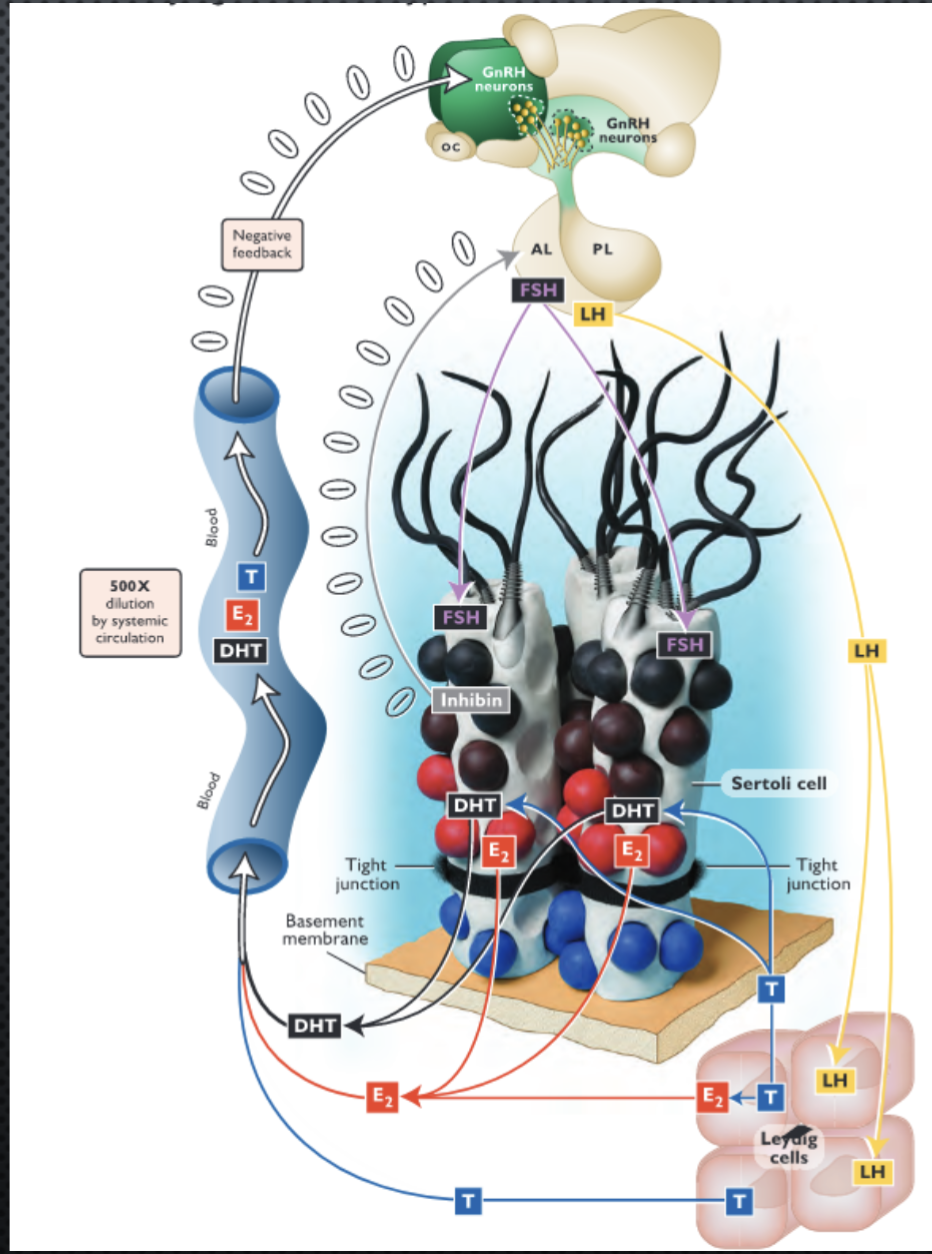
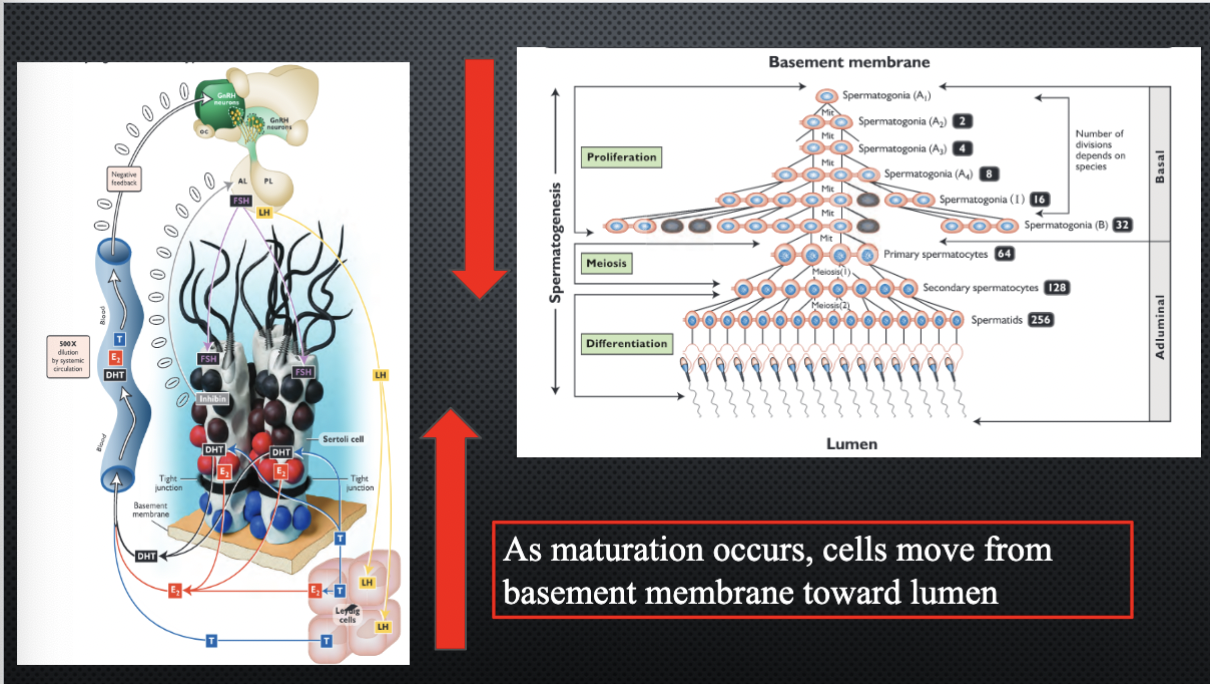
Adequate secretion of GnRH
FSH & LH secretion
secretion of gonadal steroids (testosterone and estradiol)
NO _____ center in the male
Surge center
4-8 episodes/24 hours
FSH has >3x half-life of LH
Inhibin secretion by Sertoli cells → inhibits FSH
Spermatogenesis happens in the
seminiferous tubule
under control of FSH
LH acts on _______ cells
Leydig cells
leydig cells = theca interna cells
Receptors for LH
LH binds to receptors
Synthesize P4 - which is then converted to testosterone (T)
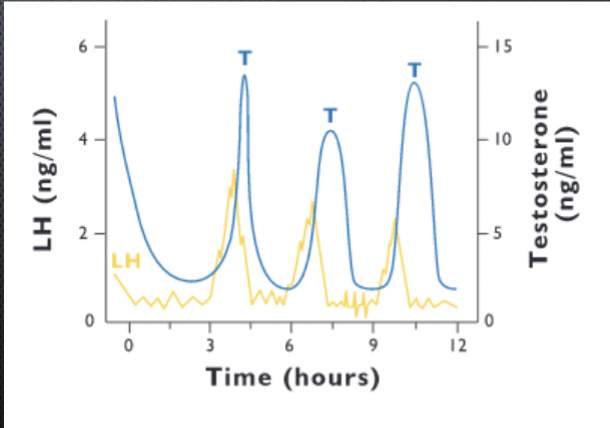
For spermatogenesis to be constant, ___ must also be constant
Testosterone → LH → GnRH
LH must be pulsatile for normal testicular function (prevents leydig cells from becoming refractory)
T concentrations in testes are much _______ than T conc. in blood
HIGHER (100-500X)
high T required for spermatogenesis
Testes also secrete ________
estradiol
especially in boars and stallions
relevance - probably neg. feedback on hypothalamus with T
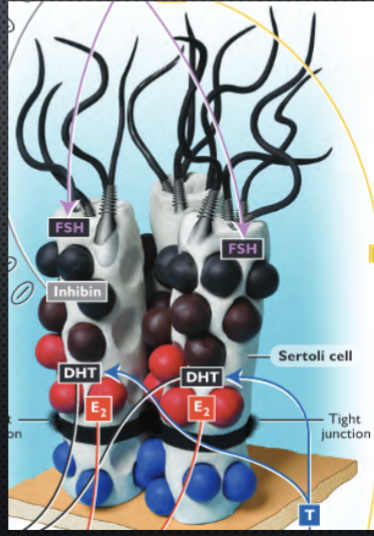
Sertoli cells are ____ dependant
FSH
sertoli cells = granulosa cells
convert T to E2 and dihydrotestosterone (DHT)
secrete inhibin - supress FSH
Spermatogenesis
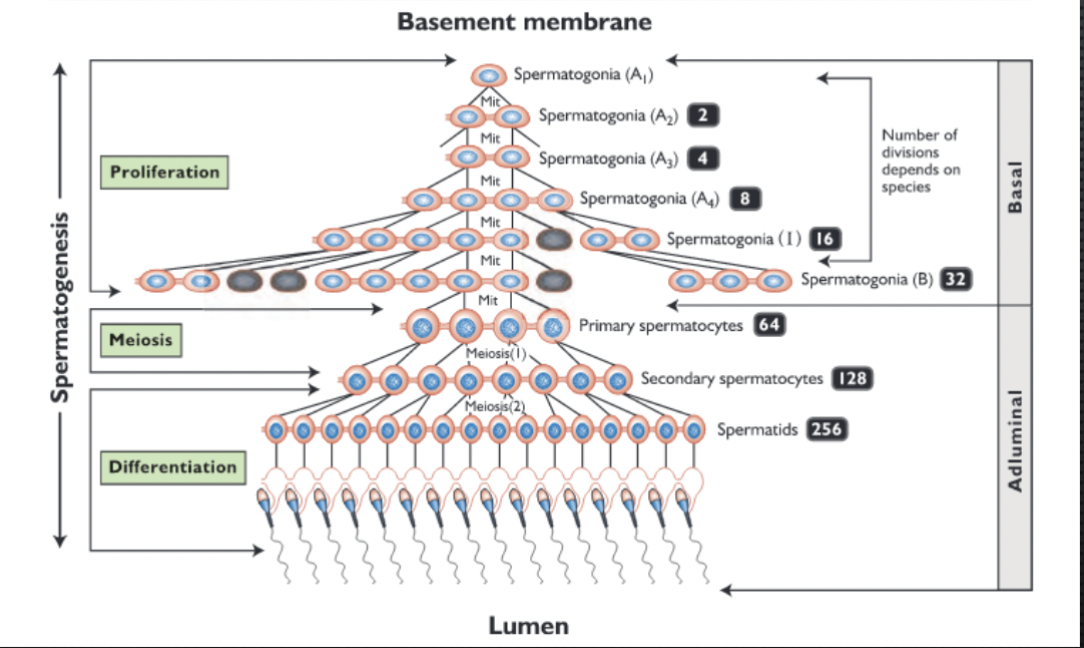
Takes place entirely within seminiferous tubules
3 phases:
Proliferation phase → all mitotic divisions of spermatogonia
Meiotic phase → haploid spermatids (1N)
Differentiation phase → transformation into spermatozoa
Proliferation Phase
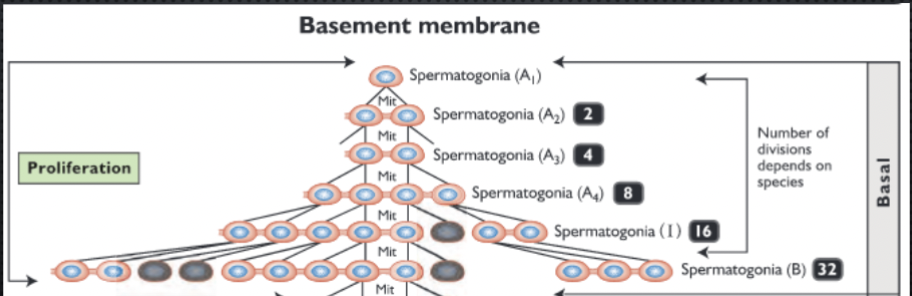
All mitotic divisions of spermatogonia
continuous stem cell renewal - allows new spermatogonia to develop
each generation has cytoplasmic bridges - synchronized cohort
some degenerate throughout process
results in primary spermatocytes
Specialized diploid (2N)
A1-A4, I (intermediate) and B spermatogonia
Pool of stem cells - continual source of A-spermatogonia
Meiotic phase
Begins w primary spermatocytes
Meiosis I:
Gentic diversity - DNA replication and crossing over during production of secondary spermatocytes
No 2 sperm are identical
Meiosis II:
results in haploid spermatids (1N)

_________________ protects spermatocytes from immune cells
Blood-testis barrier
Meiotic phase continued
Reduces the number of chromosomes to haploid
DNA synthesis and replication
Crossing over - random assortment of different segments of each chromosome
genetic diversity

Differentiation Phase
No further cell division
from spherical undifferentiated spermatid to fully differentiated, specialized spermatozoa
nucleus becomes highly condensed
acrosome is formed
cells become potentially motile
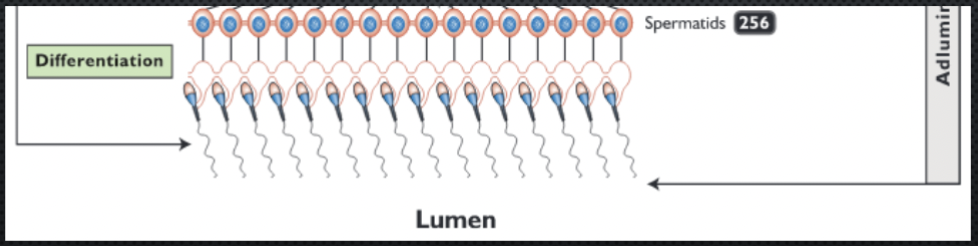
Differentiation phase PHASES
Golgi phase
Cap phase
Acrosomal phase
Maturation phase
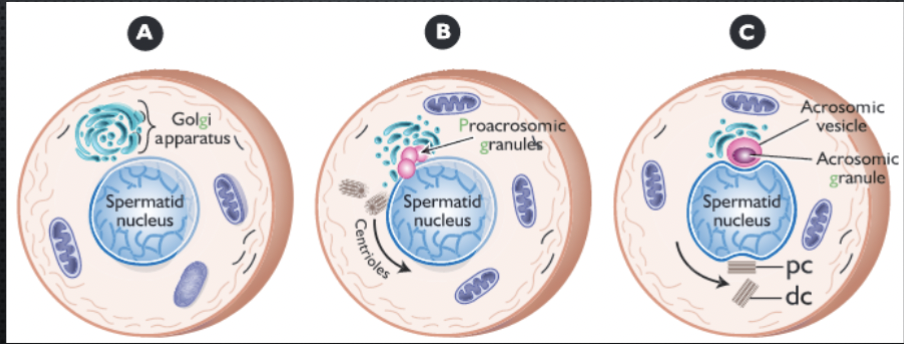
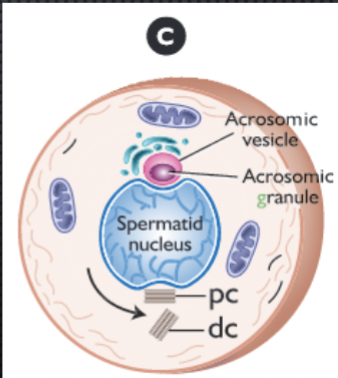
Golgi phase (A, B, & C)
= acrosomic vesicle formation
packages acrosomal contents and membranes
Acrosome
contains enzymes
a cap-like, membrane-bound organelle located at the tip of the sperm head, derived from the Golgi apparatus during spermatid development
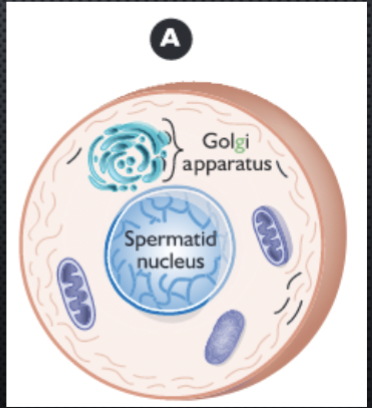
Golgi phase A
Newly formed spermatid is spherical
Well developed golgi apparatus
many small vesicles
golgi will give arise to acrosome
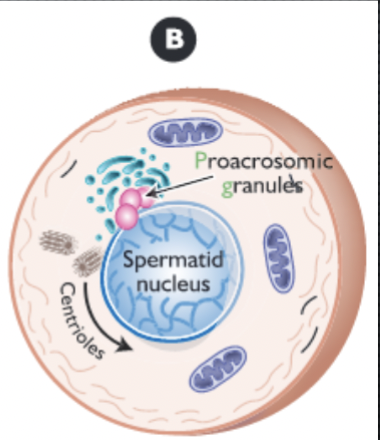
Golgi phase B
proacrosomic granules form and fuse
centroles migrate to base of nucleus
Golgi phase C
Acrosomic vesicle contains dense acrosomic granule
smaller golgi vesicles are continually added
Proximal centriole - implantation apparatus that allows flagellum to anchor to nucleus
Distal centirole - gives rise to axoneme (flagellum)
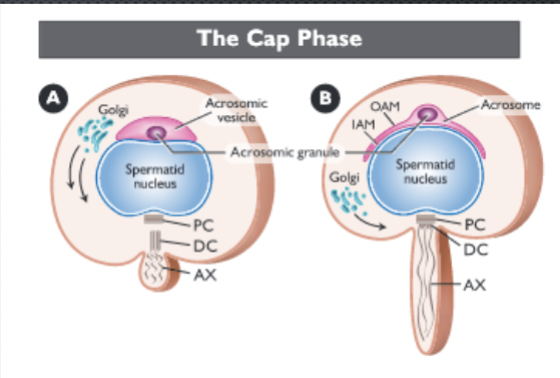
Cap phase
= acrosomic vesicle spreads over nucleus
Distal centriole - gives rise to axoneme (flagellum)
Acrosomal vesicle flatens and forms distinct cap
outer acrosomal membrane
inner acrosomal membrane
enzymes
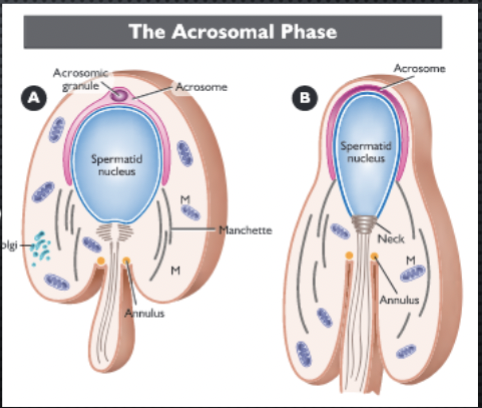
Acrosomal phase
spermatic elongates
acrosome coves most of antirior nucelus
manchette forms - some microtubules will be postnuclear cap
neck and annulus form
plasma membrane surounds all
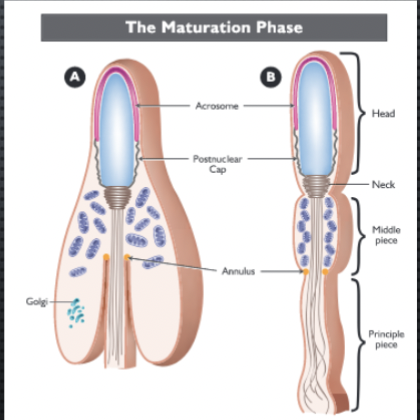
Maturation phase
Mitochondria migrate and form a spiral = middle piece
postnuclear cap - formed from manchette
annulus - juncture between middle and principle piece
plasma membrane!!
As maturation occurs, cell move from the __________ toward the _________
As maturation occurs, cell move from the basement membrane toward the lumen
Spermitation
release of spermatozoa from Sertoli cells into lumen
analogous to ovulation, except occurs continuously throughout testis
Spermatozoa =
Head + Tail
Head =
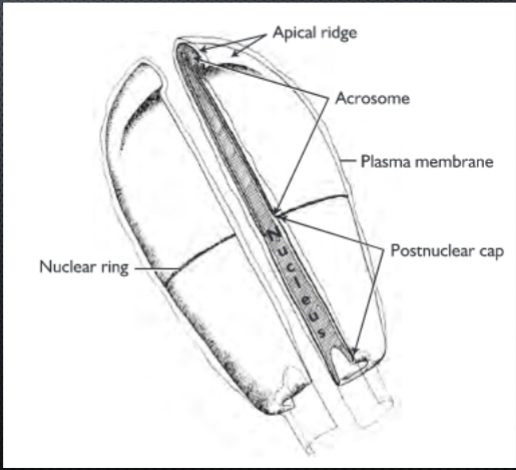
nucleus + acrosome + post-nuclear cap
In mammals, head shape differs between specis
Nucleus is oval & flattened → nuclear membrane
Chromatin
the material of which the chromosomes of organisms other than bacteria (i.e., eukaryotes) are composed. It consists of protein, RNA, and DNA.
In spermatozoa, chromatin is _________
keratinized
disulfide bonds
transcription and translation stop
protects DNA after spermiation until fertilization
reversed after fertilization
The process of nuclear condensation (keratinization & DNA stability) is reversed only ________ the sperm enters the oocyte cytoplasm
The process of nuclear condensation (keratinization & DNA stability) is reversed only AFTER the sperm enters the oocyte cytoplasm
Antiorior (front) 2/3 of nucleus is covered by _________
Acrosome
→ is a lysosome
Hydrolytic enzymes: Acrosin, Hyluronidase, Zona lysin, Esterases, Acid hydrolases
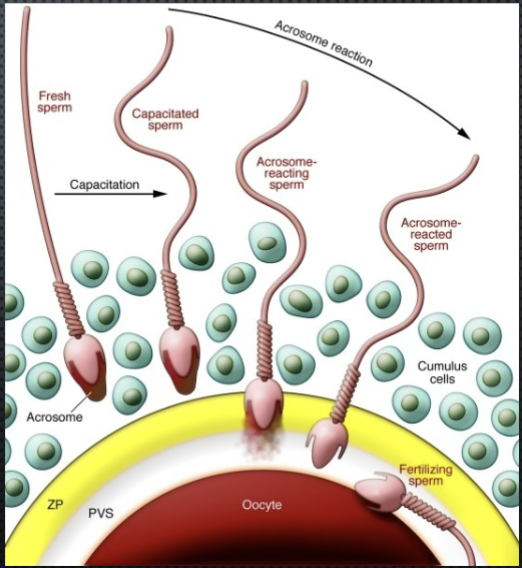
Acrosome reaction
during fertilization
Ordered, highly specialized exocytosis
allows release of enzymes
digests zona pellucida
How do we prevent more than one spermatozoa to fertilize oocyte?
Chemical reactions that harden outer layers in oocyte
**in class talking, not on exam**
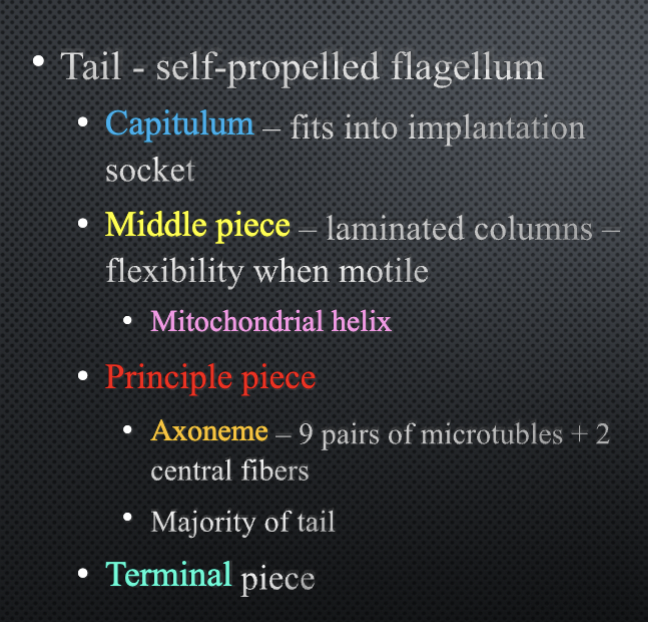
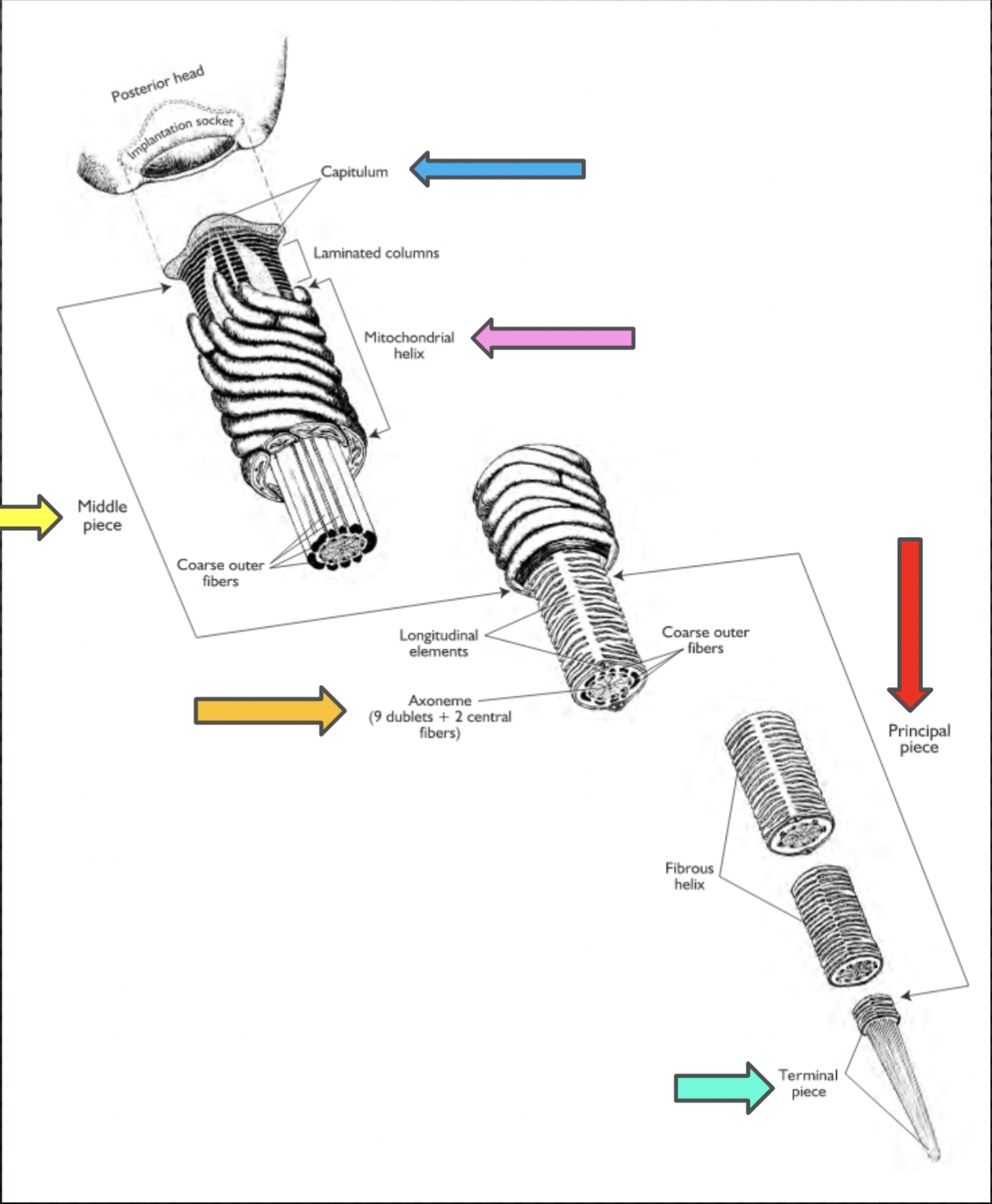
Tail =
middle piece + principle piece + terminal piece
self propelled flagellum
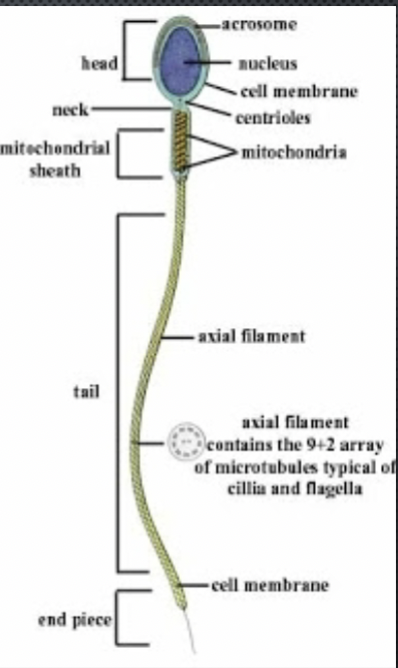
Middle piece - where energy is utilized
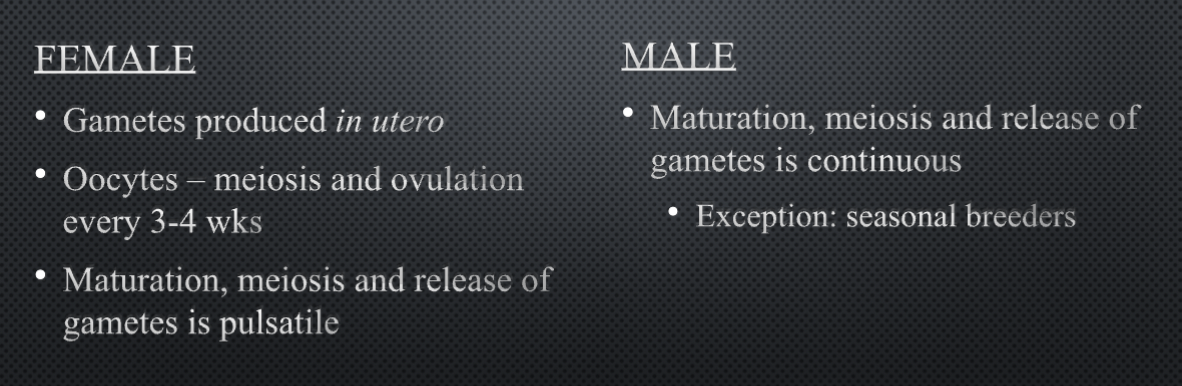
Differentiation between males and females:
Male has to have constant and continuous spermatogenesis!
always ready
____ week delay before negative effects on spermatogenesis are observed in ejaculated sperm
2-4 weeks
heat stress
shipping
fever
exposure to certain toxins
6-12 weeks until complete restoration of spermatogenesis afterwards
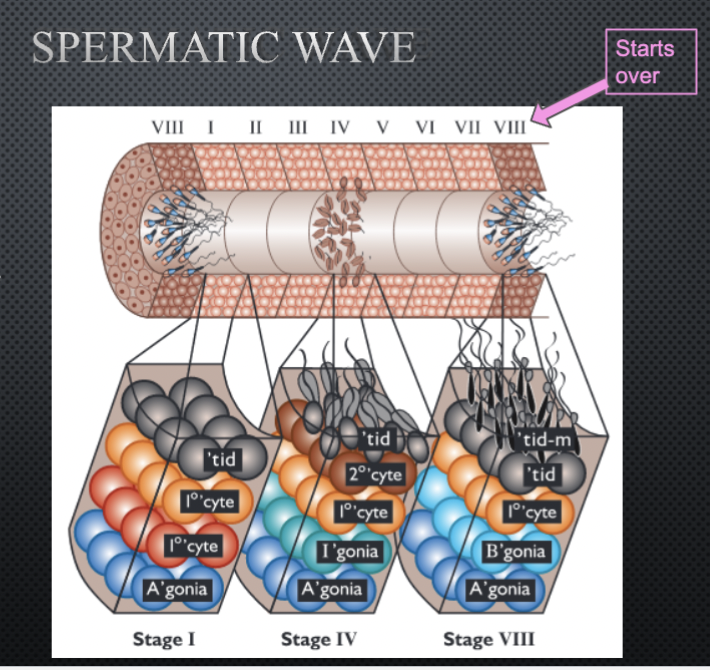
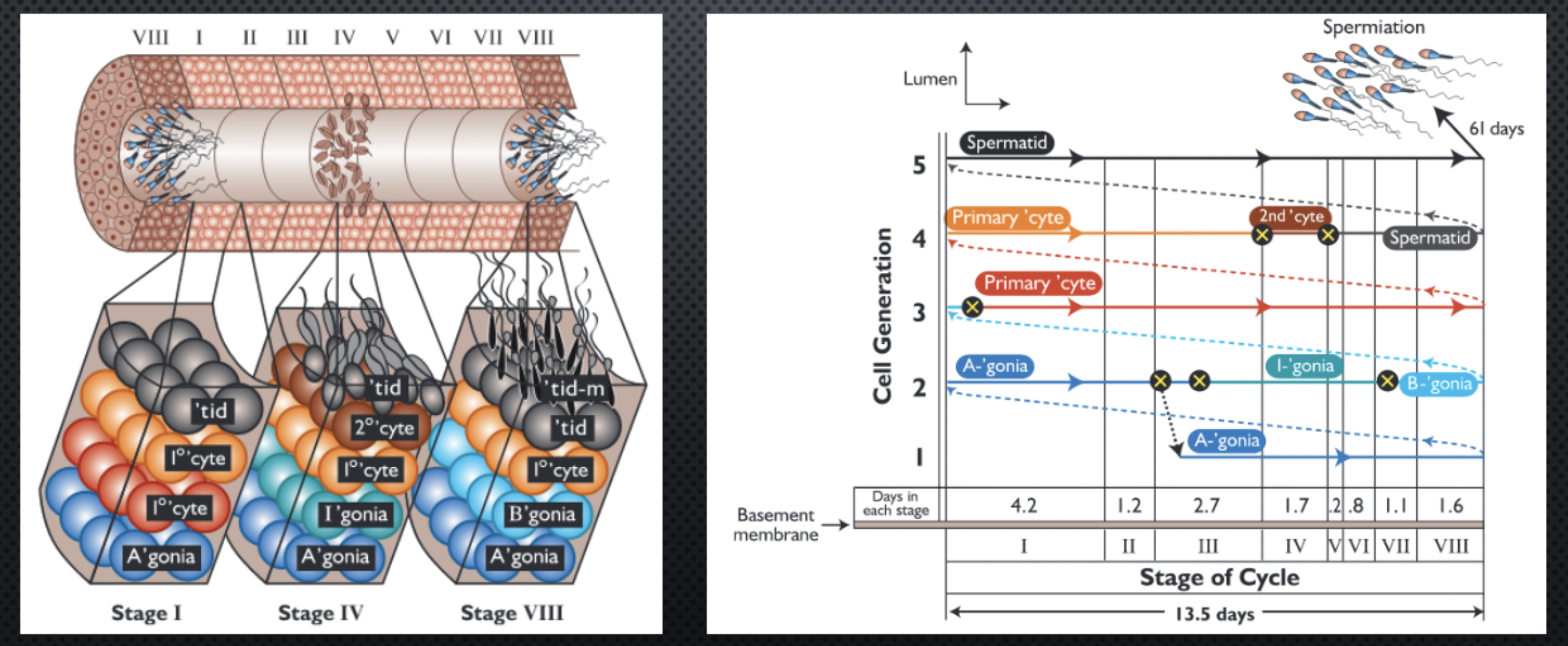
Spermatic wave
the sequential ordering of stages along the length of the seminiferous tubule