psychology - attachment
 Call Kai
 Learn
Learn Practice Test
 Spaced Repetition
 Match
Match Flashcards
 Knowt Play
1/122

There's no tags or description
Looks like no tags are added yet.
Name | Mastery | Learn | Test | Matching | Spaced | Call with Kai |
|---|
No analytics yet
Send a link to your students to track their progress
123 Terms
reciprocity
an interaction is reciprocal when each person responds to the other and elicits a response from them
interactional synchrony
the temporal co ordination of micro level social behaviour
studies into interactional synchrony
meltzoff and moore (1977)
observed the beginnings of international synchrony in infants as young as 2 weeks old
an adult displayed one of three facial expressions or one of three distinctive gestures
childs response was filmed and identified by independent observers
an association was found between the expression or gesture the adult had displayed and the actions of babies
research into synchrony
isabela et al (1989)
observed 30 mothers and infants together and assessed the degree of synchrony
also assessed the quality of mother infant attachment
found that high kevels of synchrony were associated with better quality mother infant attachment
evaluation for caregiver infant interactions
it is hard to know what is happening when observing infants
controlled observations capture fine detail
observations don’t tell us the purpose of synchrony and reciprocity
it is hard to know what is happening when observing infants
gratier(2003) - many studies involving observation of interactions between mothers and infants have shown the same patterns of interaction
HOWEVER, what is being observed is merely hand movements or changes in expression - is is extremely difficult to be certain what is taking place from the infants perspective bases on these observations
this means we cannot know for certain that behaviours in mother infant interaction have a special meaning
controlled observations capture fine detail
observations of mother-infant interactions are well controlled procedures- both mother and infant are filmed and often from multiple angles
ensures that very fine details of behaviour can be recorded and later analysed
babies don’t know or care that they are being observed so their behaviour does not change in response to controlled observation - reduces demand characteristics which is a strength because research has good validity
observation don’t tell us the purpose of synchrony and reciprocity
feldman 2012 states that synchrony simply describe behaviours that occur at the same time - these are robust phenomena in the sense that they can be reliably observed , but this may not be particularly useful as it does not tell us their purpose
HOWEVER there is some evidence that reciprocal interaction and synchrony are helpful in the development of mother-infant attachment as well as helpful in stress responses, empathy ,language and moral development
attachment figures
parent-infant attachment
the role of the father
father as primary carers
parent-infant attachment
schaffer and emerson 1964 found that the majority of babies did become attached to their mother first(around 7 months) and within a few weeks or months formed secondary attachments to other family members including the father
in 75% of the infants studied an attachment was formed with the father by the age of 18 months - this was determined by the fact that the infants protested when their father walked away
the role of the father
grossman(2002) carried out a longitudinal study looking at both parents behaviour and its relationship to the quality of childrens attachments into their teens
quality of infant attachment with mothers but not fathers was related to childrens attachment in adolescence suggesting that father attachment was less important
HOWEVER the quality of fathers play with infants was related to the quality of adolescent attachments- this suggests that fathers have a different role in attachment- one that is more to do with play and stimulation and less to do with nurturing
fathers as primary caregivers
tiffany field(1978) filmed 4 month old babies in face to face interaction with primary caregiver mothers , secondary caregiver fathers and primary caregiver fathers
primary caregiver fathers like mothers spent more time smiling imitating and holding infants that the secondary caregiver fathers
this behaviour appears to be important in building an attachment with the infant - meaning that fathers can be the more nurturing attachment figure
the key to attachment relationship is the level of responsiveness not the gender of the parent
evaluation for attachment figure studies
inconsistent findings on fathers
if fathers have a distinct role why aren’t children without fathers different?
why don’t fathers generally become primary attachments?
inconsistent findings on fathers
research into the role fathers in attachment is confusing because different researchers are interested in different questions
some psychologists are interested in understanding the role fathers have as secondary attachment figures whereas others are more concerned with the father as primary attachment figure
the former have tended to see fathers behaving differently from mothers and having a distinct role
the latter have tended t find that fathers can take on a maternal role
problem because it means psychologists cannot easily answer a single question about the role of fathers in attachment
if fathers have a distinct role why arent children without fathers different
grossman found that fathers as secondary attachment figures had an important role in their childrens development
HOWEVER other studies have found that children growing up in single or same sex parent families do not develop any differently form those in two parent heterosexual families
suggests that the fathers role as a secondary attachment figure is not important
why don’t fathers generally become primary attachments
the fact that fathers tend to not become the primary attachment figure could simply be the result of traditional gender roles - women are expected to be more caring and nurturing then men
therefore fathers simply don’t feel they should act like that
HOWEVER it could be that female hormones such as oestrogen create higher levels or nurturing and therefore women are biologically pre-disposed to be the primary attachment figure
which psychologists experimented into attachment
schaffer and emerson (1964)
aim of schaffer and emersons study
to investigate the formation of early attachment in particular the age at which they developed , their emotional intensity and to whom they were directed
participants of schaffer and emersons experiment
involved 60 babies
31 male and 29 female
all from Glasgow
majority were from skilled working class families
procedure of schaffer and emersons experiment
the babies and their mothers were visited at home every month for the first year and again at 18 months
the researchers asked the mothers questions about the kind of protest their babies showed in seven everyday separations e.g. adult leaving the room - this was designed to measure the infants attachment
researchers also assessed stranger anxiety- the infants anxiety response to unfamiliar adults
findings of schaffer and emersons study
between 25 and 32 weeks of age about 50% of the babies showed signs of separation anxiety towards a particular adult, usually the mother (specific attachment)
attachment tended to be to the caregiver who was most interactive and sensitive to infant signals and facial expressions(i.e. reciprocity)
this was not necessarily the person with whom the infant spent most time
by the age of 40 weeks 80% of the babies had a specific attachment and almost 30% displayed multiple attachments
evaluation for schaffer and emersons experiment
good external validity
longitudinal design
limited sample characteristics
good external validity
carried out in the families own homes and most of the observation was actually done by parents during ordinary activities and reported to researchers later
this means that the behaviour of the babies was unlikely to be affected by the presence of observers therefore it is likely participants behaved naturally while being observed
study has good external validity
longitudinal design
strength=study was carried out longitudinally - this means that the same children were followed up and observed regularly
longitudinal designs do not have the confounding variable of individual differences between participants so therefore have better internal validity
limited sample characteristics
all the families involved were from the same district and social class in the same city
study happened over 50 years ago
limitation because child rearing practises vary from one culture to another and one historical period to another
therefor we cannot generalise these results on the wider population
what are the stages of attachment
stage 1: asocial stage
stage 2: indiscriminate attachment
stage 3: specific attachment
stage 4: multiple attachments
stage 1 : asocial stage
baby is recognising and forming bonds with careers
babys behaviour towards non-human objects and humans is quite similar
babies show some preference for familiar adults in that those individuals find it easier to calm them
babies are happier when in the presence of other humans
stage 2: indiscriminate attachment
from 2-7 months babies display more observable social behaviour
show a preference for people rather than inanimate objects and recognise and prefer familiar adults
usually accept cuddles and comfort from any adult and they do not usually show separation anxiety or stranger anxiety
their attachment behaviour is therefore said to be indiscriminate because it is not different towards any one person
stage 3: specific attachment
from around 7 months the majority of babies start to display anxiety towards strangers and to become anxious when separated from one particular adult
at this point baby is said to have formed a specific attachment
this adult is termed the primary attachment figure - this person is not necessarily the person the child spends most time with but the one who offers the most interaction and responds to the babys signals with the most skill
stage 4: multiple attachments
shortly after babies start to show attachment behaviour towards one adult they usually extend this attachment behaviour to multiple attachments with other adults with whom they regularly spend time- these relationships are called secondary attachments
in schaffer and emerson study 29% of the children had secondary attachments within a month of forming a primary attachment - by the age of one year, the majority of infants had developed multiple attachments
evaluation for stages of attachment
problem studying the asocial stage
conflicting evidence on multiple attachments
measuring multiple attachment
problem studying the asocial stage
schaffer and emerson describe the first few weeks of life as the asocial stage although important interactions take place in those weeks - the problem is that babies that are young have poor co-ordination and are generally pretty much immobile
therefore it is difficult to make any judgements about them based on observations of their behaviour as there isn’t much observable behaviour
conflicting evidence on multiple attachments
it is not entirely clear when children become capable of multiple attachments
bowlby (1969) most babies form attachments to a single main carer before they become capable of developing multiple attachments
van Ijzendoorn et al(1993) who works in those cultural contexts where multiple caregivers are the norm , believes babies form multiple attachments from the outset
such cultures are called collectivist because families work together jointly in everything - such as producing food and child rearing
measuring multiple attachment
problem with how multiple attachment is assessed
just because a baby gets distressed when an individual leaves the room does not necessarily mean that the individual is a true attachment figure
bowlby(1969) pointed out that children have playmates as well as attachment figures and may get distressed when a playmate leaves the room but this does not signify attachment
limitation of schaffer and emersons stages because their observation does not take into account the differences between behaviour shown towards playmates and secondary attachment figures
which psychologists investigated animal studies of attachment
lorenz (geese and ducks) and harlow (monkeys)
procedure of lorenz’s study
set up a classic experiment in which he randomly divided a clutch of goose eggs
half the eggs were hatched by with the mother goose in their natural environment and the other half hatched in an incubator where the first moving object they saw was lorenz
findings of lorenz study
the incubator group followed lorenz everywhere whereas the control group hatched in the presence of their mother followed her
when the two groups were mixed up the control group continued to follow the mother and the experimental group followed lorenz - this is known as imprinting
what is imprinting
whereby bird species that are mobile from birth attach to and follow the first moving object they see
what is the time in which imprinting needs to take place referred to
critical period - this varies on the species which can just be a few hours to several days after hatching
what happens if imprinting does not occur within the critical period
chicks did not attach themselves to a mother figure
lorenz investigation on sexual imprinting
investigated the relationship between imprinting and adult mate preferences
observed that birds that imprinted on a human would often later display courtship behaviour towards humans
case study lorenz(1952) described a peacock that had been reared in the reptile house of a zoo where the first moving objects the peacock saw after hatching were giant tortoises
as an adult this peacock would only direct courtship behaviour towards giant tortoises- lorenz concluded that this meant he had undergone sexual imprinting
evaluation of lorenz research
generalisability to humans
some of lorenzs observations have been questioned
generalisability to humans
limitation= results of animal studies cannot be generalised to human behaviour
mammalian attachment system is quite different from that in birds e.g. mammalian mothers show more emotional attachment to young than do birds and mammals may be able to form attachments at any time , albeit less easily than in infancy
some of lorenz’s observations have been questioned
other researchers argue lorenz’s conclusions that imprinting has a permanent effect on mating behaviour is not applicable
guiton et al (1966) found that chickens imprinted on yellow washing up gloves would try to mate with them as adults but that with experience they eventually learned to prefer mating with other chickens
suggests that the impact of imprinting on mating behaviour is not as permanent as lorenz believed
harlows experiment procedure
harlow (1958) tested the idea that a soft object serves some of the functions of a mother
in one experiment he reared 16 monkeys with two wire model mothers
in one condition milk was dispensed by the plain wire mother whereas in the second condition the milk was dispensed by the cloth covered mother
findings of harlows study
baby monkeys cuddled the soft object in preference to the wire one and sought comfort from the cloth one when frightened regardless of which dispensed milk
this showed that ‘contact mirror’ was of more importance to the monkeys than food when it came to attachment behaviour
maternally deprived monkey as adults
harlow followed the monkeys who had been deprived of a real mother into adulthood to see if this early maternal deprivation had a permanent effect - found severe consequences
the monkeys reared with wire mothers only were the most dysfunctional however even those reared with a soft toy as a substitute did not develop normal social behaviour
they were more aggressive and less sociable than other monkeys and they bred less often than is typical for monkeys being unskilled at mating
as mothers some of the deprived monkey s neglected their young and others attacked their children even killing them in some cases
the critical period for normal development
like lorenz , harlow concluded that there was a critical period for this behaviour - a mother figure had to be introduced to an infant monkey within 90 days for an attachment to form
after this time attachment was impossible and the damage done by early deprivation became irreversible
evaluation of harlows research
theoretical value
practical value
ethical issues
theoretical value
harlows findings have had a profound effect on psychologists understanding of human mother-infant attachment
showed that attachment does not develop as the result of being fed by a mother figure but as a result of contact comfort
showed the importance of the quality of early relationships and successfully rear children
practical value
harlows research has had important applications in a range of practical contexts
Howe(1998) it has helped social workers understand risk factors in child neglect and abuse and so intervene to prevent it
we can now understand the importance of proper attachment figures for baby monkeys in zoos and also in breeding programmes in the wild
ethical issues
the monkeys suffered greatly as a result of harlows procedures
the species is considered similar enough to humans to be able to generalise the findings which also means that their suffering was presumably human-like
harlow himself was well aware of the suffering he caused - harlow referred to the wire mothers as iron maidens after a medieval torture device
who proposed that caregiver-infant attachment can be explained by learning theory
dollard and miller (1950)
learning theory
is a psychological framework that suggests caregiver-infant attachment arises from conditioned responses to stimuli, emphasizing the role of reinforcement and learning in establishing these bonds
what does learning theory propose about caregiver-infant attachment
that attachment develops through parents feeding their child and providing comfort, leading to positive reinforcement in the child's behaviour
classical conditioning regarding learning theory
food serves as an unconditioned stimulus - being fed gives us pleasure and we don’t have to learn that so it is an unconditioned response
a caregiver starts as a neutral stimulus
when the same person provides the food over time they become associated with ‘food’ - when the baby sees this person there is an immediate expectation of food
the neutral stimulus has become a conditioned stimulus
one conditioning has taken place the sight of the caregiver produces a conditioned response of pleasure - causing the baby to attach to the caregiver
operant conditioning regarding learning theory
crying leads to a response from the caregiver - like feeding
as long as the caregiver provides the correct response - crying is reinforced
the baby then directs crying for comfort towards the caregiver who responds with comforting ‘social suppressor behaviour’
this reinforcement is a two-way process - at the same time as the baby is reinforced for crying - the caregiver receives negative reinforcement because the crying stops - escaping from something unpleasant
this interplay of mutual reinforcement strengthens an attachment
drive reduction
primary drive= hunger is a primary drive as it’s an innate - biological motivator as we are motivated to eat in order to reduce the hunger drive
secondary drive= as caregivers provide food , the primary drive of hunger becomes generalised to them
attachment is thus a secondary drive learned by an association between the caregiver and the satisfaction of a primary drive
evaluation for learning theory
counter-evidence from animal research
counter-evidence from human research
learning theory ignores other factors associated with forming attachments
counter-evidence from animal research
animal studies show that some actually young animals do not necessarily attach to those who feed them
lorenz’s geese imprinted before they were fed and maintained these attachments regardless of who fed them
harlow’s monkeys attached to a soft surrogate in preference to a wire one that dispensed milk
this suggests that attachment does not develop as a result of feeding in animals - must be the same for humans
this is a limitation as it suggests that learning theory is inaccurate decreasing its validity and reliability
counter-evidence from human research
studies with infants shows that feeding does not appear to be an important factor in humans
schaffer and emersons study - many of the babies developed a primary attachment to their biological mother even though other careers did most of the feeding
limitation of learning theory because it suggests that feeding is not the key element to attachment and so there is no unconditioned stimulus or primary drive involved
learning theory ignores other factors associated with forming attachments
isabella et al (1989) suggests that the quality of attachment is associated with factors like developing reciprocity and good levels of interactional synchrony
studies have shown that the best quality attachments are with sensitive careers that pick up infant signals and respond appropriately
therefore it attachment developed purely because or primarily as a result of feeding there would be no purpose for these complex interactions and we could not expect to find relationships between them and the quality of infant-caregiver attachment
factors apart of bowlby’s monotropic theory
monotropy
social releasers and the critical period
internal working model
what did bowlby propose
proposed that human infants have an innate tendency to form attachments to their primary caregiver , most often their mother - this innate system has survival value
imprinting in animals (lorenz and harlow research) and attachment in humans evolved because they ensure that young animals stay close to their caregivers and protect them from hazards
what does monotropic mean
a primary attachment figure
why is bowlbys theory described as monotropic
because he placed great emphasis on a childs attachment to one particular caregiver
monotropy
bowlbys theory is described as monotropic because he placed great emphasis on a childs attachment to one particular caregiver
he believed that the childs attachment to this one caregiver is different and more important than others - bowlby called this person the ‘mother but it was clear that it need not be the biological mother or indeed a woman
bowlby believed that the more time spent a baby spent with this mother figure/primary attachment figure, the better, the two reasons for this :
the law of continuity states that the more constant and predictable a childs care, the better the quality of their attachment
the law of accumulated separation stated that the effects of every separation from the mother add up ‘ and the safest dose is therefore a zero dose’
social releasers
bowlby suggested that babies are born with a set of innate ‘cute’ behaviours like smiling , cooing and gripping that encourage attention from adults - he called these social releasers because their purpose is to activate adult social interaction and so make an adult attach to the baby
bowlby recognised that attachment was a reciprocal process - both mother and baby are ‘hard-wired’ to become attached
the interplay between baby and adult attachment systems gradually builds the relationship between baby and caregiver, beginning in the early weeks of life
what is the critical period
babies have an innate drive to become attached - there is a critical period for this to occur - just as the imprinting process babies must form the attachment with their caregiver during a critical period
this is between about 7 months to 2 years old
bowlby states that if this didn’t happen during this period the child is unlikely to form an attachment and the child would be damaged for life , socially, emotionally, intellectually and physically
bowlby viewed it more as a sensitive period - the child is maximally sensitive at the age of 2 and if the attachment is not formed in this time the child will find it much harder to form one later
who proposed the internal working model
bowlby
what is the internal working model
bowlby proposed that a child forms a mental representation of their relationship with their primary attachment figure
this is a model for relationships - which acts as a template for future relationships because it generates expectations of how relationships are like based on their first relationship with their primary attachment figure
the internal working model also affects the childs later ability to be a parent themselves - people tend to base their parenting behaviour on their own experiences of being parented - this explains why children from functional families tend to have similar families themselves
example of internal working model
a child whose first experience is of a loving relationship with a reliable caregiver will tend to form an expectation that all relationships are as loving and reliable and they will bring these qualities to future relationships
However a child whose first relationship involves poor treatment will tend to form further poor relationships in which they expect such treatment from others and/or treat others in that way
evaluation of bowlbys explanation of attachment
validity of monotropy challenged
support for social releasers
support for internal working model - counterpoint
evaluation of bowlbys explanation of attachment : validity of monotropy challenged
P = one limitation of bowlbys theory is that the concept of monotropy lacks validity
E = rudolph schaffer and peggy emerson (1964) found that although most babies did not attach to one person at first , a significant minority formed multiple attachments at the same time
Also, although the first attachment does appear to have a particularly strong influence on later behaviour, this may simply mean it is stronger , not necessarily different in quality from the childs other attachments e.g. other attachments to family members provide all the same key qualities (emotional support, a safe base etc)
C = this means that bowlby may be incorrect that there is a unique quality and importance to the childs primary attachment
evaluation of bowlbys explanation of attachment : support for social releasers
P = one strength of bowlbys theory is the evidence supporting the role of social releasers
E = there is clear evidence that cute baby behaviours are designed to elicit interaction from caregivers
Brazelton et al (1975) observed babies trigger interactions with adults using social releasers - the researchers then instructed the babies primary attachment figures to ignore their babies’ social releasers
Babies who were previously shown to be normally responsive - became increasingly distressed and some eventually curled up and lay motionless
C = this illustrates the role of social releasers in emotional development and suggests that they are important in the process of attachment development
evaluation of bowlbys explanation of attachment : support for internal working model
P = a strength of bowlbys theory is support for the internal working model
E = the internal working model predicts that patterns of attachment will be passed from one generation to the next
heidi bailey et al (2007) assessed attachment relationships in 99 mothers and their one year old babies
the researchers measured the mothers attachment to their own primary attachment figures ( their parents) - the researchers also assessed the attachment quality of the babies
they found that mothers with poor attachment to their own primary attachment figures were more likely to have poorly attached babies
C = this supports bowlbys idea that mothers’ ability to form attachments to their babies is influenced by their internal working models - which in turn comes from their own early attachment experiences
evaluation of bowlbys explanation of attachment : counterpoint to support for internal working model
P = there are probably more important influences on social development
E = e.g. kornienko (2016) some psychologists believe that genetic differences in anxiety and sociability affect social behaviour in both babies and adults - these differences could also impact on their parenting ability
C = this means that bowlby may have overstated the importance of the internal working model in social behaviour and parenting at the expense of other factors
who was the strange situation developed by
mary ainsworth and silvia Bell
what was the aim of the strange situation
the aim was to be able to observe key attachment behaviours as a means of assessing the quality of a baby’s attachment to a caregiver
procedure of strange situation
is a controlled observation procedure designed to measure the security of attachment a baby displays towards a caregiver
it takes place in a room with quite controlled conditions (i.e. a laboratory) with a two way mirror and/or cameras through which psychologists can observe the baby’s behaviour
the behaviours used to judge the attachment included :
proximity-seeking = a baby with a good quality attachment will stay fairly close to a caregiver
exploration and secure-base behaviour = good attachment enables a baby to feel confident to explore ,using their caregiver as a secure base i.e. a point of contact that will make them feel safe
stranger anxiety = one of the signs of becoming closely attached is a display of anxiety when a stranger approaches
separation anxiety = another sign of becoming attached is to protest at separation from the caregiver
response to reunion = babies who are securely attached greet the caregiver’s return with pleasure and seek comfort
the different episodes of the procedure of the strange situation
each episode lasts 3 minutes
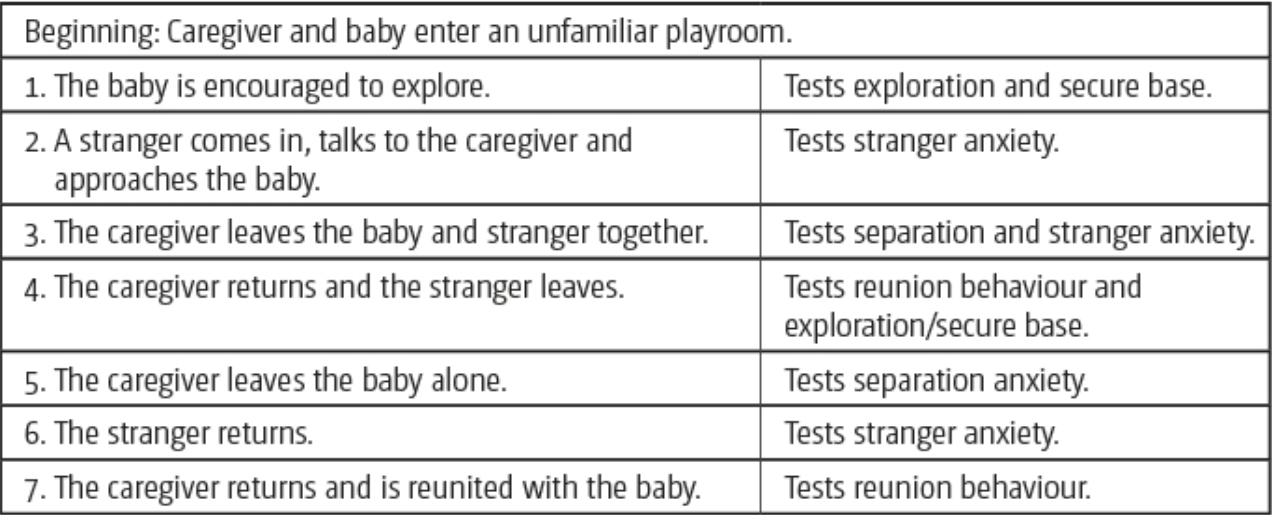
findings of the strange situation
Ainsworth et al (1978) found that there were distinct patterns in the way that babies behaved, they identified three main types of attachment :
secure attachment (type B) = these babies explore happily but regularly go back to their caregiver (proximity-seeking and secure-base behaviour). They usually show moderate separation distress and moderate stranger anxiety - securely attached babies require and accept comfort from the caregiver in the reunion stage
insecure-avoidant attachment (Type A) = these babes explore freely but do not seek proximity or show secure-base behaviour. They show little or no reaction when their caregiver leaves and little stranger anxiety - they make little effort to make contact when the caregiver returns and may even avoid such contact
insecure-resistant attachment ( Type C) = these babies seek greater proximity than others and so explore less - they show high levels of stranger and separation distress but they resist comfort when reunited with their caregiver
evaluation of strange situation
good predictive validity - counterpoint
good reliability
the test may be culture bound
evaluation of strange situation : good predictive validity
P = one strength of the strange situation is that its outcome predicts a number of aspects of the baby’s later development
E = a large body of research has shown that babies and toddlers assessed as Type B( secure) tend to have better outcomes than others , both in later childhood and in adulthood
In childhood this includes better achievement in school and less involvement in bullying (Mccormick et al 2016, kokkinos 2007)
securely attached babies also tend to go on to have better mental health in adulthood (Ward et al 2006) - those babies assessed as having insecure-resistant attachment and those not falling into types A, B or C tend to have the worst outcomes
C = this suggests that the strange situation measures something real and meaningful in a baby’s development
evaluation of strange situation : counterpoint to good predictive validity
P = the strange situation clearly measures something important that is associated with later development - however not all psychologists believe this something is attachment
E = e.g. jerome kagan (1982) suggested that genetically influenced anxiety levels could account for variations in attachment behaviour in the strange situation and later development
C = this means that the strange situation may not actually measure attachment
evaluation of strange situation : good reliability
P = a strength of the strange situation is it has good inter-rater reliability
E = johanna bick et al (2012) tested inter-rater reliability for the strange situation for a team of trained observers and found agreement on attachment type in 94% of cases
This high level of reliability may be because the procedure takes place under controlled conditions and because behaviours ( such as proximity-seeking and stranger anxiety) involve large movements and are therefore easy to observe e.g. anxious babies cry and crawl away from strangers
E = this means that we can be confident that attachment type as assessed by the strange situation does not depend on subjective judgements
evaluation of strange situation : the test may be culture-bound
P = one limitation of the strange situation is that it may not be valid measure of attachment in different cultural contexts
E = the strange situation was developed in Britain and the US - it may be culture bond, only valid for use in certain cultures ( in this case Europe and USA)
one reason for this is that babies have different experiences in different cultures and these experiences may affect their responses to the strange situation e.g. Japanese study by keiko takahashi (1986) babies displayed very high levels of separation anxiety and so a disproportionate number were classified as insecure-resistant
Takahashi suggests that this anxiety response was not due to high rates of attachment insecurity but to the unusual nature of the experience in japan where mother-baby separation is very rare
C = this means that it is very difficult to know what the strange situation is measuring when used outside Europe and the US
studies of cultural variations
van IJzendoorn and kroonenberg’s research
an italian study
a korean study
conclusions of both these studies
what did IJzendoorn and kroonenberg do
conducted a study to look at the proportions of secure , insecure -avoidant and insecure -resistant attachments across a range of countries to assess cultural variation
They also look at the differences within the same countries to get an idea of variations within a culture
procedure of IJzendoorn and kroonenberg research
the researchers located 32 studies of attachment where the strange situation had been used to investigate the proportions of babies with different attachment types
these were conducted in 8 countries - 15 were in the US - Overall the studies yielded results for 1,990 children
the data for these 32 studies was meta analysed - this means that the results of the studies were combined and analysed together , weighting each study for its sample size
findings of IJzendoorn and kroonenberg’s research
there was a wide variation between the proportions or attachment types in different studies
in all countries secure attachment was the most common classification - however the proportion varied from 75% in britain to 50% in china
in individualist cultures rates of insecure -resistant attachment were similar to ainsworth’s original sample (all under 14%) but this was not true for the collectivist sample from china, japan and israel where rates were above 25% ( and where rates of insecure-avoidant attachment were reduced)
variations between result of studies within the same country were actually 150% greater than those between countries - in the US for example, one study found only 46% securely attached compared to one sample as high as 90%

