L4_Centroid & Center of Gravity
 Studied by 0 people
 Call with Kai
 Learn
Learn Practice Test
 Spaced Repetition
 Match
Match Flashcards
 Knowt Play
1/42

There's no tags or description
Looks like no tags are added yet.
Name | Mastery | Learn | Test | Matching | Spaced | Call with Kai |
|---|
No analytics yet
Send a link to your students to track their progress
43 Terms
all hyperplanes
hyperplane
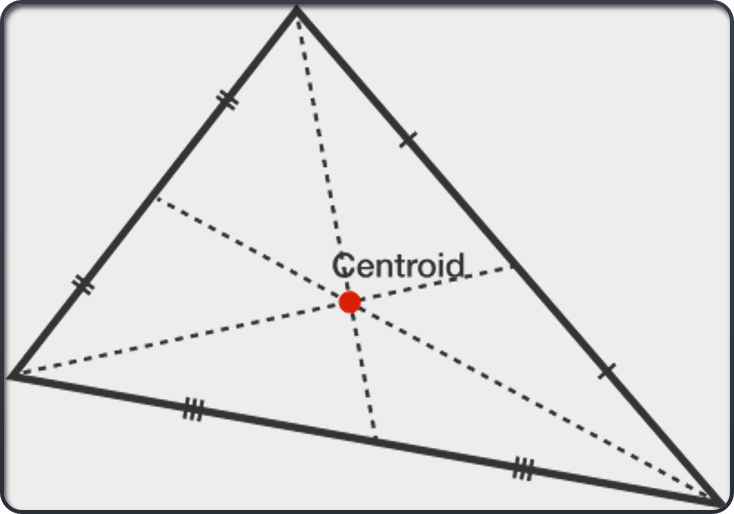
The centroid of an object in dimensional space is the intersection of _____ that divide into two parts of equal moment of the _____.
Centroid
is the "average" of all points of an object.
centroid
For an object of uniform composition, the _____ of a body is also its center of mass.
vertices
medians
intersection
To find the centroid of any triangle, construct line segments from the _____ of the interior angles of the triangle to the midpoints of their opposite sides.
These line segments are the _____.
Their _____ is the centroid.
G(x, y) = ((x1 + x2 + x3)/3, (y1 + y2 + y3)/3)
We can calculate the centroid of the triangle by taking the average of the x coordinates and the y coordinates of all the three vertices.
So, the centroid formula can be mathematically expressed as
Centroid of a circle
is very easy to determine.
Centroid of circle
lies at the center of a circle that is also called as the radius of circle from edges of a circle.
individual centroids
individual areas
individual areas
To calculate the centroid of a combined shape, sum the _____ times the _____ and divide that by the sum of the _____.
Center of Gravity (C.G.)
is a geometric property of any object.
C.G.
is the average location of the weight of an object.
Elevator
Rudder
Ailerons
An airplane in flight can be maneuvered by the pilot using the aerodynamic control surfaces (3)
C.G.
As the control surfaces change the amount of force that each surface generates, the aircraft rotates about a point called the _____.
C.G.
is the average location of the weight of the aircraft.
The weight is actually distributed throughout the airplane.
location of the C.G
One of the most important steps in the aircraft design is the _____.
weight and balance
balance
The aircraft designer should permanently keep track of the _____ and _____ of the airplane.
This is so important for every aircraft.
“Weights Group”
Factory has a _____ in its Engineering Department.
“Weight Engineers”
continuously check the weight of each component during the design.
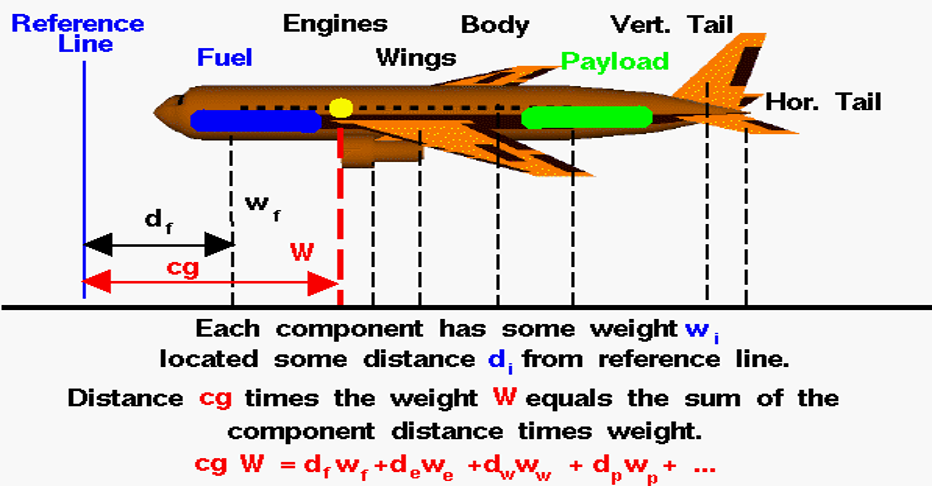
C.G. of an object
is calculated by taking the sum of its moments divided by the overall weight of the object.
moment
origin
The _____ is the product of the weight, and its location as measured from a set point called the _____.
A
A
C.G. envelope
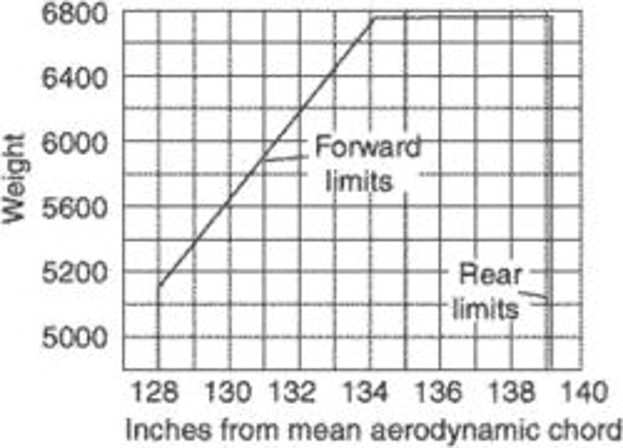
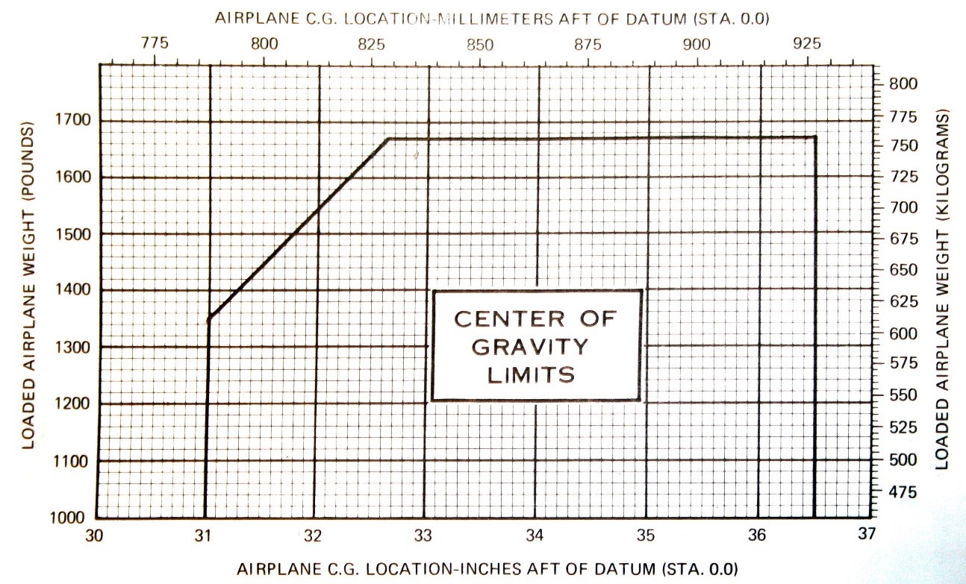
an envelope drawn on a graph included in aircraft certificates, data sheets, and flight manuals, showing the way the center of gravity may vary with the gross weight of an aircraft.
loading condition
Any combination of weight and the center of gravity that falls within C.G. envelope is an approved _____ for that aircraft.
Center of Pressure (C.P.) of an aircraft
is the point where all of the aerodynamic pressure field may be represented by a single force vector with no moment.
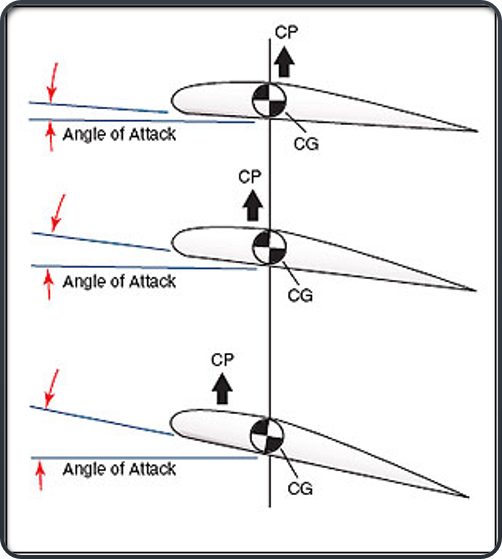
C.P.
is the point where the Lift acts.
C.G. limits
are specified longitudinal (forward and aft) and/or lateral (left and right) limits within which the aircraft's center of gravity must be located during flight.
Nose Heavy
is a condition in which having the center of gravity located forward of the center of lift so that the nose tends to drop when the longitudinal control is released in level flight.
Tail Heavy
is a condition in which having the center of gravity located rear of the center of lift so that the nose tends to rise when the longitudinal control is released in level flight.
forward CG limit
is often established at a location that is determined by the landing characteristics of an aircraft.
forward CG limit
stalling speeds
During landing, one of the most critical phases of flight, exceeding the _____ may result in excessive loads on the nosewheel, a tendency to nose over on tailwheel type airplanes, decreased performance, higher _____, and higher control forces.
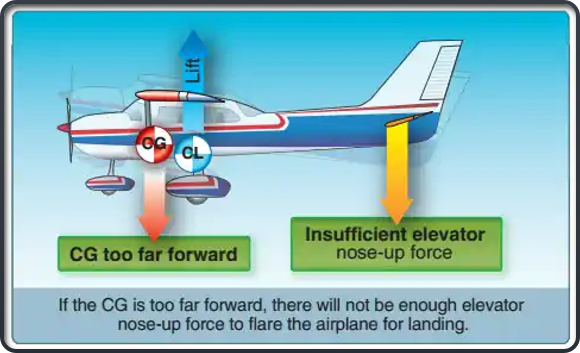
Stable
Nose Heavy
takeoff
induced drag
stall speeds
Forward C.G.
_____ feeling
_____
Longer _____ distance (more airflow required to provide more force to lift heavy nose)
Increased _____
High _____ (more airflow deflection of the elevator required to maintain altitude at slower airspeeds resulting in high AoA
aft CG limit
is the most rearward position at which the CG can be located for the most critical maneuver or operation.
stable condition
As the CG moves aft, a less _____ occurs, which decreases the ability of the aircraft to right itself after maneuvering or turbulence.
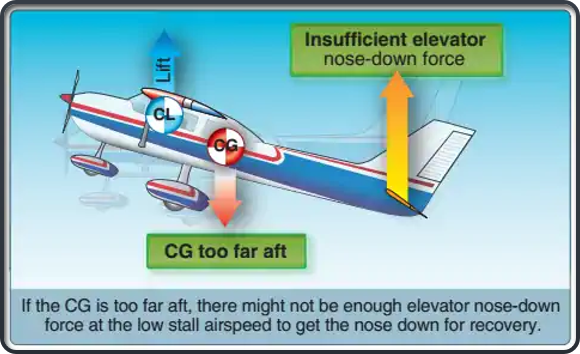
decreases
tail
stall or spin
Decreased
true airspeed
decreases
lift/drag
Rearward/Aft C.G.
As the C.G. moves rearward (towards the tail), the arm between the center of gravity and the tail (downforce) _____, thus the aircraft becomes more and more dynamically unstable
The _____ will feel heavy to compensate, which requires additional nose down-force
Should the aircraft _____ or _____, it will be much more difficult, if not impossible, to recover
_____ induced drag
Higher _____ due to lower angle of attack
Longitudinal stability _____
Performance impacts are due to _____ changes
Forward C.G.
Longer takeoff distance (more airflow required to provide more force to lift heavy nose)
Forward C.G.
Increased induced drag
Forward C.G.
High stall speeds
Rearward/Aft C.G.
As the C.G. moves rearward (towards the tail), the arm between the center of gravity and the tail (downforce) decreases, thus the aircraft becomes more and more dynamically unstable
Rearward/Aft C.G.
The tail will feel heavy to compensate, which requires additional nose down-force.
Rearward/Aft C.G.
Should the aircraft stall or spin, it will be much more difficult, if not impossible, to recover.
Rearward/Aft C.G.
Decreased induced drag
Rearward/Aft C.G.
Higher true airspeed due to lower angle of attack
Rearward/Aft C.G.
Longitudinal stability decreases
Rearward/Aft C.G.
Performance impacts are due to lift/drag changes
 Note
Note  Flashcards (20)