Modern Biology Chapter 46 : Gas Exchange, The Respiratory System
 Call Kai
 Learn
Learn Practice Test
 Spaced Repetition
 Match
Match Flashcards
 Knowt Play
1/61

There's no tags or description
Looks like no tags are added yet.
Name | Mastery | Learn | Test | Matching | Spaced | Call with Kai |
|---|
No analytics yet
Send a link to your students to track their progress
62 Terms
Physiological Respiration is the process by which animals
Exchange gases with their surroundings
Physiological represents how they
Take in O2 from environment, deliver it to the body cells, and remove CO2 from body cells and deliver it to the environment
Cellular Respiration includes all the ___________ _______ that lead to the production of _______ in _____________ of animals cells - where what is used?, and what is released?
Oxidative Reactions
ATP in Mitochondria
O2 is Used and CO2 is released
What is Diffusion?
Molecules move from High Contration to Low Concentration regions
The gas animals tkae depend on their respiratory medium of?
Water, Air, or Both
The layer of epithelial cells acts as an?
Interface between body and respiratory medium, where molecules exchange
That layer of epithelial cells will be known as the?
Respiratory Surface
Breathing is known as the?
Exchange of gasses with the respiratory medium
Two primary adaptations help animals maintain what? This will maximize what?
Difference of concentration between gases outside and inside the respiratory surface, maximizing the rate of gas exchange
The two primary adaptations are?
Ventilation and Perfusion
Ventilation is the
Flow of respiratory medium over external side of respiratory surface
Perfusion is the flow of
Blood or other body fluids on internal side of respiratory surface
The respiratory surface must be? Why is that?
-Wetted
-Gas exchange will occur only if the surface is wet
What are ways for Respiratory Surface to be wetted?
By respiratory medium or thin film of water
Why couldn’t gas exchange work?
O2 and CO2 cannot cross cell membrane as dry gasses, so they must dissolve
What are the two main Respiratory Media?
Water and Air
Water hold less _______ than air?, what is that content affected by?
Oxygen, Affected by Temperature and Solutes
What does Water take more than Air?
More energy to move Water
Air holds a? (Hint: It’s a List)
-High O2 Content
-Low Density
-Low Viscosity (Reduce energy required for ventilation)
Gas Molecules will diffuse faster in?
Air
What is the main drawback of Air as a Respiratory Media
Respiratory Surface can dry out, due to animals losing water during breathing
In all animals the exchange of gas molecules across the Respiratory Surface occurs by?
Simple Diffusion
Respiratory Surfaces have what structural properties that favor high rate of diffusion?
-Large surface areas
-They are thin
(Rate of Diffusion= Surface Area/ thickness of surface
Rate of diffusion can become higher with?
Large concentration gradients and increasing temperature
Go back for Fick’s Law of Diffusion
Most animals that live in water exchange gasses through? and Aquatic Mammals exchange though?
-Skin or Gills
-Lungs
Most animals that live in land will exchange gasses through? (Hint: Their are three)
-Lungs
-Sometimes Gills
-A Tracheal System
What are the Advantages of the Extended Body Surface of a Flatworm?
The flattened and elongated body surface allows direct contact of respiratory surface with respiratory medium
Disadvantages of Extended Body Surfaces?
-Must always be in a wet environment
-Respiratory surface is not well protected
-Diffusion must go directly to cells, so organism must be thin
Gills and Lungs have the purpose of?
Increasing surface area of the Respiratory Surface
What will it form to increase the surface area?
-Branched Structures/Tubes
-Fingerlike & Platelike projections
-Folds
-Pockets
-Air Sacs
In water breathing animals, gills are ________ of the body - they will _________________ (Hint: First is a single word, second is a sentence)
Evaginations
Extend outward into respiratory Medium
In terrestial animals, lungs are __________ of the body surface, deep in the ________________ where they are less susceptible to ________
Invaginations
Body Interior
Drying Out
Work on Slide 15 to 19
For Fish they use a Mouth-Operculum Pump, what is that?
Mouth Opens —→ Water Flows in
Mout Closes + Operculum Opens —→ Water Flows out Gill Filaments
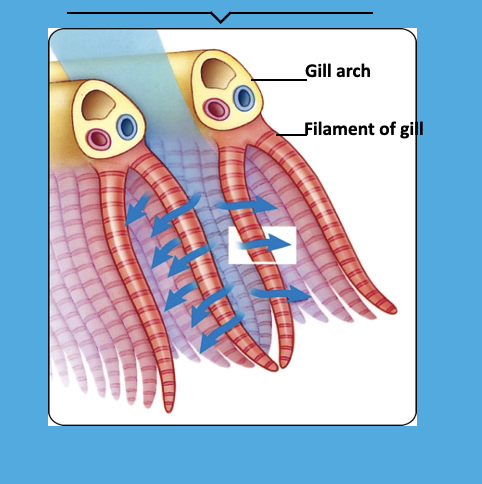
What structures in fish gills provide the surface for gas exchange?
Gill arches support gill filaments, which contain lamellae — thin, high‑surface‑area structures where oxygen diffuses into blood
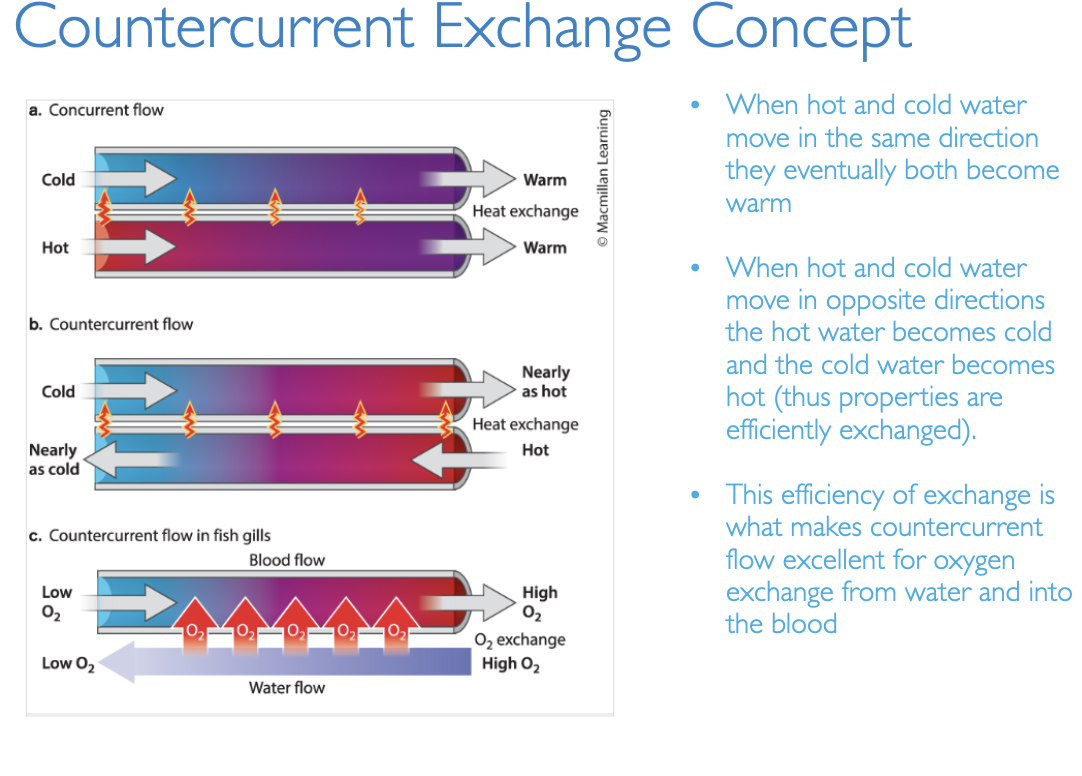
What is countercurrent flow in fish gills?
The blood under the respiratory surface and Water over the gills move/flow in opposite directions, maintaining a constant oxygen gradient
Countercurrent Exchange uses a?
One-way flow of water over the gills to maximize exchange
What would occur if the water is more highly oxygenated than the blood along the gill filament?
O2 diffuses from water into blood across entire respiratory surface
Countercurrent exchange is top tier because it will efficiently?
Remove 80-90% of water’s O2 content
Countercurrent Exchange Concept
Insects breathe air through their?
Air-conducting tubes known as Tracheae
Trachea are ____________ of the outer epidermis of the animals reinforced by _______ ____ ________ - the material of the exoskeleton
Invaginations, Rings of Chitin
Go over slide 24
Lungfish and Mature Amphibians use what breathing process
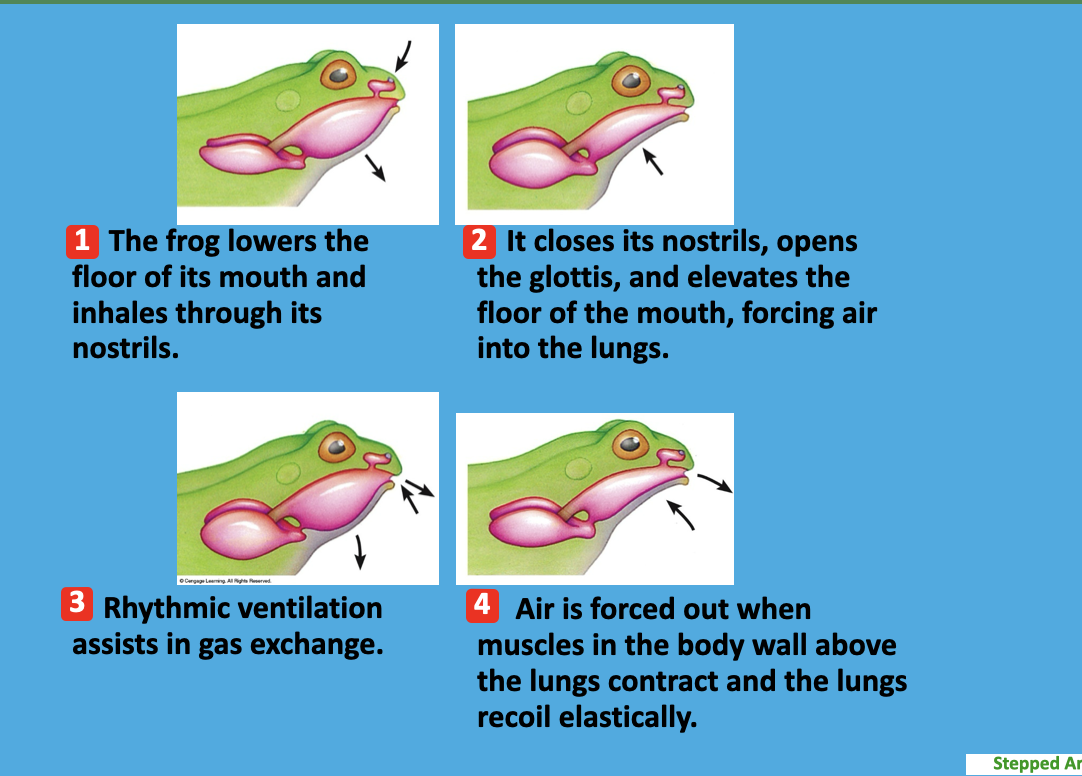
Positive Pressure Breathing
Positive Pressure Breathing
Animals push air into the lungs by increasing pressure in mouth cavity (gulping motion)
Reptiles and Mammals fill their lungs by using
Negative Pressure Breathing
Negative Pressure Breathing
Muscular expansion of the chest/lungs lowers internal pressure, pulling air into the lungs.
Diagram for Positive Pressure Breathing
Go over slide 28-29
Nasal Passages
Chamber in which air is moistened, warmed, and filtered and in which sound resonates
Pharynx (Throat)
Airway connecting nasal passages and mouth with Larynx; enhances sounds, also connects with esophagus
Epiglottis
Closes off larynx during swallowing
Larynx (Voice Box)
Airway where sound is produced
Trachea
Airway connecting larynx with two bronchi that lead to lungs
Lung
Lobed,elastic organ of breathing that exchanges gases between internal environment and outside air
Bronchi
Increasingly branched airways leading to alveoli fo lung tissue
Mouth
Supplemental Airway
Pleura
Double-layered membrane separating lugns from wall of throacic cavity
What does the fluid between the layers of the Pleura do?
Lubricate breathing movements
Intercostal muscles Skeletal
Muscle between ribs that contract to fill and empty lungs
Diaphragm
Muscle sheet between chest cavity and abdominal cavity that contracts to fill lungs

