WHA Final Exam -- Absolutism and Enlightenment v25 - JW
 Studied by 38 people
 Call Kai
 Learn
Learn Practice Test
 Spaced Repetition
 Match
Match Flashcards
 Knowt Play
1/31

There's no tags or description
Looks like no tags are added yet.
Name | Mastery | Learn | Test | Matching | Spaced |
|---|
No study sessions yet.
32 Terms
An important goal of Philip II of Spain was to
defend the Catholic Reformation.
Why did Spain’s Philip II try to invade England in 1588?
to end English attacks on Spanish treasure ships and as retribution for punishing England for supporting Protestants who rebelled against his crown.
Louis XIV strengthened the power of the monarchy in France by
centralizing control
"L'État, c'est moi." ("The state, it is me.")—Louis XIV
This quote expresses a belief in
absolute rule by divine right.
Read a passage to determine what sentence best summarizes Louis’ XIV treatment of nobles?
Influencial noble were encouraged, or event commanded to to live with king a Versailles.
Read a passage to determine evidence for Louis’ XIV treatment of nobles?
At Versailles, the king provided amusements for them, and here he could keep his eye on them. If noble displeaed king, he was sent back to live in his own house in disgrace.
Read passage to determine an accourate statement on power of Parliament before and after English Civil War vs. French Estates General during time of Louis XIV through XVI?
Members of Parliament resisted attempts by the British monarchs to control finances without their authority.
Peter the Great waged war against Sweden to:
gain a warm-water port on the Baltic Sea
Which change is most closely associated with Peter the Great of Russia?
westernization and modernization of the country
Which statement would Louis XIV, Philip II, and Peter the Great most likely support?
“The king is entitled to unquestioning obedience.”
One effect of the Thirty Years’ War was
the severe depopulation of Europe, especially in Germany.
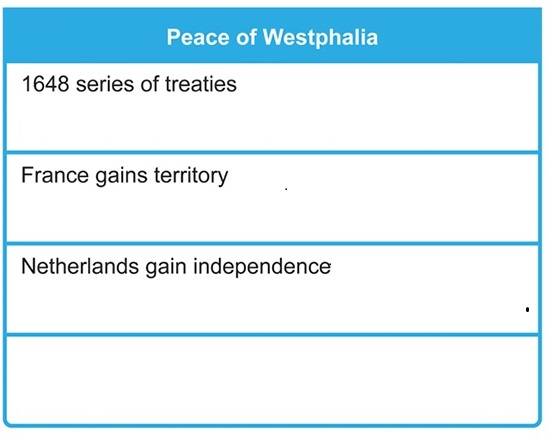
Which choice correctly completes the chart?
German states remain divided
Among other provisions, the 1648 Treaty of Westphalia
recognized the independence of the Netherlands and expanded France.
Read the statement by James I. How was this idea related to the Glorious Revolution?
“The state of Monarchy is the supremest thing upon earth; for kings are not only God’s lieutenants upon earth and sit upon God’s throne, but even by God himself they are called gods. . . . Kings are justly called gods for that they exercise a manner or resemblance of Divine power upon earth. . . . And to the King is due both the affection of the soul and the service of the body of his subjects. . . .”
—James I, to Parliament, 1610
The Glorious Revolution was a rejection of ideas like those expressed by James I.
What contributed to the start of the English Civil War?
Charles' decision to rule without Parliament when they would not pass his tax increases.
Which is a true statement about England’s Commonwealth?
The Commonwealth was a republic in name, but Cromwell ruled as a dictator.
Which of the following was one result of the English Bill of Rights of 1689?
The monarch could not interfere in parliamentary debates.
One way in which Peter the Great, Louis XIV, and Philip II are similar is that each
sought to centralize power by limiting the power of the nobility
• Signing of the Magna Carta
• Signing of the Petition of Right
• Passage of the English Bill of Rights
In England, these events were instrumental in
developing parliamentary democracy and a constitutional monarchy
“We hold these truths to be self-evident, that all men are created equal, that they are endowed by their Creator with certain inalienable rights, that among these are life, liberty, and the pursuit of happiness . . .”— The Declaration of Independence
Which Enlightenment thinker most directly influenced the notion expressed in this passage?
John Locke
"Manufacturing and commercial monopolies owe their origin not to a tendency [naturally found in a] capitalist economy but to governmental interventionist policy directed against free trade and laissez-faire."—Ludwig Von Mises, Austrian economist
This quote by a modern economist reflects the ideas which Enlightenment thinkers?
Adam Smith
What statement is most likely to be made by a proponent of natural law and natural rights?
Government does not grant rights; it protects them.
He expanded the idea of the government being a social contract between the government and its people in a book called The Social Contract?
Rousseau
His book Spirit of the Laws suggested a separation of powers into executive, legislative, and judicial branches:
Montesquieu
Baron de Montesquieu believed that a separation of powers would______________________
prevent tyranny by acting as a check on power
"The only way to erect such a common power, as may be able to defend them from the invasion of foreigners . . . is to confer all their power and strength upon one man, or upon one assembly of men, that may reduce all their wills, by plurality of voices, unto one will . . ."
This quote best reflects the philosophy of_______________
Thomas Hobbes.
And because the condition of man ... is a condition of war of every one against everyone, in which case every one is governed by his own reason, and there is nothing he can make use of that may not be a help unto him in preserving his life against his enemies; it followeth that in such
a condition every man has a right to every thing, even to one another's body. And consequently it is a precept, or general rule of reason: that every man ought to endeavour peace, as far as he has hope of obtaining it; and when he cannot obtain it, that he may seek and use all helps and advantages of war. The first branch of which rule containeth the first and fundamental law of nature, which is: to seek peace and follow it. The second, the sum of the right of nature, which is: by all means we can defend ourselves. Thomas Hobbes Leviathan.
1. What is Hobbes’ point of view?
2. Who might use Hobbes writings to support his or her own point of view?
People should use whatever means necessary to defend themselves.
A monarch offering protection in exchange
for reduced individual rights
Her A Vindication of the Rights of Woman published in 1792 argued for educational and political opportunities and freedoms for women:
Mary Wollstonecraft
The ideas of Enlightenment philosophers were based on
faith in human reason
One way in which the Scientific Revolution and the Enlightenment are similar is that both
questioned traditional values and past practices
Why is the Enlightenment considered a turning point in world history?
Europeans changed their thinking about the role of government.
How did Enlightenment ideas influence the political atmosphere leading up to the French Revolution?
They encouraged citizens to question the government and assert natural rights like liberty and property.
 Note
Note  Flashcards (35)