exam 1 Sensation and Perception - Intro to SnP Slides
 Studied by 0 people
 Call Kai
 Learn
Learn Practice Test
 Spaced Repetition
 Match
Match Flashcards
 Knowt Play
1/90

There's no tags or description
Looks like no tags are added yet.
Name | Mastery | Learn | Test | Matching | Spaced | Call with Kai |
|---|
No analytics yet
Send a link to your students to track their progress
91 Terms
Ventral vs Dorsal
Ventral: towards the front (palm)
Dorsal: towards the back (backside of palm)
what does transduction mean?
the vital process where your sensory organs convert physical energy from the environment (like light, sound waves, or pressure) into electrical signals, or neural impulses, that your brain can understand and interpret to form perceptions, making sense of the world.
Basically: Suppose someone runs a finger down your back. Neurons within the skin respond to the pressure and send electrical signals farther into the nervous system. This elementary process of converting physical signals into neural responses is called transduction. What ensues is a sensation that might be perceived as a gesture of affection from a friend or something else from the officer at an airport security checkpoint.
what are the 2 kinds of reality?
Physical (Objective) reality
Individual (Subjective) reality
Physical (Objective) reality
consists of all the particles, forces, and energies in a place / time.
- all possible stimuli, including that beyond our science or ability to experience.
Individual (Subjective) reality
- All experienced reality is __.
- Shaped by ? and ?
- Goal:
is created by the body & brain using electricity transduced from a limited subset of stimuli.
- All experienced reality is Subjective.
- Shaped by genetics and past experiences.
- Goal: to tell a coherent story, quickly.
Receptors transduce stimuli into __.
Brain, the physical matter, receives __ info
• Mind creates ?
• Illusions show that perception is?
electricity.
transduced.
consciousness: thoughts, feelings, experiences & perceptions.
defined & constrained by neural processing, not objective reality itself (basically we don’t see the world as it is; we see it as our brain computes it.)
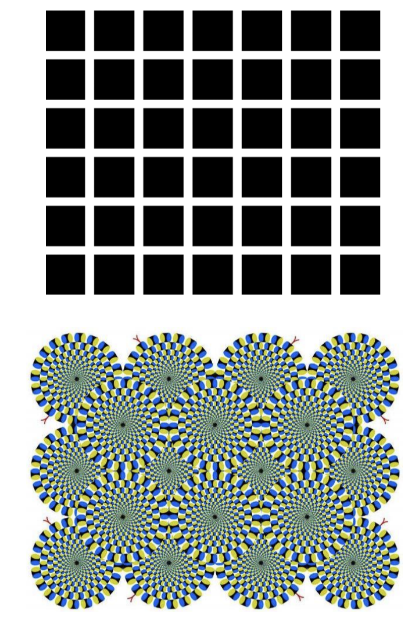
The brain–mind relationship asks how physical neural activity gives rise to thoughts, feelings, and consciousness. Different schools of thought answer this in different ways. Here are three major approaches commonly taught:
Dualism.
Panpsychism.
Materialism.
Dualism:
why was this considered as philosophical rather than science?
The mind (self) has an existence separate from the material world (Rene Descartes, 1596 – 1650)
• Cogito, Ergo Sum: I think, therefore I am. - Not science.
Basically proposes that the mind (or self) is non-physical and exists separately from the material body and brain.
The mind, as Descartes defined it, is: Non-physical, Not directly observable, Not measurable or testable. However Scientific explanations require testable, falsifiable evidence, which dualism does not provide.
Panpsychism:
The mind is a property of all matter. Father of experimental psyc, Wundt, thought this.
Distributed Cognition - idea is mental processes extend beyond the physical mind.
Basically Panpsychism has to do with the idea that “Mind is everywhere, at some level.” while Distributed cognition has to do with “Thinking is spread across brain, body, and environment.” In essence, a panpsychist might argue that the compass itself has some experience, while a DCog theorist would focus on how the compass, map, and navigator work together as a cognitive system, without asserting the compass is conscious.
Materialism:
only matter exists, mind and consciousness are the results of interactions between bits of matter.
Sensation
The ability to detect the pressure of your finger as you turn a page or swipe a screen and turn that detection into your own private experience is an example of sensation.
Basically the body’s ability to detect a stimulus; to transduce energy from the environment into neural energy used by brain. Might become an experience
Perception
can be thought of as the act of converting detected sensations into a representation that offers the ability to perform an action, derive meaning, or understand events in a broader social context.
Basically Includes assigning meaning to, understanding, identifying, interpreting and the act of assigning meaning to sensations. Is Always Subjective.
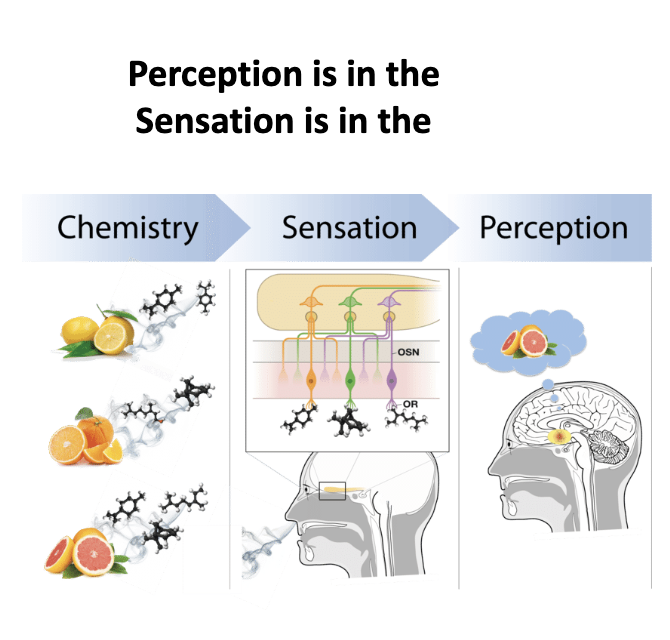
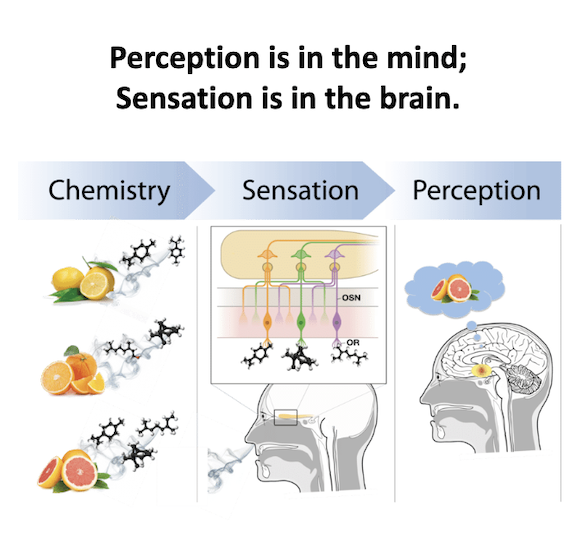
Photoreceptor cells are specialized neurons in the retina that detect ? and convert it into ? for the brain to interpret as vision, with two main types:
light.
electrical signals.
rods [responsible for low-light (night) and peripheral vision]
cones [which handle color vision and sharp, central daylight vision]
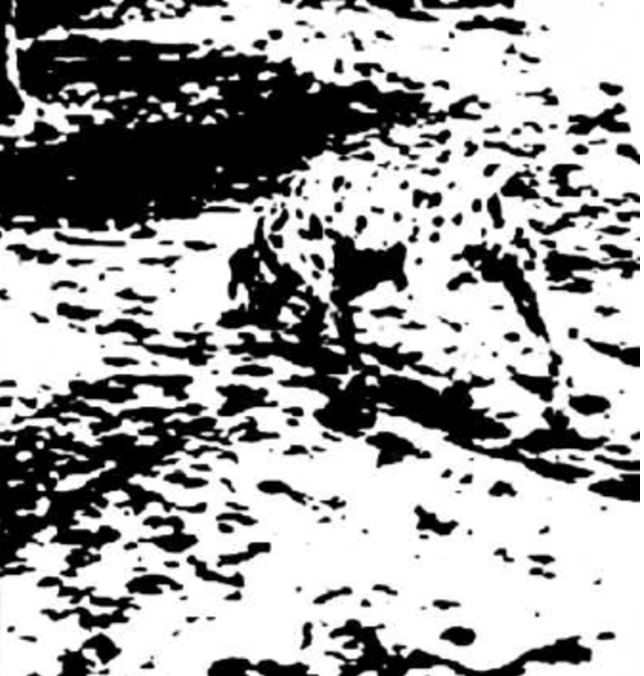
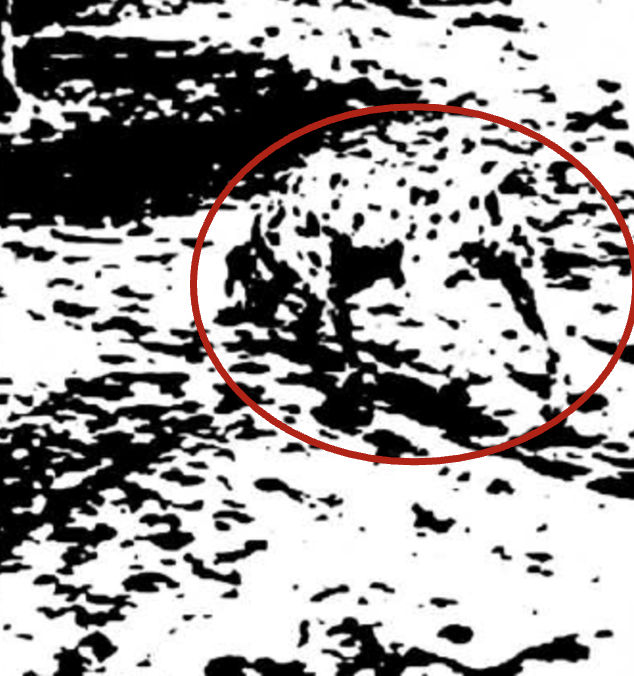
What is this picture? (What is this Sensation)?
What do you see (Perceive)?
S: Physical: visible light (a type of electromagnetic radiation) is detected by structures in your eyes which transduce it into neural impulses.
P: First, you might only perceive white color & shape: black & white blobs. Then, you might identify the dalmatian dog sniffing the ground.
Bottom-Up vs Top-Down
T/F: They work together.
Bottom-Up: builds perception from sensory details (data-driven).
Top-Down: uses prior knowledge and expectations to interpret sensory input (concept-driven).
TRUE
Sensation is a bottom-up/top-down process by which ?
bottom-up process.
our sense receptors receive and transduce stimuli info, like sound pressure waves, into neural signals.
Perception is a bottom-up/top-down way our brains?
top-down way.
organize and interpret stimulus info to put it into context.
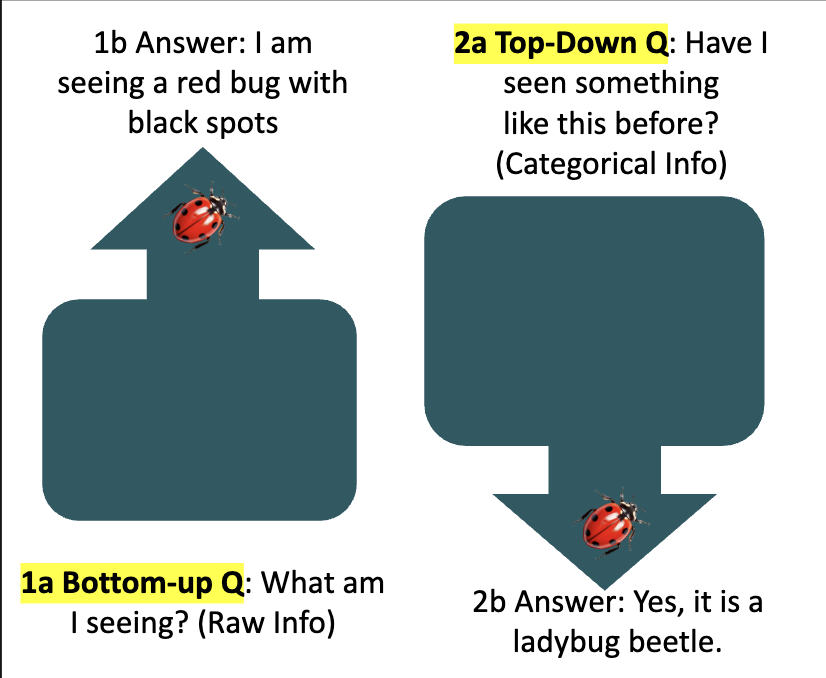
Which one is considered Bottom-up processing and Top-down processing? Explain what each process does.
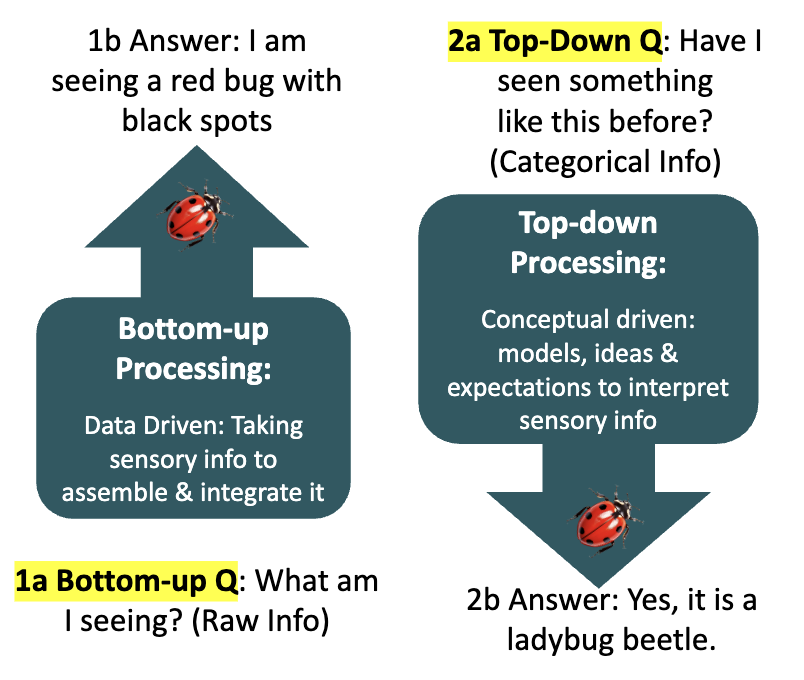
Consciousness (especially Perception) is primarily bottom-up/top-down.
top-down
Brain gets indirect info: Allegory of the Cave – brain gets shadows
• Meaning:
Our Brain is a prediction machine never knowing objective reality.
Anil Seth: __ is a Controlled Hallucination. Why?
Consciousness.
It is controlled because sensory data continuously constrains and updates it. When control weakens (dreams, psychosis), perception drifts from reality.
Perception is an Active Construction: How?
comes from inside (top-down predictions) but is closely coupled AND reined in by constant updates from stimuli (bottom-up input).
Basically Consciousness is best understood as mostly bottom-up/top-down, guided by predictions, with bottom-up sensory signals acting as ? . We don’t perceive __ directly—we experience the brain’s continuously updated model of it.
top-down.
error-correction.
reality.
5 Traditional Senses Commonly Studied Across Science:
● Vision (Sight)
● Audition (Hearing)
● Olfaction (Smell)
● Gustation (Taste)
● Tactile (Touch, a somatosensation)
Besides the 5 Traditional senses are there another 5 more Common Somatosensations Studied in Neuropsych?
Yes
● Proprioception (Limb position & movement)
● Nociception (Pain)
● Thermoreception (Temperature)
● Equilibrioception (Balance)
● Body Movement
What is Echolocation? Who is better at it?
to judge distance from objects. All people can, but blind are better. Blind individuals are much better than blindfolded people – can do smaller objects. Ex) Think of a blind person sensing a way approaching them quicker than a blindfolded person.
Most humans can briefly detect __ using Haidinger’s brushes, not as a clear signal, but as a faint yellow hourglass-shaped illusion created by the retina and brain working together.
the orientation of polarized light

Some humans have unconscious neural activity in response to __.
• When the brain detects a sensation, the __ drop.
• For some people, it does this when magnetic fields are changed – showing it was detected __.
magnetic fields.
alpha waves.
unconsciously.
Do Perceptions remain stagnant throughout life?
NO! Perceptions change from moment to moment & over the lifespan.
Senses are tuned into new or important info: otherwise, stimuli becomes __.
• Some senses are __; such as some taste preferences.
• Some senses are informed by __: such as odor preferences.
habituated (an organism's response to a repeated, unchanging stimulus decreases over time because the stimulus is no longer novel or threatening, allowing focus on more important things. think of a clock’s ticking being tuned out)
innate.
culture or experience.
T/F: Changes occur across the lifespan to all senses.
• They develop in the early/late years & become less acute in the late years.
• Some are lost entirely with __ - such as hearing high frequencies.
• Often, loss can be mitigated/lessened with __ – like consistently wearing UV sunglasses & hearing protection (people who live in NYC lose hearing quicker).
TRUE.
early years.
age.
LIFESTYLE choices.
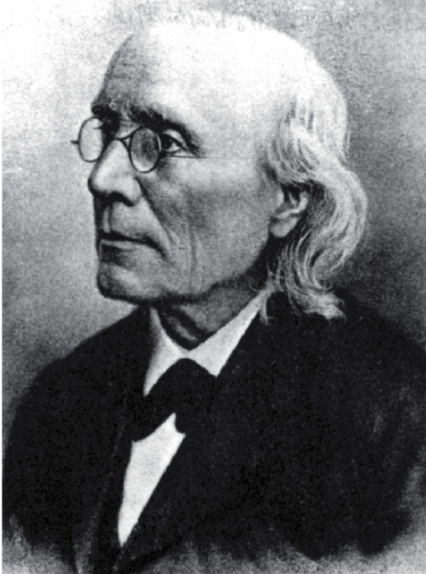
Gustav Fechner
He attempted to describe the relationship between?
The relationship between the mind and body using the language of mathematics.
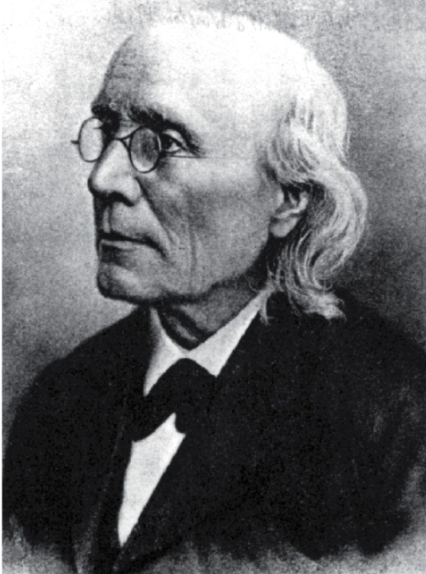
Gustav Fechner
What did he invent? What is he the true founder of?
Invented “psychophysics” and is often considered to be the true founder of experimental psychology.
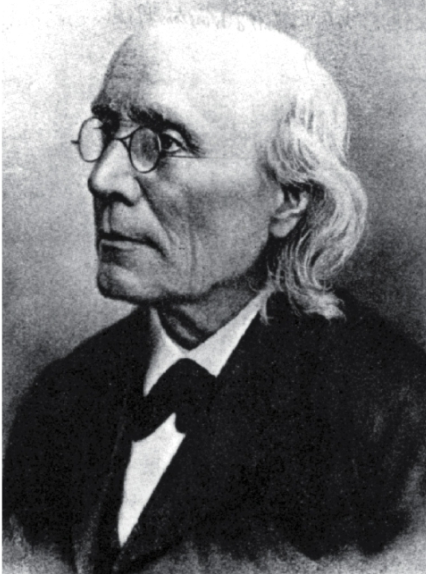
Gustav Fechner
What is Psychophysics?
the science of defining quantitative relationships between physical and psychological (subjective) events.
• Sound Pressure & Perceived Loudness.
• Light energy & Perceived brightness.
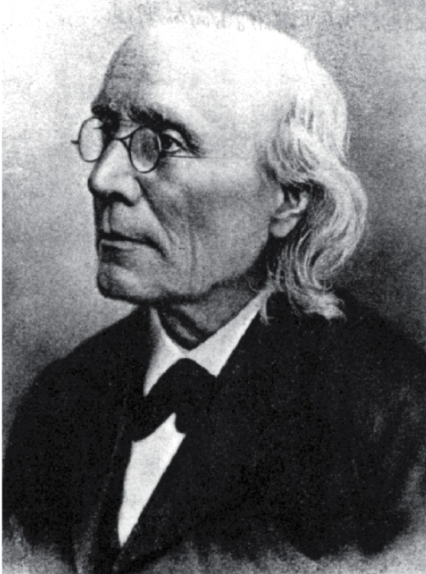
Gustav Fechner
We still use some of Fechner’s methods today:
Two-point Touch Threshold:
Just Noticeable Difference (JND):
Absolute Threshold:
TTT: minimum distance at which two touches can be distinguished.
JND: the smallest detectable difference between two stimuli, or the minimum change in a stimulus that can be correctly judged as different from another.
AT: minimum amount of stimulation necessary for a person to detect a stimulus 50% of the time.
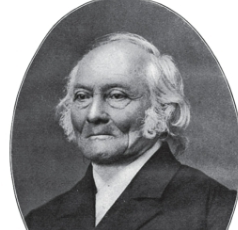
Ernst Weber
What did he discover?
discovered that the smallest detectable change in a stimulus is a constant proportion of the stimulus level.
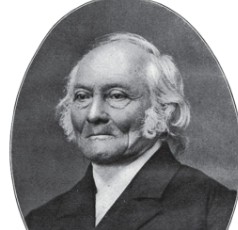
Ernst Weber
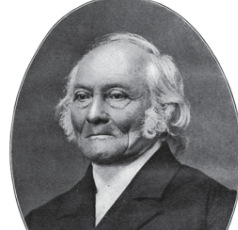
Weber’s Law:
The principle describing the relationship between stimulus and resulting sensation that says the JND is a constant proportion of the stimulus.
• Thus, larger stimulus values have larger JNDs and smaller stimulus values have smaller JNDs.
• Is generally right; breaks down at high & low intensities.
Ernst Weber
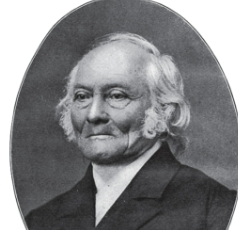
Weber observed that the JND was relative to __.
• T/F: Not precisely right; not so good at large & tiny numbers.
physical intensity of stimulus, i.e., a Constant Proportion.
TRUE.
Ernst Weber
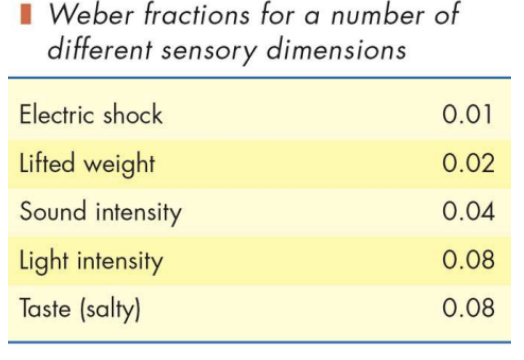
Weber Fraction Example: If an individual was just able to tell difference between a 100 and a 102-gram object, they would also be just able to discriminate 400 from 408 grams – because it is a 2% difference in weight
● JND is 2 grams; Weber Fraction is 2%
● Fixed ratio for difference __.
senses.
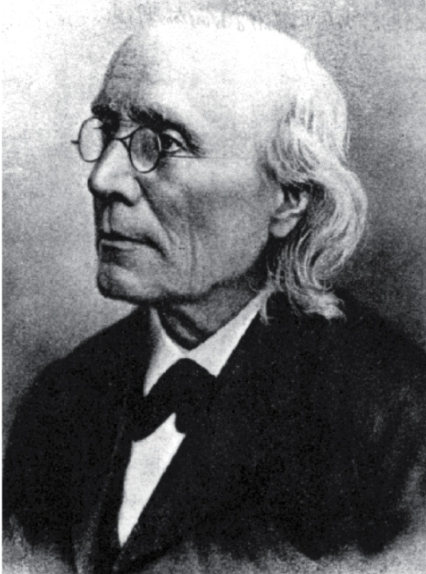
Gustav Fechner
What did Gustav do to Weber’s Law?
Gustav Fechner mathematically extended Weber’s law to make it more universal.
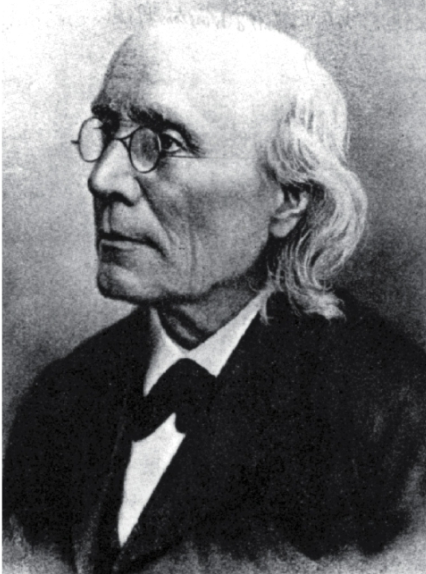
Gustav Fechner
Fechner’s law:
Says:
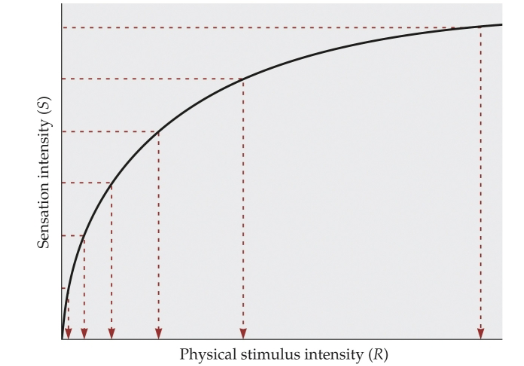
Fechner’s law: describes the relationship between stimulus magnitude (intensity) and resulting sensation magnitude.
Says: It takes larger and larger changes of physical intensity (x-axis) to equal the same changes of sensation intensity (y-axis).
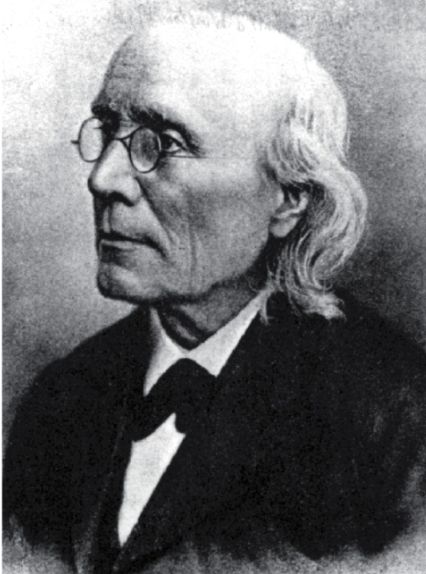
Gustav Fechner
Fechner’s Law: Introspective Sensation (S) increases logarithmically (a pattern where something grows quickly at first, but the rate of growth slows down significantly over time) with __.
AKA: As x increases, y increases, but at a __ rate (logarithmically).
objective physical intensity (R)
S = k* log R
decreasing.
Stanley Stevens
Refined Fechner’s law explains __ well.
magnitude estimates
Stanley Stevens
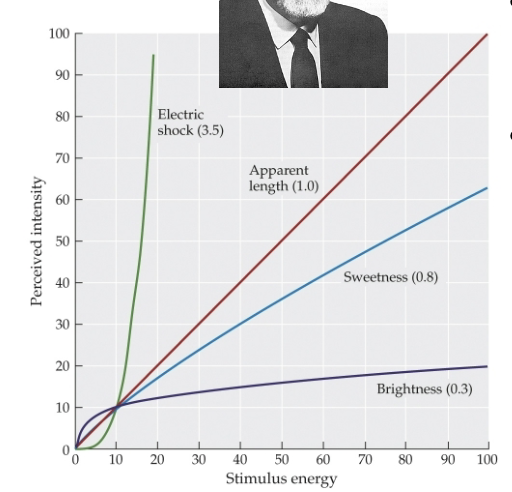
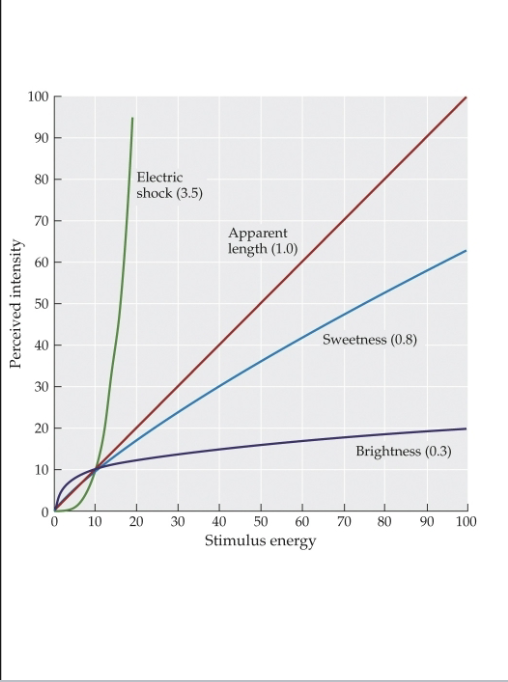
S = aI^b ; Introspective sensation (S) depends on objective intensity (I) as well as a modality specific constant (a) and exponent (b)
Means:
● Some perceptual estimates are linear;
● Some perceptions become saturated;
● Some perceptions exponentially increase;
Something twice as long looks twice as long.
Object twice as bright is perceived as being only a bit brighter.
Slightly more intense electric shock feels much stronger.
What are 3 Measurement Methods?
Psychophysical Methods
Scaling Methods
Signal Detection Theory
Today scientists commonly study S&P through: (6 ways)
1. Thresholds – testing an individual’s sensory limits.
2. Scaling - measuring private experience.
3. Signal detection theory -measuring difficult decisions (can you hear it or not?).
4. Sensory neuroscience – the biology of sensation and perception.
5. Neuroimaging - an image of the mind; MRI, PET, CT.
6. Computational models – using math and computation to understand perception.
Psychophysical Methods
2 Types of Thresholds:
Absolute threshold: minimum amount of stimulation necessary for a person to detect a stimulus 50% of the time. faintest sound that person will say that they have heard at least 50% of the time.
Difference Threshold: minimum change in intensity required to produce a just noticeable difference.
Psychophysical Methods
3 Common Ways to Measure Thresholds:
Method of constant stimuli: many stimuli, ranging from rarely to almost always perceivable, are presented one at a time, randomly.
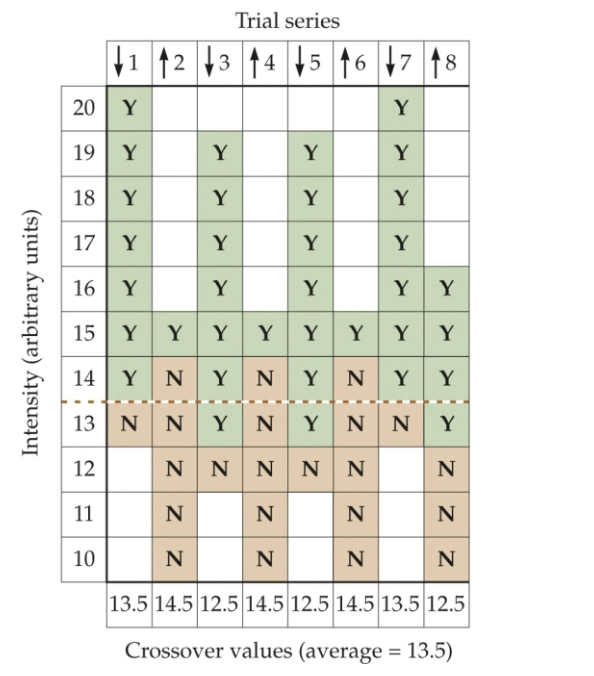
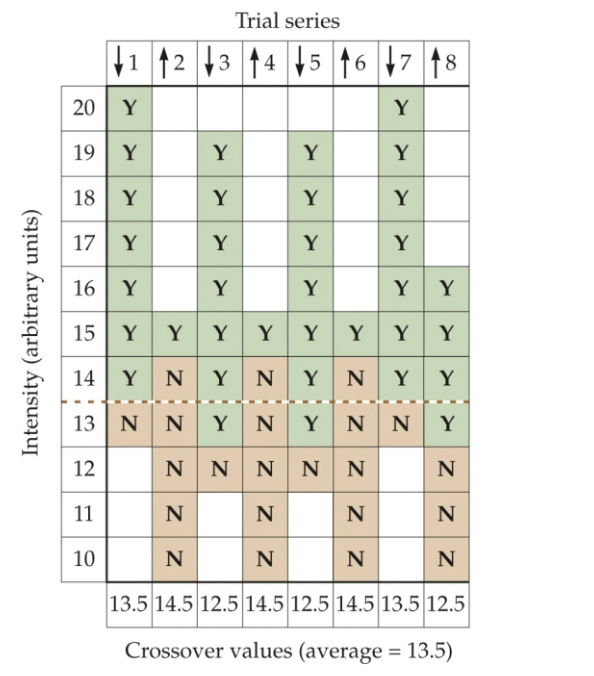
Method of limits: the magnitude or the difference between two stimuli is changed incrementally until the participant responds differently.
Method of adjustment: like the method of limits, but the participant controls the stimulus directly.
Psychophysical Methods
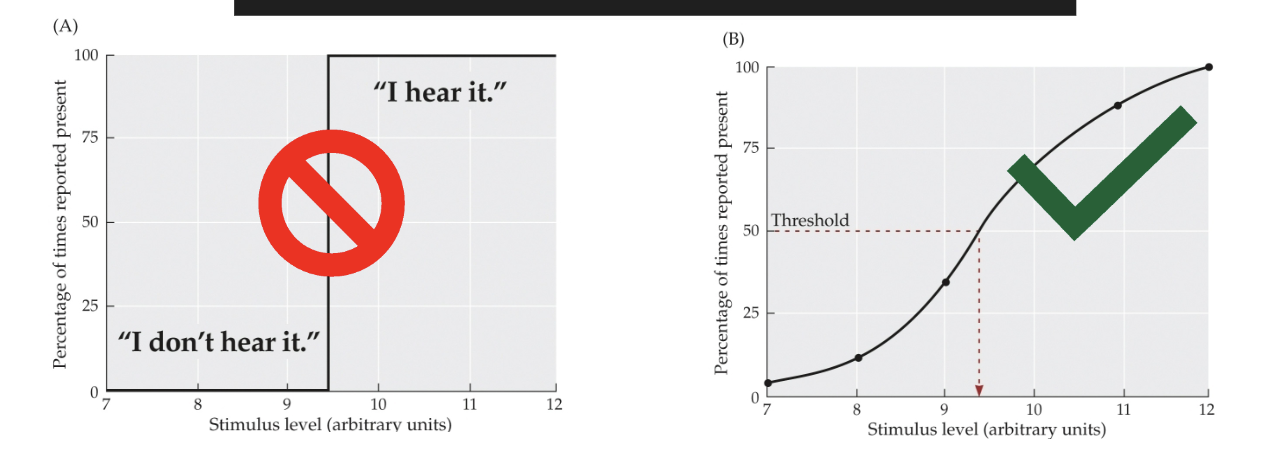
Method of constant stimuli
There is NOT a hard cut off where Yes always becomes No, as in figure A. It is like B: The stimulus levels depicted on the x-axis (7 – 12) are presented 10 times each, in random/specific order. The percentage of time they detect the stimulus is reported on the y-axis.
random
Psychophysical Methods
Method of limits
T/F: Stimulus is presented in increasing or decreasing intensities.
1. First, a stimulus is presented at a high intensity and then lowered until?
2. Next, a stimulus is presented at a low intensity the participant can’t sense and then raised until?
3. The crossover points are then?
TRUE.
the participant reports not being able to sense it. (Trial 1 on left).
the participant reports sensing it. (Trial 2, second from left).
averaged to determine the subject’s threshold.
Scaling Methods
participant assigns numerical values based on perceived magnitude:
• Example: “If the worst pain you can feel is a 10 out of 10, what value would you give your pain?”
• Example: “If this taste is a 5 out of 10 on sweetness, what sweetness value do you give this cookie?”
Magnitude estimates are well described by what law?
Magnitude estimation.
Stevens’ power law.
Scaling Methods
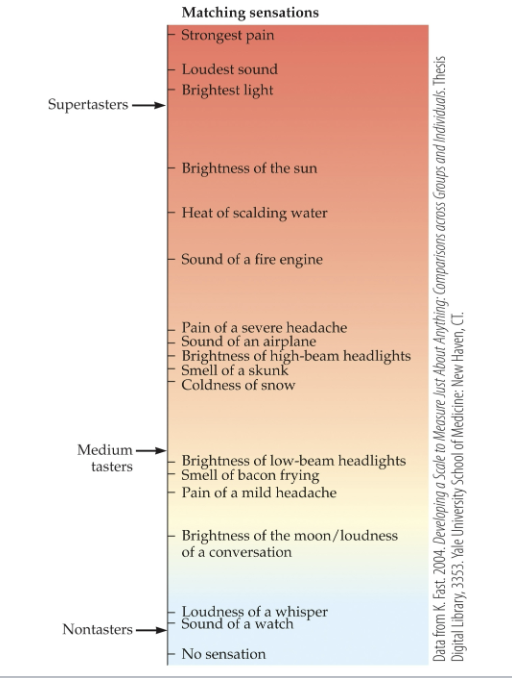
the participant matches the intensity of a sensation in one sensory modality with the intensity of a sensation in another:
• Provides a bridge for linking __.
• Example: “Adjust this light so it is as bright as the stimulus sound is loud.”
Cross-modality matching.
subjective experiences to objective measurements.
Signal Detection Theory
what is this theory?
measuring difficult decisions: a search for a signal amidst noise.
Signal Detection Theory
a theory to explain _ to a signal in the presence of ?
responses of an observer.
noise.
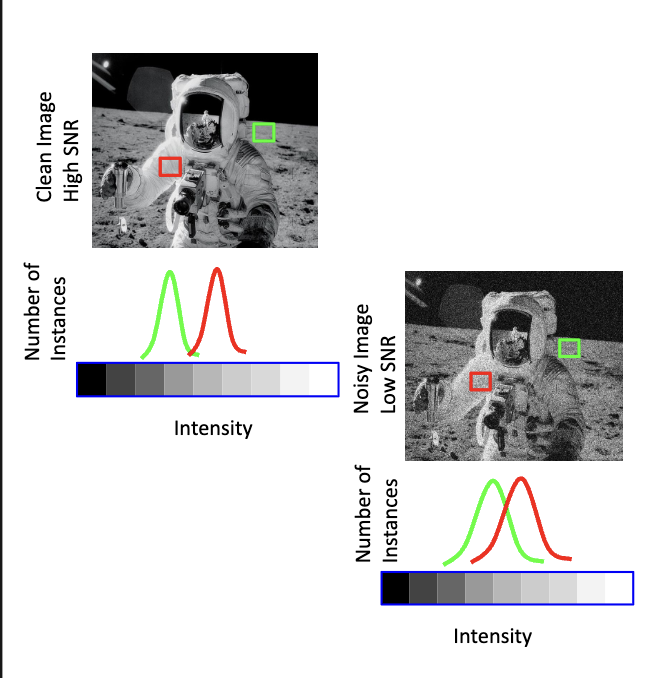
1.2.3 Psychophysical Measurement Methods
The SNR (Signal to Noise Ratio) measures ?
how much meaningful information (signal) stands out from irrelevant background activity (noise).
1.2.3 Psychophysical Measurement Methods
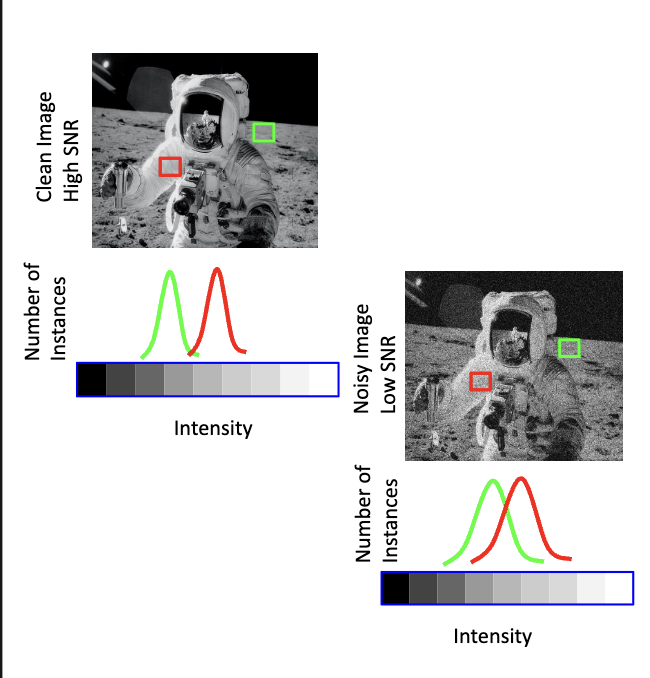
T/F: A higher SNR makes it easier to detect or distinguish signals, while a lower SNR increases uncertainty.
• Neuroimaging: Higher SNR improves accuracy of functional MRI data by __.
• Perceptual tasks example: reading a blurred sign relies on detecting signals with a reduced __.
TRUE.
separating brain activity.
SNR.
Signal Detection Theory
Signal detection theory distinguishes between an observers’ ability to perceive a signal and their willingness to __.
report it.
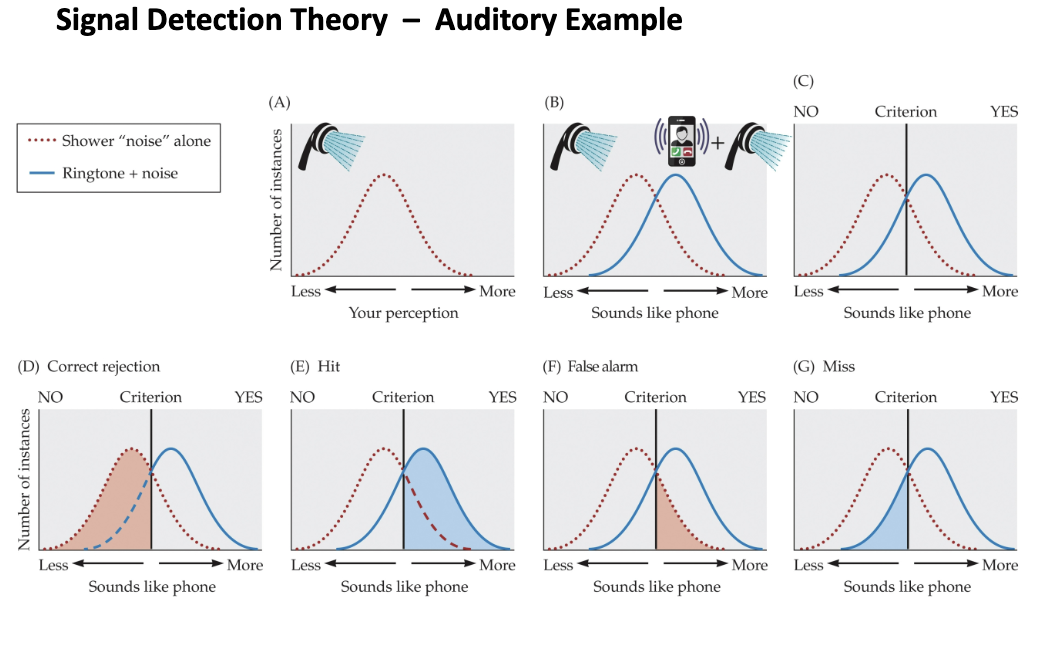
Signal Detection Theory
Sensitivity: the ability to detect a signal and distinguish it from _. It indicates how well an observer can differentiate between the presence and absence of a signal.
• Usually represented as __ – which measures ?
noise.
d’ (d prime).
the separation b/t signal and noise distributions.
Signal Detection Theory
Criterion: an internal __ that is set by the observer.
• If the internal response is above criterion, the observer gives one __; another if it is below criterion.
threshold.
response.
Signal Detection Theory
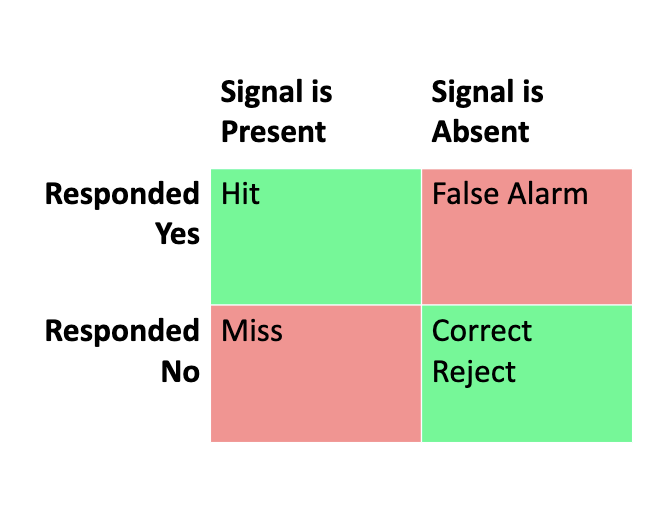
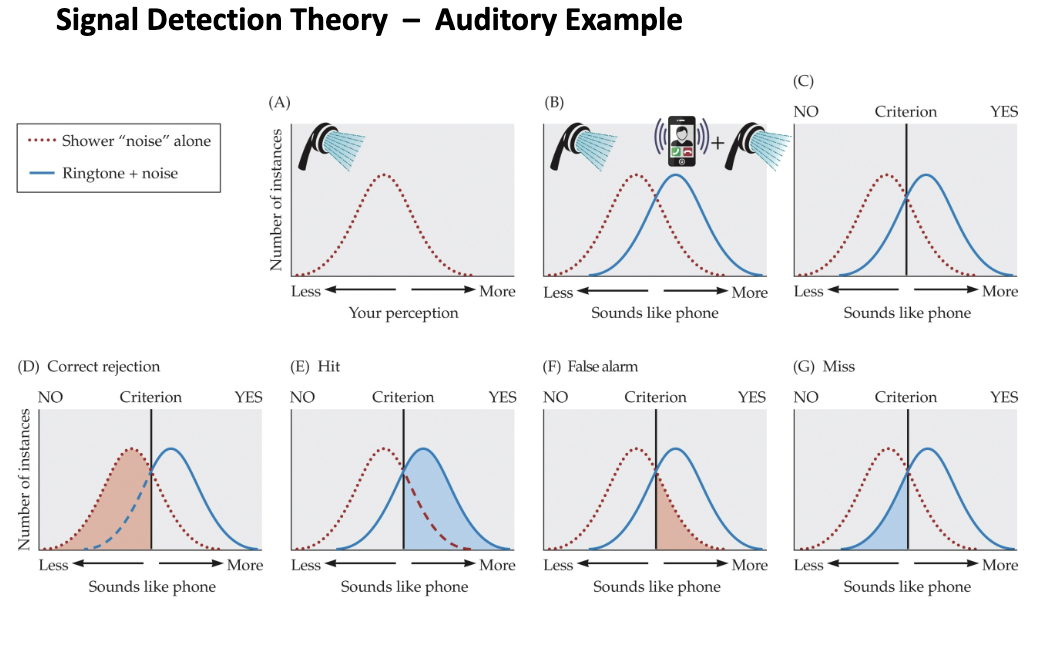
What are Four possible stimulus/response situations in signal detection theory?
• Hit: stimulus is present and observer responds “Yes”.
• Miss: stimulus is present and observer responds “No”.
• False alarm: stimulus is not present and observer responds “Yes”.
• Correct rejection: stimulus is not present and observer responds “No”.
Signal Detection Theory
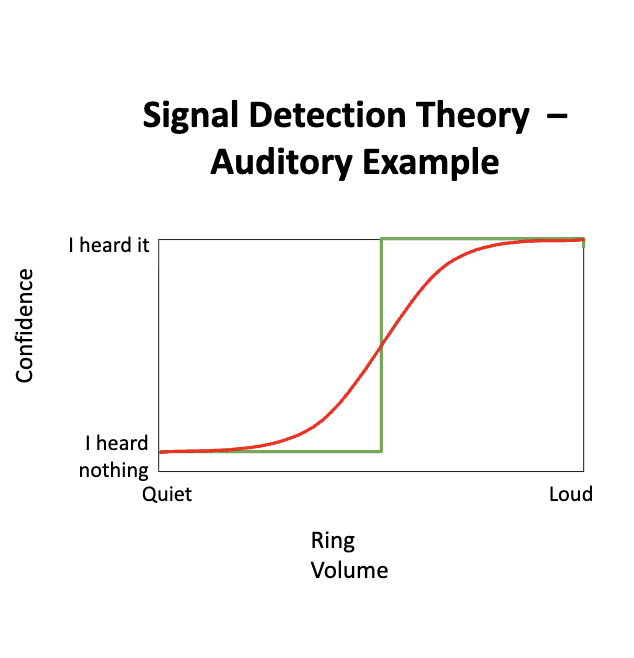
Consider hearing a phone call when you are taking a shower:
T/F: The ability to detect the call and the confidence in hearing it are influenced by relative frequencies and loudness of both.
• Overlapping Frequencies:
• Relative Loudness:
TRUE.
Part of the call’s sound frequencies may overlap with the shower.
of the phone call relative to the shower noise affects the ability to hear it. A louder phone call relative to the shower will be easier to detect.
Signal Detection Theory
The more widely the signal and noise curves are separated, the fewer __ the observer will make.
You can increase the distance between the signal and noise curves through training.
errors.
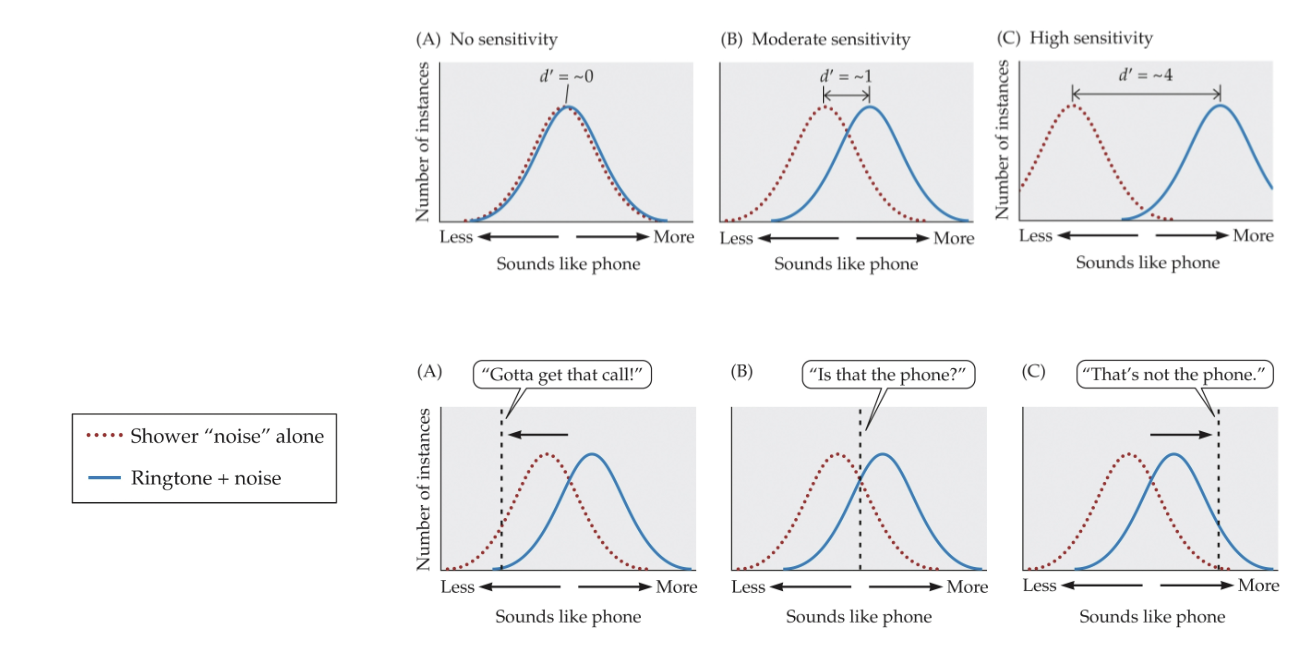
Signal Detection Theory
T/F: Willingness to Miss the Call will affect the False Alarm Rate.
TRUE
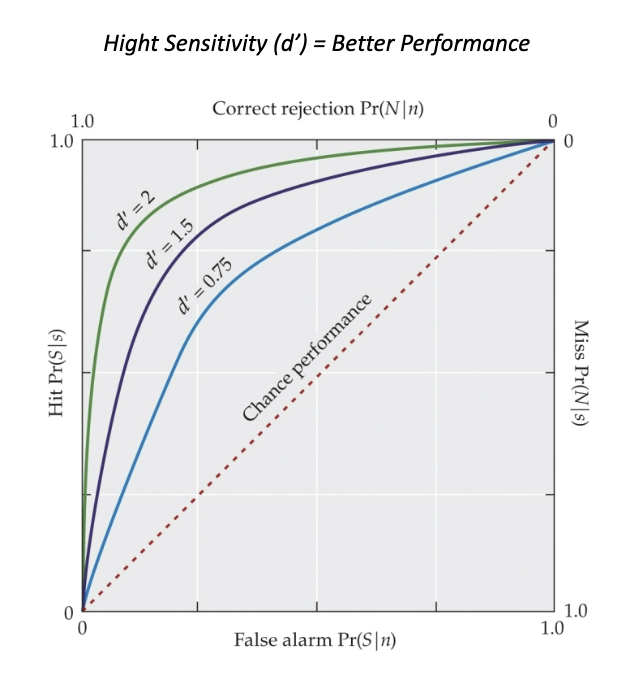
1.2.3 Psychophysical Measurement Methods
Receiver operating characteristic (ROC): In signal detection, the graphical plot of the hit rate (true positives) as a function of the false alarm rate.
• Chance performance will fall along the diagonal.
• Good performance (high sensitivity) “bows out” towards the __.
Plotting the ROC curve allows you to predict the __
• T/F: Changes in criteria move performance along a curve but do not change the shape of the curve.
upper left corner (in green).
proportion of hits for a given proportion of false alarms, and vice versa.
TRUE.
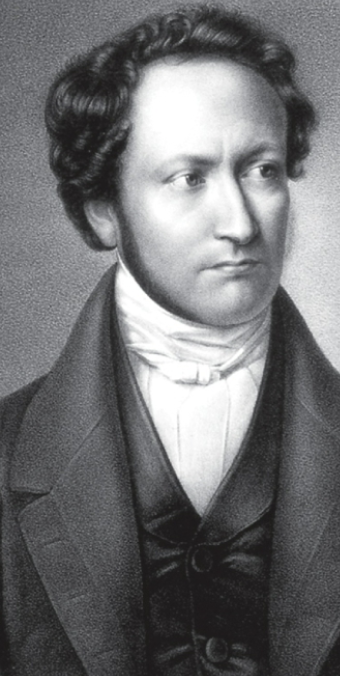
Doctrine (a fundamental principle, belief, or body of teachings) of __ was formulated by Johannes Müller (1801 – 1858).
• It says: BECAUSE we are only aware of nerve activity (fires or not) & not the world itself = perception depends on __.
• Emphasizes that the brain's perception of sensation is closely tied to __.
• A Cold receptor can only say yes or no about cold. If triggered it says Yes – and the brain perceives __.
specific nerve energies.
which fibers are stimulated, not how they are stimulated.
specific neural pathways.
cold.
What Illustrate the Doctrine of Specific Nerve Energies?
Cranial Nerves.
Name the 12 Cranial Nerves
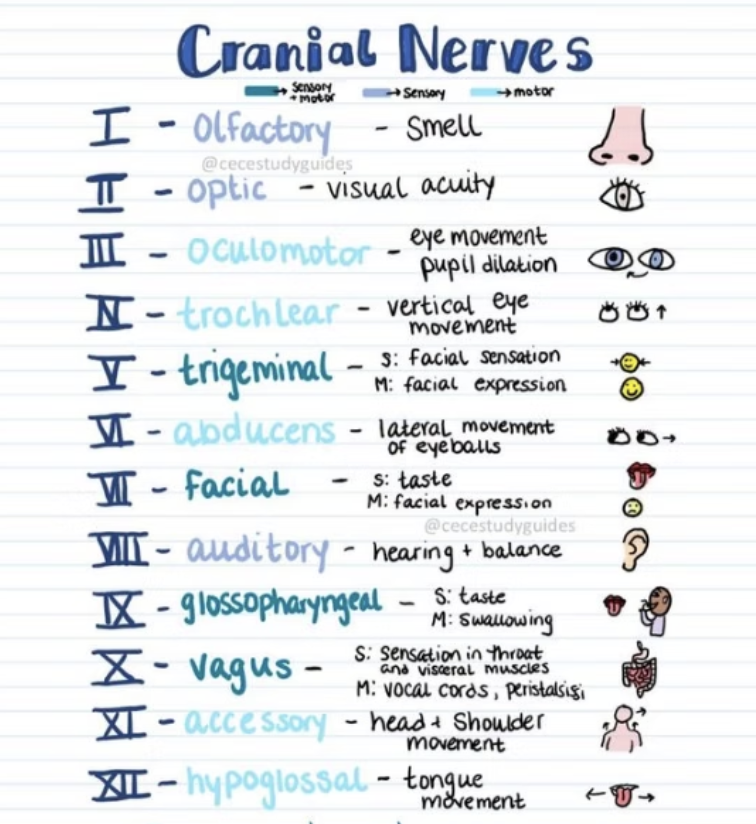
What are Cranial Nerves?
Name the ones that are important in this class:
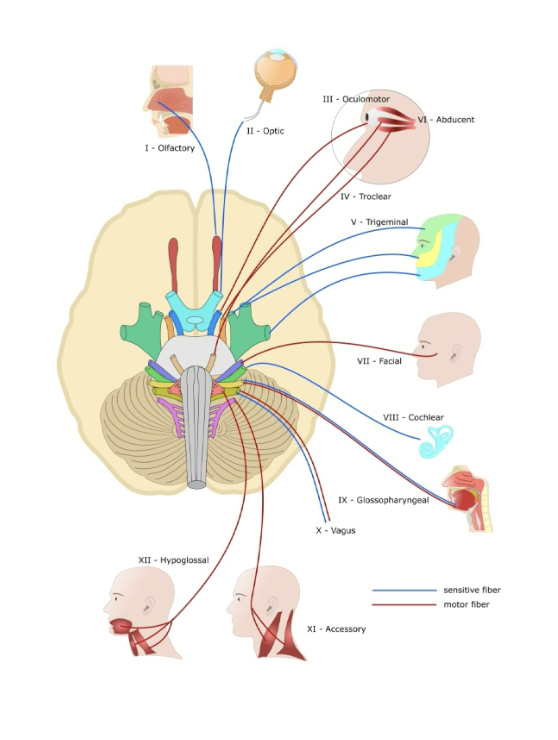
12 pairs of nerves that originate in the brain stem and reach sense organs and muscles in the head and neck through openings in the skull. Numbered I to XII.
• Smell: (I) Olfactory nerves
• Vision: (II) Optic nerves
• Hearing & Balance: (VIII) Auditory nerves
• Taste: 3 Cranial Nerves
Why do some people sneeze as a reaction to bright sunlight?
• Photic Sneeze Reflex – sneezing in response to a __.
Inherited: 18 – 35 % of the population, blue eyes especially.
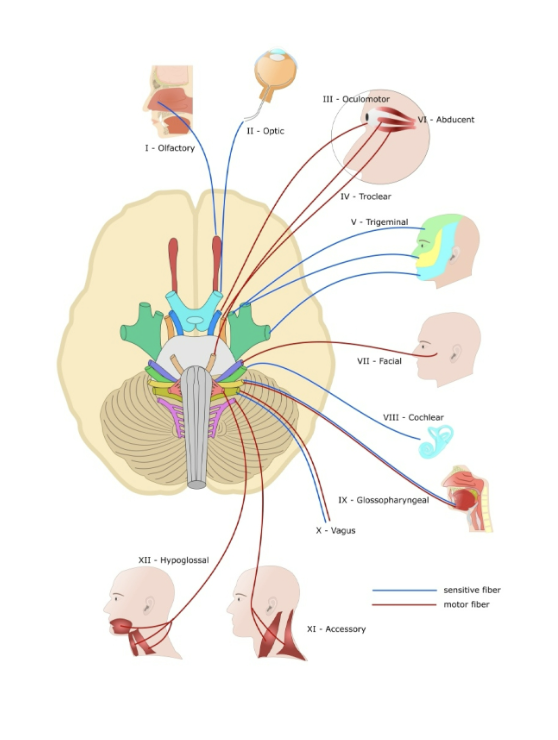
• Cross wiring. Pupil dilation on vision nerve triggers the V2 olfaction nerve to fire – which responds to irritants by sneezing.
• i.e., Doctrine of Specific Nerve Energies.
change in light intensity.
(Basically Sun causes eyes to dilate and that info is sent through nerve and that nerve is touching another nerve like the nose nerve and now it is stimulated and it causes it to sneeze.)
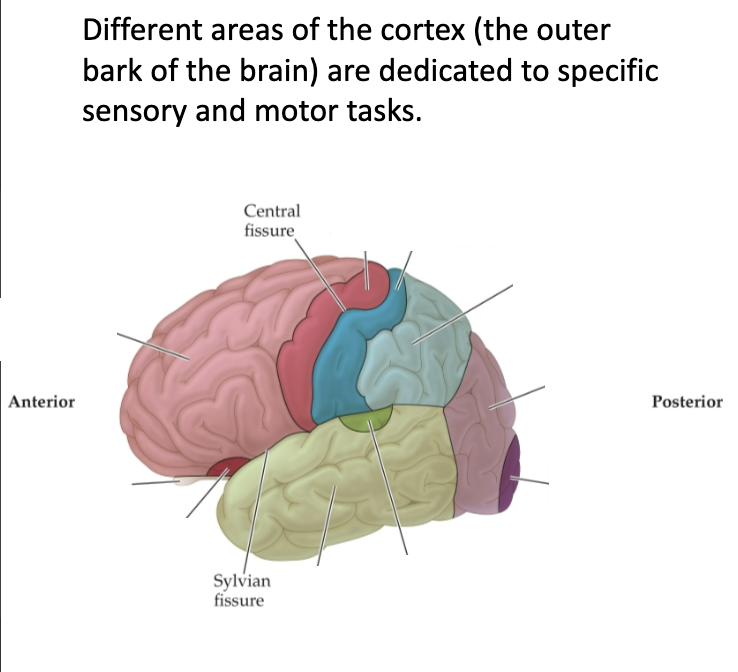
Label
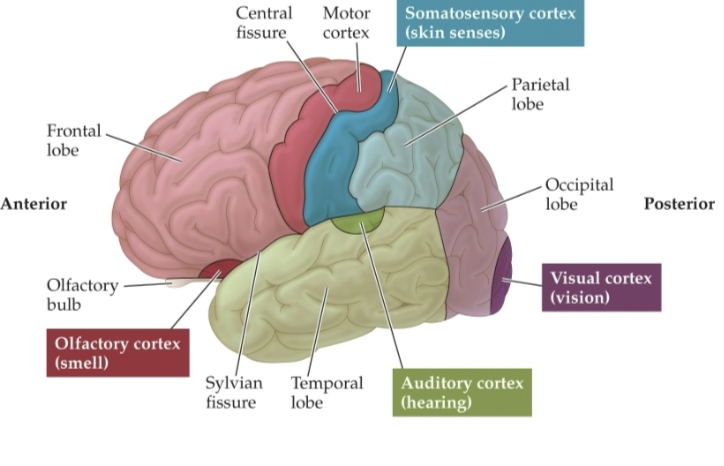
• Primary Somatosensory Cortex for touch – ?
• Primary Vision Cortex – ?
• Primary Auditory Cortex – ?
• Olfactory Cortex – ?
• Insular Cortex for Taste – ?
in the parietal lobe.
in the Occipital lobe.
in the Temporal lobe.
on the Ventral Frontal Lobe.
deep in Sylvian fissure, in the insular cortex.
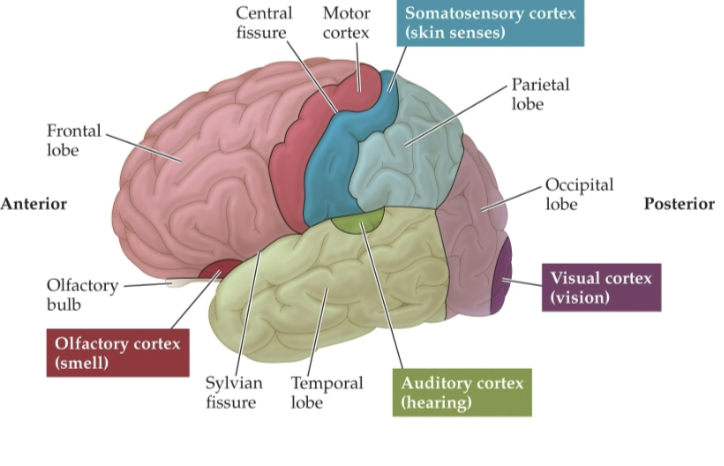
What 2 senses are deeper in the brain? Where are they?
Taste & smell.
• Smell is on the bottom (ventral) surface of the frontal lobe.
• Taste is processed in the insular cortex, which is deep within the Sylvian fissure.
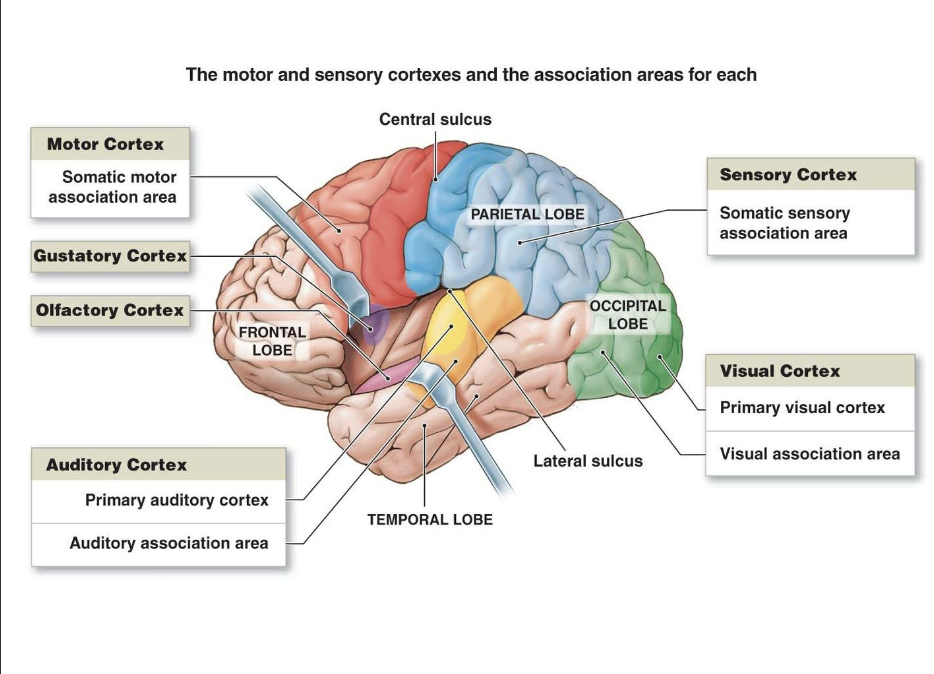
Neurons receive, carry, and pass on signals from sensory receptors & each other to the ?
brain.
Graded Potentials
Local changes in membrane voltage.
• Occur in dendrites and cell body.
• Continuous - vary in size with input strength.
• Can be excitatory or inhibitory.
• Summed across space and time.
• Determine whether threshold is reached to trigger an action potential.
AP are triggered when graded input reaches __.
• Begin near the __.
• All-or-none electrical spikes
• __ codes stimulus intensity.
• Propagate as electricity down axon without __.
• __ increases speed.
threshold.
axon hillock.
Frequency (fast or slow firing).
weakening.
Myelin.
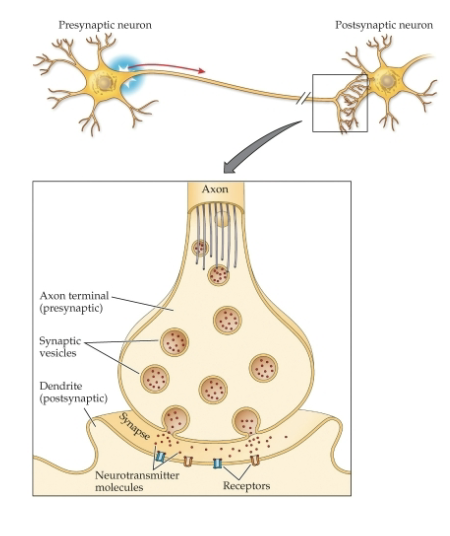
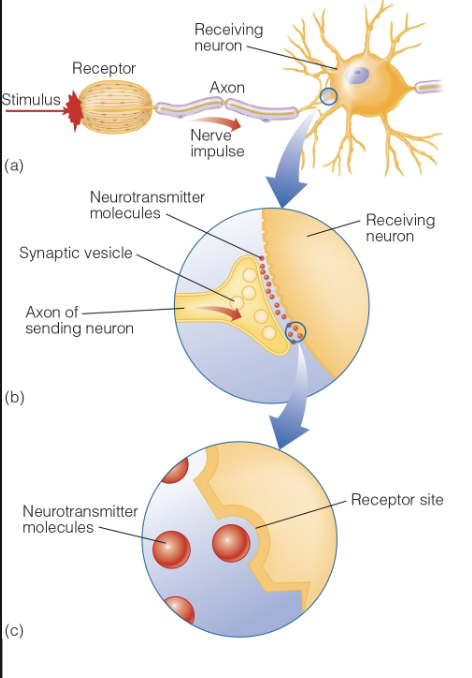
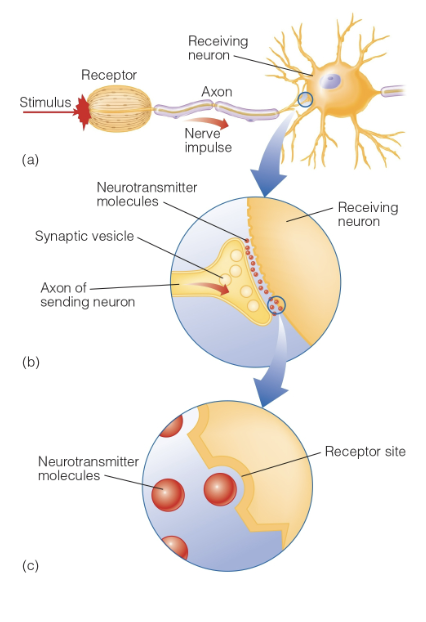
Synapse: ?
• Electrical/Chemical signal cannot cross the synapse directly.
• When the action potential reaches the axon terminal:
- Synaptic vesicles release __.
- Neurotransmitters cross the synapse and bind to __.
- Binding alters the __ of the receiving neuron.
The gap between the axon terminal of one neuron and the dendrite or cell body of another.
Electrical.
neurotransmitters.
receptors.
electrical state.
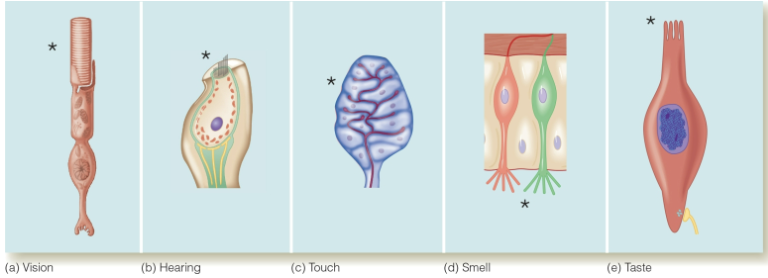
Sensory receptors transduce __.
• Some are __ – olfaction, photoreceptors (vision), and some somatosensory (touch).
• Some are __ – hair cells in hearing, taste receptor cells.
• All pass their info to sensory neurons that fire __.
physical energy (light, sound, pressure, chemicals) into graded electrical signals.
neurons.
specialized cells.
action potentials.
Name 6 Modern Brain imaging technologies: Neuroimaging
1. Computerized tomography (CT)
2. Magnetic resonance imaging (MRI)
3. Electroencephalography (EEG)
• Event-related potential (ERP)
4. Magnetoencephalography (MEG)
5. Positron emission tomography (PET)
6. Functional magnetic resonance imaging (fMRI)
• Blood oxygen level-dependent (BOLD) signal
Neuroimaging
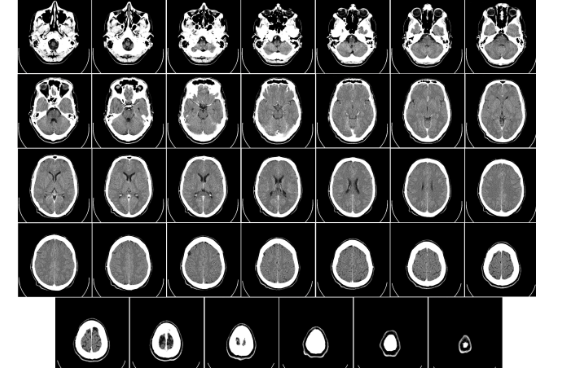
1. Computerized tomography (CT)
An imaging technology that uses X-rays to create images of slices through volumes of material (e.g., the human body).
Neuroimaging
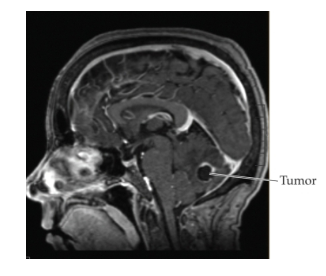
2. Magnetic resonance imaging (MRI)
uses the responses of atoms to strong magnetic fields to form images of structures like the brain.
Neuroimaging
3. Electroencephalography (EEG)
• Event-related potential (ERP)
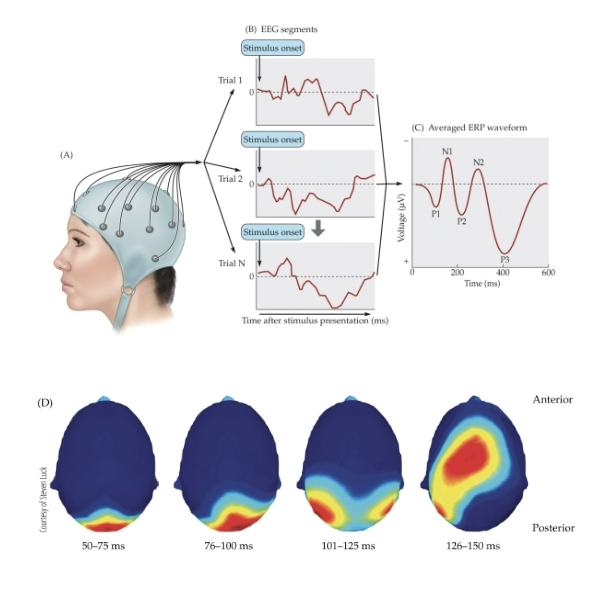
Electroencephalography (EEG): using many electrodes on the scalp, measures electrical activity from populations of many neurons in the brain.
• High Temporal resolution - captures changes over time well.
• Low Spatial Resolution - no fine detail.
• Event-related potential (ERP) – created by averaging many EEG recordings.
Neuroimaging
4. Magnetoencephalography (MEG)
What are some downsides?
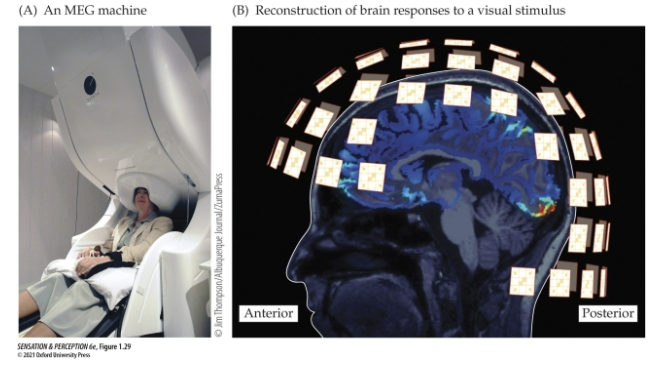
Magnetoencephalography (MEG): similar to EEG: measures changes to magnetic fields produced by the electrical activity of neurons.
• MEG has the same high temporal resolution as EEG.
• MEG has better spatial resolution than EEG b/c magnetic signals are less distorted by the skull than electrical signals.
Downsides: Expensive, Technical
Neuroimaging
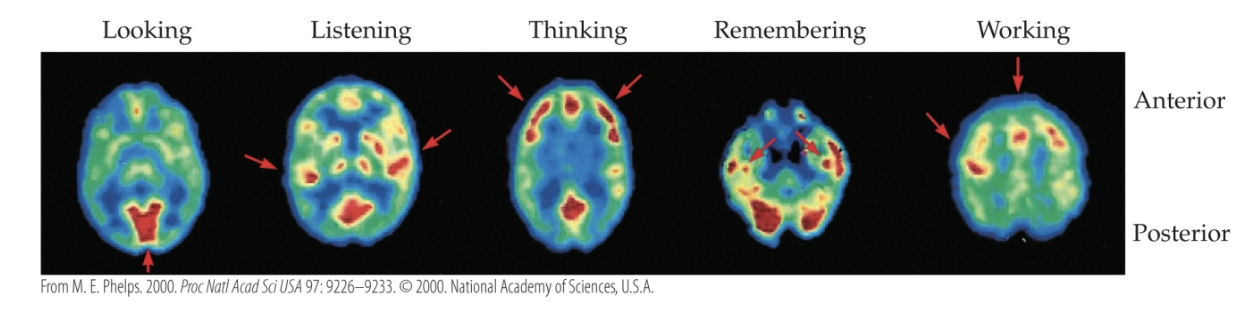
5. Positron emission tomography (PET)
Positron emission tomography (PET): An imaging technology that allows us to define locations in the brain where neurons are especially active by measuring the metabolism of brain cells using safe radioactive isotopes.
Neuroimaging
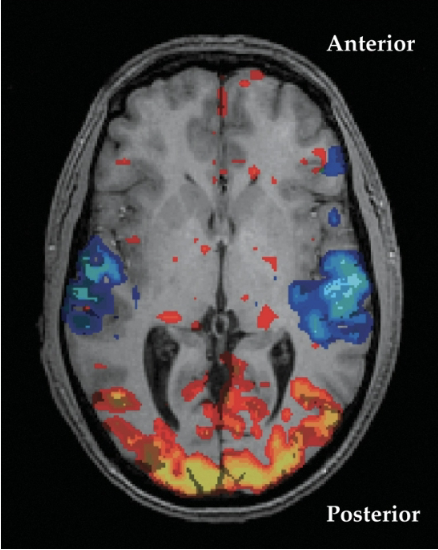
6. Functional magnetic resonance imaging (fMRI)
• Blood oxygen level-dependent (BOLD) signal
fMRI: Variant of MRI. Measures localized patterns of brain activity.
• Activated neurons trigger increased blood flow, oxygen in blood is used faster (deoxygenated) by most active regions.
• Blood oxygen level-dependent (BOLD) signal: is the measurement of the magnetic properties of hemoglobin, the molecule in red blood cells that carries oxygen.
• BOLD Signal is a ratio - Deoxygenated to Oxygenated indicating strength of neural activity.
Neuroimaging
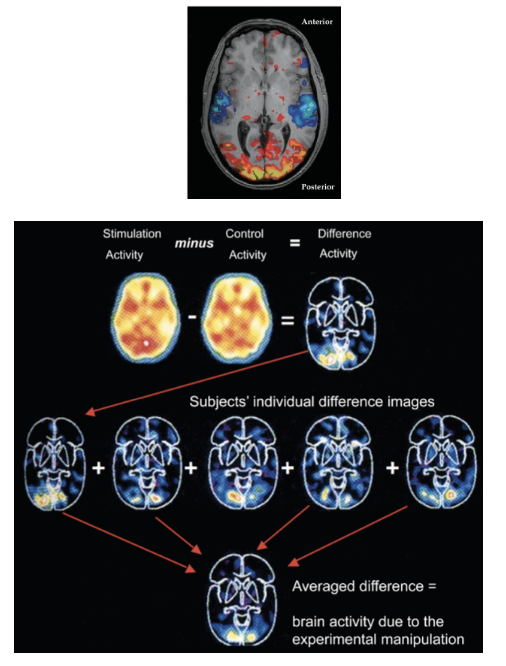
fMRI – How they are created
Two Images are Taken:
• One image is baseline brain activity (e.g., at rest)
• Another captures activity during a task or stimulus
• Subtraction Method:
- Images are subtracted to highlight differences in activity.
- Areas with increased or decreased BOLD signal show neural activity changes.
• What It Means:
- fMRI is correlational, showing patterns of blood flow linked to activity.
- Is an average across multiple individuals.
Neuroimaging
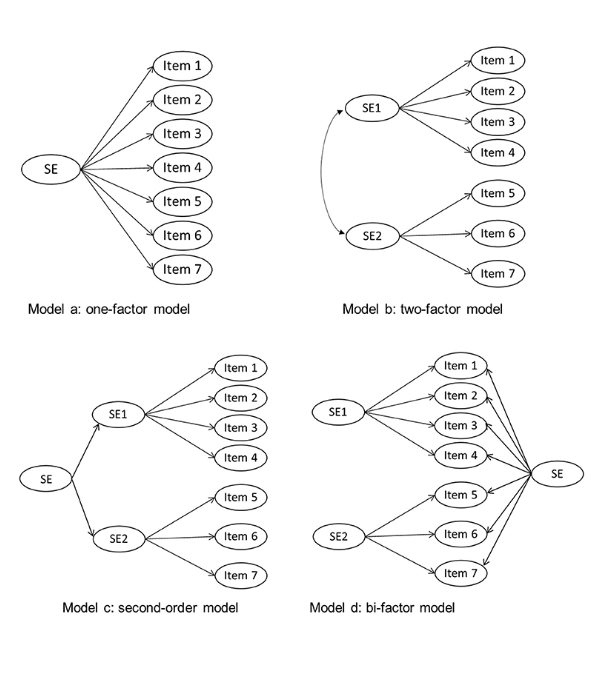
Mathematics and computer programs can help us understand __.
• Mathematical models:
• Computational models:
perception.
use mathematical language and equations to describe psychological and/or neural processes.
simulate the steps in psychological and/or neural processes in a computer using mathematical language and equations.
What are 3 Computational Models?
• Efficient coding models: Computational models that discover structure in sensory input to efficiently encode the world (such as Regressions & Structural Equation Modeling).
• Bayesian models: Use statistics to make predictions based on prior knowledge about the world.
• Artificial neural networks: Computers simulate neurons with layers of inputs interconnected with outputs that can excite or inhibit each other. Has 1 hidden layer.
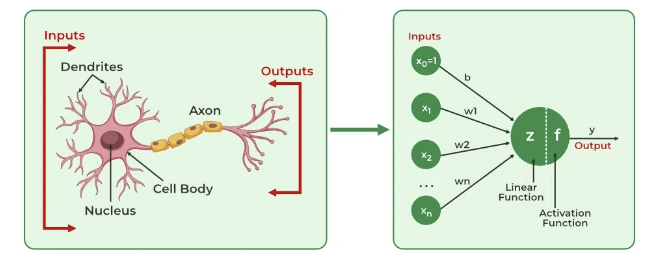
Efficient coding models:
Efficient coding models: just trying to identify patterns and structures and encode them to minimize redundancy. Inspired how brain tries to optimize information transmission.
Bayesian models:
Bayesian models: very important. Rely on basin statistics to make predictions. Like how our sensory and brain works. Trying to make a prediction about what is about to happen and is always going to combine previous knowledge and whatever is new evidence. What is the most likely outcome to be true.
Artificial neural networks:
• Artificial neural networks: simulate behavior of biological neurons. Deep neural network if more than one hidden layer. Don’t really know what is happening in the hidden layer.
 Note
Note  Flashcards (133)