1.3: Market Failure (EDEXCEL A LEVEL ECONOMICS)
 Studied by 0 people
 Call with Kai
 Learn
Learn Practice Test
 Spaced Repetition
 Match
Match Flashcards
 Knowt Play
1/39

There's no tags or description
Looks like no tags are added yet.
Name | Mastery | Learn | Test | Matching | Spaced | Call with Kai |
|---|
No study sessions yet.
40 Terms
economic welfare
benefit to consumer-cost to producer
marginal private benefit
The benefit from an additional unit of a good or service that the consumer of that good or service receives.
marginal private cost
the cost of producing an additional unit of a good or service that is borne by the producer of that good or service
economic welfare is maximised at equilibrium
before equilibrium: MPB>MPC ( welfare is positive but up until equilibrium is reached there is still extra welfare to be attained)
after equilibrium : MPC>MPB ( welfare is negative so any increase in production subtracts from the optimum welfare at equilibrium )
market failure
failure to allocate scarce resources in the best or optimum way to maximise economic welfare
complete market failure
When a market fails to supply any of a good which is demanded, creating a missing market
partial market failure
When a market for a good exists but there is overproduction or underproduction of the good
externalities
under provision of public goods
information gaps
causes of market failure
externalities
when actions of a producer or consumer have an effect on the bystander, other than by the normal function of the price mechanism
negative externality
actions are harmful and reduce well-being, the bystander won't get compensation
positive externality
actions are beneficial and increase well-being, the bystander doesn't pay for the benefit
merit goods
goods which are under-provided by the private sector and have positive externalities
demerit goods
Goods that are considered to be undesirable for consumers and are over-provided by the market. ( negative externalities )
negative externalities in production
MPB=MSB benefit to society and consumer are equal
MPC
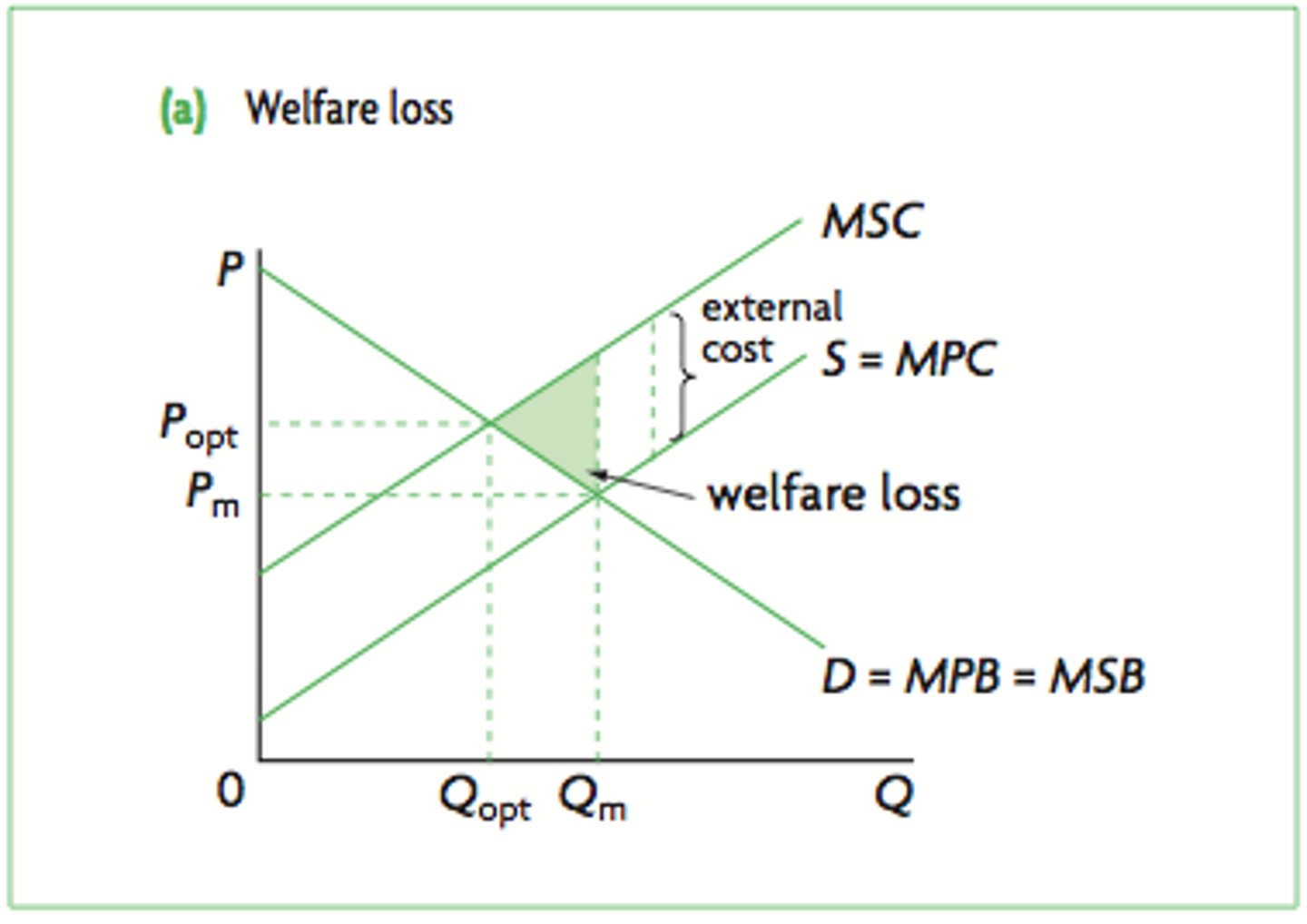
private costs
costs incurred by the individual
external costs
costs incurred by bystanders
social costs
private + external costs
welfare loss
reduction of economic welfare when external costs aren't taken into account, quantity is above socially optimal level
positive externalities in consumption
MPC=MSC no negative externalities, cost to individual and society is the same
MSC>MPB positive externalities, benefit to society is greater than to the individual if production is at MSC and MPB equilibrium then there will be underproduction and welfare loss, if it is at MSC and MSB equilibrium then production will rise to socially optimal levels
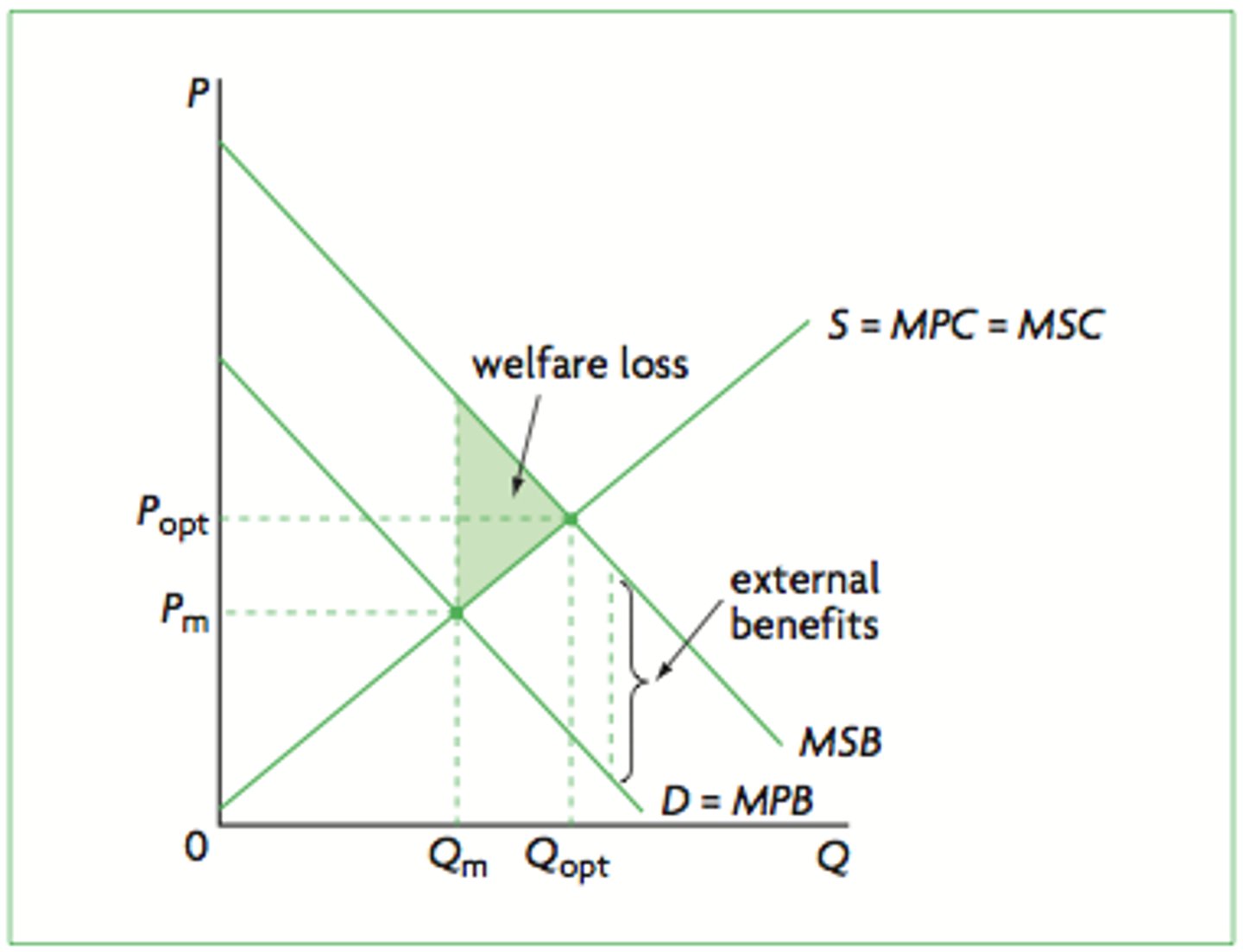
private benefits
benefit to the individual
external benefits
benefits that are received by those not immediately involved in economic transaction
social benefit
private + external benefit
internalising externalities
making the private supplier pay for the external costs
public goods
are goods that are non-rivalrous and non-excludable
non-rivalrous
A characteristic of some goods where the consumption of the good by one person does not reduce consumption by someone else; it is one of the two characteristics of public goods.
non-excludable
A characteristics of some goods where it is not possible to exclude someone from using a good, because it is not possible to charge a price. It is one of the characteristics of public goods.
private goods
goods that are both excludable and rival in consumption
semi-public goods
goods which are non-rivalrous but excludable
the free rider problem
people enjoy the benefits of the goods without paying because they are non-excludable, everybody waits for someone else to provide the good or service so they can use it for free, therefore no one ever does. Scarce resources are not used in the desired way because people's demand is never registered on the market-allocative inefficiency
information gaps
Where consumers, producers or the government have insufficient knowledge to make rational economic decisions. Can't assess the true cost or benefits, may over or under value goods and can't be sure if welfare is maximised, only with perfect information can there be allocative efficiency
symmetric information
Where consumers and producers have access to the same information about a good or service in a market. leads to perfect knowledge
asymmetric information
a situation in which one party to an economic transaction has less information than the other party, leads to imperfect knowledge
lemon laws
exist in many states and protect consumers from the consequences of buying a defective car, sellers know the truth about the car but buyers don't until purchase, therefore buyers are reluctant to pay the price for a good car meaning car dealers rarely got a fair price and the market collapsed
why there is asymmetric info between buyers and sellers
specialisation and technicality of financial products
perceived costs of obtaining info outweigh benefits
info may be limited to specific institutions
info may be expensive
leekage of info between departments and employees
regulatory capture
A situation in which bureaucrats favor the interests of the groups or corporations they are supposed to regulate at the expense of the general public.
moral hazard
taking risks to benefit yourself knowing the negative effects will be felt by other people, arises because of asymmetric information
externalities in the financial sector
bankers didn't account full external costs
imposed massive externalities on the economy
financial crisis: fall in GDP, income and unemployment
taxpayers had to suffer the costs
foreign exchange market rigging
bankers sold info about client activity on online forums
brag about 'free money and bonuses'- bank making money led to bankers making money
traders obtain private info about clients which could change currency value
traders then place orders and sales to profit from the change in currency
market rigging
price fixing
insider trading- buying and selling assets in possession of info not available to all
market bubbles
Occurs when prices are grossly overvalued due to speculation. fueled by poor lending decisions, once it peaks investors sell so the bubble bursts leading to a loss of confidence and aggregate demand
 Note
Note  Flashcards (50)