Functional Analysis test 2
 Call Kai
 Learn
Learn Practice Test
 Spaced Repetition
 Match
Match Flashcards
 Knowt Play
1/6

There's no tags or description
Looks like no tags are added yet.
Name | Mastery | Learn | Test | Matching | Spaced | Call with Kai |
|---|
No analytics yet
Send a link to your students to track their progress
7 Terms
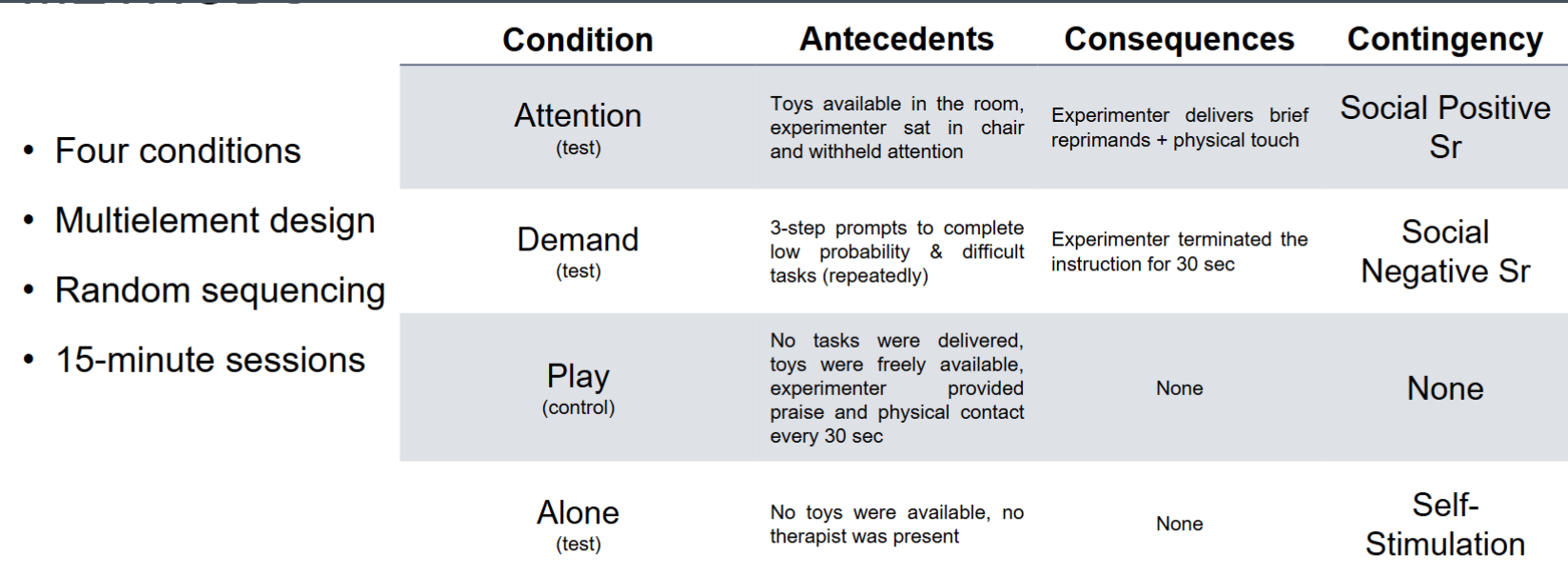
Iwata et al., 1994 (Original FA Procedures)
Chapman et al., 1993 (Concurrent FA Procedures)
Red - Medical Staff Attention
Orange - Mother Attention
Blue - Escape from work activities
Yellow - Control no consequence
Smith & Churchill, 2002 (How to validate a precursor)
If both the Precursor & Target Behavior Function Analysis matched
If contengencies placed on the precursors caused a reduction in the SIB
Fahmie & Iwata, 2011 (Main Precursor Categories)
Vocalizations (Say something)
Small Movements (Reaching for a stimulus)
Loco Motions (Running)
Posture (Holding Knees)
Bloom et al., 2011 (Describe Trial-Based Functional Analysis TBFA)
Control for 2 minutes
(AO – Continuous Access)
To
TEST </=2 min
(EO + Contingent Access)
Then
Control for 2 minutes
(AO – Continuous Access)
These three trials occurred for each condition
Sessions were terminated when problem behavior occurred, except during the ignore condition
Thomason-Sassi et al., 2011 (Describe Latency FA)
The shorter the latency the stronger the response
What response has a shorter latency
The response that has the shortest latency is most likely the function of behavior. This is the value at the bottom of the latency graph.
Latency scale
Up to 300-600 seconds on Y axis
RPM on X Axis
With legend
Key part should be lower in the latency graph (the condition at the bottom of the graph and closest to 0 seconds is the function of behavior since it occurs the quickest after the session begins.

