Intro to AI - First Order Logic
 Studied by 2 people
 Call Kai
 Learn
Learn Practice Test
 Spaced Repetition
 Match
Match Flashcards
 Knowt Play
1/65

There's no tags or description
Looks like no tags are added yet.
Name | Mastery | Learn | Test | Matching | Spaced |
|---|
No study sessions yet.
66 Terms
What are Propositional Logic Limitations?
Stating similar facts is cumbersome
Can’t make generalizations
In propositional logic, world contains facts, not objects
Ontological commitment of PL is limited
Propositional Logic vs Natural Language
Natural language deals with objects (nouns) and relations (verbs), hence is more expressive
Facts vs Objects
Fact: Felix is a cat, Garfield is a cat, Nemo is a fish, Garfield is a cat implies Garfield has whiskers
Object: Felix, Garfield, Nemo, Dory, Reef, Indiana
Properties, Relations (Predicates)
Cat, Fish, Swims, HasWhiskers, Lives
Cat(Felix), Cat(Garfield)
Fish(Nemo), Fish(Dory)
Lives(Nemo, Reef), Lives(Garfield, Indiana)
Generalizations
For all X, if Cat(X) then HasWhiskers(X)
“All cats have whiskers”
For all X, if Fish(X) then Swims(X)
“All fishes can swim”
First Order Logic (FOL) World consists of ___?
Objects, Reactions, Functions
First Order Logic (FOL) Sentences are made up of
Symbols, Connectives, Quantifiers and Variables
Symbols
for constant objects, predicates, and functions
Connectives
as in propositional logic
Quanitifiers and variables
Ɐx, Ǝy
Constants
Refer to objects, unlike propositional var referring to propositions
EX. John, Richard, C, L1, L2
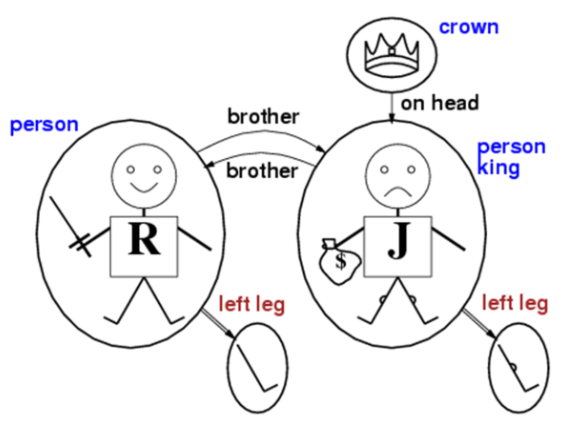
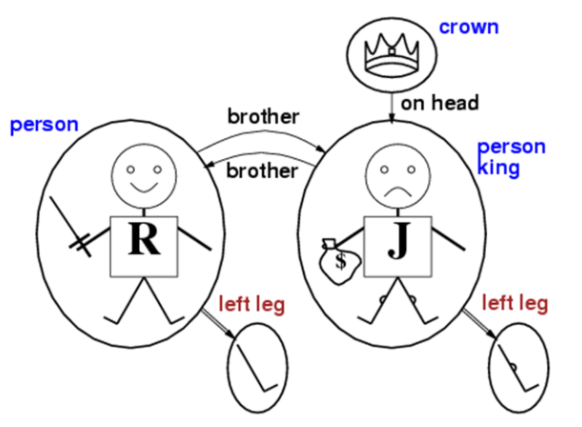
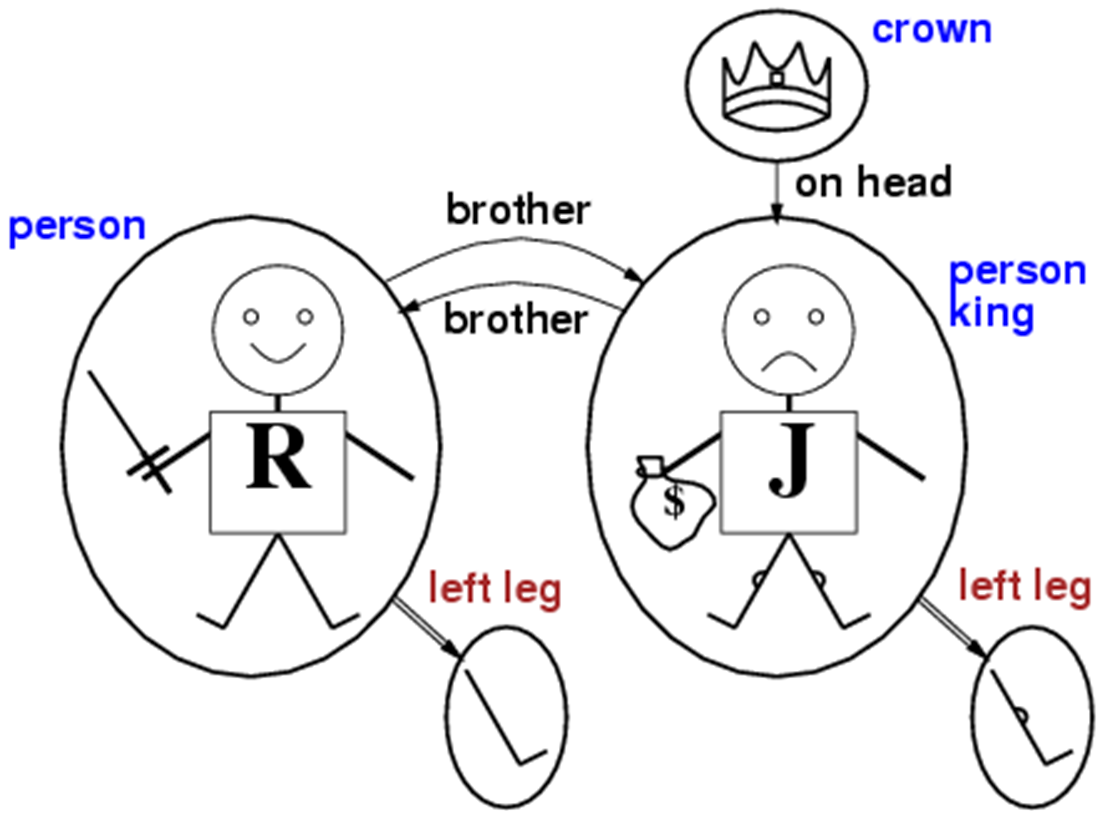
Name the predicates in this example
Person = {John, Richard}
King = {John}
Crown = {C}
Brother = {(John, Richard), (Richard, John)}
OnHead = {C, John}
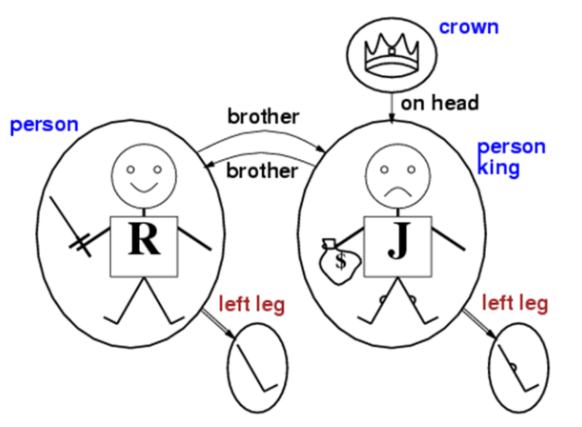
Name the Functions in this example
LeftLeg={(Richard->L1),(John->L2)}
Strictly speaking, the function should be total—all objects should have a value when the function is applied to it
Models in FOL
Consists of the objects (domain elements) and relations (including functions)
Conceptual view of the world
Interpretations in FOL
Associates the symbols to the objects, relations and functions in the model
Number of interpretations for a given set of symbols is combinatorially explosive
Given this example, what are the sentences you can make?
Person(John) ∧ Person(Richard)
OnHead(C, John)
LeftLeg(John) = L1 ∨ LeftLeg(Richard) = L2
∀x King(x) ⇒ Person(x)
Term
Expression that refers to an object
EX. Richard
EX. LeftLeg(John)
Atomic Sentences
Constructed by equating terms (=) or by a predicate (with terms as arguments)
Complex Sentences
Sentences with connectives or quantifiers
What are the possible forms of a sentence in FOL?
Atomic Sentence
(Sentence Connective Sentence)
¬Sentence
Quantifier Variable Sentence
What are the types of Terms in FOL?
Function-Symbol(Term, …)
Constant-Symbol
Variable
What do Connectives represent in FOL?
Logical operations combining sentences
List the main Connectives in FOL
∧ (and), ∨ (or), ⇒ (implies), ⇔ (if and only if)
What are the Quantifiers in FOL?
∀ (for all), ∃ (there exists)
Semantics
Truth of a sentence in FOL:
Determined with respect to a model and an interpretation
Analogous notions for entailments, validity and satisfiability
Model enumeration is impractical in FOL
Types of Quantifiers
Universal Quantification
Existential Quantification
Universal Quantification
∀x P is true in a model m iff P is true with x being each possible object in the model
A conjunction of instantiations
Existential Quantification
∃x P is true in a model m iff P is true with x being some object in the model
A disjunction of instantiations
Universal Quantification for this example
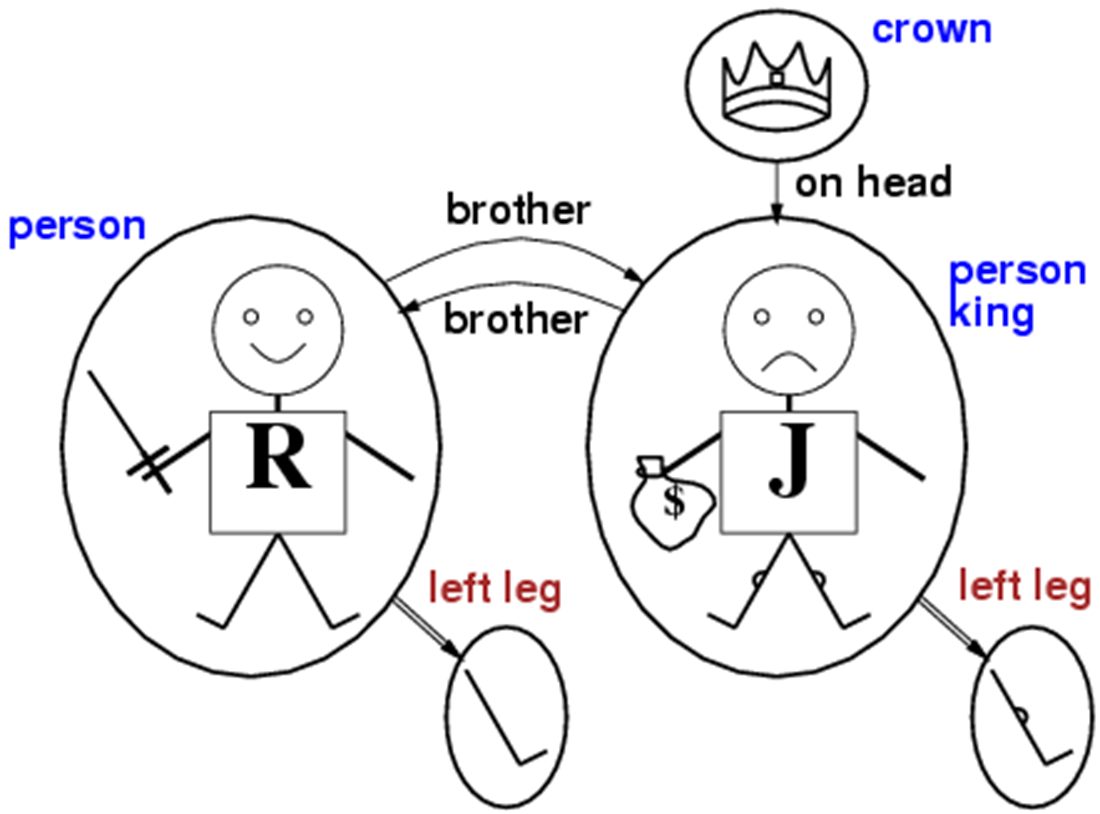
∀x King(x) ⇒ Person(x)
Means that King(x) ⇒ Person(x) holds for all objects
(e.g., John, Richard, C, L1,L2)(King(John) ⇒ Person(John)) ∧ (King(Richard) ⇒ Person(Richard)) ∧ (King(C) ⇒ Person(C)) ∧ (King(L1) ⇒ Person(L1)) ∧ (King(L2) ⇒ Person(L2))
Existential Quantification for this example
∃x Crown(x)
“there is at least one crown”Means that for one of the objects (e.g., John, Richard, C, L1,L2), Crown(x) holds
Crown(John) ∨ Crown(Richrd) ∨ Crown(C) ∨ Crown(L1) ∨ Crown(L2)
Translate to english: ∀x King(x) ⇒ Person(x)
“All kings are persons”
Translate to english: ∃x Crown(x) ∧ OnHead(x,John)
“John has a crown on his head”
Translate to english: ∀x∀y Brother(x,y) ⇔ Brother(y,x)
“The ’Brother’ relationship goes both ways”
Translate to english: ∃x∃y Brother(x,Richard) ∧ Brother(y,Richard) ∧ ¬(x=y)
“Richard has at least 2 brothers”
Translate to english: ∀x King(x) ⇒ ∃y Crown(y) ∧ OnHead(y,x)
“All kings have crowns”
Properties of Quantifiers: Nested Quantifiers
∀x ∀y P equivalent to ∀y ∀x P
∃x ∃y P equivalent to ∃y ∃x P
Does not apply if quantifiers are different
Properties of Quantifiers: De Morgan's law of quantifiers
∀x ¬P ≡ ¬∃x P
∀x P ≡ ¬∃x ¬P
∃x ¬P ≡ ¬∀x P
∃x P≡ ¬∀x ¬P
Turn this into logic: Everybody loves somebody
∀x∃y Love (x, y)
Turn this into logic: There is somebody that everybody loves
∃x∀y Love (y, x)
What to look out for in quantifiers?
Using quantifiers (∀, ∃) in combination with ∧, ⇒
The domain consists of multiple kinds of objects
Translate this to english: ∀x King(x) ⇒ Person(x)
“All kings are persons”
Translate this to english and is it true or false: ∀x King(x) ⇒ Person(x)
“All kings are persons”
True
Translate this to english and is it true or false: ∀x King(x) ∧ Person(x)
“Everything in the world is a king and a person”
False
Translate this to english and is it true or false: ∃x Crown(x) ∧ OnHead(x,John)
“There is a crown on John’s head”
True
Translate this to english and is it true or false: ∃x Crown(x) ⇒ OnHead(x, John)
“There is an object where this rule holds”
Almost always true
Functions vs Predicates
Functions map objects to one another
Predicates describe properties of objects
Functions
Returns an object; this object is a term
Serves as a noun phrase
FatherOf(x) returns whoever is x’s father
Sum(4,3) returns 7
Predicates
Returns a truth value; result of a formula
Serves as a verb phrase, which can be an atomic sentence
Father(x,y) means x is the father of y
EqualTo(Sum(4,3), 7) evaluates to True
Is this ok: ∃x LeftLeg(x)
not ok because LeftLeg is a function
Is this ok: ∃x LeftLeg(John) = x
ok since it compares a function value (LeftLeg(John)) to an object (x)
Is this ok: ∃x LeftLeg(x) = L1
ok because it’s a valid equality — the function LeftLeg(x) returns an object, and you’re checking if that object equals L1
Is this ok: ∃x Crown(x)
ok because Crown is a predicate
Common error between Functions and Predicates
Treating a function (returns an object) like a predicate (returns a true/false value)
Often, because = was omitted
LeftLeg(John) = L1 ∨ LeftLeg(Richard) = L1
“L1 is either John’s or Richard’s left leg”
FOL in Wumpus World
Represent Wumpus World more compactly
Less sentences to represent rules
Capture rules on pits and breezes, Wumpus and stenches
Can include time and percept objects in the world
Percept is represented as a list of constant symbols
Predicates with time arguments capture the dynamic nature of the agent moving in this world
Inference Algorithms in FOL
Reduction to propositional inference (propositionalization)
More efficient methods:
Lifting and unification
Resolution
Can be demonstrated in Logic programming languages like prolog
Propositional Logic VS First Order Logic
While PL deals with logical symbols, FOL deals with objects, relations, and functions
Translate this to FOL: Cottonball loves fish
Loves(Cottonball, Fish)
Translate this to FOL: Emilio is a student
Student(Emilio)
Translate this to FOL: Drea studies Computer Science
Students(Drea, CS)
Which natural language statement is the best interpretation of: ∃y ∀x Loves(x, y)?
There is a specific person whom everybody loves.
Choose the FOL notation which uses a function correctly to represent: "Alice's father is older than Bob."
OlderThan(FatherOf(Alice), Bob)
Translate to english: Loves(Buddy, Tasha) ∧ ~Loves(Tasha, Buddy)
Buddy loves Tasha but Tasha doesn’t love Buddy.
Which natural language statement is the best interpretation of: ∀x (Cat(x) ∨ Dog(x))?
Everything is either a cat or a dog.
Which natural language statement is the best interpretation of: ∃x (Apple(x) ∧ Red(x) ∧ ∃y (Box(y) ∧ In(x, y)))?
There is an apple that is red and in a box.
Which natural language statement is the best interpretation of: ∀x (Car(x) → ¬∃y (HasWheel(x, y) ∧ Three(y)))?
(Assume Three(y) means y is the number 3)
No cars have three wheels.
Which FOL notation best represents the statement: "All students like music."
∀x (Student(x) → Likes(x, Music))
 Note
Note  Flashcards (46)