GEOL 106 Midterm Exam (Queen's)
 Studied by 0 people
 Call Kai
 Learn
Learn Practice Test
 Spaced Repetition
 Match
Match Flashcards
 Knowt Play
1/165

There's no tags or description
Looks like no tags are added yet.
Name | Mastery | Learn | Test | Matching | Spaced | Call with Kai |
|---|
No analytics yet
Send a link to your students to track their progress
166 Terms
Mineral
Naturally occurring crystalline solid with a definite, but not necessarily fixed, chemical composition
Crystalline Solid
Atoms/ions arranged and chemically bonded in a regular and repeating geometric pattern
Chemical Composition
Definite, but not necessarily fixed, composition
Quartz
Mineral with a chemical composition of ratio 1Si:2O
Olivine
Mineral with a chemical composition of (MG,Fe)2SiO4
Rock
Aggregate of minerals held together by an interlocking arrangement of minerals or cement
Rock Cycle
Global rock-recycling system that links subsurface processes and the tectonic cycle to surface processes
Igneous Rock
Rock formed from cooled and solidified magma
Magma
Hot, molten rock material beneath the Earth's surface
Volcanic Rock (extrusive)
Igneous rock that forms from lava erupted onto the Earth's surface
Plutonic Rock (intrusive)
Igneous rock that forms from magma that solidifies beneath the Earth's surface
Sedimentary Rock
Rock formed near Earth's surface from the accumulation and lithification of sediment (pre-existing rocks and once-living organisms)
Metamorphic Rock
Rock formed from the alteration of pre-existing rocks through heat and pressure
Weathering
Processes that alter the physical and chemical state of minerals, rock, and soil at or near the Earth's surface
Chemical Weathering
Process of chemicals in rainwater making changes to the minerals in a rock
- Factor in the creation of sinkholes
Physical Weathering
Process where physical processes affect the rock, such as changes in temperature or exposure to wind, rain, and waves
- Freeze-thaw cycles, pressure cycles
Biological Weathering
Process caused by the movements of plants and animals
Geological Time
The age of the Earth and the subdivision of time in geology
- Earth is 4.54 billion years old
- Based on radioactive decay of elements found in rocks
Catastrophism
The belief that major changes in the Earth's crust result from catastrophes rather than uniform processes
Uniformitarianism
The belief that geological processes occur over long periods of time at constant rates
Plate Tectonics
The theory that describes the development of landforms and the evolution of Earth's crust, atmosphere, biosphere, hydrosphere, and climate
Earth's Structure
The internal layers of the Earth, including the core, mantle, and crust
Seismic Waves
Waves of energy that travel through the Earth while reflecting and bending as a result of built-up energy from an earthquake
P-Wave
Primary wave, the first seismic wave that travels through solids, liquids, and gases with a back-and-forth compressional motion
S-Wave
Secondary wave or shear wave, travels only through solids, has a snake-like up and down motion
Surface Waves
Seismic waves that move along the Earth's surface; ripple-like
Seismic Zones
Regions where earthquakes are more likely to occur
Earthquake Early Warning (EEW)
A system that provides rapid detection and real-time estimation of shaking hazard before strong shaking starts
Earthquake
-Shaking produced by the rapid release of energy in the Earth's crust
-Generates seismic waves
-Along faults associated with plate boundaries
Focus
The point of energy release during an earthquake
Epicenter
The point on the Earth's surface directly above the focus of an earthquake
Volcanic Hazards
Dangers associated with volcanic eruptions, including lava flows, pyroclastic activity, gas emissions, lahars, landslides, and volcanic gases.
Volcanic Ash
Fine, abrasive material ejected from a volcano during an eruption
Lapilli
Fragments of lava that cool and deform/stretch between 2 and 64 mm in size ejected from a volcano
Blocks and Bombs
Large fragments of rock ejected from a volcano during an eruption
§ Block - pre-existing rocks shattered by eruption
§ Bomb - lava cools as it travels through the air, becomes stream-lined
Volcanic Gas
Gases present in magma released during a volcanic eruption, including water vapor, carbon dioxide, sulfur dioxide, and hydrogen sulfide
Vog
Volcanic smog,
o SO2 and other gases chemically interact with sunlight and atmospheric oxygen, moisture and dust
o Health hazard, irritant, visibility issues
Volcanic Explosivity Index (VEI)
A scale that measures the explosiveness of a volcanic eruption
Shield Volcano
A broad, gently sloping volcano formed by effusive eruptions of basaltic lava at divergent plate boundaries
-Includes lava flows, ejections of tephra, fissure eruptions, lava fountains, and magmatic rift zones
-Lava with low silica and low viscosity
Stratovolcano
A tall, conical volcano formed by explosive eruptions of andesitic or rhyolitic magma at subduction zones
-Includes vertical and horizontal blasts and pyroclastic deposits and lava flows
-Intermediate silica and viscosity
Cinder Cone
A small, steep-sided volcano formed by explosive eruptions of gas-charged lava which break into small fragments that solidify and fall as cinders around vent
-Lava with low silica and low viscosity
Density and stratification of early earth
§ Same composition throughout
§ Bombardment of surface = heating
§ Earth partially melts
§ Gravity pulls nickel and iron downward forming Earth's centre (core)
§ Lighter minerals rose towards surface forming the Earth's surface (crust)
§ Start to see cooling of the Earth, formation of the first surface 4.5 billion years ago
Core
Earth's centre
§ Iron-nickel
§ Very high density
§ ~3300 km thick
§ Sloid and liquid
Mantle
Between core and crust
§ Made up of dense silicate minerals
§ ~3000km thick
§ Mostly solid with 'liquid' near the top (asthenosphere)
Crust
Outermost layer
§ Solid
§ Thin (up to 100km thick)
Lithosphere
Uppermost mantle and crust
§ Solid
§ Thin (up to 400km thick)
§ Outer solid part of the Earth, includes the crust and uppermost mantle
§ Thicker under continents than the ocean
§ Is rigid and brittle - breaks apart
§ Forms lithospheric (tectonic) plates
Seismic shadow zones
Where seismic waves cannot be recorded
- P-waves encounter liquid which bends them
- S-waves encounter liquid that they cannot travel through
Oceanic crust
§ Thin (4 to 9 km thick)
§ High density
§ Young (<200 million years old)
Continental crust
§ Thick (~25 to 75 km thick)
§ Low density
§ Usually older (3.9 billion years to present)
Transform Boundaries
§ Plates 'slide' past each other
§ 'Conservative' boundary
§ Earthquakes are common
§ San Andreas Fault, Alpine Fault
Divergent Boundaries
§ Plates move apart - magma rises and fills the gap = new oceanic crust
§ Associated with volcanism
§ Creation of lithosphere - 'constructive'
§ Typically submarine, a few exceptions
§ Volcanism is common
· Eruptions, hot springs
Convergent Boundaries
§ Plates come together
§ Material is consumed
§ 'Destructive' plate margin
§ 3 flavours
Oceanic-oceanic convergence
o One ocean plate sinks below another
o Temperature important - what plate is cooler (subducts)
o Subduction zone forms, deep trenches
o Earthquakes and volcanoes
Continental-continental convergence
o Compression (equally dense and thick)
o High mountains, earthquakes
o Formation of the Himalayas
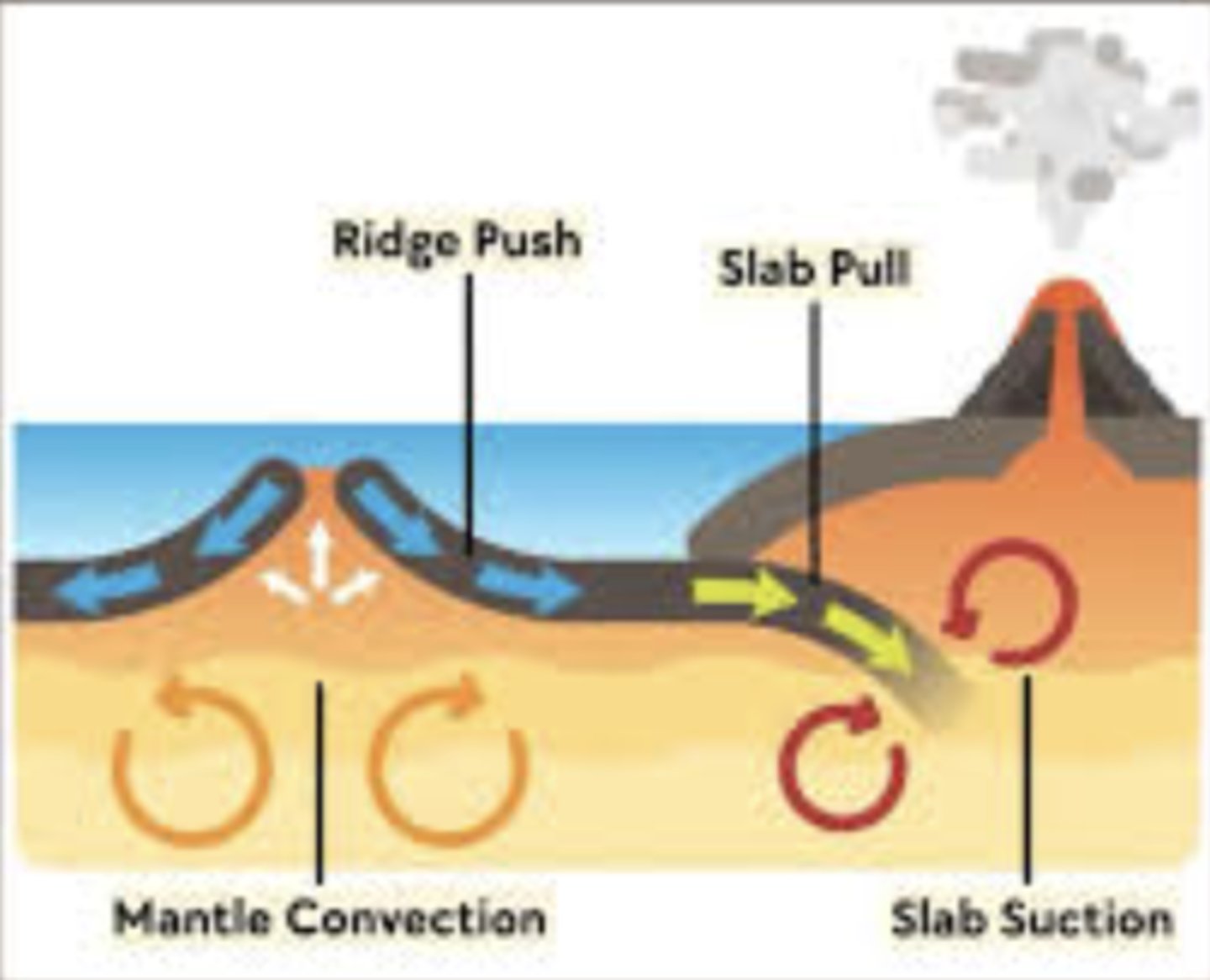
Convection currents
§ Warm material rises, cold material sinks; drags lithosphere
§ Heat supplied by formation of Earth 4.5 bya and from radioactive decay of elements in the mantle
Ridge push
· Develops because the region of a rift is elevated, mass pushes sideways
· Observed at mid-ocean ridges (divergent plant margins)
· Gravity happens and buoyant upwelling
o Gravity causes the elevated lithosphere at the ridge axis to push on the lithosphere that lies farther from the axis, making it move away
· Newly formed plates are warmer and less dense - higher elevation at ridge
· Allow movement of lithospheric plates
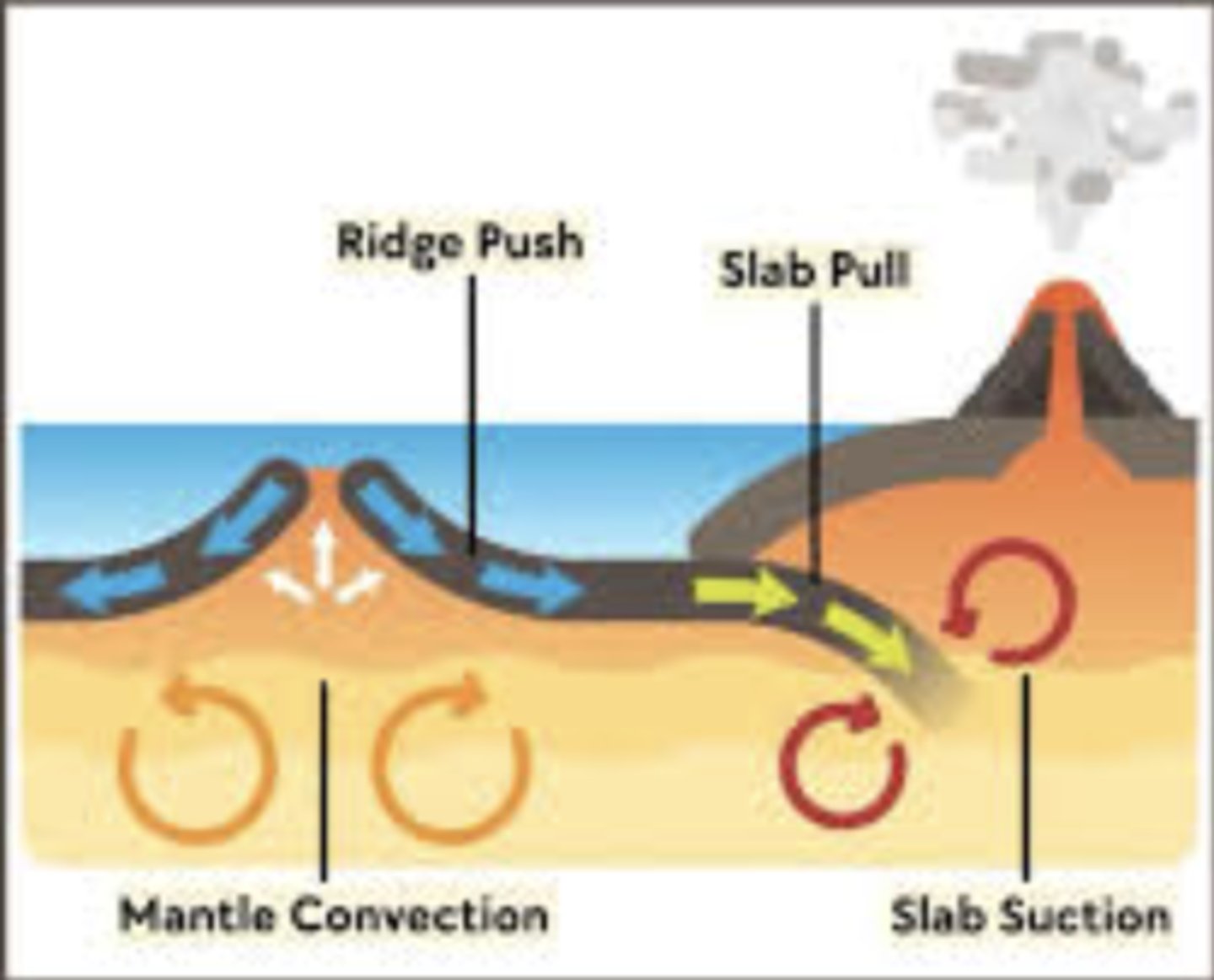
Slab pull
· Develops because lithosphere is denser than the underlying asthenosphere, and sinks like a stone in water (slowly)
· Occurs as subduction zones (convergent plate margins); dominant
· Plates older and colder at subduction zone start to sink and pulls the rest of the plate downward
· More dominant than ridge push
· Allow movement of lithospheric plates
Marie Tharp
o Proved existence of mid-ocean ridges (and rift valleys)
o Bruce Heezen dismissed initial findings
o Movement in the rift valley; continents might actually be drifting apart
o Created what is still considered a definitive map of the ocean floor
Harry Hess
o Sea floor moves and transports/carries continents (plates)
o Convection cells are important
o 1962 - theory of seafloor spreading
Mid-ocean ridges
o At spreading centers
o New crust is added to edges of plates
o Create mid-ocean ridges
o Form extensive submarine mountain chains
Evidence of seafloor spreading
-Some minerals (magnetite) align with the direction of Earth's magnetic field
-'Reverse'/'normal' polarity is recorded in rocks/sediments and shows rocks get older as you move away from spreading centre
-Seafloor sediment thinner closer the edge
J. Tuzo Wilson (1960s)
§ Canadian geologist who revolutionized geology
§ Integrated concepts of continental drift and seafloor spreading - plate tectonics
§ Theorized plate movement over a stationary hotspot
· Process led to formation of the Hawaiian islands
Hotspots
- Places in the mantle where magma is generated, magma rises and produces volcanism and/or geothermal activity
· Hawaii and Yellowstone
- Can be on continents and oceans
- Form a chain of volcanoes above
Shallow earthquakes
- Divergent or transform boundaries, sometimes convergent
- <50 to 70km
- More destructive
Intermediate depth earthquakes
70 - 300 km
Deep earthquakes
- Convergent boundaries
- >300 km
Intraplate Earthquakes
Earthquakes that occur within a single tectonic plate, far from plate boundaries, and are shallow in depth.
Interplate Earthquakes
Earthquakes that occur at the boundaries of tectonic plates.
Fault Reactivation
The process by which a previously inactive fault becomes active again due to changes in stress.
Glacial (Isostatic) Rebound
The upward movement of the Earth's crust after the melting of glaciers.
Nepal 2015 Earthquake
- Mw = 7.8
- Shallow, ~8km
- 9000 deaths, 22,000 injured
- $10 billion damage
- Triggered landslides and avalches
Modified Mercalli Intensity Scale
A qualitative scale used to measure the intensity of an earthquake based on its effects on people, buildings, and the natural environment.
Richter Magnitude
A quantitative logarithmic scale used to measure the size of an earthquake based on the amplitude of seismic waves best for smaller earthquakes.
Moment Magnitude (Mw)
A quantitative logarithmic measure of the amount of energy released by an earthquake, based on the size of the area where movement occurs, the distance moved, and the rock type/rigidity best for larger earthquakes.
Surface Wave Magnitude (Ms)
A magnitude scale based on the measurements of surface waves produced by an earthquake.
Shake Maps
Maps that show the ground movement and shaking intensity following major earthquakes, used for emergency response.
Fault
- A fracture zone between two blocks of rocks that allows the blocks to move relative to each other
- Response to stresses in the rock
San Andreas Fault (SAF)
The main fault in the San Andreas Fault system, which is a series of other faults. The Hayward Fault is considered the most dangerous fault in the US.
Deformation
The change in shape and/or volume of rocks in response to stress.
- Elastic is reversible
- Brittle is permanent
Stress
The force acting on a rock that changes its shape and/or volume.
Rupture
The propagation of a fault starting from the focus of an earthquake and moving outwards, releasing waves of energy.
R Wave
Rayleigh wave, a surface wave that arrives after body waves with a complex 'rolling' motion and is the most dangerous of all waves.
Seismic wave frequency
The number of waves passing a point in a given time period.
Attenuation
The weakening or removal of high-frequency seismic waves as they travel through the Earth; low frequencies travel farther
Volcano
An opening in the Earth's crust through which lava, volcanic ash, and gases escape.
Lava Flows
Streams of molten rock that flow away from volcanic vents, with different types of lava flows having varying viscosities and flow rates.
Pyroclastic Flows
Fast-moving currents of hot gas, ash, and volcanic rock fragments that flow down the slopes of a volcano during some explosive eruptions.
Laze
A hazardous gas plume created when lava comes into contact with seawater, producing hydrochloric acid steam, water vapor, and ash.
Slip rate
Long-term rate of movement along a fault; mm/yr
Normal Faults
- Extension (tension) at divergent plate boundaries
- Vertical displacement
- Slides down and away
Reverse Faults
- Compression at convergent plate boundaries
- Vertical displacement
- Slides up and toward
Strike-slip Faults
- Shear at transform plate boundaries
- Horizontal displacement
- Slides across fault
Seismic waves and buildings
o Low frequency - tall buildings vibrate
o High frequency - low buildings vibrate
Volcanic vent/fissure
Rupture in the crust that allows lava, volcanic ash, and gases to escape from a magma chamber below the surface
Lava
Molten rock that breaks through the Earth's surface
Volcanic dome
Rounded hill formed by slow-moving, cooling rhyolitic lava
- Lava with high silica and high viscosity
Magmatic rift zone
§ Linear cracks develop in a volcanic edifice
§ Form two or three well-defined regions along the flanks of the vent
§ Extensional forces
Lava fountain
- Jet of lava sprayed into the air by the rapid
- Formation and expansion of gas bubbles
- Range in height from about 10 to 100 m (can reach 500 m)
Subduction Zone Earthquakes
Earthquakes at convergent plate boundaries, largest on earth with > M 8.5; aka megathrust earthquakes
- Observe uplift on overriding plate prior to rupture, continual slow movement in transition zone, and elevation changes
Thrust Fault
A low-angle fault where a younger oceanic plate slips under an older continental plate with a more shallow dip making it stronger

