AP Psychology semester one exam

4.0(1)
studied byStudied by 3 people
4.0(1)
full-widthCall Kai
learnLearn
examPractice Test
spaced repetitionSpaced Repetition
heart puzzleMatch
flashcardsFlashcards
GameKnowt Play
Card Sorting

1/160

encourage image

There's no tags or description

Looks like no tags are added yet.

Study Analytics
Name
Mastery
Learn
Test
Matching
Spaced

No study sessions yet.

161 Terms

1
New cards

empiricism

the view that knowledge originates in experience and that science should rely on observation and experimentation

2
New cards

structuralism

An early school of psychology that used introspection to explore the structural elements of the human mind. introduced by Edward Titchener

3
New cards

Functionalism

a school of psychology that focused on how our mental and behavioral processes function and how they enable us to adapt, survive, and flourish. Introduced by William James

4
New cards

Behaviorism

the view that psychology (1) should be an objective science that (2) studies behavior without reference to mental processes. most researcher psychologists today agree with (1) but not (2)

5
New cards

Humanistic Psychology

historically significant perspective that emphasized the growth potential of healthy people and the individual’s potential for personal growth

6
New cards

Cognitive neuroscience

the interdisciplinary study of the brain activity linked with cognition (thinking, memory, language etc)

7
New cards

psychology

the science of behavior and mental processes of people and organisms. Wilhelm Wundt established the first psychology lab in Leipzig, Germany.

8
New cards

psychometric

the scientific study of the measurement of human abilities, attitudes, and traits

9
New cards

developmental psychology

the scientific study of physical, cognitive, and social change throughout lifespan

10
New cards

Socrates and Plato

the mind is separable from the body and continues after the body dies. Knowledge is innate

11
New cards

Aristotle

derived principles from careful observations. Knowledge is not preexisting. It grows from experiences stored in our memories.Rene

12
New cards

Rene Descartes

agreed with Socrates and PLato about the existence of innate ideas and mind’s

13
New cards

William Wundt

established the first psych lab in Germany

14
New cards

Edward Titchener

Cornell professor who introduced the school of structuralism by using introspection to search for the mind’s structural elements

15
New cards

William James

Harvard philosopher-psychologist who introduced the school of functionalism by considering the functions of our thoughts and feelings. Wrote the textbook Principles of Psychology and tutored Mary Calkins

16
New cards

Mary Calkins

student of William James who became the first female president of the American Psychological Association. She also became a pioneering memory researcher.

17
New cards

Margaret Floy Washburn

became the first woman to receive a PhD in Psychology. She also studied animal behavior

18
New cards

Max Wertheimer

developed the Gestalt perspective

19
New cards

Behavioral Perspective

school of thought based on how we learn observable responses and experiences. Key people include John Watson & B. F. Skinner

20
New cards

Psychoanalytic/Psychodynamic Perspective

school of thought based on how behavior springs from unconscious drives and conflicts. Key person is Sigmund FreudS

21
New cards

Humanistic Perspective

school of thought based on how we strive for personal growth. Key people include Carl Rogers & Abraham Maslow

22
New cards

Cognitive Perspective

school of thought based on how we encode, process, store, and retrieve information. Key person is Jean Piaget

23
New cards

Biological/Neuroscience Perspective

school of thought based on how the body and brain enable emotions, memories, and sensory experiences

24
New cards

Evolutionary Perspective

the school of thought based on how evolution influences behavior. Key person is CHarles Darwin

25
New cards

Social-Cultural Perspective

school of thought based on how behavior and thinking vary across situations and cultures. Key person is Alfred Bandura

26
New cards

Gestalt Perspective

the school of thought based on the “organized whole”. Key people include Hohler, Wertheimer, and Koftka

27
New cards

case study

an observation technique in which one person is studied in depth in the hope of revealing universal principles

28
New cards

Longitudinal Study

studying a person or event over a long period of time (ex. the effetcs of medications on kids)

29
New cards

Cross sectional study

a study in which people of different ages a

30
New cards

Ex-post facto study

studying something after it happened naturally. look at the effect, seek the cause. (ex. birth defects)

31
New cards

operational definiton

specifically names the operations (steps or procedures) that the experimenter must use to control or measure the variables in the experiment. This allows the experiment to be replicated

32
New cards

Replication

repeating the essence of a research study, usually with different participants in different situations, to see whether the basic finding extends to other participants and circumstances

33
New cards

confounding variable

a factor other than the IV that might produce an effect in an experiment (ex. the temperature of the room, external noises)

34
New cards

Mode

the measure of central tendency that is most frequently occurring score(s) in a distribution

35
New cards

Mean

the measure of central tendency that is the arithmetic average of a distribution

36
New cards

Median

the measure of central tendency that is the middle score in a distribution (falls at thee 50th percentile). Half the scores are above it, half the scores are below it

37
New cards

Range

the measure of variation that is the difference between the highest and lowest scores in a distribution. Expressed as a singular number

38
New cards

standard deviation

a computed measure of how much scores vary around the mean score

39
New cards

normal curve (normal distribution)

a symmetrical, bell-shaped curve that describes the distribution of many types of data; most scores fall near the mean (68% fall within one standard deviaton of it) and fewer near the extremes

40
New cards

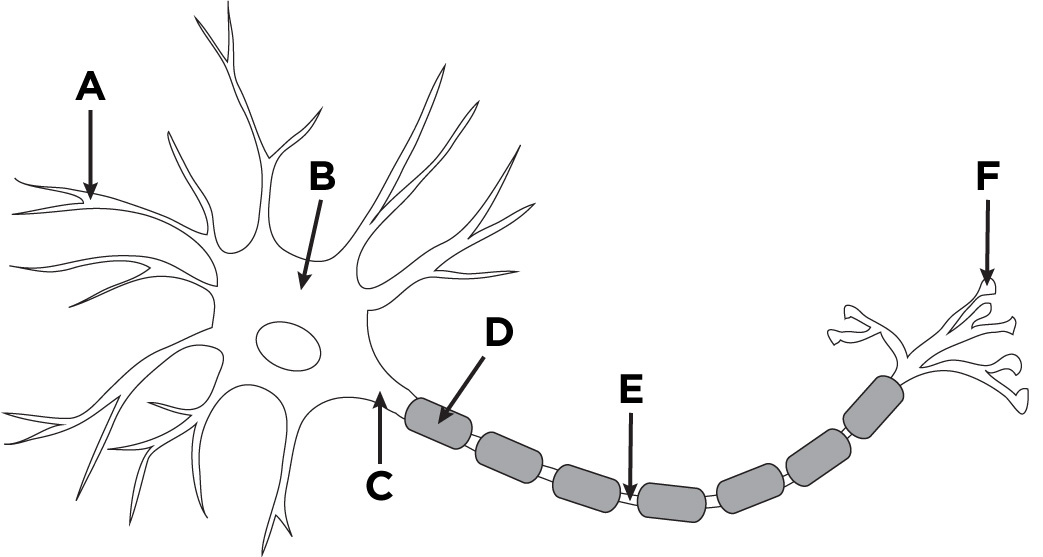
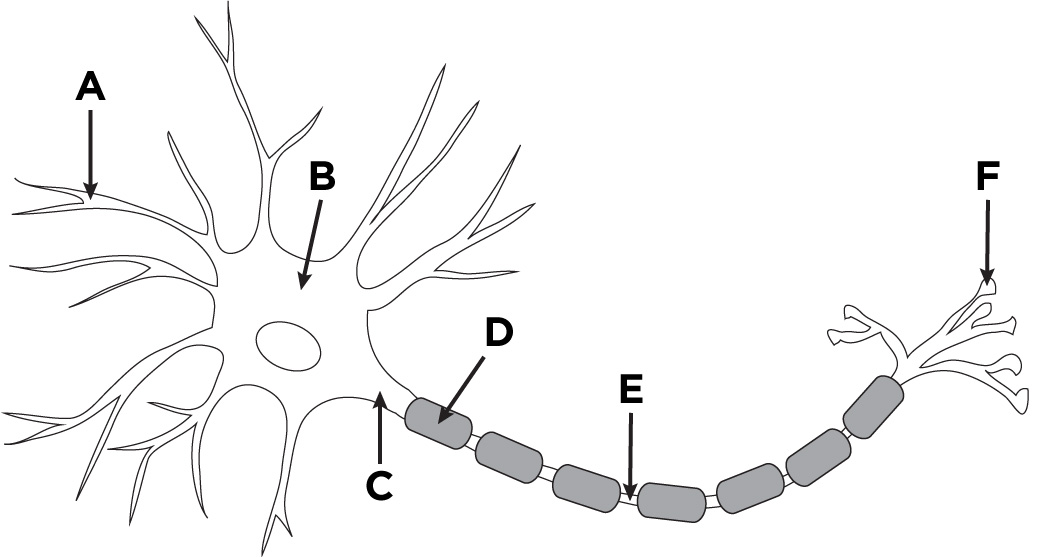
dendrites

what is A?

<p>what is A?</p>
41
New cards

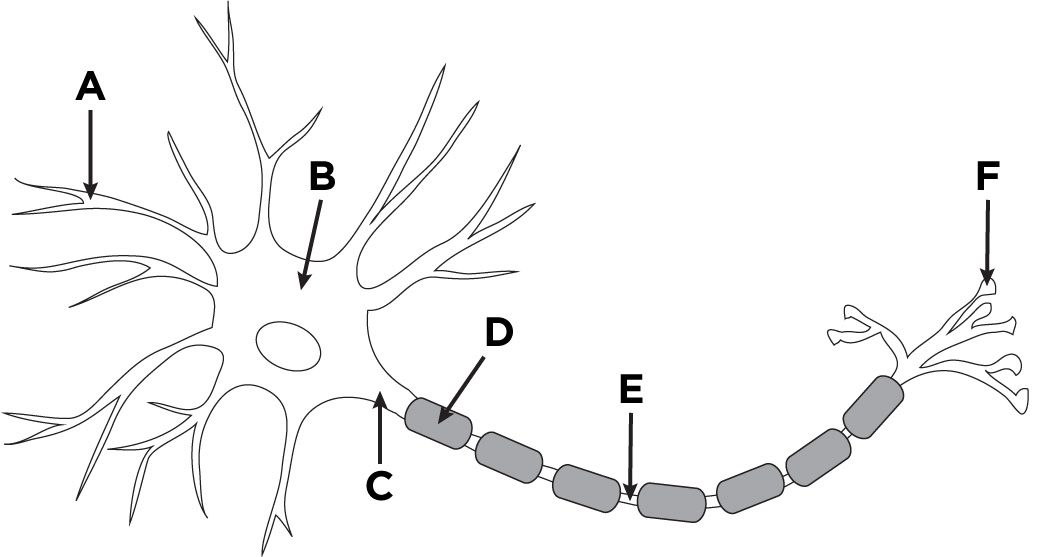
cell body/soma

what is B?

<p>what is B?</p>
42
New cards

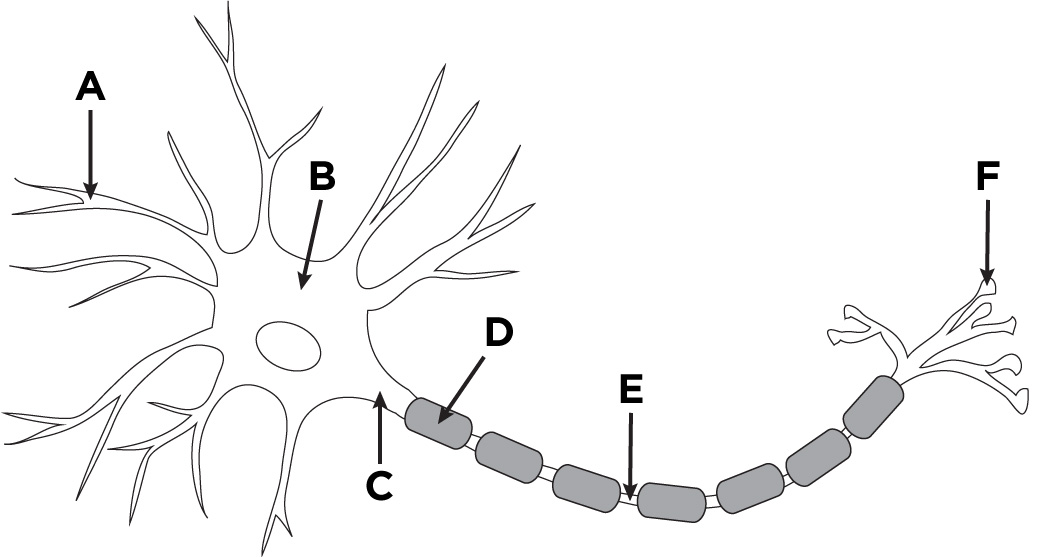
axon

what is C?

<p>what is C?</p>
43
New cards

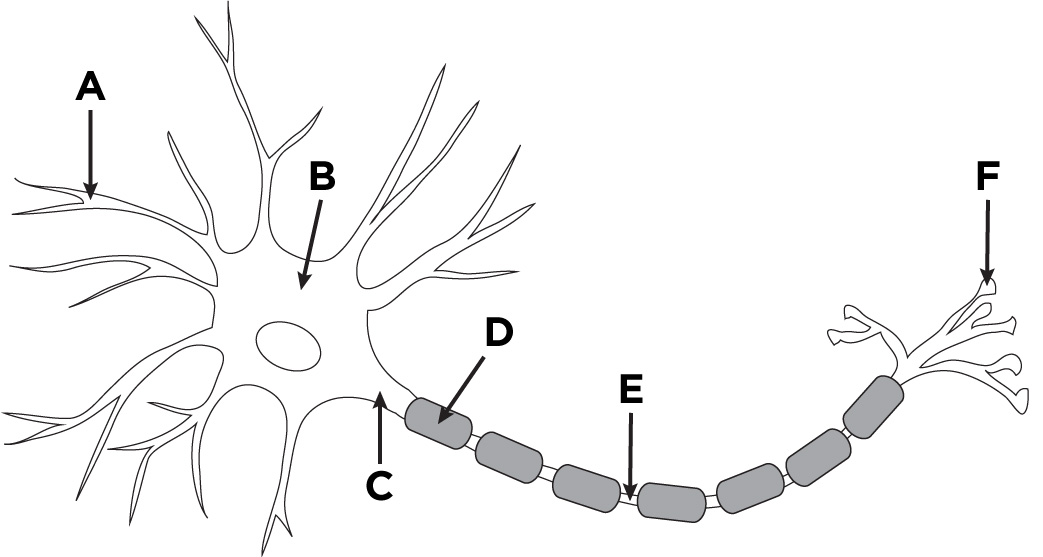
myelin sheath

what is D?

<p>what is D?</p>
44
New cards

Nodes of Ranvier

what is E?

<p>what is E?</p>
45
New cards

terminal branches of axon

what is F?

<p>what is F?</p>
46
New cards
statistical significance
a statistical statement of how likely it is that an obtained result occurred by chance
47
New cards
illusory correlation
the perception of a relationship where none exists (ex. thinking you play better when you wear your lucky socks)
48
New cards
descriptive research method
a research method used to observe and record behavior. Examples are case studies, surveys, and naturalistic observation. No variable is manipulated.
49
New cards
Weaknesses of descriptive research
no control of variables; single cases may be misleading
50
New cards
Strengths of descriptive research
Case studies require one participant; surveys can be conducted quickly & cheaply; naturalistic observations may be done when it is not ethical to manipulate variables
51
New cards
Correlational research method
research method used to detect naturally occurring relationships; to assess how well one variable predicts another. Examples are computed statistical associations, usually done among survey responses. No variable is manipulated.
52
New cards
Strengths of Correlational Research
works with large groups of data; can be used in situations where an experiment would not be ethical or possible
53
New cards
Weaknesses of Correlational Research
does not specify cause and effect (weakness of a type of research)
54
New cards
Experimental research method
A research method used to explore cause and effect. Examples are manipulating one or more factors; using random assignment. The Independent Variable is manipulated.
55
New cards
Strengths of Experimental Research
specifies cause and effect; variables are controlled
56
New cards
Weaknesses of Experimental Research
sometimes not practical/possible; results may not generalize to other contexts; not ethical to manipulate certain variables
57
New cards
Nervous System
The body's speedy electrochemical communication network, consisting of all the nerve cells of the PNS and CNS
58
New cards
Central Nervous System (CNS)
The brain and the spinal cord make up this nervous system
59
New cards
Peripheral Nervous System (PNS)
connects CNS to he limbs and organs, essentially serving as a communication relay going back and forth between the brain and the extremities
60
New cards
Somatic Nervous System
The division of the PNS that controls the body's skeletal muscles (AKA the Skeletal Nervous System)
61
New cards
Autonomic Nervous System
The part of the PNS that controls the glands and the muscles of the internal organs. Controls the sympathetic and parasympathetic nervous system
62
New cards
Sympathetic Nervous System
The division of the autonomic nervous system that arouses the body, mobilizing its energy in stressful situations. "Fight or Flight"
63
New cards
Parasympathetic Nervous System
The division of the autonomic nervous system that calms the body, conserving its energy. "Rest and Digest"
64
New cards
Reflex
a simple, automatic response to a sensory stimulus, such as the knee-jerk response
65
New cards
Neuron
a nerve cell; the basic building block of the nervous system
66
New cards
sensory neurons
neurons that carry incoming information from the sensory receptors to the brain and the spinal cord
67
New cards
motor neurons
neurons that carry outgoing information from the brain and the spinal cord to the muscles and glands
68
New cards
interneurons
neurons within the brain and spinal cord that communicate internally and intervene between the sensory inputs and motor outputs
69
New cards
soma (cell body)
the neuron's life support center that also produces neurotransmitters
70
New cards
dendrite
The bushy, branching extensions of a neuron that receive messages and conduct impulses toward the cell body
71
New cards
axon
the extension of a neuron, ending in branching terminal fibers, through which messages pass to other neurons, muscles, or glands
72
New cards
Nodes of Ranvier
spaces between the myelin
73
New cards
Schwann Cell
produces myelin
74
New cards
Action potential
a neural impulse; a brief electrical charge that travels down an axon
75
New cards
Resting potential
The fluid interior of a resting axon has an excess of negatively charged ions, while the fluid outside the axon membrane has more positively charged ions
76
New cards
polarized
During the resting state of a neuron, when the outside is positively charged, and the inside is negatively charged
77
New cards
depolarized
axon is no longer at resting potential; outside is now negatively charged, and inside is not positively charged
78
New cards
refractory period
resting state after firing, in which the neuron goes back to its polarized resting state
79
New cards
synapse
the junction between the terminal branch of the synaptic gap
80
New cards
Synaptic Gap/Synaptic Cleft
the tiny gap at the synapse in which neurotransmitters cross
81
New cards
reuptake
a neurotransmitter's reabsorption by the sending neuron
82
New cards
Acetylcholine (ACh)
A neurotransmitter that enables muscle action, learning, and memory. malfunctions include Alzheimer's disease with deteriorating ACh-producing neurotransmitters
83
New cards
Dopamine
A neurotransmitter that influences movement, learning, attention, and emotion. Malfunctions include schizophrenia (excess dopamine), Parkinson's disease (lack of dopamine)
84
New cards
Serotonin
A neurotransmitter that affects mood, hunger, sleep, and arousal. Malfunctions include depression (undersupply)
85
New cards
Norepinephrine
A neurotransmitter that helps control alertness and arousal. Malfunctions include depressed mood (undersupply)
86
New cards
gamma-aminobutyric acid (GABA)
A neurotransmitter that is a major inhibitory neurotransmitter. Malfunctions include seizures, tremors, and insomnia (undersupply)
87
New cards
Glutamate
A neurotransmitter that is a major excitatory involved in memory. Malfunctions include migraines & seizures (oversupply)
88
New cards
Agonist
a molecule that may be similar enough to a neurotransmitter to bind to its receptor and mimic its effects (ex., morphine mimics endorphins to block pain)
89
New cards
Antagonist
a molecule that binds to receptors but blocks a neurotransmitter's functioning (ex., Botulin blocks ACh, causing paralysis)
90
New cards
Endocrine System
the body's "slow" chemical communication system; a set of glands that secrete hormones into the bloodstream
91
New cards
hormones
chemical messengers that are manufactured by the endocrine glands, travel through the bloodstream, and affect other tissues
92
New cards
Adrenal glands
a pair of endocrine glands that sit just above the kidneys and secrete hormones
93
New cards
Pituitary glands
The endocrine system's most influential gland. Under the influence of the hypothalamus, the pituitary gland regulates growth and controls other endocrine glands
94
New cards
Lesion
tissue destruction that is naturally or experimentally caused to help study regions and functions of the brain
95
New cards
EEG scan
an amplified recording of the waves of electrical activity that sweep across the brain's surface
96
New cards
CT/CAT scan
a series of X-ray photographs of the brain taken from different angles and combined by computer to create an image that represents a slice through the brain
97
New cards
PET scan
measures the different levels of activity in the brain by detecting where a radioactive form of glucose goes while the brain is performing a given task
98
New cards
MRI scan
uses magnetic fields and radio waves to produce computer-generated images of different structures of the brain
99
New cards
fMRI scan
a technique for revealing blood flow and, therefore, brain activity by composing successive MRI scans. fMRI scans show brain function
100
New cards
thalamus
The brain's sensory switchboard is located at the top of the brainstem. It directs messages to the sensory receiving areas in the cortex. It also transmits replies to the cerebellum and medulla. The sense of smell does NOT go through the thalamus