BIO 140 lecture slides 13
 Call Kai
 Learn
Learn Practice Test
 Spaced Repetition
 Match
Match Flashcards
 Knowt Play
1/72

There's no tags or description
Looks like no tags are added yet.
Name | Mastery | Learn | Test | Matching | Spaced | Call with Kai |
|---|
No analytics yet
Send a link to your students to track their progress
73 Terms
gene
specific DNA sequences that provide instructions to make proteins
polymorphic trait
naturally occurring, heritable variations in the physical or genetic characteristics of a population, where two or more distinct forms (morphs) exist at a frequency higher than 1%
chromosome theory of inheritance
genes are located on chromosomes and that the transmission of chromosomes to daughter cells at meiosis accounts for the patterns of inheritance that Mendel observed
self fertilization
a flower’s pollen falls on the female reproductive organ of that same flower
allele
a variant form of a specific gene, located at the same position (locus) on a chromosome, that determines distinct traits like eye color or blood type
genotype
the specific genetic makeup or combination of alleles (e.g., AA, Aa, aa) an organism inherits at a particular genetic locus
phenotype
an individual’s observable features
homozygous
having two of the same allele
heterozygous
have two different allele
dominant allele
the trait is always observable in heterozygotes and homozygotes — they mask the other allele
not necessarily more fit; not necessarily more common
recessive allele
“recedes” in heterozygous condition, but expressed in homozygous condition
pure line
produces identical offspring when self-pollinated because they are genetically identical to the parents (homozygous genotypes → AA or aa)
hybrid
offspring from crosses between homozygous parents with different genotype
monohybrid cross
starts with “true breeding” (homozygous) parental lines to follow the inheritance of one trait
dihybrid cross
tested the hypothesis that traits are inherited independent of one another
genetic linkage
maintained by selection, it’s when traits are determined by genes on the same chromosome — the distance between genes determines the likelihood of crossing over occurring, and determines the time it will take for linkage to be broken
polygenic traits
characteristics influenced by two or more genes, resulting in a continuous range of variation rather than distinct categories
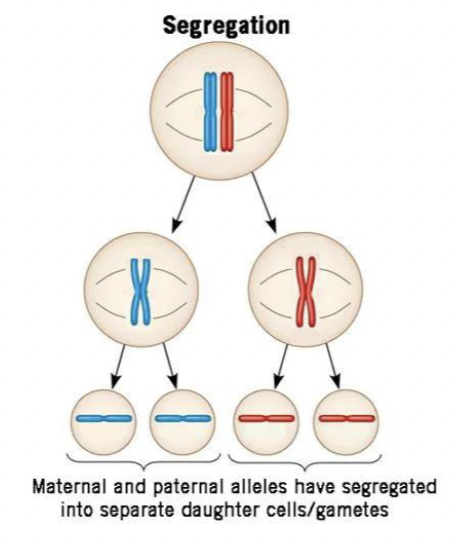
principle of segregation
diploid individuals have two alleles of each gene, and these alleles segregate into gametes at meiosis
each gamete receives one of the two parental alleles determined by chance
each parent contributes one gamete to each offspring
principle of independent assortment
alleles of different genes separate independently during the formation of gametes (if on different chromosomes)
how does genetic linkage influence the evolution of traits?
causing nearby genes on a chromosome to be inherited together, limiting independent assortment and forcing traits to evolve as units rather than independently
blending inheritance
a concept of heredity before Mendel that describes how an offspring’s traits are a blend of parental traits
inheritance of acquired characteristics
a concept of heredity before Mendel that describes how parents develop traits as they grow and mature, offspring inherit these acquired (novel) traits
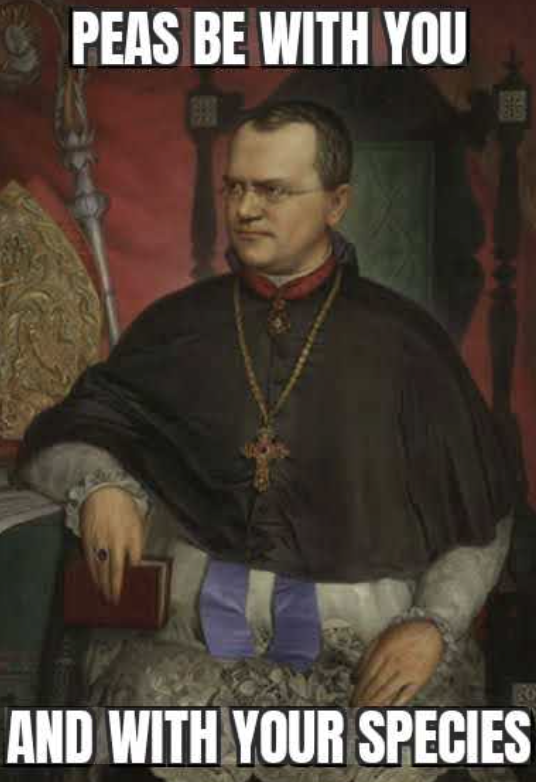
Gregor Mendel
a 19th-century monk who was an active member of his city’s agricultural society that was interested in heredity; published his work in 1866, demonstrating the actions of invisible “factors” to explain the inheritance of visible traits in predictable ways
heredity
the transmission of traits from parents to their offspring
trait
any characteristic of an individual
what was the first model organisms in genetics?
garden peas
genetics
the branch of biology that focuses on the inheritance of traits that uses model organisms to understand how genotypes produce phenotypes
why did Mendel choose garden peas for genetics?
short generation time, produces lots of seeds, and is cheap
they had distinct traits (pod color, height, seed coat texture)
crosses were genetically easy to control (self or cross pollinated)
parental generations
the individual used in the initial cross, they’re progeny are the F1
what traits did Mendel study?
worked with pea pure lines that differed in 7 easily recognizable traits (seed shape, seed color, pod shape, pod color, flower color, flower and pod position, and stem length)
the pea population has 2 distincy phenotypes of each of the traits
why did Mendel cross pure lines?
to produce “hybrids” to observe traits in parents and their offspring to study patterns of inheritance
what concepts did Mendel’s model include?
the characteristic of a single trait are inherited in a “particulate fashion”
traits in offspring result not from blending, but from the combination of particles (alleles) inherited from parents
each gamete receives one of the two parental alleles
each parent contributes one gamete to each offspring
T or F: according to Mendel, the characteristics of a single trait are inherited in a [“random fashion”]
false
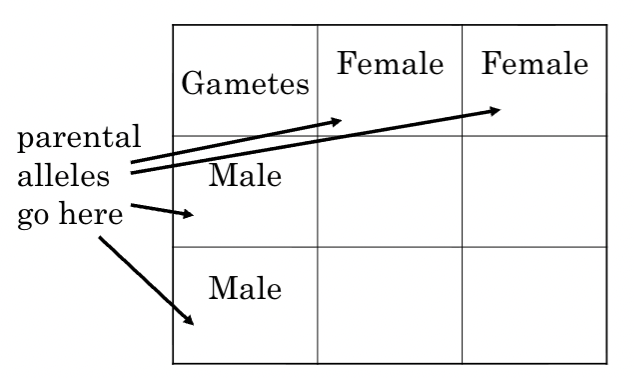
genotype and phenotype frequencies can be predicted using a…
Punnett square (developed by Reginald Crundell Punnett)
what was the basis/ question of Mendel’s second set of experiments?
are different traits inherited independent of one another — does the segregation of alleles affecting certain phenotype have any affect of the segregation of alleles affecting another phenotypic trait?
Mendel’s Dihybrid Cross Model
used pure breeding lines that bred “pure” for two traits (homozygous at two genes affecting two traits)
Mendel’s ___ tested the hypothesis that traits are inherited independent of one another
Dihybrid Cross Model
T or F: inheriting [one] allele from mom at [one] genetic locus doesn’t necessarily mean you’ll inherit a particular allele from mom at another genetic locus
true
what is the null hypothesis about the inheritances of traits from a dihybrid cross of heterozygotes (what is the expected ratio of phenotypes)?
traits are inherited independently — the two traits follow Mendel’s Law of Independent Assortment and show complete dominance, resulting in an expected phenotypic ratio of 9:3:3:1
what is the alternative hypothesis of independent assortment?
they are not inherited independently of each other
evolution
any change in the genetic characteristics of a population over time (change in the frequency of alleles over time); the theory that all organisms on Earth are related by common ancestry and have changed over time
pleiotropy
a single gene that affects two or more traits; constrains traits to co-evolve, correlated evolutionary responses of traits to selection
what if two traits are not independently assorting every generation (the same combinations of traits are inherited together in offspring)?
it would lead to
what is the Mendelian ratio of genes?
9:3:3:1
what is the implications of independent assortment for evolution?
it allows for different combinations of traits to occur in offspring
creates genetically based variation in trait combinations
heritability is required for…
natural selection and enables evolutionary change across generations
particulate inheritance preserves…
variation on which selection can act
T or F: dominant alleles show up in heterozygotes, and they [are the most frequent in a population]
false
what was the expected ration resulting from an independent assortment of traits from the pea table that produced 16 phenotypes?
9:3:3:1
each p value tells us…
how likely it is to get a chi-square value from your data this large if the null hypothesis is true
if the p-value. the probability is small (< 0.05), we…
reject the null hypothesis (not due to chance)
if the p-value. the probability is large (> 0.05), we…
consider the null hypothesis (due to chance)
how is the degree of freedom (d.f.) calculated?
(Number of rows [categories] of data -1) x (Number of columns [categories] of data -1)
T or F: The [distance] between genes determines the likelihood of crossing over occurring
true
reciprocal cross
a set of matings where the female’s phenotype in the initial cross is the male’s phenotype in a subsequent cross, and the male’s phenotype in the initial cross is the female’s phenotype in a subsequent cross.
particulate inheritance
is the genetic model, proposed by Gregor Mendel and confirmed by early geneticists, which states that traits are transmitted from parents to offspring through discrete, separate units (now known as genes) rather than by blending parental traits

