Inventory managment W5
 Studied by 0 people
 Call with Kai
 Learn
Learn Practice Test
 Spaced Repetition
 Match
Match Flashcards
 Knowt Play
1/11

There's no tags or description
Looks like no tags are added yet.
Name | Mastery | Learn | Test | Matching | Spaced | Call with Kai |
|---|
No study sessions yet.
12 Terms
Inventory
the accumulation of things as they flow through a business or network. It forms whenever the rate of supply (stuff coming in) is different from the rate of demand (stuff going out).
physical inventory - stock
stock → accumulation of physical materials such as components, parts, finished goods, or paper information records.
why do you want to have stock?
is an insurance against uncertainty (in demand or supply)
can counteract a lack of flexibility
allows operations to take advantage of short-term opportunities
anticipate future demands
can reduce overall costs
can increase in value
fill the processing ‘pipeline’
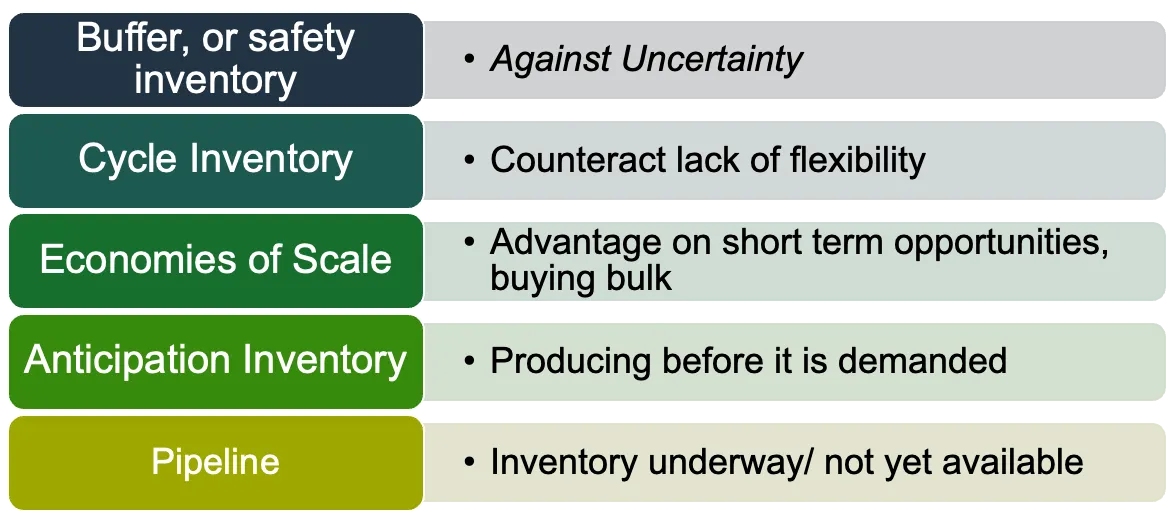
Types of stock
Insurance (Safety/Buffer Inventory) → It protects against the unexpected. If a supplier is late or demand suddenly spikes (like the COVID-19 PPE example or Swiss coffee stocks), safety stock prevents you from running out.
Cycle Inventory → You cannot make every product continuously. A baker makes bread in batches (e.g., White bread → Wholemeal → Grain). Inventory allows them to sell White bread while the oven is busy baking Wholemeal.
Economies of scale → This is a systematic strategy. You intentionally buy large quantities regularly to get a lower price per unit.
Anticipation Inventory → You build up stock before a known peak. (e.g., Making chocolate all year round to prepare for the Easter rush).
Pipeline → This is stock that is "on the move" (in a truck or warehouse). It exists because goods cannot teleport instantly from factory to store.
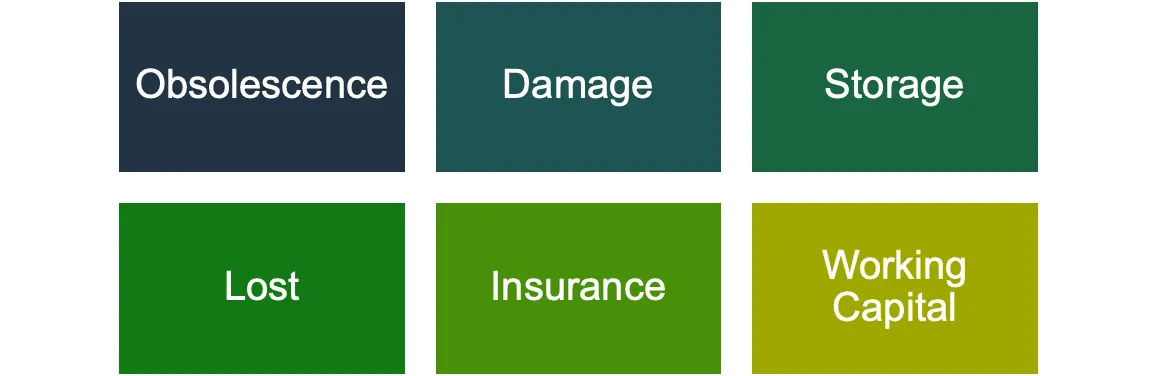
Consequences of having an inventory (picture)
Obsolete stock, or dead stock, refers to inventory that's no longer sellable or usable due to factors like expired shelf life, changing customer demand, or technological advancements, tying up capital and space.
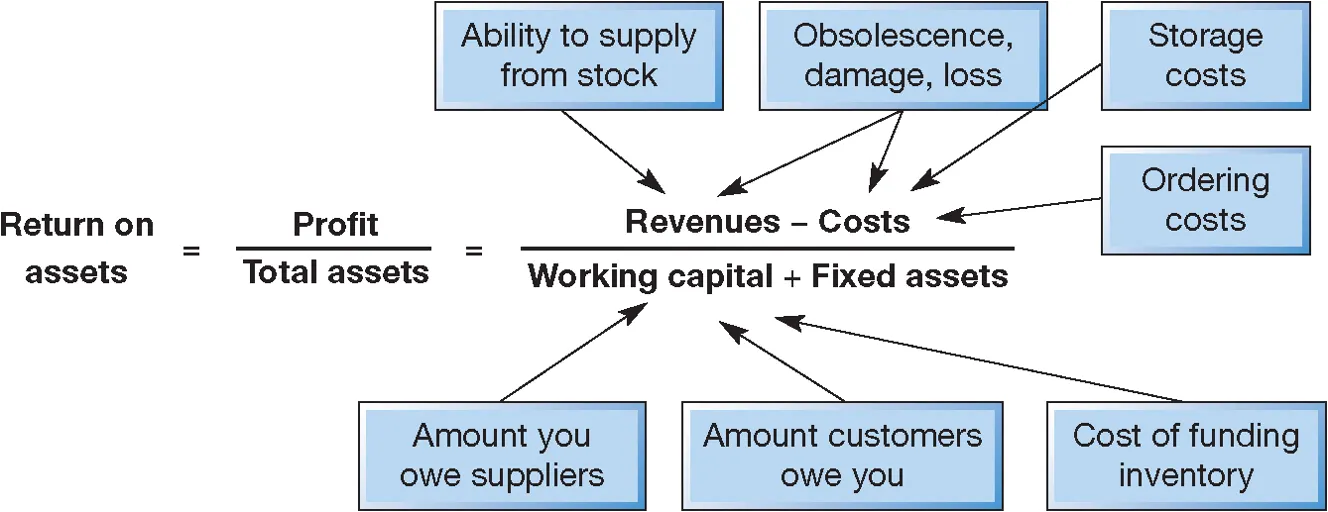
Financial impact of stock
revenues - costs = cost of goods sold
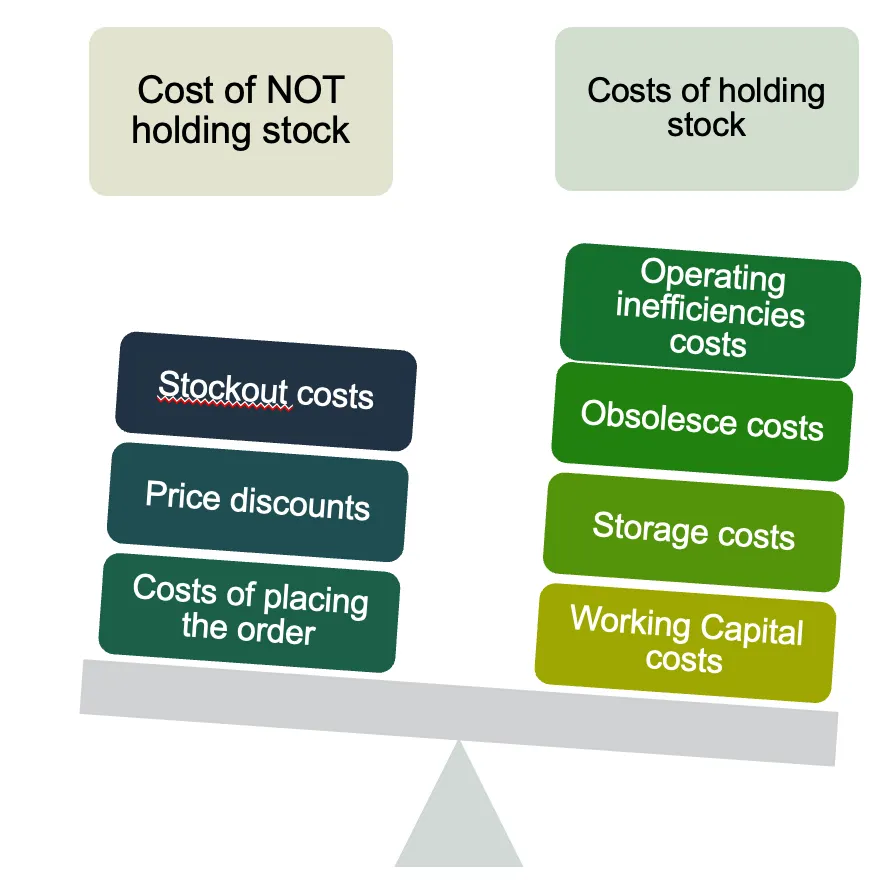
Inventory costs
costs of NOT holding stock
stockout costs → the money you lose when you run out of a product, including lost sales, expensive emergency shipping, and disappointed customers.
price discounts → the missed opportunity to get "bulk pricing" or volume discounts because you are ordering in small quantities rather than buying a lot at once to store.
costs of placing the order → These are the fixed administrative and processing fees you pay every single time you make a purchase, regardless of how many items you buy.
costs of holding stock
operating inefficiencies costs → Holding too much "safety stock" can hide deeper problems in your business, like slow production or quality issues, which prevents you from fixing them.
obsolesce costs → This is the financial loss that happens when your stored items become outdated, expire, or get damaged before you can sell them.
storage costs → This is the direct cost of the physical space needed for inventory, including rent for the warehouse, electricity, security, and insurance.
working capital costs → This represents the "opportunity cost" of having your cash tied up in unsold boxes on a shelf instead of using that money to grow the business or earn interest
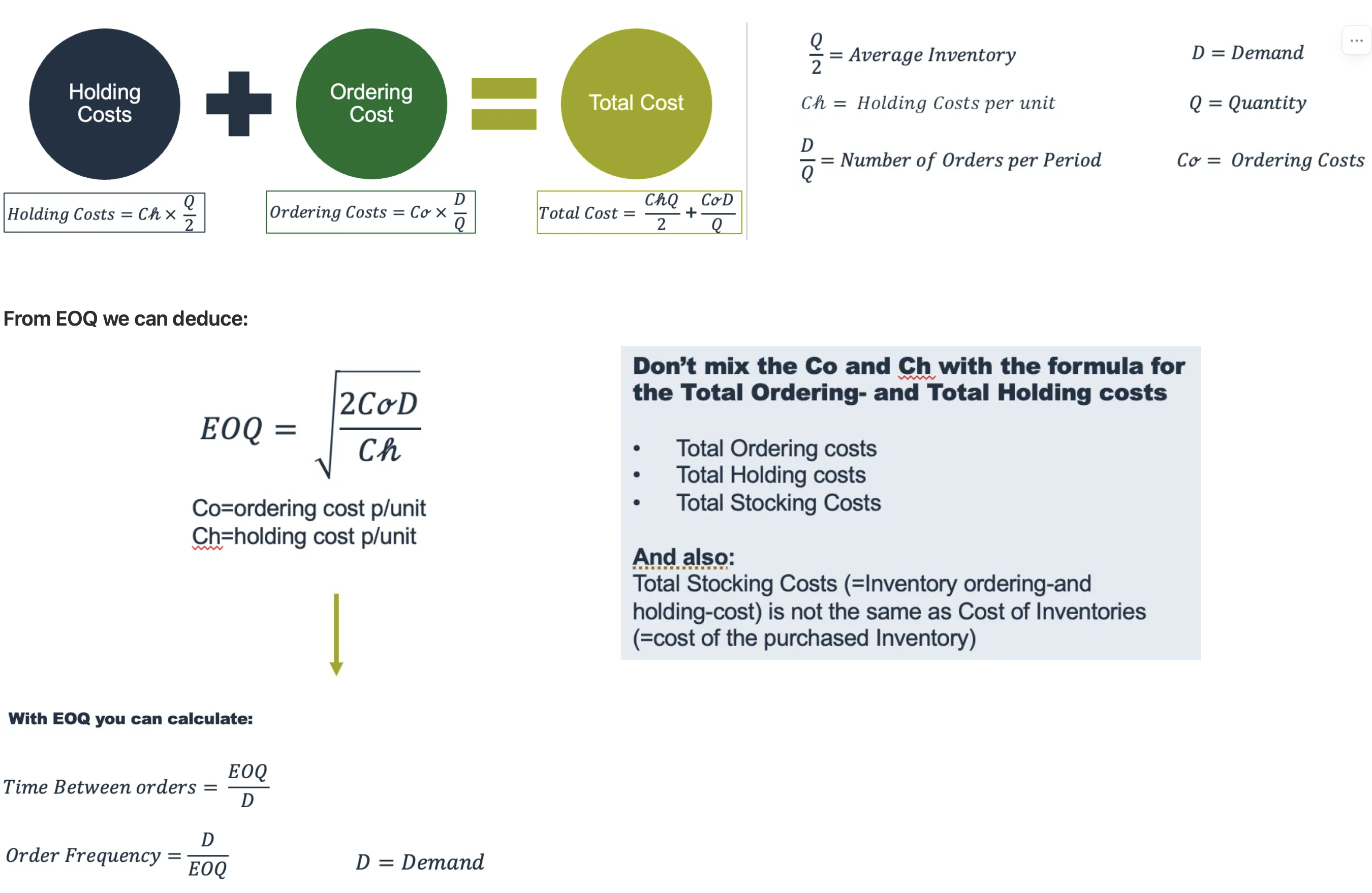
(calculate the Economic Order Quantity (EOQ)
EOQ (economic order quantity)
→ to find the perfect order size that minimizes your total costs.
Disadvantages of EOQ
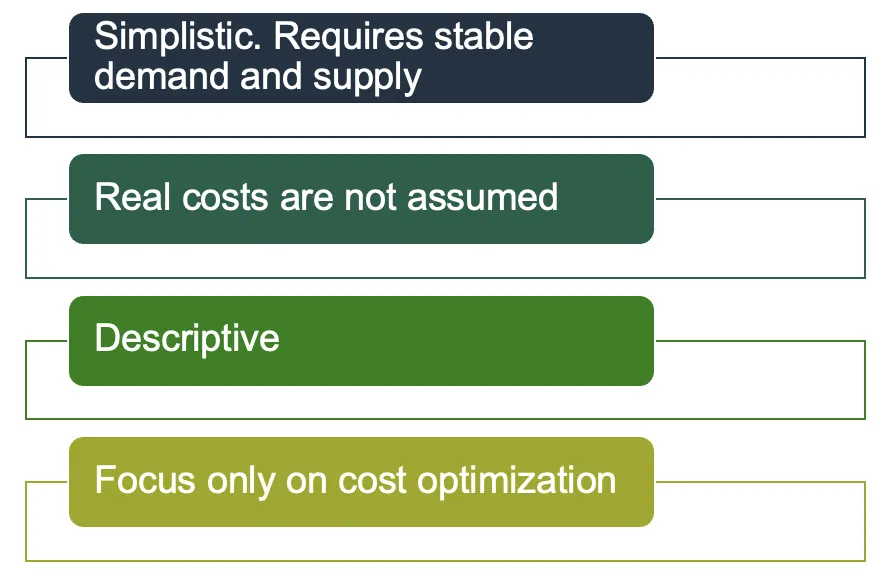
Simplistic / Requires stable demand and supply: The model unrealistically assumes that customer demand and supplier delivery times never change, which ignores real-world issues like seasonality or supply chain delays.
Real costs are not assumed: It relies on fixed theoretical estimates for holding and ordering costs, often failing to account for reality-based factors like bulk quantity discounts or fluctuating market prices.
Descriptive: It merely describes a static, theoretical ideal rather than providing a dynamic strategy that adapts to the constantly changing conditions of a real business environment.
Focus only on cost optimisation: By strictly prioritising the lowest possible inventory expense, the model overlooks other critical success factors like customer service levels, product quality, and responsiveness.
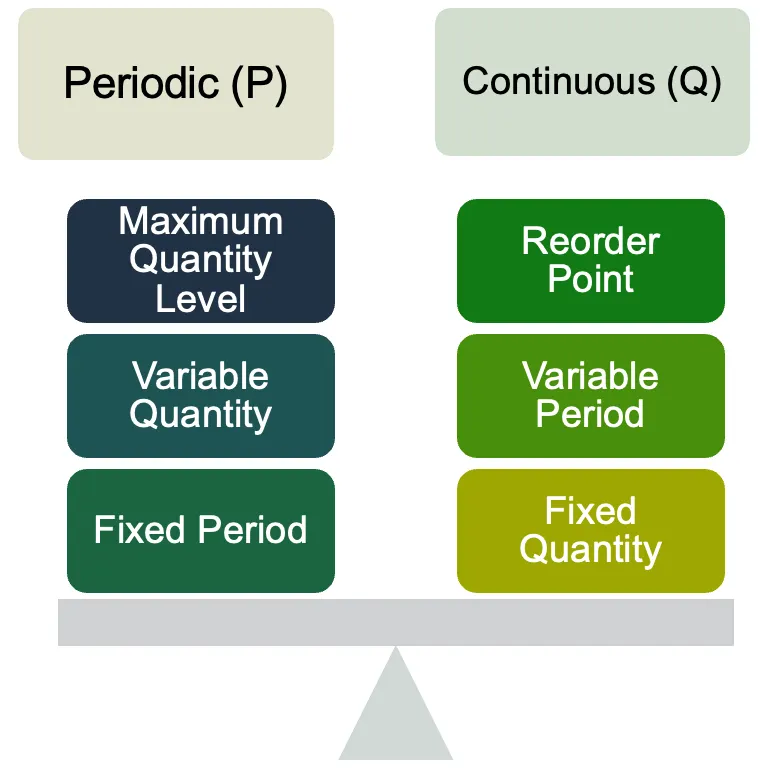
periodic x continuous review
Periodic Review (P-System)
Order always the same quantity whenever a minimum set stock level is reached
How it works: Inventory is checked at fixed time intervals (e.g., weekly, monthly).
Order trigger: An order is placed to bring stock up to a predetermined maximum (target) level.
Pros: Simplified scheduling, lower monitoring effort, easy to coordinate with other tasks (e.g., supplier deliveries).
Cons: Higher risk of stockouts between review periods because demand isn't tracked constantly; requires more safety stock.
Best for: Lower-value items, predictable demand, consolidated shipments.
Continuous Review (Q-System or Reorder Point System)
Order always the same quantity whenever a minimum set stock level is reached
How it works: Inventory levels are monitored constantly (in real-time).
Order trigger: An order is placed immediately when stock reaches a specific reorder point.
Pros: Lower safety stock needed, better responsiveness to demand changes.
Cons: Higher monitoring costs, more administrative effort.
Best for: High-value items, variable demand, items where stockouts are costly.
two-bin & three-bin system
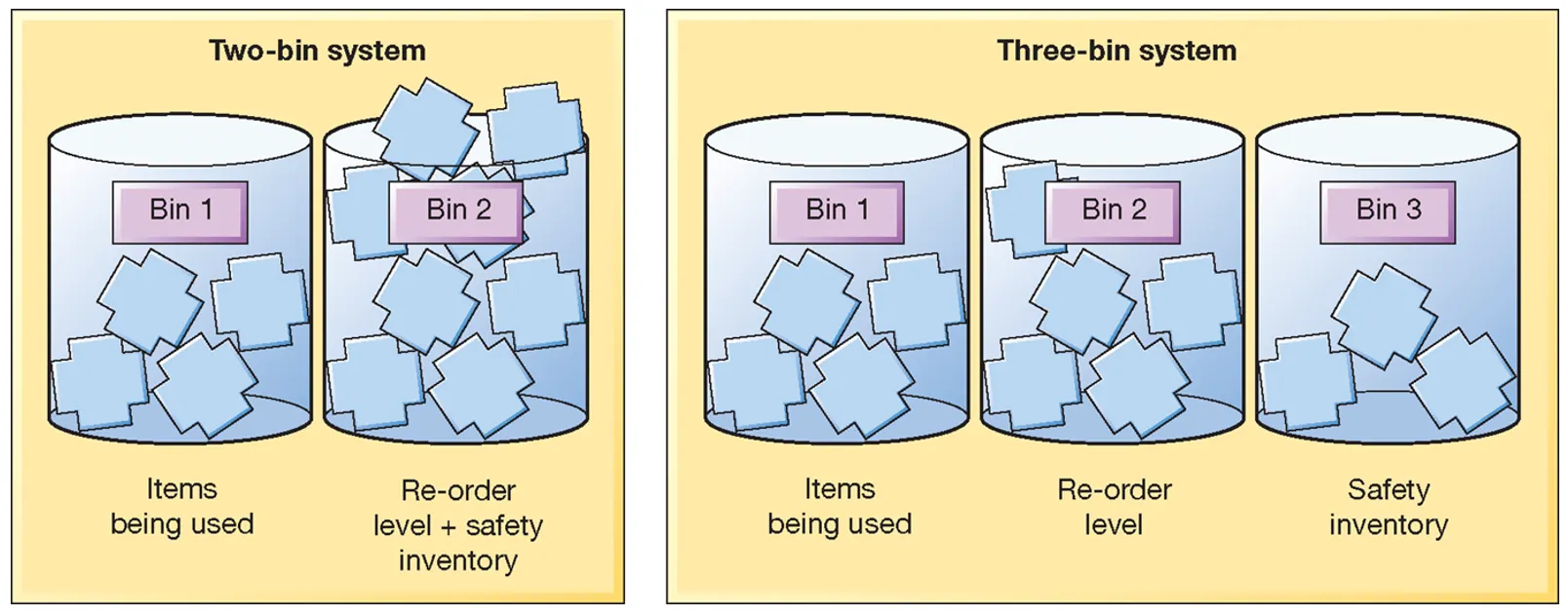
two-bin system → you use stock from the first bin until it runs out, at which point you switch to the second bin, which automatically signals that it is time to place a new order while providing enough supply to last until that delivery arrives.
three-bin system → this system adds an extra layer of security by keeping a third, separate container strictly for emergencies, ensuring you have a dedicated safety buffer (Bin 3) even if your reorder stock (Bin 2) runs out before the new shipment gets there.
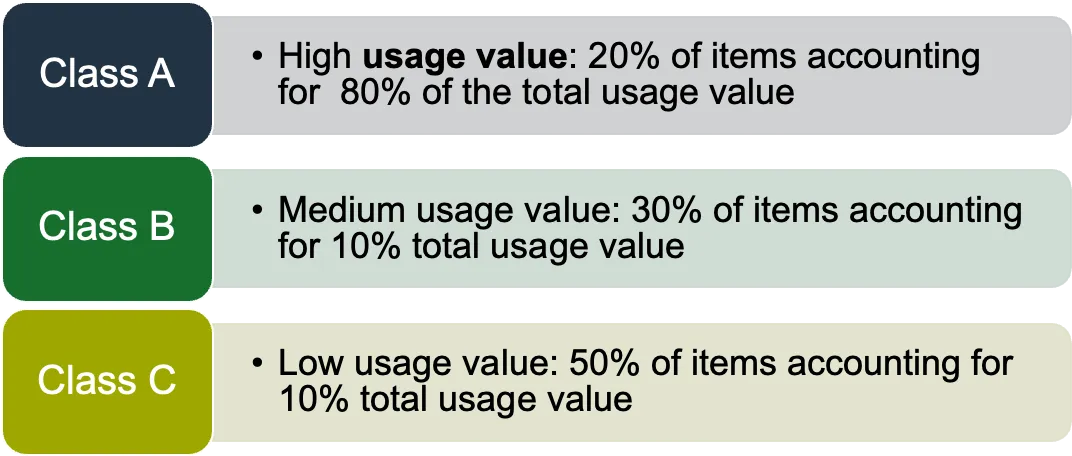
use ABC inventory analysis
Usage Value=usage rate × item individual value
QUIZ
Inventories exist because → there is a difference in the timing or rate of supply and demand
A queue of people is an accumulation of customers, and, in the example of people waiting on a phone to speak to a customer adviser from a service helpline, can be considered as inventory → TRUE
Which of the following is NOT a common disadvantage of holding physical inventory? → it counteracts inflexibility
Which of the following is NOT a common advantage of having queues of customers? → queues utilise space efficiently
Which of the following costs generally increase as order size is increased? → insurance costs
The re-order point is → the point at which stock will fall to zero minus lead-time
What is a two-bin system? → a system in which orders are placed when only one complete bin of stock is remaining
Stock cover, stock turn
Stock Cover = nr of weeks or days of supply, before stock becomes zero and needs to be refilled
Days of Supply = inventory on hand / average daily usage
Example: a company as 9000 units on hand and the annual usage is 48000 units. There are
240 working days in the year. What is the days of supply?
Answer: avg daily usage = 48000/240 = 200 units
days of supply = inv on hand/avg daily usage = 9000/200 = 45 days
Stock Turn = nr of times the stock turns a year
Stock Turn = Cost of goods sold/Average inventory value
Example (see Annual report on next slide): Apple has as Sept 2023 a twelve month sales of
USD 383 billion. Cost of the sales (or cost of goods sold) were USD 189 billion.
Average Inventory value was USD 5,6 (=(4,9+6,3)/2). What is the stock turn?
Answer: cost of goods sold (or cost of sales) / avg inventory value = 189 / 5,6 = 34 times
or in other words Apple turns its inventory every 11 days! (365 days /34 times = 11 days).
 Note
Note  Flashcards (89)