L9 Theory of Mind
 Studied by 0 people
 Call Kai
 Learn
Learn Practice Test
 Spaced Repetition
 Match
Match Flashcards
 Knowt Play
1/59

There's no tags or description
Looks like no tags are added yet.
Name | Mastery | Learn | Test | Matching | Spaced |
|---|
No study sessions yet.
60 Terms
What is Theory of Mind (ToM)?
The ability to understand others’ mental states and predict behaviour based on these internal states.
What is coherence in ToM
people act in accordance with their goals and beliefs
Why are mental states difficult for children to learn about?
Mental states are invisible, private, and not directly observable
What cognitive process underlies ToM?
Perspective-taking—putting oneself in another person’s mental position
3 key mental states underlying ToM
goals/intentions and desires, perception and beliefs/representations of the world
4 types of beliefs / representations of the world or the reality
true-belief, ignorance, false-belief, and second-order beliefs
What is the representation of true-belief
correctly represent the reality
What is the representation of ignorance
unaware of the reality
What is the representation of false-belief
incorrectly represent the reality
What is the representation of second-order beliefs
beliefs about beliefs
What do children refer to, to understand goals and intentions
successful vs unsuccessful actions
What is the purpose of referring to successful vs unsuccessful actions to infer goals
to distinguish between intentional vs accidental behaviour
What two conditions do Behne et al, test when failing to hand infants a toy (to test how children understand goals and intentions)
unwilling vs unable
How did infants respond to the adult not giving the toy to the infant vs being unable to give the toy to the infant
infants showed more frustration
What is the significance of infants showing more frustration in the unwilling vs unable condition
they can infer/differentiate the intention behind the actions
At what age do infants first distinguish unwilling vs. unable actions, according to Behne et al?
Around 9 months.
What are desires in ToM development?
Preferences or likes/dislikes that motivate behaviour
What do children assume about desires
everyone likes or dislikes what they like and dislike
At what age do infants demonstrate that they can appreciate people might have different likes and dislikes
age 2
What did Repacholi & Gopnik (1997) show about infants changes in understanding of desire (what did the study involve)?
Children younger than 2 give an adult their own preferred snack, while around age 2 they give the adult her preferred snack
What is knowledge access?
Understanding that seeing leads to knowing and that people have different knowledge depending on what they can or cannot see.
What did Moll & Tomasello (2004) find about visual access when an adult showed excited about something behind a barrier (what age infant? And what does this show)?
12-month-olds follow an adult’s gaze behind a barrier, showing awareness of different visual perspectives.
What did Moll & Tomasello (2006) reveal about knowledge access when an adult either searched for an object out in the open or an object only visible to the infant (what age infant and what does this demonstrate)?
24-month-olds help an adult find an object by handing the one the adult could not see, showing early knowledge-state reasoning.
What is a belief in ToM?
A mental representation of the world, which can be true, false, or incomplete.
Why are false beliefs important for ToM research, what ability does this test in infants – what is the core evidence of, what component of ToM?
They show the child understands that minds can misrepresent reality/there are multiple representations of one situation —core evidence of representational ToM.
What does it indicate if a child understand that a representation contradicts reality
they can distinguish between mind and world
What are the two main types of false belief tasks?
Unexpected location tasks and unexpected contents/identity tasks.
What is the Wimmer & Perner (1983) unexpected location task?
Maxi puts chocolate in a cupboard; his mum moves it to the drawer; children are asked where Maxi will look.
What age will respond to the unexpected location task saying the real location vs the belief-based location
3-year-olds vs 4–5-year-olds
What does passing the unexpected location task indicate?
Understanding that behaviour is guided by beliefs, not reality.
What age will fail the unexpected location and contents task vs pass
3 year olds vs 4 year olds
What is the unexpected contents task (Perner et al., 1987) with a box of smarties?
Children see a “Smarties” box that actually contains pencils and are asked what another person will think is inside and what they thought was in the box first
What do 3-year-olds typically answer in unexpected contents tasks?
They claim both they and others thought the true content
What do 4-year-olds answer in unexpected contents tasks?
Correctly report their prior false belief and others’ false belief
What is explicit ToM and how is it measured
relies on conscious tracking of other’s mental states measured by standard false belief tasks
What is implicit ToM
the ability to track others’ mental states unconsciously
How is implicit ToM measured in infants and how do they interpret looking times?
Through looking-time methods where infants look longer at events that violate belief-based expectations.
What are the two models explaining ToM
conceptual change model and competence model
Who came up with conceptual change model (think about wellbeing and person, and first place)
Wellman et al, and Wimmer
Who came up with competence model (think Spanish hello and tv show friends)
Hala and Chandler
What does the conceptual change model argue about children’s shift in their ToM abilities
children shift from reality-based to a representation-based understanding of mind
What does a representation-based understanding of mind mean?
believing that belief equates to an internal reality/representation of reality
What does the conceptual change module argue that children’s early ToM equate to?
desire-based psychology
What is the core reasoning behind competence models?
Traditional false belief tasks underestimate young children’s abilities due to task demands
How does the competence model address task complexity issues (2 ways)
by adjusting the wording of the questions to improve accuracy and to give a reason for displacement
Why does providing a reason for displacement allow children to engage in false-belief tasks (according to competence model)
tasks that are meaningful and motivating are more feasible to engage with
What executive function skill is essential in false belief tasks which the competence model argue to explain children’s struggle with false belief tasks?
Inhibitory control
What is inhibitory control
suppressing one’s own knowledge of reality to consider another’s perspective.
When does inhibitory control develop
preschool years
What did Birch & Bloom (2003) find about children’s ability of inhibitory control when they don’t know the toy’s new location and what does this suggest?
Children perform better when they do not know the toy’s new location, suggesting reality-information interferes with perspective-taking.
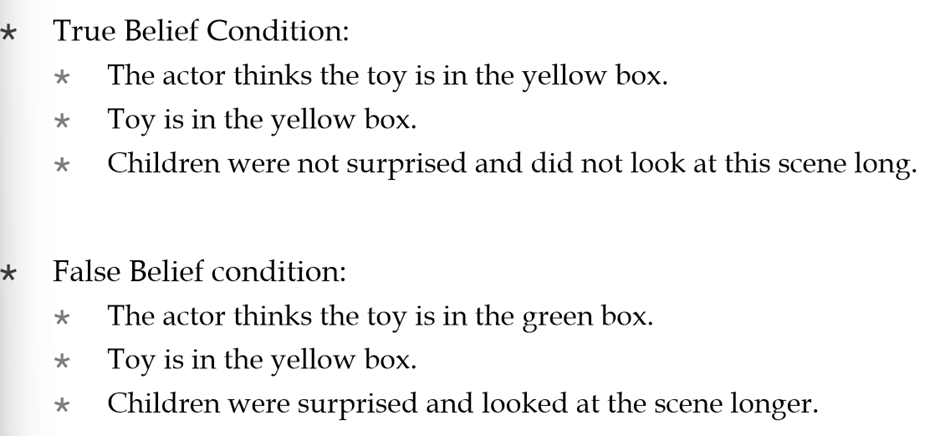
What do these findings with 15-month-olds suggest about infants implicit ToM
by looking longer at belief-inconsistent actions, shows violation-of-expectation which suggests infants implicit false belief understanding
What does the competence model highlight that helps children improve in false belief tasks
sufficient scaffolding
What is the nature of infants performance in false belief tasks, generally
quite unstable
What does the instability of performance suggest about ToM development (what period/age?)?
there is a significant developmental change between ages 3-5, a conceptual change which influences the acquirement of ToM
What 5 factors predict individual differences in ToM?
Language ability, executive function, family talk about mental states, pretend play, and presence of siblings.
Is ToM development universal across cultures (what is universal), what is the exception to the universality?
Yes, children follow the same developmental sequence but differences in when the mental states are mastered
Why might some cultures appear slower on ToM tasks (2 reasons and what does this suggest about competency)?
Social norms may discourage explicit mental-state talk, or languages may differ in mental-state verbs, affecting task performance—not underlying competence.
How can primates perceive others (in terms of ToM)
goal-oriented beings
Do primates show explicit, implicit or both ToM
implicit
Which type of ToM is uniquely a human skill
explicit ToM focusing on false belief understanding
 Note
Note  Flashcards (53)