Gen bio 2 exam 2 real
 Call Kai
 Learn
Learn Practice Test
 Spaced Repetition
 Match
Match Flashcards
 Knowt Play
1/29

There's no tags or description
Looks like no tags are added yet.
Name | Mastery | Learn | Test | Matching | Spaced | Call with Kai |
|---|
No analytics yet
Send a link to your students to track their progress
30 Terms
Water soluble hormones (polypeptides always)
exits cell via exocytosis
dissolves in blood stream
interacts with cell via signal transduction - gpcr
is water soluable pathway fast or slow response
fast because acting on proteins already existing, lasts short time
Lipid soluble pathway
diffuses through membrane
travels in bloodstream via lipid carrier proteins
then diffuses through cell membrane and gets into nucleas with a bound receptor that changes gene expression
slow response , longer duration
Hypothalamus 2 modes of action
acts on AP (sends IH or RH via portal vessels - vascular)
acts on PP ( makes hormones wich are sent to PP through axons) then stored in vesicles until needed
3 types of AP hormones
Tropic - interdmediate singal, acts on another endocrine gland
non tropic - acts directly on muscle/tissue, direct physiological effect
both
Thyroid functions
Stimulate cellular metabolism in virtually all cells
Maintain normal BP, heart rate, muscle tone
Regulate digestive, reproductive functions
general thyroid hormone pathway
TRH - TSH -TH
Hypothalamus secretes thyrotropin-releasing hormone (TRH)
Stimulates AP to secrete thyroid-stimulating hormone (TSH)
Stimulates thyroid gland to secrete thyroid hormone (TH)
TH is regulated by what mechanism
negative feedback.
hypothyroidism
Not enough TH in body, excess TSH from AP causes thyroid glands to become large, never ending cycle until iodine deffincy is fixed and thyroid can make TH again.
hyperthyroidism
In Grave's disease, antibodies mimic TSH by binding to thyroid receptors, causing permanent activation that overrides negative feedback and leads to excessive TH secretion
Adrenal glands
Sit on top of kidney’s and have two parts, adrenal medulla and adrenal cortex
Adrenal Medulla
acute stress, nerve impulses sent from, hypothalamus, and primarily rleases epi and norepi.
effects: more blood to brain, muscles, heart
glycogen broken down to glucose
increase metabolic rate (up to 100%)
increase O2 delivery
Adrenal Cortex
Deals with chronic stress and endocrine system.
Stress → hypothalamus secretes corticotropin-releasing factor (CRF)
→ AP releases adrenocorticotropic hormone (ACTH)
→ ACTH stimulates adrenal cortex to produce corticosteroids
2 types of corticosteroids
Glucocorticoids- produces glucose from non carb sources (muscle breakdown). supresses immune system at high levels.
Mineralocorticoids - maintains ion homeostasis, salt and water balance. excess can cause hypertension by causing kidneys to retain salt, therefore making blood saltier. water follows salt, and increases volume inside blood vessels in arteries.
primitive response to dehydration/hypovolemia.
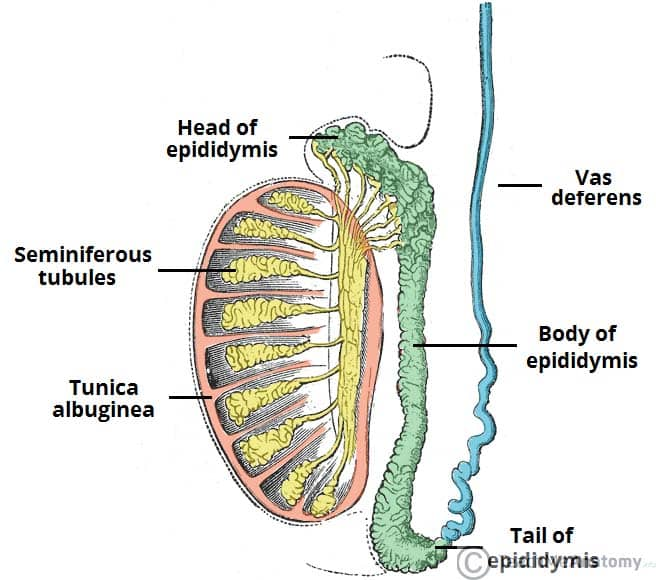
seminiferous tubes
site of spermatogenesis, coilied within testes.
leydig cells
surround seminiferous tubes, make test
epididymus
transports sperm
matures sperm
stores sperm
seminal vesicle
Produce fluid that contains: Fructose – energy for sperm after ejaculation and Prostaglandins – stimulate contractions of uterus
secreted into vas deferens, accounts for 60% of semen volume and is forensically significant
prostate gland
secretes fluid with anticoag enzymes and citrate into eurethra during ejactulation
Bulbourethral gland
pre cum, 1st gland to secrete during arousal, Contain mucus to neutralize acidic urine
sperm path
Sperm are produced in the seminiferous tubules of the testes, mature in the epididymis, travel through the vas deferens, enter the ejaculatory duct to mix with seminal and prostatic fluids, and finally exit the body via the urethra.
spermatogenesis
primordial germ cells differentiating into spermatogonial stem cells, which divide via mitosis into spermatogonia; who specialize into primary spermatocytes (2n) that undergo meiosis I to become secondary spermatocytes, followed by meiosis II to produce spermatids, which finally mature into sperm cells.
Male endocrin
hypothalamus releases GnRH → AP releases two gonadotropins (LH) (FSH)
LH: targets Leydig cells in testes to produce testosterone
FSH: dev of seminiferous tubes & stimulates sertoli cells to make ABP and inhibin (stops FSH secretion)
Ovaries
female sex organ, production and release of mature eggs
oviducts (fallopian tubes)
Collect secondary oocytes from ovary, move to uterus, Move via beating cilia, contractions
Site of fertilization
uterus
site of emrybonic dev, has two layers: myometrium thick wall of smoth muscle, endometrium - Connective tissue, glands, blood vessels
Thickens each moth – prepare for pregnancy
Fertilization – embryo implants into endometrium
No fertilization – sloughed off – menstruation
cervix
closes uterus and separates it from vagina
oogenesis (embryonic stage)
2n primoridal germ cells divide to become oogonia 2n who develop to become primary oocytes who start meiosis but arrest in prophase 1.
oogenesis post embryonic stage
6–12 follicles begin maturing in the ovary each month, but only the largest allows its primary oocyte ($2n$) to complete meiosis I. This division uses unequal cytokinesis to produce a small first polar body ($n$) and a large secondary oocyte ($n$), which then starts meiosis II but arrests at metaphase II. During ovulation, this arrested oocyte is ejected into the oviduct, where it will only complete meiosis II to become a mature ovum if it is successfully penetrated by a sperm.

