Taste and Smell

0.0(0)
Studied by 0 people
call kaiCall Kai
learnLearn
examPractice Test
spaced repetitionSpaced Repetition
heart puzzleMatch
flashcardsFlashcards
GameKnowt Play
Card Sorting

1/9

encourage image

There's no tags or description

Looks like no tags are added yet.

Last updated 5:41 PM on 3/20/26
Name
Mastery
Learn
Test
Matching
Spaced
Call with Kai

No analytics yet

Send a link to your students to track their progress

10 Terms

1
New cards

Taste and Smell

∙ Both senses use chemoreceptors

∙Stimulated by chemicals in solution

  • mouth = saliva

  • nose = mucous

∙ Both senses complement each other and respond to many of the same stimuli

2
New cards

Olfaction - the sense of smell

Olfactory receptors are in the roof of the nasal

cavity

∙Are Neurons with long cilia (olfactory hair)

∙ Chemicals must be dissolved in mucus for

detection
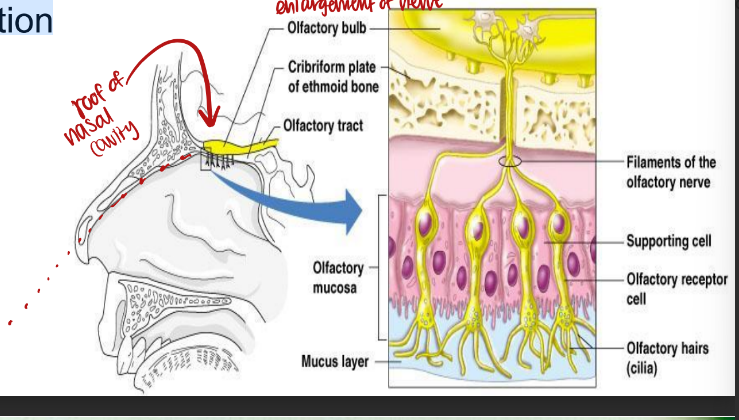
<p>Olfactory receptors are in the roof of the nasal</p><p>cavity</p><p>∙Are Neurons with long cilia (olfactory hair)</p><p>∙ Chemicals must be dissolved in mucus for</p><p>detection</p>
3
New cards

Olfaction and the brain

Impulses are transmitted via the olfactory nerve (cranial

nerve I)

∙ Interpretation of smells is made in the cortex (olfactory

area of temporal lobe)
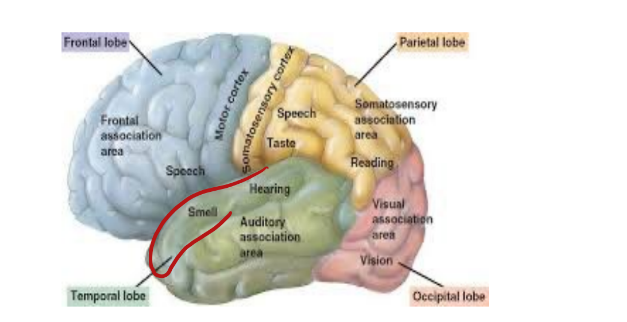
<p> Impulses are transmitted via the olfactory nerve (cranial</p><p>nerve I)</p><p>∙ Interpretation of smells is made in the cortex (olfactory</p><p>area of temporal lobe)</p><p></p><p></p>
4
New cards

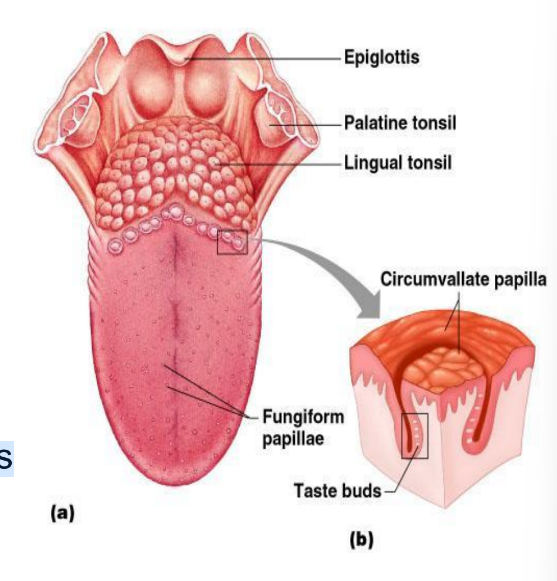
The Tongue and Taste

  • ∙ The tongue is covered with projections called papillae

  • ∙ Filiform papillae – sharp with no taste buds

    • papillae sometimes contains taste buds but trap bacteria and food dye particles

    • grips onto utensils or cups when eating/drinking

  • ∙ Fungiform papillae – central-dorsal with taste buds

  • ∙ Circumvallate papillae – large papillae with taste buds (in back of tongue)

  • ∙ Foliate- small, clustered, each side of the tongue with taste buds
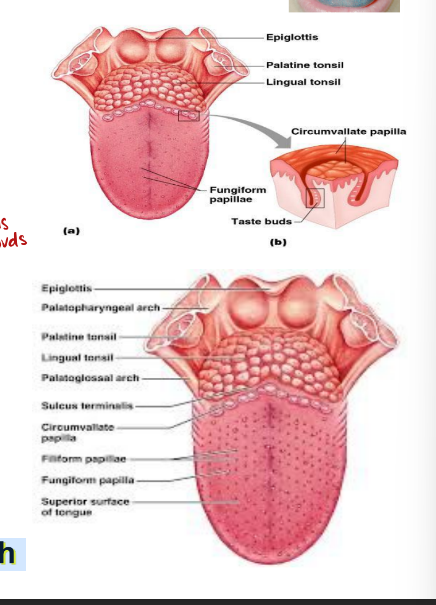
<ul><li><p>∙ The tongue is covered with projections called papillae</p></li><li><p>∙ Filiform papillae – sharp with no taste buds</p><ul><li><p>papillae sometimes contains taste buds but trap bacteria and food dye particles</p></li><li><p>grips onto utensils or cups when eating/drinking</p></li></ul></li><li><p>∙ Fungiform papillae – central-dorsal with taste buds</p></li><li><p>∙ Circumvallate papillae – large papillae with taste buds (in back of tongue)</p></li><li><p>∙ Foliate- small, clustered, each side of the tongue with taste buds</p></li></ul><p></p>
5
New cards

Black hairy tongue

happens if no hygiene
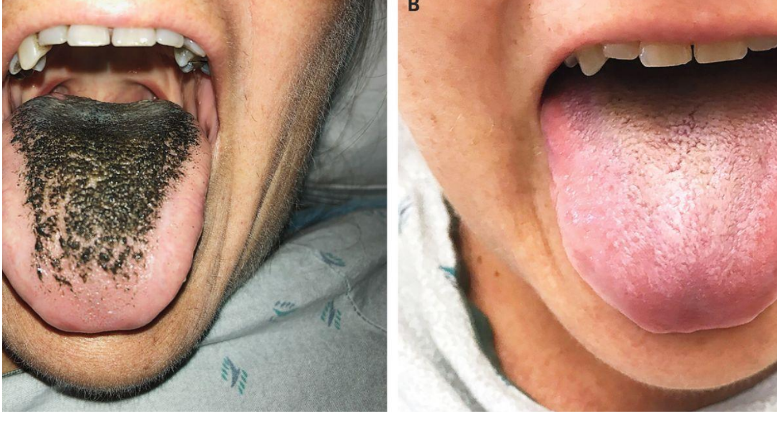
<p>happens if no hygiene </p>
6
New cards

Gustation - the sense of taste

  • ∙ Location of taste buds

  • ∙Most are on the tongue

  • ∙Soft palate

  • ∙Cheeks

  • ∙Taste buds house the receptor organs

<ul><li><p>∙ Location of taste buds</p></li><li><p>∙Most are on the tongue</p></li><li><p>∙Soft palate</p></li><li><p>∙Cheeks</p></li><li><p>∙Taste buds house the receptor organs</p></li></ul><p></p>
7
New cards

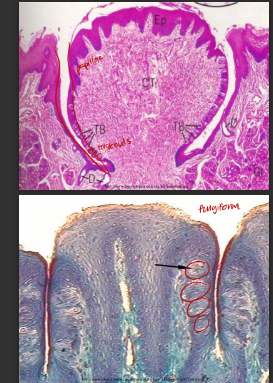
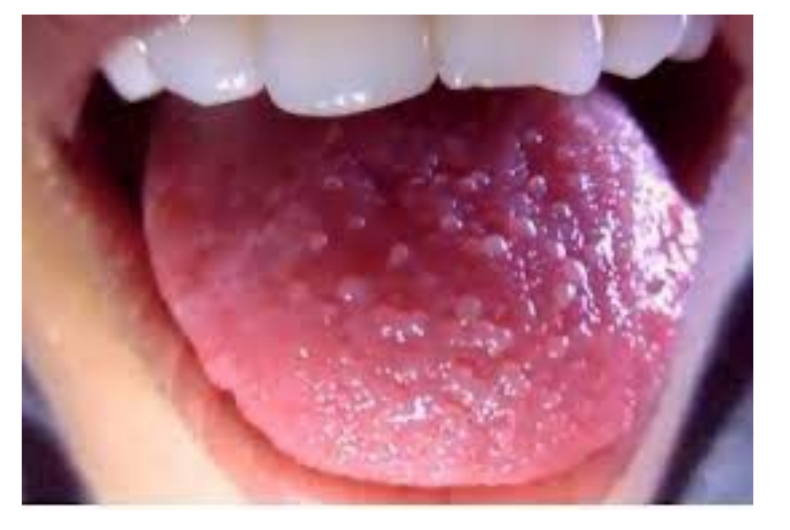
Histology of Tongue

knowt flashcard image
8
New cards

Burning tongues

  • Does burning your tongue actually kill tastebuds?

    • yes, but every 8-10 days, tastebuds are recreated through mitosisZ
<ul><li><p>Does burning your tongue actually kill tastebuds?</p><ul><li><p>yes, but every 8-10 days, tastebuds are recreated through mitosisZ</p></li></ul></li></ul><p></p>
9
New cards

Structure of Taste Buds

∙ Gustatory cells are the chemoreceptors

∙ Have gustatory hairs (long microvilli)

∙Hairs are stimulated by chemicals dissolved in saliva

∙ Impulses are carried to the gustatory complex (parietal lobe) by several cranial nerves because taste buds are found in different areas
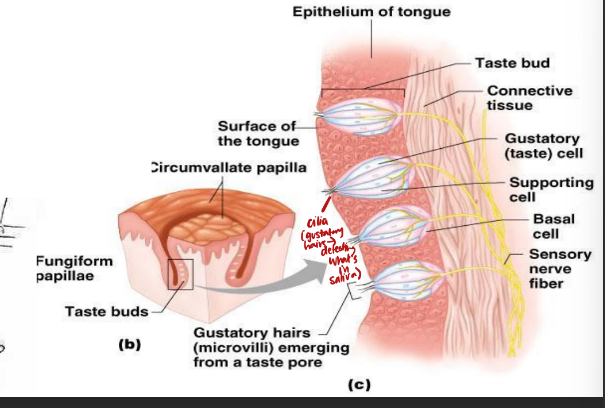
<p>∙ Gustatory cells are the chemoreceptors</p><p>∙ Have gustatory hairs (long microvilli)</p><p>∙Hairs are stimulated by chemicals dissolved in saliva</p><p>∙ Impulses are carried to the gustatory complex (parietal lobe) by several cranial nerves because taste buds are found in different areas</p>
10
New cards

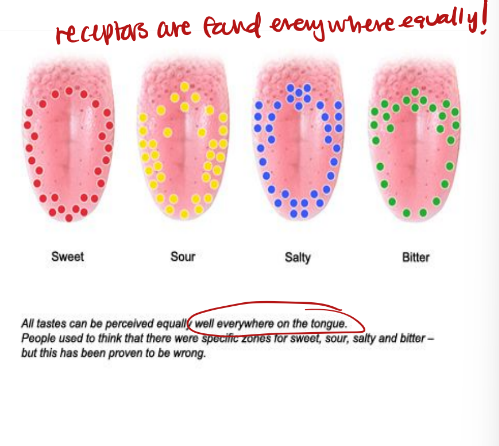
Taste Sensations

  • ∙ Sweet receptors

    • ∙Sugars

    • ∙Saccharine

    • ∙Some amino acids

  • ∙ Sour receptors

    • ∙Acids

  • ∙ Bitter receptors

    • ∙Alkaloids

  • ∙ Salty receptors

    • ∙ Metal ions

  • ∙ Umami (MSG)

    • ∙ glutamic or aspartic acid

<ul><li><p>∙ Sweet receptors</p><ul><li><p>∙Sugars</p></li><li><p>∙Saccharine</p></li><li><p>∙Some amino acids</p></li></ul></li><li><p>∙ Sour receptors</p><ul><li><p>∙Acids</p></li></ul></li><li><p>∙ Bitter receptors</p><ul><li><p>∙Alkaloids</p></li></ul></li><li><p>∙ Salty receptors</p><ul><li><p>∙ Metal ions</p></li></ul></li><li><p>∙ Umami (MSG)</p><ul><li><p>∙ glutamic or aspartic acid</p></li></ul></li></ul><p></p>

Explore top flashcards

flashcards
APUSH Progressive Era PEDLIGS
84
Updated 907d ago
0.0(0)
flashcards
US History Chapter 10 Test
32
Updated 98d ago
0.0(0)
flashcards
Latin and Greek Roots List 1-3
75
Updated 333d ago
0.0(0)
flashcards
Numbers 1 - 20
20
Updated 528d ago
0.0(0)
flashcards
Business Law - Midterm
126
Updated 186d ago
0.0(0)
flashcards
La inmigración
45
Updated 488d ago
0.0(0)
flashcards
APUSH Progressive Era PEDLIGS
84
Updated 907d ago
0.0(0)
flashcards
US History Chapter 10 Test
32
Updated 98d ago
0.0(0)
flashcards
Latin and Greek Roots List 1-3
75
Updated 333d ago
0.0(0)
flashcards
Numbers 1 - 20
20
Updated 528d ago
0.0(0)
flashcards
Business Law - Midterm
126
Updated 186d ago
0.0(0)
flashcards
La inmigración
45
Updated 488d ago
0.0(0)