Occlusion Pt2 (review slides)
 Studied by 0 people
 Call Kai
 Learn
Learn Practice Test
 Spaced Repetition
 Match
Match Flashcards
 Knowt Play
1/62

There's no tags or description
Looks like no tags are added yet.
Name | Mastery | Learn | Test | Matching | Spaced | Call with Kai |
|---|
No analytics yet
Send a link to your students to track their progress
63 Terms
Rotation
The process of moving around an
axis
rotation
In the masticatory system,
__ occurs when the mouth
opens and closes.
condyles
Teeth can be separated and then
occluded with no positional
change of the __.
Translation
Movement in which every point of
the moving object has
simultaneously the same velocity
and direction
Translation
In the masticatory system, __
occurs when the mandible
moves forward as in protrusion
same
The teeth, condyles and rami, all
move in the __ direction and
to the __ degree
Mandibular Movements
We trace or record these
movements (tooth or condylar
movements) from three spatial
planes: (Sagittal, frontal and horizontal)
Maximum intercuspation
The complete intercuspation of the opposing teeth, independent of the condylar position. (The best fit of the teeth together independent of the condylar position)
posterior
MI is Habitual position for dentate patient, requires __
teeth.
posterior
MI means that the maxillary lingual and mandibular
buccal cusps of the __ teeth are evenly distributed
and in stable contact with the opposing occlusal fossae
and /or marginal ridge
Centric relation
Maxillo-mandibular relationship in which the condyles articulate with the thinnest avascular portion of their respective disc within the TMJ complex in their anterior superior positions against the slope of the
articular eminence
MI
CR Rarely coincides with __ in dentate patients (independent of tooth contact)
CR
The most orthopedically sound position
CR
A position that we use for:
• Complete dentures
• When MI does not exist
• Full mouth rehabilitation
CR
Usually need to manipulate the mandible into this position
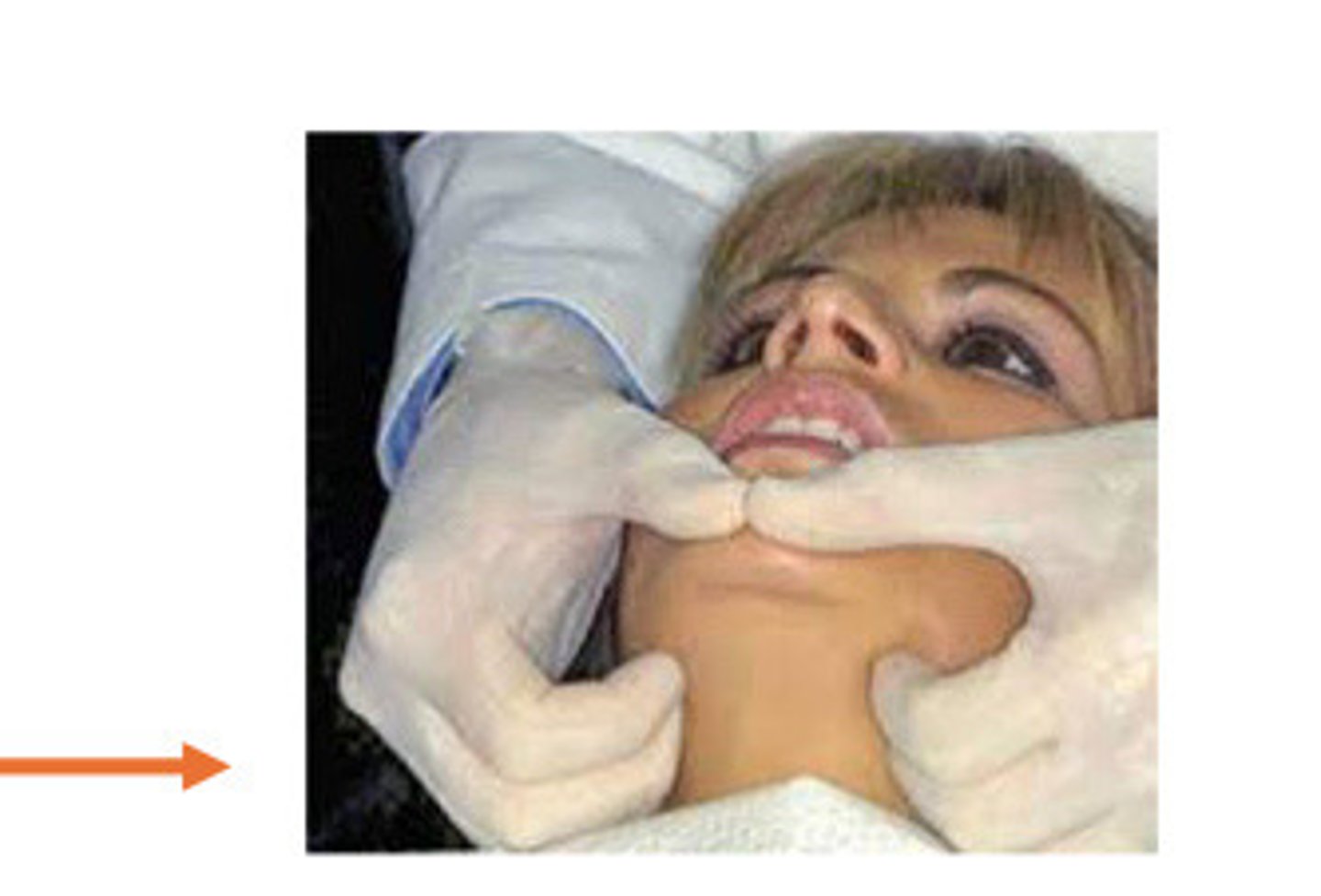
Retrusive
Backward movement of the mandible from
MI back to CR
1-2
Retrusive: In 90% people there is a discrepancy
between MI and CR about __ mm
protrusive
Forward moment of mandible with the teeth
together
• Usually guided by the incisors.
Working Side
Left and right lateral excursions: Side towards which mandible moves
Non-Working side
Left and right lateral excursions: opposite side towards which
mandible moves. Also called balancing side
Working side
the side toward which
the mandible moves in a lateral
excursion; syn, LATEROTRUSION
laterotrusive contacts
Contacts of
teeth made on the side of the occlusion
toward which the mandible has been
moved. (In this image left side contacts)
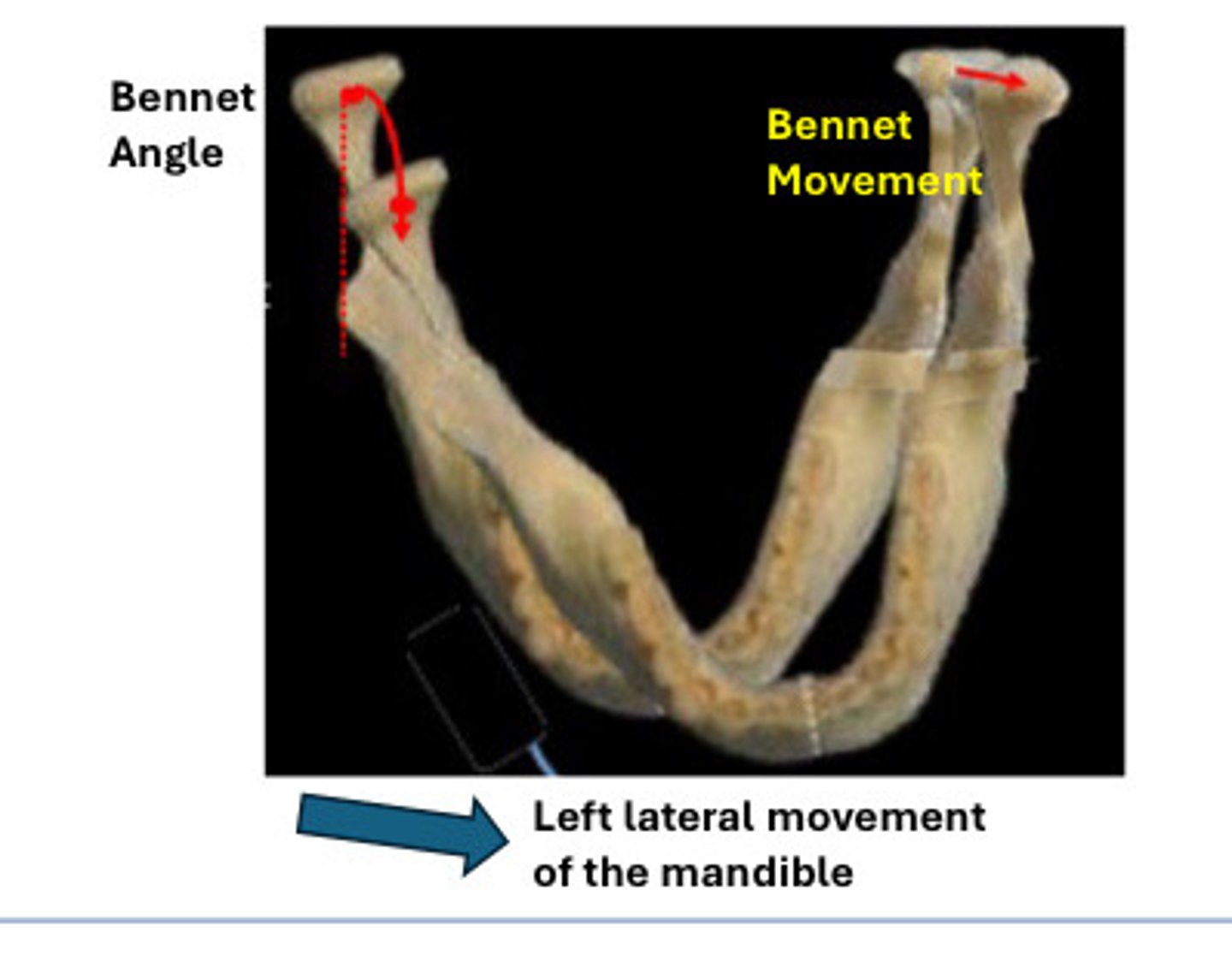
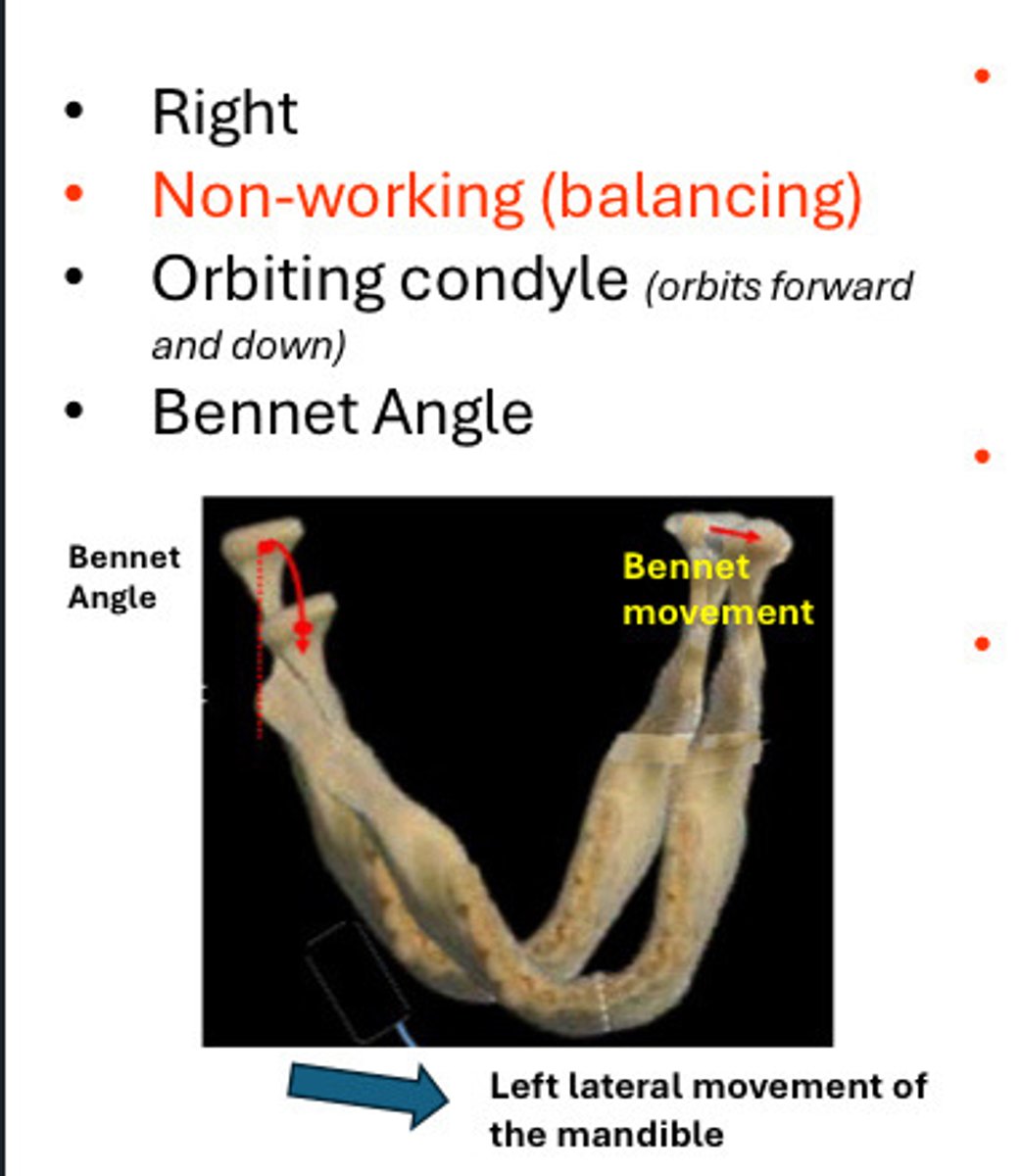
Bennet angle
the angle that is formed by the non-working condyle and the sagittal plane during lateral movement
Bennet movement
The side shift of the mandible is also know as the ______________
Non working side
that side of the mandible that
moves toward the medial line in a lateral excursion
(the opposite side toward which the mandible
moves in a lateral excursion; syn, MEDIOTRUSION
Mediotrusive contacts
Contact of the teeth on the side opposite to the
direction of laterotrusion of the mandible.
• Most common mediotrusive contact is the palatal cusp of
maxillary second molar
the mandible
Undesirable contacts
(In this image right side
contacts. (very desruptive if present)
Review
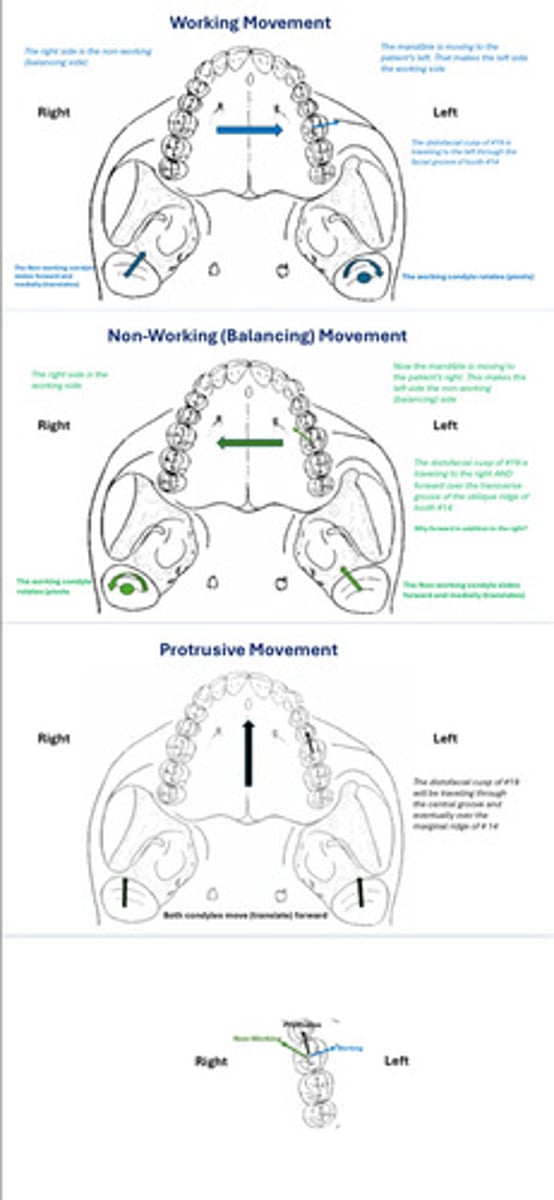
MI
Red dots
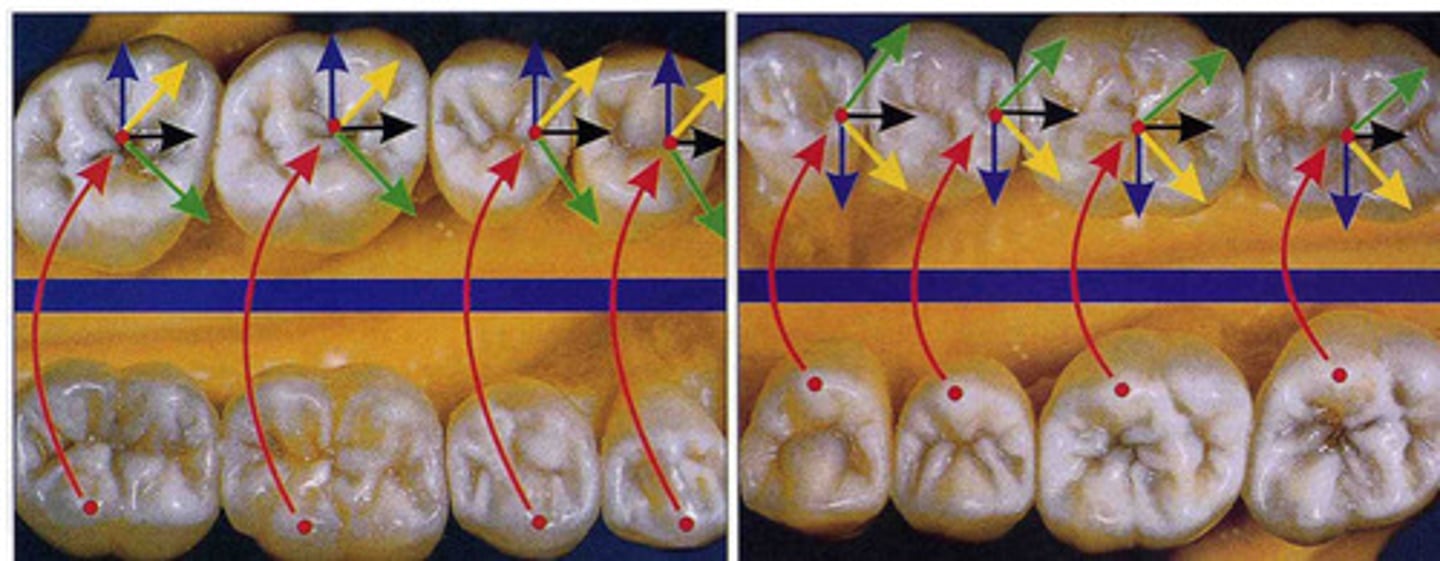
Protrusion
Black arrows
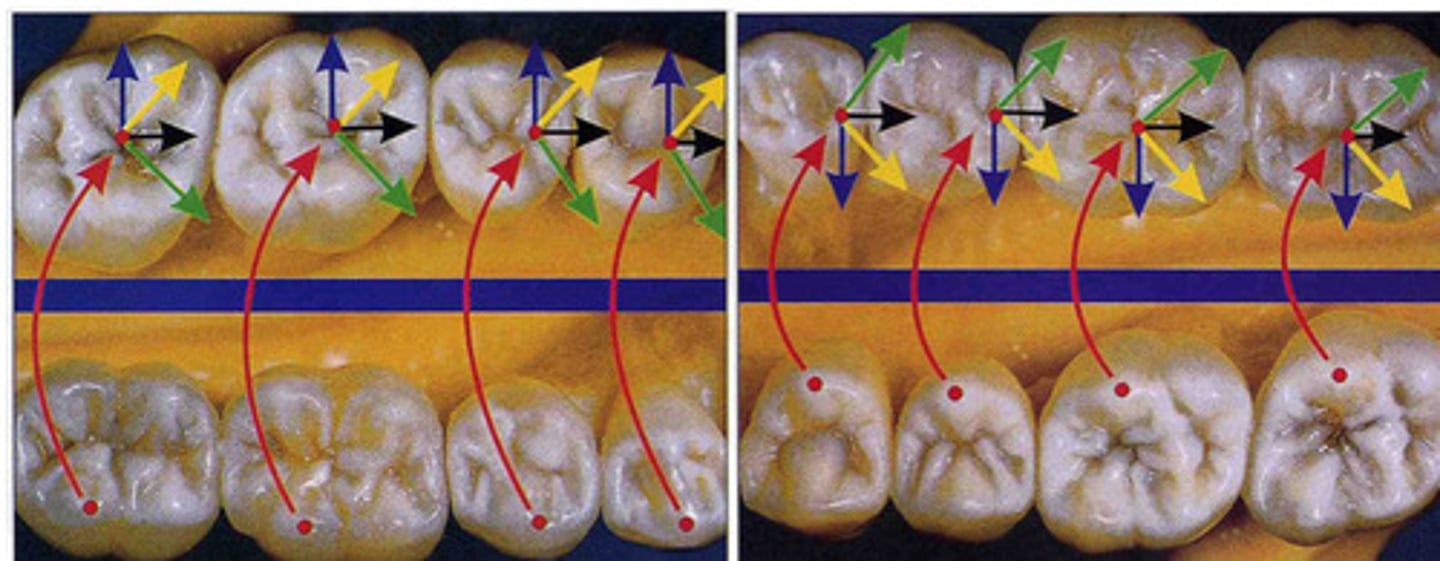
Mediotrusion
Green arrows
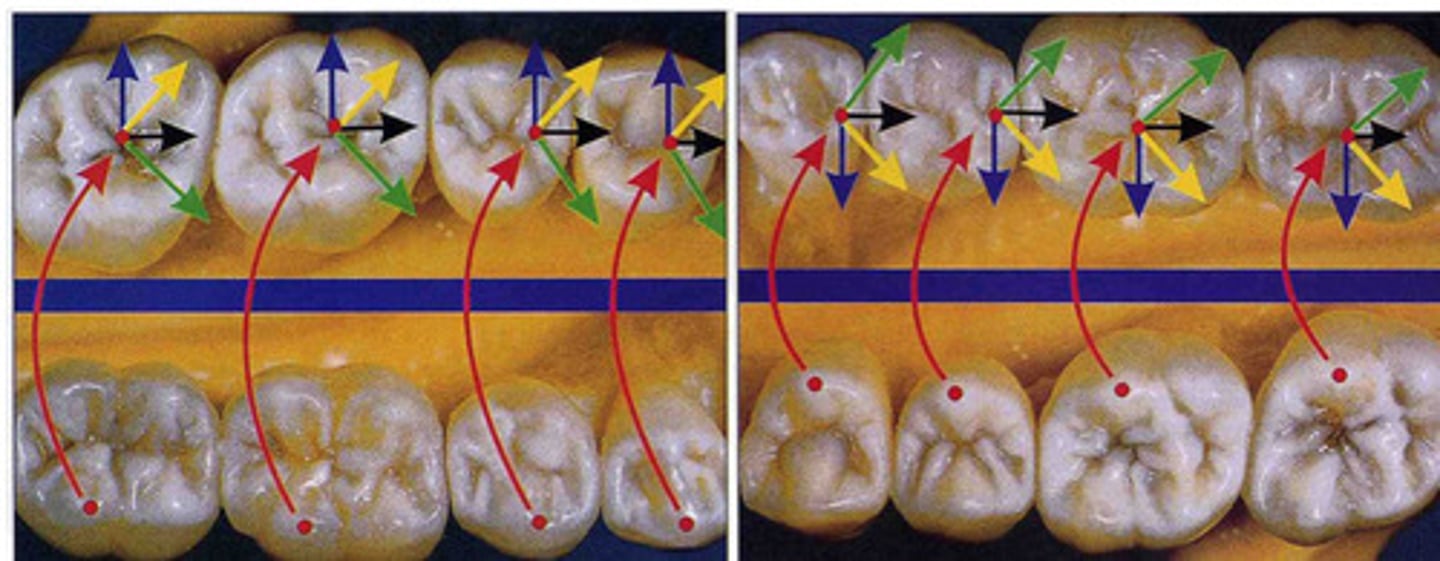
Laterotrusion
Blue arrows
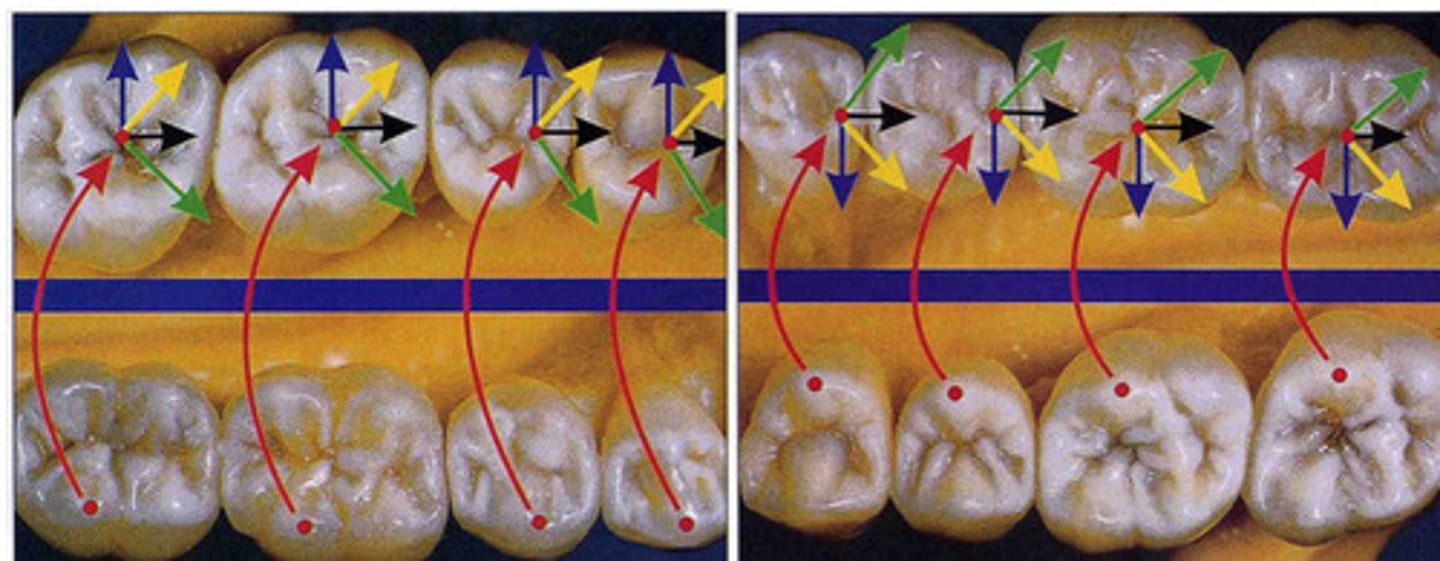
Left and right lateral excursions
• Canine guidance (only the canines contact on that side)
• All anterior teeth
• Group function (multiple teeth contact on that side)
• Combination
working
Ideally contact should only be on the __ side
Occlusal interference
Contact between teeth in one of the
excursions/movements of the mandible
when free sliding movement of the mandible
is interrupted
• Example, when there is contact on the non-
working side during lateral translation
Occlusal harmony
• Absence of occlusal interference
• Allows free movement of teeth in all excursions
without damage to teeth or restorations
vertical dimension of occlusion
Relationship between the mandible and
the maxilla with the teeth in MI
Optimal Functional Occlusion
The optimum orthopedic relationship that will prevent, minimize or eliminate any break down or trauma
Optimal Functional Occlusion
When the mouth closes, condyles in most superior
anterior position (Musculo skeletally stable) resting
on posterior slope of articular eminence, with
articular disc properly interposed. Even,
simultaneous bilateral contact of all posterior teeth.
Slight clearance of anterior teeth.
posterior
All __ tooth contact provide axial loading of
occlusal force.
PDL
The fibers of the __ are aligned such that
vertically directed forces through the long axis
(axial loading) can be well accepted and
dissipated.
Non-axial
loading
•When the force is not directed through its long
axis but rather a horizontal component (__) is incorporated that tends to cause
tipping and other problems.
Vertical forces
__- well accepted by the PDL
Horizontal forces
__ - cannot be effectively dissipated
Cusp tips contact flat surfaces
the resultant force is directed vertically through the long axes of the teeth (arrows). This type of force is accepted well by the periodontal ligament.
Opposing teeth contact on inclines
the direction of force is not through the long axes of the teeth. Instead tipping forces are created (arrows) that tend to cause compression of certain areas of the PDL. The forces are not effectively dissapated to the bone
Can cause mobility and/or tooth sensitivity
guiding
Because these non-axial forces are so damaging to the posterior teeth, we need specific __ systems to make sure the posterior teeth separate the instant the mandible starts to move off- center.
canine guidance
When the mandible moves a right or left laterotrusive excursion, the maxillary and mandibular canines are the appropriate teeth to contact and dissipate the horizontal forces while disoccluding or disarticulating the posterior teeth. When this condition exists, the patient is said to have __.
horizontal
Canines are best suited to accept __ forces that occur during eccentric movements in addition to disarticulating the posterior teeth.
lateral
• canines have Longest and largest roots that are surrounded by dense compact bone which tolerates __ forces better than the medullary bone found around posterior teeth
muscles
Fewer __ are active when canines contact during eccentric movements than when posterior teeth contact lower level of muscular activity would decrease forces to the dental and joint structures.
group function
If canine guidance is not possible, the acceptable alternative is __.
Group function
Multiple contact relations between the maxillary and mandibular teeth in lateral movements on the working side whereby simultaneous contact of several teeth acts as a group to distribute occlusal forces.
posterior
In group function Any laterotrusive contacts more __ than the mesial portion of the first molar are not desirable because of the increased amount of force that
can be created as the contact gets closer to the fulcrum (TMJ).
canines and the premolars
In group function The contacts are on the __
disocclude
The laterotrusive contacts (either canine guidance
or group function) need to provide adequate
guidance to __ the teeth on the opposite
side of the arch (mediotrusive or nonworking
side).
Mediotrusive
__ contacts (interferences) can be
destructive because of the amount and
direction of the forces
anterior guidance
During protrusive movement the anterior teeth can best receive and dissipate the forces. Unlike posterior teeth, anterior teeth are in proper position to accept
the forces of eccentric mandibular movements. Therefore during protrusion, the anterior and not the posterior teeth should contact. The anterior teeth should provide adequate contact or guidance to disarticulate the posteriors,
which is called __
Posterior teeth:
Static loading and vertical forces
Anterior teeth:
__ dynamic loading and horizontal forces
Posterior teeth:
Function effectively in forces applied during closure of the mouth, primarily
because their position in the arch is such that the force can be directed through their long axes and thus dissipated efficiently.
Anterior teeth:
Unlike posterior teeth, anterior teeth are in proper position to accept the
forces of eccentric mandibular movements
Bilateral occlusion
The ability of ornithopods to chew on both sides of the mouth at the same time is referred to as:
 Note
Note  Flashcards (31)