Accuracy of eyewitness testimony: Anxiety
 Call Kai
 Learn
Learn Practice Test
 Spaced Repetition
 Match
Match Flashcards
 Knowt Play
1/23

There's no tags or description
Looks like no tags are added yet.
Name | Mastery | Learn | Test | Matching | Spaced | Call with Kai |
|---|
No analytics yet
Send a link to your students to track their progress
24 Terms
What normally happens when people are in stressful situations?
They become anxious
What is the definition of anxiety?
An unpleasant emotional state
What does this anxiety tend to be accompanied by?
Physiological arousal
What is physiological arousal?
The body’s physical response to a stimulating situation
(Eg pounding heart, rapid breathing)
What is the usual effect of anxiety on performance in general?
Has a negative effect on memory and performance generally.
Although it can be argued that anxiety can in fact have a positive effect on memory…
Who studied the effect of anxiety on EWT?
Johnson and Scott (1976)
KEY STUDY: What was the AIM of Johnson and Scott’s 1976 experiment? (NEGATIVE)
To test the weapon focus effect.
This is the view that a weapon in a criminal’s hand distracts attention from other things because of the anxiety it creates - reducing identification accuracy in EWT.
What was the PROCEDURE of Johnson and Scott’s experiment.
They asked participants to sit in a waiting room.
For one group, a man ran through the room with a pen covered in grease (low anxiety condition).
For the other group, the man had a knife covered in blood (high anxiety/weapon focus condition).
Participants were then asked to identify the man from a set of photographs.
What were the FINDINGS of Johnson and Scott’s experiment?
Mean accuracy in identifying the man with pen - 49%
Mean accuracy in identifying the man with the knife - 33%
What were the conclusions of the experiment?
The weapon focus effect is true, anxiety has a negative effect on EWT.
What was a negative of the experiment?
Unethical - put participants through a traumatic situation
What was the AIM of Christianson and Hubinette’s 1993 experiment? (POSITIVE)
To test the effect of anxiety on memory
What was the PROCEDURE of Christianson and Hubinette’s experiment?
Questioned 58 real witnesses to bank robberies in Sweden.
The witnesses were either victims (high anxiety) or bystanders (low anxiety)
What were the FINDINGS of Christianson and Hubinette’s experiment?
All witnesses showed generally good memories for details of the robbery.
The victims had better recall than the bystanders.
What were the conclusions of the experiment?
Anxiety increases accuracy of recall.
What’s a possible explanation for remembering high anxiety situations?
Evolutionary explanation - it would’ve been adaptive to remember high-anxiety events so you could learn from these how to respond in similar high anxiety situations in the future.
What was a NEGATIVE of the experiment?
Interviews were conducted 4-15 months after robberies happened. So witnesses may have forgotten details.
What explains these contrasting results on the effect of anxiety on EWT?
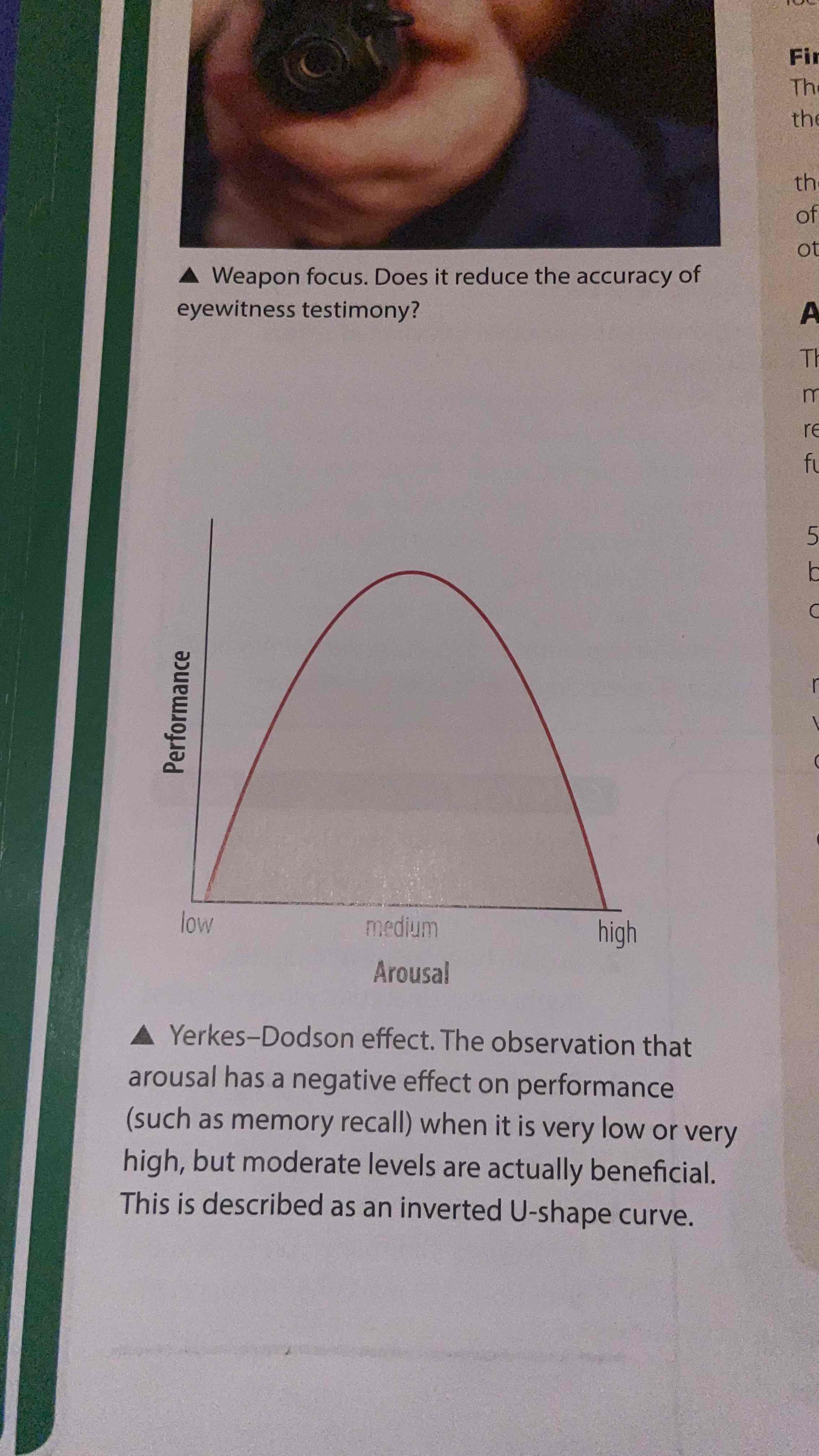
Deffenbacher (1983) suggested that the Yerkes-Dodson effect can account for this inconsistency.
What is the Yerkes-Dodson effect?
States that when arousal (anxiety) is too low, there will be a low performance in eyewitness accuracy. If it is too high, there will also be a low performance.
States that the optimum levels of performance occur with medium arousal. Moderate levels of anxiety are beneficial.
Yerkes-Dodson diagram
What is a negative of the Yerkes-Dodson law?
Individual differences
Positive eval
Christianson and Hubinette’s study was a real crime - high ecological validity
Negative eval
Weapon focus effect (WFA) may not be caused by anxiety - could just be the element of surprise.
To test this Pickel (1998) arranged for participants to watch a person entering a hairdressing salon carrying either:
Scissors (high threat, low surprise)
A handgun (high threat, high surprise)
A wallet (low threat, low surprise)
Or a raw chicken (low threat, high surprise)
Identification was least accurate in the high surprise conditions, rather than high threat.
More negatives
Violence of the event has an impact on memory - Halford and Milne (2005) found that violent crime witnesses are more accurate in EWT than non-violent crime witnesses.
Individual differences - emotional sensitivity is a key extraneous variable. Bothwell (1987) found that some people can be neurotic (become anxious quickly), and are different to stable individuals. Bothwell found that stable individuals showed rising levels of accuracy as stress levels increased, with the opposite true for neurotics.

