Electromotive force and Internal Resistance
 Studied by 0 people
 Call Kai
 Learn
Learn Practice Test
 Spaced Repetition
 Match
Match Flashcards
 Knowt Play
1/19

There's no tags or description
Looks like no tags are added yet.
Name | Mastery | Learn | Test | Matching | Spaced | Call with Kai |
|---|
No analytics yet
Send a link to your students to track their progress
20 Terms
What happens when charge passes through a power supply?
It gains electrical energy
What is the electromotive force?
The amount of chemical energy converted to electrical energy per coulomb of charge (C) when passing through a power supply
What is the equation for electromotive force?
E.M.F = Energy transformed from other froms to electrical /charge
e = E/Q
How is EMF represented?
E.m.f can be represented by the symbol ε (greek letter epsilon)
What is EMF equal to?
E.m.f is equal to the potential difference across the cell when no current is flowing
How is EMF measured?
E.m.f can be measured by connecting a high-resistance voltmeter around the terminals of the cell in an open circuit
*e.m.f is measured using a voltmeter connected in parallel with the cell
What is the terminal potential difference?
the potential difference across the terminals of a cell
What happens if there was no internal resistance?
the terminal p.d would be equal to the e.m.f
What is terminal p.d defined by?
V = IR
Where:
V = terminal p.d (V)
I = current (A)
R = resistance (Ω)
Why is the terminal p.d less than e.mf when power source is a cell?
Since a cell has internal resistance, the terminal p.d is always lower than the e.m.f
What happens in a closed circuit with internal resitance?
In a closed circuit, current flows through a cell and a potential difference develops across the internal resistance
What happens because resistance opposes current?
Since resistance opposes current, this reduces the energy per unit charge (voltage) available to the rest of the external circuit
This difference is called the ‘lost volts'
What is the lost energy per unit charge called?
Lost volts, which is represented by little v
What are lost volts?
The work done per unit charge / coulomb to overcome the internal resistance / resistance inside the battery (when current flows)
What can be derived from conservation of energy in a circuit?
v = ε – V = Ir (Ohm’s law)
Where:
v = lost volts (V)
I = current (A)
r = internal resistance of the battery (Ω)
ε = e.m.f (V)
V = terminal p.d (V)
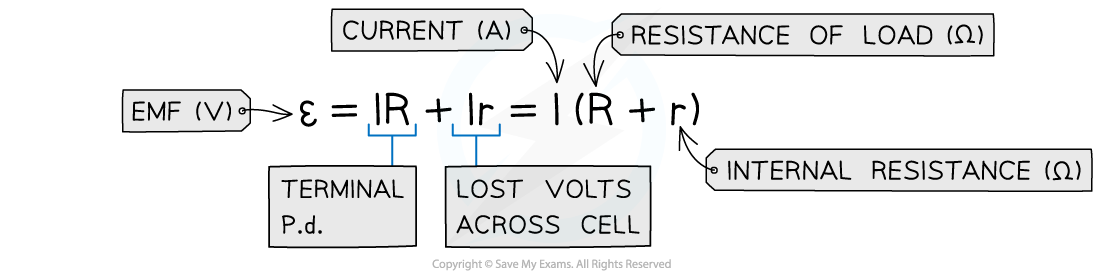
What is EMF in terms of Current, internal resistance and lost volts
ε = IR + Ir = I(R+r)
where:
Where:
Resistor R is the 'load resistor'
r is the internal resistance
ε is the e.m.f
Vr is the lost volts
VR is the p.d across the load resistor, which is the same as the terminal p.d
What is another definition of E.M.F?
the total, or maximum, voltage available to the circuit
What is internal resistance?
The resistance of the materials within the battery
What does Internal resistance cause?
It is internal resistance that causes the charge circulating to dissipate some electrical energy from the power supply itself
This is why the cell becomes warm after a period of time
What are the effects of internal resistance on a cell?
Therefore, over time the internal resistance causes loss of voltage or energy loss in a power supply
 Note
Note  Flashcards (33)