Chem lab overall
 Call Kai
 Learn
Learn Practice Test
 Spaced Repetition
 Match
Match Flashcards
 Knowt Play
1/100

There's no tags or description
Looks like no tags are added yet.
Name | Mastery | Learn | Test | Matching | Spaced | Call with Kai |
|---|
No analytics yet
Send a link to your students to track their progress
101 Terms
How long is the CHEM 125L practical exam?
1.5 hours.
Do you complete the practical exam with a partner?
No. It is completed independently.
How is the task assigned for the practical exam?
You are assigned a unique task at random as you enter the room.
Will detailed step-by-step instructions be provided during the exam?
No. You must know the basic lab skills and decide the procedure details yourself.
What information will be given during the exam?
Chemical names, formulas, molar masses if needed, and reaction equations if needed.
What procedure details will not be given during the exam?
Exact masses, volumes, glassware choices, preparation steps, and number of trials.
What are the three equally weighted grading categories?
Accuracy of results, worksheet/calculations/questions, and skill in techniques used.
What is the exam really testing besides calculations?
Whether you can independently choose and carry out a sensible lab procedure.
What should you identify first when reading your task?
The unknown, what quantity you must determine, what you can measure directly, and the needed stoichiometric relationship.
What is a good general goal when choosing a titration sample size?
Choose a sample that gives a moderate titration volume at the endpoint. (30 mL)
Why is a very small titration volume a bad idea?
Because it gives a larger relative error.
Why is a very large titration volume not ideal?
It takes more time and can be less efficient during the exam.
What is a smart titration trial plan in a timed exam?
One rough trial, then two or more careful concordant trials.
Why do a rough trial first?
To estimate the endpoint region so later trials are faster and more accurate.
What should every final answer be checked for?
Reasonableness, correct units, correct stoichiometry, and whether it fits the expected range.
What formula gives moles from mass and molar mass?
n = m / M
What formula gives moles from concentration and volume?
n = C × V, with volume in liters.
What formula gives concentration from moles and volume?
C = n / V
What formula is used for dilution?
C1V1 = C2V2
What formula is used for percent by mass?
% by mass = (mass of analyte / mass of sample) × 100
What formula is useful for calculating the mass needed to prepare a solution of known concentration?
m = C × V × M
After finding moles of one substance in a titration, what do you do next?
Use the balanced equation to convert by mole ratio.
What is one of the most common titration calculation mistakes?
Forgetting the stoichiometric coefficient from the balanced equation.
What glassware should be used to prepare a solution to an accurate final volume?
A volumetric flask.
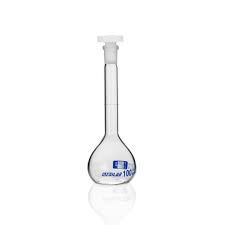
Why is a volumetric flask used for solution preparation?
Because it gives a very accurate final volume.
What glassware is best for transferring a precise aliquot?
A volumetric pipette.
What glassware is used to deliver titrant during a titration?
A burette.
What vessel is typically used to hold the analyte during titration?
An Erlenmeyer flask.
Why is an Erlenmeyer flask preferred during titration?
Because it can be swirled easily without spilling.
What does quantitative transfer mean?
Making sure all of the sample ends up in the final solution, usually by rinsing the container into the flask.
What should you rinse a burette with before filling it?
The titrant solution.
Why should a burette be rinsed with titrant first?
So leftover water does not dilute the titrant.
What must you check for in the burette tip before titrating?
Air bubbles.
Why is an air bubble in the burette tip a problem?
It makes the delivered volume inaccurate.
Why should the funnel be removed from the burette before titration starts?
So extra titrant cannot drip in and change the measured volume.
How should the meniscus be read in a burette?
At eye level.
What must be recorded for a burette reading?
Initial reading and final reading.
How do you find the volume delivered from a burette?
Final reading minus initial reading.
What should you do continuously to the flask during titration?
Swirl it.
Why do you wash down the walls of the flask with DI water during titration?
To make sure all analyte stays in the reacting solution.
Does adding DI water to the flask during titration change the number of moles of analyte?
No. It changes only the volume, not the number of moles.
How should you add titrant near the endpoint?
Dropwise.
What is the endpoint in an indicator titration?
The visible color change that signals the titration is complete.
Why is overshooting the endpoint bad?
Too much titrant is added, making the measured volume too large.
What is the usual appearance of a good phenolphthalein endpoint?
A very faint pink that persists.
What should determine your choice of indicator?
The pH range of the equivalence point.
For many weak-acid/strong-base titrations like KHP with NaOH or KOH, what is a common indicator?
Phenolphthalein.
Why is phenolphthalein commonly used in weak-acid/strong-base titrations?
Because its color change occurs in a basic pH range near the equivalence point.
What is the basic idea of Task A?
Prepare an accurately known solution from a primary standard solid, then use it to standardize an unknown solution by titration.
What is a primary standard?
A pure, stable substance of known composition that can be weighed accurately to prepare a solution of known concentration.
What are the main steps in Task A?
Choose target concentration and flask volume, calculate the needed mass, prepare the solution accurately, titrate an aliquot against the unknown, and calculate the unknown concentration.
In Task A, what formula is used to calculate the mass of solid needed for the standard solution?
m = C × V × M
In Task A, why must the primary standard be dissolved fully before final dilution?
So the entire measured mass contributes to the final concentration.
What should be done after filling the volumetric flask to the mark?
Stopper it and invert it several times to mix thoroughly.
In the oxalic acid and NaOH example, what is the stoichiometric ratio?
1 mole of oxalic acid reacts with 2 moles of NaOH.
What is the general calculation path for Task A?
Mass of primary standard → moles of primary standard → moles of unknown from stoichiometry → concentration of unknown.
What is a common practical error in Task A?
Incomplete transfer of solid or not filling exactly to the mark.
What is the basic idea of Task B?
Weigh a known mass of primary standard for each trial, dissolve it, and titrate it directly with the unknown solution.
What is the main difference between Task A and Task B?
Task A uses a prepared standard solution; Task B uses a weighed solid directly for each trial.
In Task B, why is the exact mass of solid so important?
Because it directly determines the number of moles used in that trial.
What formula gives the moles of primary standard in Task B?
n = m / M
In the KHP/KOH example, what is the stoichiometric ratio?
1 mole of KHP reacts with 1 mole of KOH.
If KHP and KOH react 1:1, what does that mean at equivalence?
Moles of KHP equal moles of KOH.
Does the amount of water used to dissolve the primary standard in Task B affect the moles present?
No. It changes only the solution volume, not the moles of solid weighed.
Then why do you still need enough water in Task B?
So the solid dissolves completely and can react fully.
What is the general calculation path for Task B?
Mass of primary standard → moles of primary standard → moles of titrant from stoichiometry → concentration of titrant.
What is the basic idea of Task C?
Use a standardized titrant to determine how much analyte is present in an unknown sample.
What type of final answer often appears in Task C?
Percent composition or amount of analyte in the sample.
In Task C, what is usually measured directly from the titration?
The volume of standardized titrant used.
What formula is first used to find moles of titrant in Task C?
n = C × V
After finding moles of titrant in Task C, what is the next step?
Use stoichiometry to find moles of analyte.
After finding moles of analyte in Task C, what do you do if asked for mass or percent by mass?
Convert moles to mass, then use the percent by mass formula if needed.
In the KHP mixture example, why is the denominator the total sample mass and not just the KHP mass?
Because the sample contains KHP plus inert material.
What is the main conceptual difference between Task B and Task C?
In Task B the weighed solid is a pure primary standard; in Task C the weighed sample is an unknown mixture or analyte-containing sample.
What is a useful one-line memory aid for Task C?
Titration volume → moles titrant → moles analyte → mass analyte → percent in sample.
What is the basic idea of Task D?
A cation in solution displaces H+ ions from the resin, and the released H+ is titrated to determine how much cation was present.
What type of resin is used in Task D?
A cation exchange resin in the H+ form.
What does it mean that the column is saturated with H+ ions?
The exchange sites on the resin are occupied by H+ ions.
What happens when a metal cation passes through the H+-form cation exchange column?
The metal cation binds to the resin and displaces H+ ions into the eluate.
What is the eluate?
The liquid that comes out of the column.
Why is the eluate titrated in Task D?
Because it contains the displaced H+, which shows how much cation was in the original sample.
If NaOH is used to titrate the eluate, what is the relationship between moles of NaOH and moles of H+?
They react 1:1, so moles of NaOH equal moles of H+.
What determines how many moles of H+ are displaced by a cation?
The charge on the cation.
How many H+ ions are displaced by a 1+ cation?
One.
How many H+ ions are displaced by a 2+ cation?
Two.
How many H+ ions are displaced by a 3+ cation?
Three.
In the ZnCl2 example, what is the relationship between moles of Zn2+ and moles of H+ displaced?
n(Zn2+) = n(H+) / 2
Once you find moles of cation in Task D, how do you find the analyte concentration?
Divide by the original sample volume passed through the column.
Why must DI water be run after the sample through the column?
To push the displaced ions fully out of the column into the collected eluate.
What is a major conceptual trap in Task D?
Forgetting to account for cation charge when converting H+ to analyte moles.
What is the basic idea of Task E?
Make standards of known concentration, measure absorbance, build a calibration curve, then use it to find the unknown concentration.
What is λmax?
The wavelength at which the solution has maximum absorbance.
Why do you use λmax in spectrophotometry?
Because it gives the greatest sensitivity for measuring concentration.
What must be prepared before reading standards and unknowns in a spectrophotometer?
A blank.
What is the purpose of the blank in spectrophotometry?
To set the baseline and account for solvent and cuvette effects.
What is a standard curve?
A graph of absorbance versus concentration for solutions of known concentration.
In a standard curve, which variable goes on the x-axis and which on the y-axis?
Concentration on the x-axis and absorbance on the y-axis.
What is the usual form of the calibration equation?
A = mC + b
How do you solve for concentration from the calibration line?
C = (A - b) / m
What must you remember if the unknown was diluted before measuring its absorbance?
Correct for the dilution to find the original concentration.

