General Bio I Lecture 4 (Part 1)
 Call Kai
 Learn
Learn Practice Test
 Spaced Repetition
 Match
Match Flashcards
 Knowt Play
1/42

Earn XP
Description and Tags
Name | Mastery | Learn | Test | Matching | Spaced | Call with Kai |
|---|
No analytics yet
Send a link to your students to track their progress
43 Terms
Robert Hooke
In 1665, identified small box compartments in a homemade microscope and named them cells based off of monks
Anton van Leeuwenhoek
Bult more than 250 microscopes that could magnify up to 300 times. Identified microbial life through teeth plaque and named them animalcules
Cell Theory
All living things are composed of cells, Cells are the basic unit of life, every organism or living thing consists of 1 or more cells
Microscope Importance
Allows scientist to cell size, shape, organization, and internal structure. 1mm = 1,000um = 1,000,000 nm
Studying Cells Medical Relevance
Doctors can identify diseases based on cells shape and function (biopsies, papsmears, blood tests, microscopy and staining)
Prokaryotes
Cells that are unicellular, lack nucleus, and lack membrane bound organelles
Bacteria
Prokaryotic cells, small size allows them to adapt and occupy every environment. Most found on skin and intestinal tract and minimal cause disease. Produce vitamin K and B (aid in peptide creation to increase moods)
Lactic Acid
Turns sugar from fibers into short fatty acids used in producing ATP and NADH (enzyme for cellular respiration and energy production)
Why bacteria are successful
Long evolutionary history
small size allows them to occupy a variety of environments
They have many sources of energy (light, organic and inorganic compounds)
They have rapid reproduction rates and genetic variation
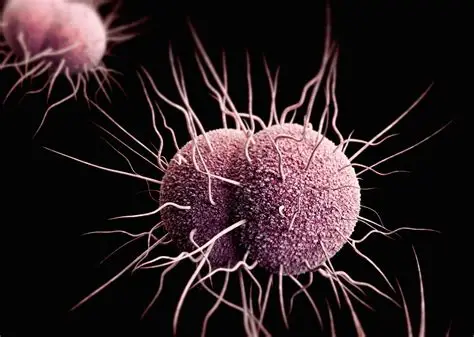
Spherical (Cocci)
Identify the processes of pathogens in the human body (STD, Gonorrhea)
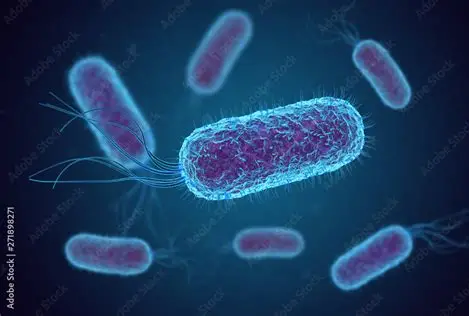
Rod (Bacilli)
Can cause a variety of diseases and decomposition (Fermentation, E.coli)
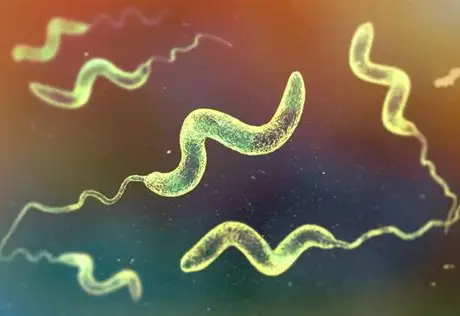
Spiral
Many cause diseases and take part in nutrient cycling (Syphilis, Lyme disease)
Antibiotics
Target structure unique to bacteria (cell wall, ribosomes, DNA enzymes). These targets cannot be found in human cells or viral infections
Archaea
Prokaryotic cell, though they look like bacteria they have unique membrane molecules, genetic sequence and enzymes. Usually live in extreme environments
Pyrococcus furiosus
Live in extremely high temperatures and has the ability to copy DNA with high validity
Halobacterium salinarum
Live in high salt concertation environments. Accumulates a high concentration of salt into potassium and chloride ions into its cytoplasm to balance out the oceans pressure
Methanobacterium
The first discovered. lives in an oxygen-free environment and produces methane as a byproduct
Cell Necessities
All cells need organelles that contain DNA, RNA, ribosomes, cytoplasm and a cell membrane. chemical reactions such as cellular respiration and protein synthesis that are needed to sustain life
Eukaryotes
Are unicellular or multicellular, have a nucleus and contain membrane bound organelles. Divide tasks into specialized compartments
Organelles
Are enclosed internal compartment in a Eucaryotic cell that perform specific functions for the cell’s survival and to reach homeostasis
Nucleus
Contains the majority of a cell’s DNA that aids in protein synthesis. It is surrounded by a nuclear envelope (double membrane) that has nuclear pores.
What do Nuclear Pores do?
They control what comes in and out of the nucleus. mRNA exits through these pores after experiencing synthesization
Nucleolus
Is a dense region inside the nucleus. it contains the genes for ribosomal RNA which is used to reduce ribosomes
Life’s Central Dogma
The explanation for how genetic information is stored, transported, and expressed
Cancer Diagnosis
Doctors examine the changes that occur to a cell’s membrane and nucleus
Eukarya
Eukaryotic cells that are found in animals, plants, fungi, and protists.
Biological Membranes
Physical barriers made with phospholipid bilayer that are buolt based off of:
hydrophobic interactions with the nonpolar fatty acid tails of phospholipids (interior)
hydrophilic interactions of the polar heads of phospholipids and water molecules (surface)
Selective Permability
The hydrophobic core allows for small nonpolar molecules to pass rapidly. Small polar molecules (ions) may diffuse at a slower rate due to their charge. Molecules that are large and too polar (glucose, amino acids) cannot be pushed with diffusion.
Fluid Mosaic Models
Membranes are not only made with phospholipids they also contain proteins, glycoproteins, glycolipids, and cholesterol. The molecules are able to move freely allowing the membrane to adapt, repair, and interacting with the environment easily
Diffusion
The spontaneous movement of molecules from an area with higher concentration to an area with lower concentration to reach equilibrium. This action is done passively without the use of ATP or the help of transportation proteins
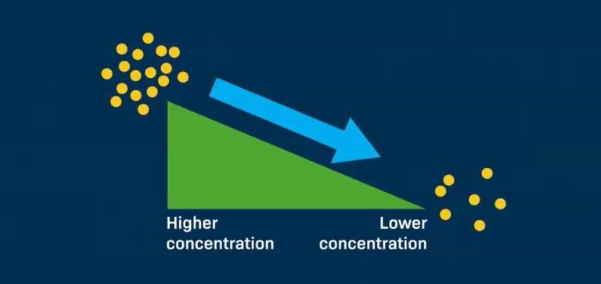
Concentration gradient
When the concentration of solutes is higher in one area compared to the other causing diffusion and osmosis
Facilitated Diffusion
A passive (no ATP) method that helps substances that cannot cross the membrane effectively overcome the membrane barrier with the help of carrier proteins moving them down the concertation gradient
Aquaporins
Water transporting proteins that act as a funnel to bring water in and out of the cell rapidly
Osmosis
The passive movement of water molecules across a membrane to an environment with less water and more solute (dissolvable substance) to reach equilibrium
Hypertonic
There is a high presence of solute on the outside if the cell causing water to leave the cell making it shrink and shrivel
Isotonic
There is an equal amount of solute present inside and outside the cell causing water to move in an out at an equal rate letting the cell stay the same size
Hypotonic
Less solute present outside the cell causing water to enter the cell making it reach a point of combustion or swelling
Active Transportation
An ATP powered method that uses transportation proteins to move substances against the concertation gradient
Phosphorylation Reaction
Method that uses ATP powered transport proteins to move substances against the concentration gradient. This move is made easier since the phosphate group, carries negative charge attaches to the protein changing its shape
Exocystosis
The movement of a large molecule or amounts of molecules from the inside to the outside of the cell. Are pushed by proteins and are held in vesicles (phospholipids) that attach to the cell membrane
Endocytosis
The action of the cell membrane folding inwards to bring in a large molecule or amounts into the cell with the formation of a pocket called a vesicle (phospholipids)
Chlamydia
Has an elementary body (infectious form) that enters host cells in the vaginal tract with endocytosis. The elementary body replicated within host cell which protects them from white blood cell. These replicas exit through exocytosis to continue the spread
Viral Infections
Infection that enters the cell through endocytosis and reproduces within host cell until it bursts or exist through exocytosis to continue spreading

