🧬 Lecture 2: Eukaryotic Gene Expression + RNA Polymerases + Gene Promoters

0.0(0)
Studied by 3 people
call kaiCall Kai
learnLearn
examPractice Test
spaced repetitionSpaced Repetition
heart puzzleMatch
flashcardsFlashcards
GameKnowt Play
Card Sorting

1/13

encourage image

There's no tags or description

Looks like no tags are added yet.

Last updated 6:51 AM on 4/1/26
Name
Mastery
Learn
Test
Matching
Spaced
Call with Kai

No analytics yet

Send a link to your students to track their progress

14 Terms

1
New cards

Chromatin and Transcription in Eukaryotes

  • Chromatin Structure
     Eukaryotic DNA is wrapped in chromatin
      Chromatin is DNA wrapped around proteins

  • Requirement for Transcription
     Chromatin must open for gene activation
      Open chromatin allows transcription to proceed

  • Type of Regulation
     Chromatin mediated regulation is eukaryotic specific
     It is part of epigenetic regulation
      Epigenetic regulation controls gene expression without changing DNA sequence
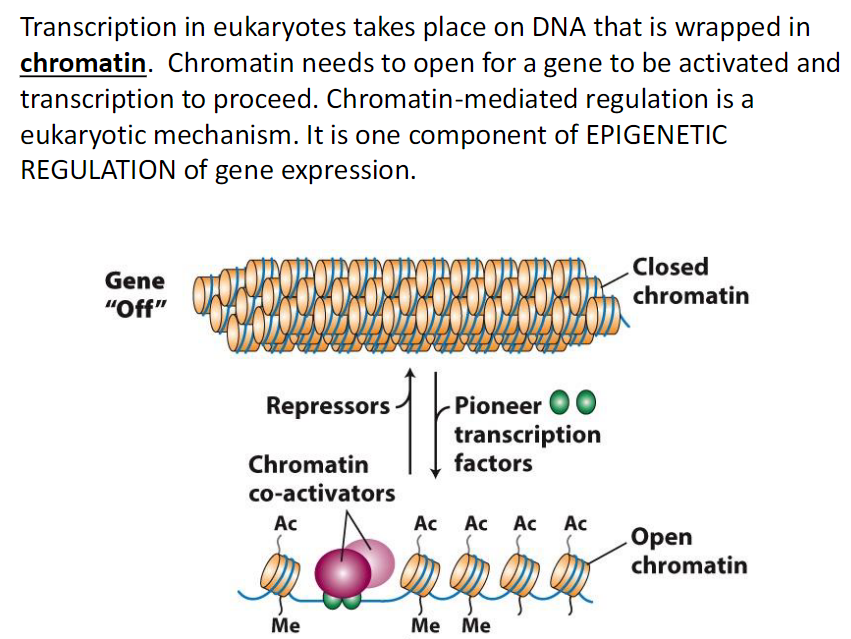
<ul><li><p><span style="background-color: transparent; font-family: &quot;Helvetica Neue&quot;, sans-serif;"><strong><span>Chromatin Structure</span><span><br></span></strong><span>  Eukaryotic DNA is wrapped in chromatin</span><span><br></span><span>   Chromatin is DNA wrapped around proteins</span></span></p></li><li><p><span style="background-color: transparent; font-family: &quot;Helvetica Neue&quot;, sans-serif;"><strong><span>Requirement for Transcription</span><span><br></span></strong><span>  Chromatin must open for gene activation</span><span><br></span><span>   Open chromatin allows transcription to proceed</span></span></p></li><li><p><span style="background-color: transparent; font-family: &quot;Helvetica Neue&quot;, sans-serif;"><strong><span>Type of Regulation</span><span><br></span></strong><span>  Chromatin mediated regulation is eukaryotic specific</span><span><br></span><span>  It is part of epigenetic regulation</span><span><br></span><span>   Epigenetic regulation controls gene expression without changing DNA sequence</span></span></p></li></ul><p></p>
2
New cards

Euchromatin and Heterochromatin

  • Heterochromatin
     Hetero means different
     Regions of chromosomes that are densely packed
     Rich in repetitive DNA
      Includes transposons centromeres and telomeres
     Not accessible to transcriptional machinery
      Transcriptional machinery is proteins needed to transcribe genes
     Inactive genes are found in heterochromatin

  • Euchromatin
     Eu means true
     Less dense regions of chromatin
     Accessible to transcriptional machinery
     Active genes are found in euchromatin
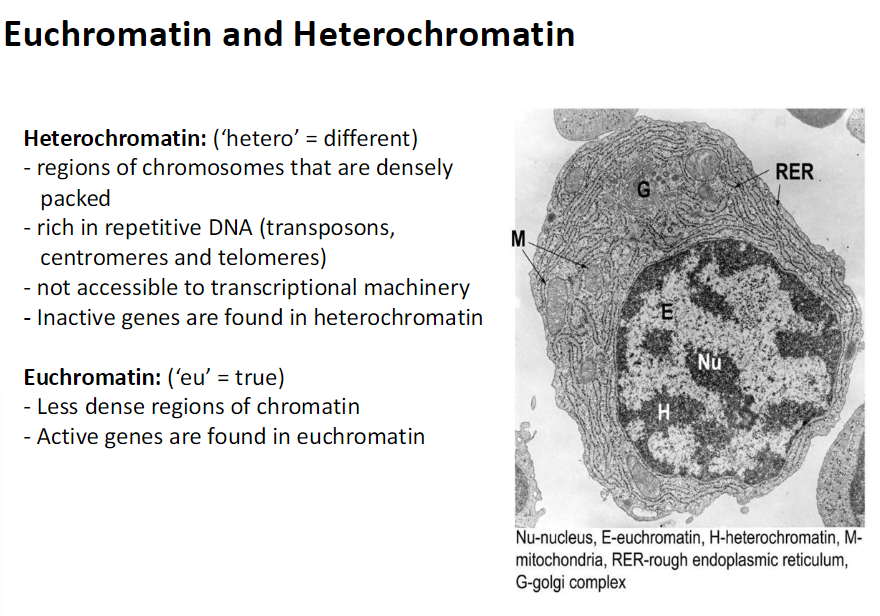
<ul><li><p><span style="background-color: transparent; font-family: &quot;Helvetica Neue&quot;, sans-serif;"><strong><span>Heterochromatin</span><span><br></span></strong><span>  Hetero means different</span><span><br></span><span>  Regions of chromosomes that are densely packed</span><span><br></span><span>  Rich in repetitive DNA</span><span><br></span><span>   Includes transposons centromeres and telomeres</span><span><br></span><span>  Not accessible to transcriptional machinery</span><span><br></span><span>   Transcriptional machinery is proteins needed to transcribe genes</span><span><br></span><span>  Inactive genes are found in heterochromatin</span></span></p></li><li><p><span style="background-color: transparent; font-family: &quot;Helvetica Neue&quot;, sans-serif;"><strong><span>Euchromatin</span><span><br></span></strong><span>  Eu means true</span><span><br></span><span>  Less dense regions of chromatin</span><span><br></span><span>  Accessible to transcriptional machinery</span><span><br></span><span>  Active genes are found in euchromatin</span></span></p></li></ul><p></p>
3
New cards

Differences Between Prokaryotes and Eukaryotes Transcription Control

  • Prokaryotes
     Relatively simple transcriptional control

  • Eukaryotes
     Very elaborate transcriptional control
     Gene must first be located in open chromatin
      Open chromatin allows access to DNA
     Once accessible a variety of factors regulate expression
     Each individual gene is regulated separately
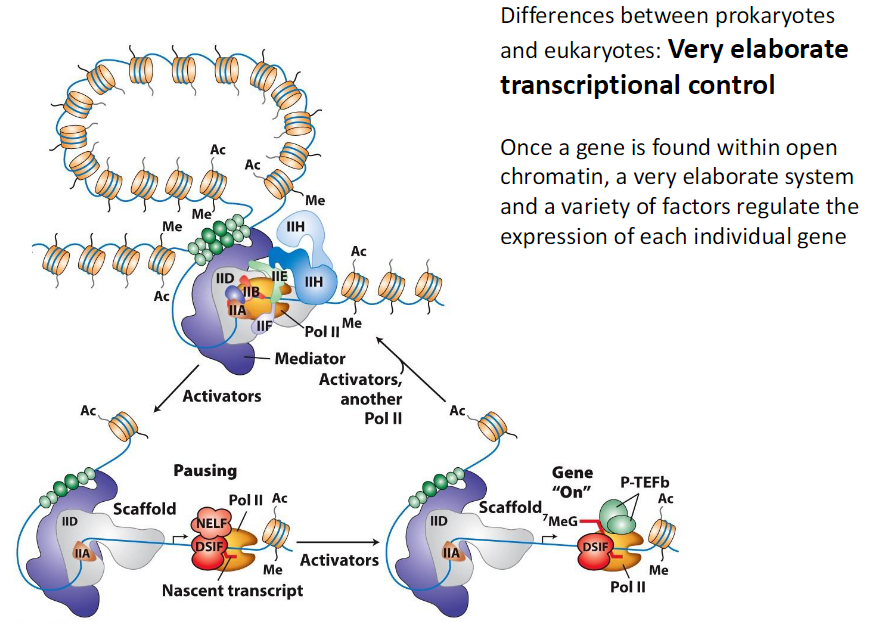
<ul><li><p><span style="background-color: transparent; font-family: &quot;Helvetica Neue&quot;, sans-serif;"><strong><span>Prokaryotes</span><span><br></span></strong><span>  Relatively simple transcriptional control</span></span></p></li><li><p><span style="background-color: transparent; font-family: &quot;Helvetica Neue&quot;, sans-serif;"><strong><span>Eukaryotes</span><span><br></span></strong><span>  Very elaborate transcriptional control</span><span><br></span><span>  Gene must first be located in open chromatin</span><span><br></span><span>   Open chromatin allows access to DNA</span><span><br></span><span>  Once accessible a variety of factors regulate expression</span><span><br></span><span>  Each individual gene is regulated separately</span></span></p></li></ul><p></p>
4
New cards

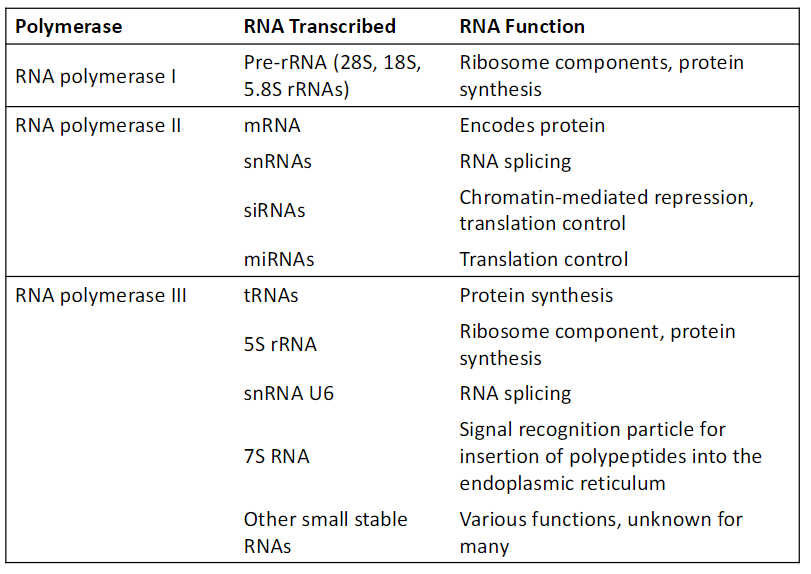
Eukaryotic RNA Polymerases

  • Don’t memorize chart

  • Know:

  • Pol I transcribes rRNA

  • Pol II transcribes mRNA

  • Pol III transcribes tRNA

<ul><li><p>Don’t memorize chart</p></li><li><p>Know:</p></li><li><p>Pol I transcribes rRNA</p></li><li><p>Pol II transcribes mRNA</p></li><li><p>Pol III transcribes tRNA</p></li></ul><p></p>
5
New cards

RNA Polymerase Structure

Crystal Structure
 The crystal structure of yeast RNA Polymerase II has been resolved at very high resolution
 This work was awarded a Nobel prize

Composition
 RNA Polymerase II consists of 12 polypeptides named RPB1, RPB2 … RPB12 (RP = RNA polymerase, B = 2)
 All other eukaryotic RNA polymerases share a very high level of similarity with yeast RNA Pol II

Key Features

Clamp Domain
 Located in RPB1
 Accommodates DNA during transcription
 After DNA is positioned the clamp closes via a bridge

Catalytic Center
 RNA synthesis occurs here
 Mg++ ions participate in the reaction

RNA Exit and Capping
 Newly synthesized RNA exits through a channel
 RNA is immediately capped with 7m Guanosine to protect it and prepare it for processing
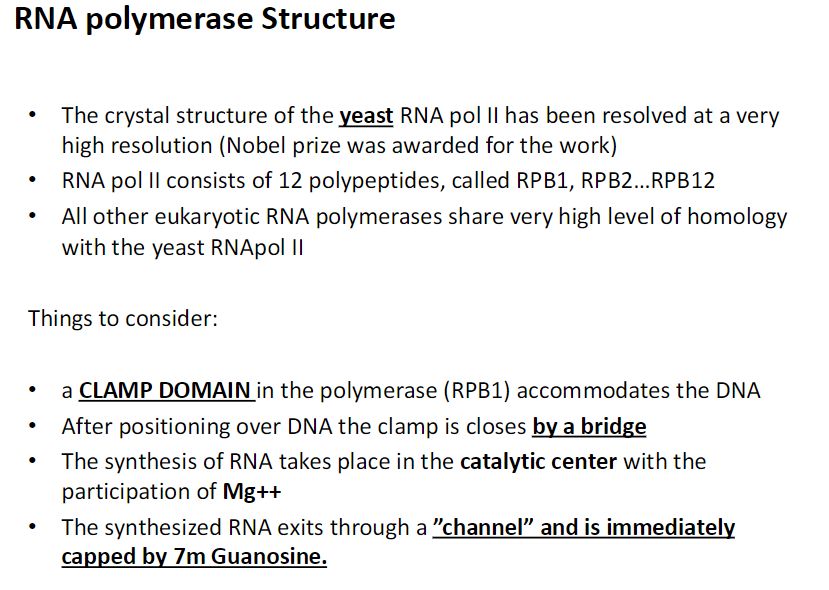
<p><strong>Crystal Structure</strong><br> The crystal structure of yeast RNA Polymerase II has been resolved at very high resolution<br> This work was awarded a Nobel prize</p><p><strong>Composition</strong><br> RNA Polymerase II consists of 12 polypeptides named RPB1, RPB2 … RPB12 (RP = RNA polymerase, B = 2)<br> All other eukaryotic RNA polymerases share a very high level of similarity with yeast RNA Pol II</p><p><strong>Key Features</strong></p><p><strong>Clamp Domain</strong><br> Located in RPB1<br> Accommodates DNA during transcription<br> After DNA is positioned the clamp closes via a bridge</p><p><strong>Catalytic Center</strong><br> RNA synthesis occurs here<br> Mg++ ions participate in the reaction</p><p><strong>RNA Exit and Capping</strong><br> Newly synthesized RNA exits through a channel<br> RNA is immediately capped with 7m Guanosine to protect it and prepare it for processing</p>
6
New cards

Eukaryotic RNA Polymerases

Complex Composition
 Eukaryotic polymerases are complexes of multiple polypeptides

Similarity to Prokaryotes
 Prokaryotic β and β’ subunits are similar to eukaryotic RPB1 and RPB2

Structural Conservation
 All these enzymes share strong structural similarity across species
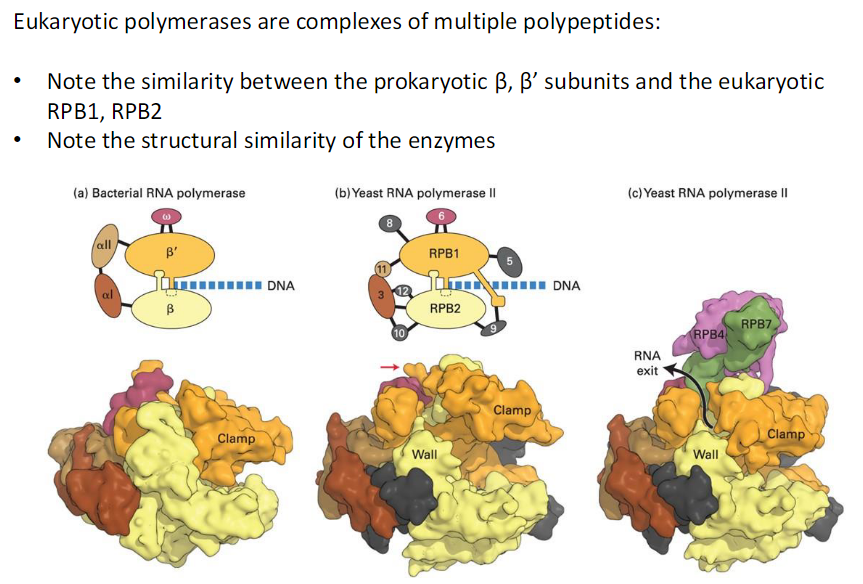
<p><strong>Complex Composition</strong><br> Eukaryotic polymerases are complexes of multiple polypeptides</p><p><strong>Similarity to Prokaryotes</strong><br> Prokaryotic β and β’ subunits are similar to eukaryotic RPB1 and RPB2</p><p><strong>Structural Conservation</strong><br> All these enzymes share strong structural similarity across species</p>
7
New cards

RNA Polymerase as a Molecular Machine

Key Features to Note
 The clamp and the bridge
 Position of DNA in the transcribing polymerase
 Channel through which the transcribed RNA is extruded from the complex
 Nascent RNA will be processed
  Processing includes splicing and other modifications
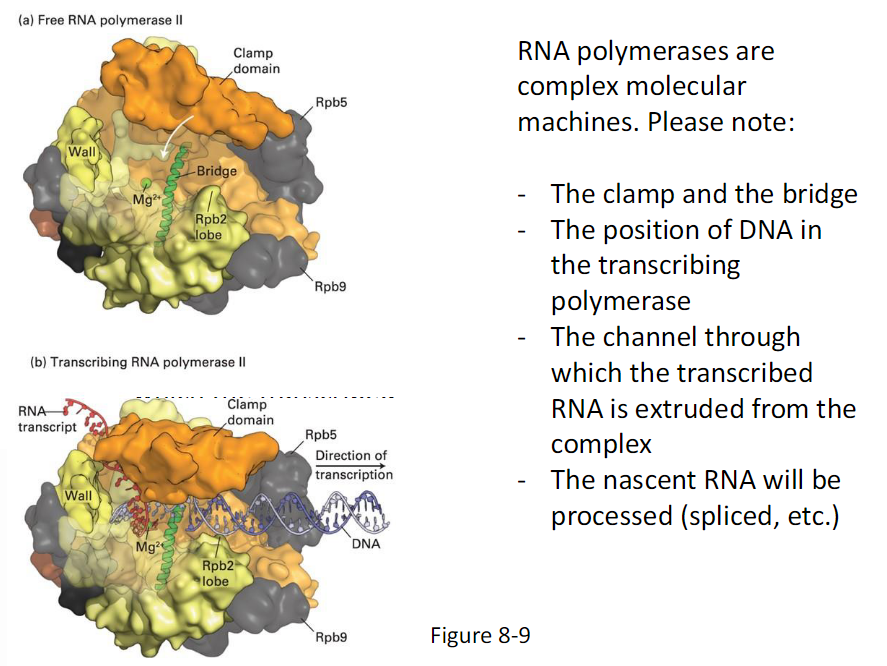
<p><strong>Key Features to Note</strong><br> The clamp and the bridge<br> Position of DNA in the transcribing polymerase<br> Channel through which the transcribed RNA is extruded from the complex<br> Nascent RNA will be processed<br>  Processing includes splicing and other modifications</p>
8
New cards

Carboxy-Terminal Domain (CTD) of RNA Polymerase II

Unique Feature
 CTD is a specialized domain of the RPB1 subunit (red arrow on image)
 Not found in any other polymerase, prokaryotic or eukaryotic

Functions
 Involved in multiple regulatory interactions
 Plays a key role in initiation, release, elongation, and processing of synthesized mRNAs

Structure
 In yeast, CTD contains 26 repeats of Tyr-Ser-Pro-Thr-Ser-Pro-Ser
 In mammals, CTD contains 52 repeats
 Ser residues are phosphorylated during transition from initiation to elongation
 CTD is intrinsically unstructured
  Not shown in crystallography-based slides because it cannot be analyzed by this method
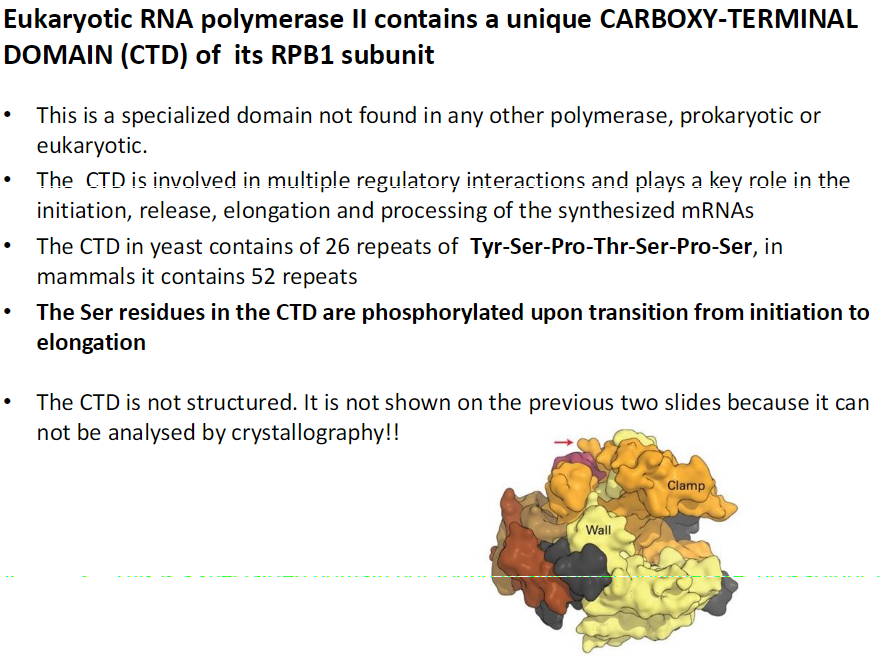
<p><strong>Unique Feature</strong><br> CTD is a specialized domain of the RPB1 subunit (red arrow on image)<br> Not found in any other polymerase, prokaryotic or eukaryotic</p><p><strong>Functions</strong><br> Involved in multiple regulatory interactions<br> Plays a key role in initiation, release, elongation, and processing of synthesized mRNAs</p><p><strong>Structure</strong><br> In yeast, CTD contains 26 repeats of Tyr-Ser-Pro-Thr-Ser-Pro-Ser<br> In mammals, CTD contains 52 repeats<br> Ser residues are phosphorylated during transition from initiation to elongation<br> CTD is intrinsically unstructured<br>  Not shown in crystallography-based slides because it cannot be analyzed by this method</p>
9
New cards

RNA Polymerase II in Drosophila DNA

Image Details
 Drosophila salivary gland DNA
 Red shows phosphorylated CTD of RNA Pol II
 Green shows dephosphorylated Pol II

Key Points
 Dephosphorylated Pol II (green) is at the transcription start site
 Cannot start elongation yet

 Actively transcribed genes can initiate transcription at multiple points
  This produces multiple RNA copies from the same gene at the same time

 Phosphorylated Pol II (red) is ready to start elongation
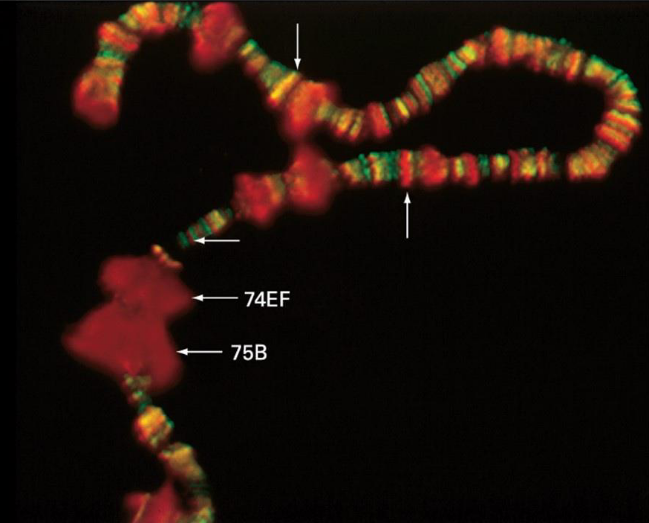
<p><strong>Image Details</strong><br> Drosophila salivary gland DNA<br> Red shows phosphorylated CTD of RNA Pol II<br> Green shows dephosphorylated Pol II</p><p><strong>Key Points</strong><br> Dephosphorylated Pol II (green) is at the transcription start site<br> Cannot start elongation yet</p><p> Actively transcribed genes can initiate transcription at multiple points<br>  This produces multiple RNA copies from the same gene at the same time</p><p> Phosphorylated Pol II (red) is ready to start elongation</p>
10
New cards

Regulation of Genes Transcribed by RNA Polymerase II (Descriptions from ChatGPT)

Basal Promoter Elements
 Also called Core Promoter Sequences
 Conserved sequences where the transcription machinery assembles

Promoter-Proximal Elements
 Binding sites near the promoter for transcriptional activators
 Help increase the efficiency of transcription initiation

Distal Regulatory Elements
 Enhancers or repressors located far from the gene
 Enhancers increase transcription
 Repressors decrease transcription

Chromatin Structure
 Organization of DNA and histone proteins affects gene accessibility
 Open chromatin allows transcription
 Closed chromatin inhibits transcription

RNA Polymerase II Promoters and General Transcription Factors
 Promoters are recognized by general transcription factors
 These factors recruit RNA Pol II and help initiate transcription
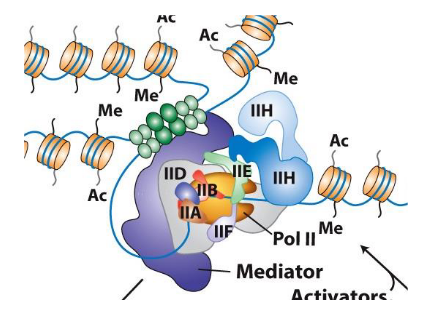
<p><strong>Basal Promoter Elements</strong><br> Also called Core Promoter Sequences<br> Conserved sequences where the transcription machinery assembles</p><p><strong>Promoter-Proximal Elements</strong><br> Binding sites near the promoter for transcriptional activators<br> Help increase the efficiency of transcription initiation</p><p><strong>Distal Regulatory Elements</strong><br> Enhancers or repressors located far from the gene<br> Enhancers increase transcription<br> Repressors decrease transcription</p><p><strong>Chromatin Structure</strong><br> Organization of DNA and histone proteins affects gene accessibility<br> Open chromatin allows transcription<br> Closed chromatin inhibits transcription</p><p><strong>RNA Polymerase II Promoters and General Transcription Factors</strong><br> Promoters are recognized by general transcription factors<br> These factors recruit RNA Pol II and help initiate transcription</p>
11
New cards

Positions of Core Promoter Elements

BRE
 TFIIB recognition element
 Located around -37 to -32

TATA Box
 Located around -31 to -26

Inr (Initiator)
 Spans -2 to +4
 +1 is the transcription start site
 Drosophila: TCAST
 Mammals: YYANTYY

DPE (Downstream Promoter Element)
 Located +28 to +32
 Sequence example: GAGACAGTTC

Other Notes
 Core promoter elements are binding sites for general transcription factors (Ac, Me, IIH, IID, etc.)
 Mediator and activators interact with these elements to regulate transcription
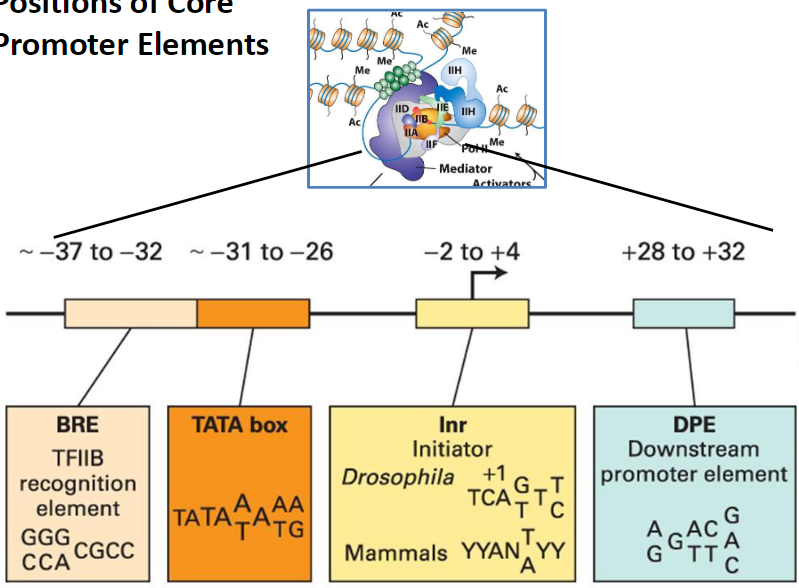
<p><strong>BRE</strong><br> TFIIB recognition element<br> Located around -37 to -32</p><p><strong>TATA Box</strong><br> Located around -31 to -26</p><p><strong>Inr (Initiator)</strong><br> Spans -2 to +4<br> +1 is the transcription start site<br> Drosophila: TCAST<br> Mammals: YYANTYY</p><p><strong>DPE (Downstream Promoter Element)</strong><br> Located +28 to +32<br> Sequence example: GAGACAGTTC</p><p><strong>Other Notes</strong><br> Core promoter elements are binding sites for general transcription factors (Ac, Me, IIH, IID, etc.)<br> Mediator and activators interact with these elements to regulate transcription</p>
12
New cards

Core Promoter Sequences in Eukaryotic DNA

TATA Box
 Tight consensus sequence
 Common in highly transcribed genes

Initiator (Inr)
 Less conserved element
 Some genes have Initiator but no TATA

BRE (TFIIB Recognition Element)
 Influences promoter activity

DPE (Downstream Promoter Element)
 Influences promoter activity

Transcription Start Site
 Defined point where transcription begins
 Usually an A on the coding strand

Polymerase Positioning
 Four elements (TATA, Inr, BRE, DPE) guide RNA polymerase to the promoter
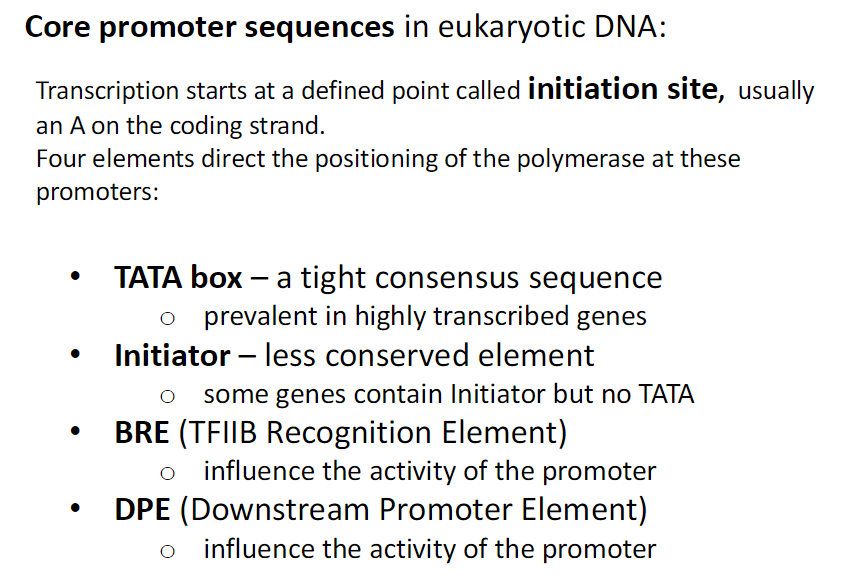
<p><strong>TATA Box</strong><br> Tight consensus sequence<br> Common in highly transcribed genes</p><p><strong>Initiator (Inr)</strong><br> Less conserved element<br> Some genes have Initiator but no TATA</p><p><strong>BRE (TFIIB Recognition Element)</strong><br> Influences promoter activity</p><p><strong>DPE (Downstream Promoter Element)</strong><br> Influences promoter activity</p><p><strong>Transcription Start Site</strong><br> Defined point where transcription begins<br> Usually an A on the coding strand</p><p><strong>Polymerase Positioning</strong><br> Four elements (TATA, Inr, BRE, DPE) guide RNA polymerase to the promoter</p>
13
New cards

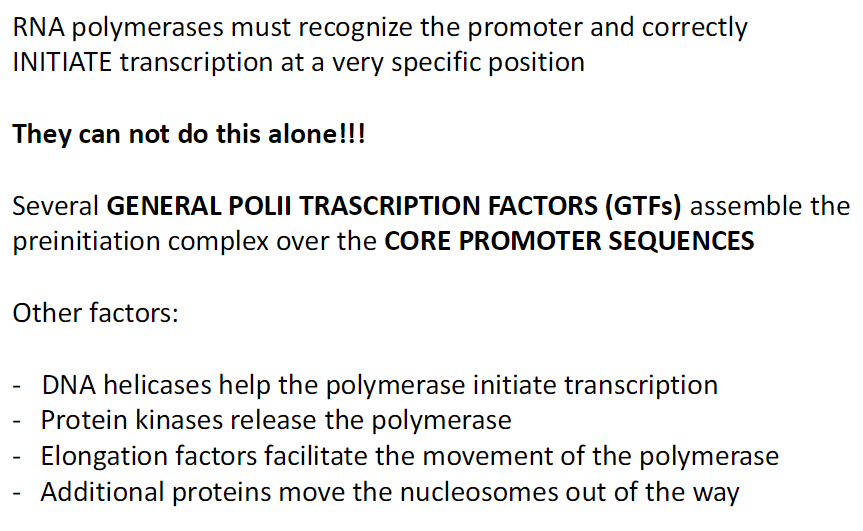
RNA Polymerase II and Transcription Initiation

Promoter Recognition and Initiation
 RNA polymerase must recognize the promoter
 Initiate transcription at a very specific site
 Cannot do this alone

General Transcription Factors (GTFs)
 Assemble the preinitiation complex over core promoter sequences

Other Supporting Factors
 DNA helicases – help unwind DNA so polymerase can start
 Protein kinases – release polymerase to begin elongation
 Elongation factors – help polymerase move along DNA
 Chromatin remodelers – move nucleosomes out of the way
<p><strong>Promoter Recognition and Initiation</strong><br> RNA polymerase must recognize the promoter<br> Initiate transcription at a very specific site<br> Cannot do this alone</p><p><strong>General Transcription Factors (GTFs)</strong><br> Assemble the preinitiation complex over core promoter sequences</p><p><strong>Other Supporting Factors</strong><br> DNA helicases – help unwind DNA so polymerase can start<br> Protein kinases – release polymerase to begin elongation<br> Elongation factors – help polymerase move along DNA<br> Chromatin remodelers – move nucleosomes out of the way</p>
14
New cards

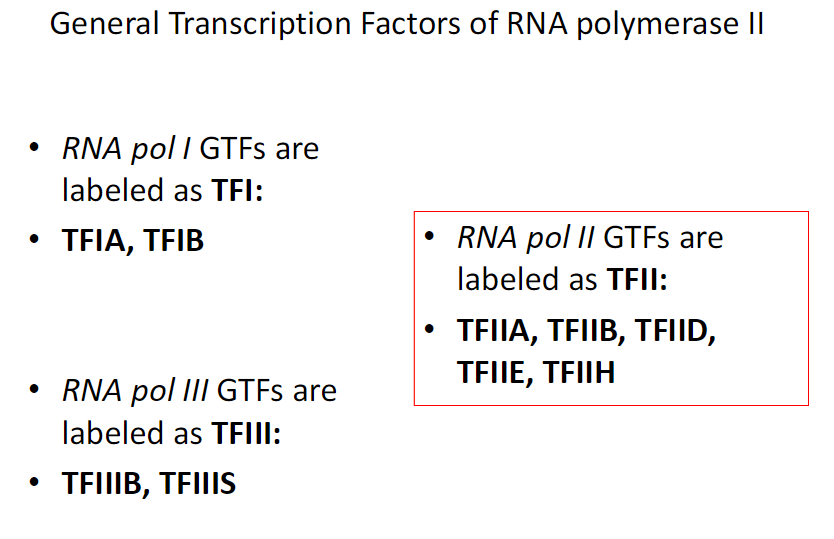
General Transcription Factors of RNA Polymerase II

RNA Polymerase I GTFs
 Labeled as TFI
 Examples: TFIA, TFIB

RNA Polymerase III GTFs
 Labeled as TFIII
 Examples: TFIIIB, TFIIIS

RNA Polymerase II GTFs
 Labeled as TFII
 Examples: TFIIA, TFIIB, TFIID, TFIIE, TFIIH
<p><strong>RNA Polymerase I GTFs</strong><br> Labeled as TFI<br> Examples: TFIA, TFIB</p><p><strong>RNA Polymerase III GTFs</strong><br> Labeled as TFIII<br> Examples: TFIIIB, TFIIIS</p><p><strong>RNA Polymerase II GTFs</strong><br> Labeled as TFII<br> Examples: TFIIA, TFIIB, TFIID, TFIIE, TFIIH</p>

Explore top notes

note
Science Test
Updated 1280d ago
0.0(0)
note
Different Types of Rocks
Updated 1260d ago
0.0(0)
note
AP Human Geography
Updated 112d ago
0.0(0)
note
3.1 Intro to Culture
Updated 128d ago
0.0(0)
note
Chapter Eight: Group Processes
Updated 1140d ago
0.0(0)
note
Period 1, c.1200 to c.1450
Updated 1161d ago
0.0(0)
note
Science Test
Updated 1280d ago
0.0(0)
note
Different Types of Rocks
Updated 1260d ago
0.0(0)
note
AP Human Geography
Updated 112d ago
0.0(0)
note
3.1 Intro to Culture
Updated 128d ago
0.0(0)
note
Chapter Eight: Group Processes
Updated 1140d ago
0.0(0)
note
Period 1, c.1200 to c.1450
Updated 1161d ago
0.0(0)

Explore top flashcards

flashcards
Spanish Set 8
53
Updated 848d ago
0.0(0)
flashcards
Areas of focus - Business
28
Updated 1161d ago
0.0(0)
flashcards
Chemistry - Ions and molecules
57
Updated 409d ago
0.0(0)
flashcards
Earthquakes and Volcanoes
28
Updated 497d ago
0.0(0)
flashcards
E2: ortho practice questions
101
Updated 411d ago
0.0(0)
flashcards
Chapter 1 - Financial Literacy
35
Updated 930d ago
0.0(0)
flashcards
Spanish Set 8
53
Updated 848d ago
0.0(0)
flashcards
Areas of focus - Business
28
Updated 1161d ago
0.0(0)
flashcards
Chemistry - Ions and molecules
57
Updated 409d ago
0.0(0)
flashcards
Earthquakes and Volcanoes
28
Updated 497d ago
0.0(0)
flashcards
E2: ortho practice questions
101
Updated 411d ago
0.0(0)
flashcards
Chapter 1 - Financial Literacy
35
Updated 930d ago
0.0(0)