ENVS 234 Oral Exam
 Call Kai
 Learn
Learn Practice Test
 Spaced Repetition
 Match
Match Flashcards
 Knowt Play
1/11

There's no tags or description
Looks like no tags are added yet.
Name | Mastery | Learn | Test | Matching | Spaced | Call with Kai |
|---|
No analytics yet
Send a link to your students to track their progress
12 Terms
What is a heat pump?
Give an example of how it is used.
Explain how it uses state changes to transfer energy.
A heat pump transfers energy from cold to hot using electricity.
Refrigerators do this as there’s evaporation on the inside and condensation on the outside.
State changes absorb the unwanted temperature
How are energy and climate related?
How does the earth receive, absorb, and retain energy?
What wavelengths of energy are important to consider in that process?
Fossil fuels directly affect the climate because of excess heat and pollution.
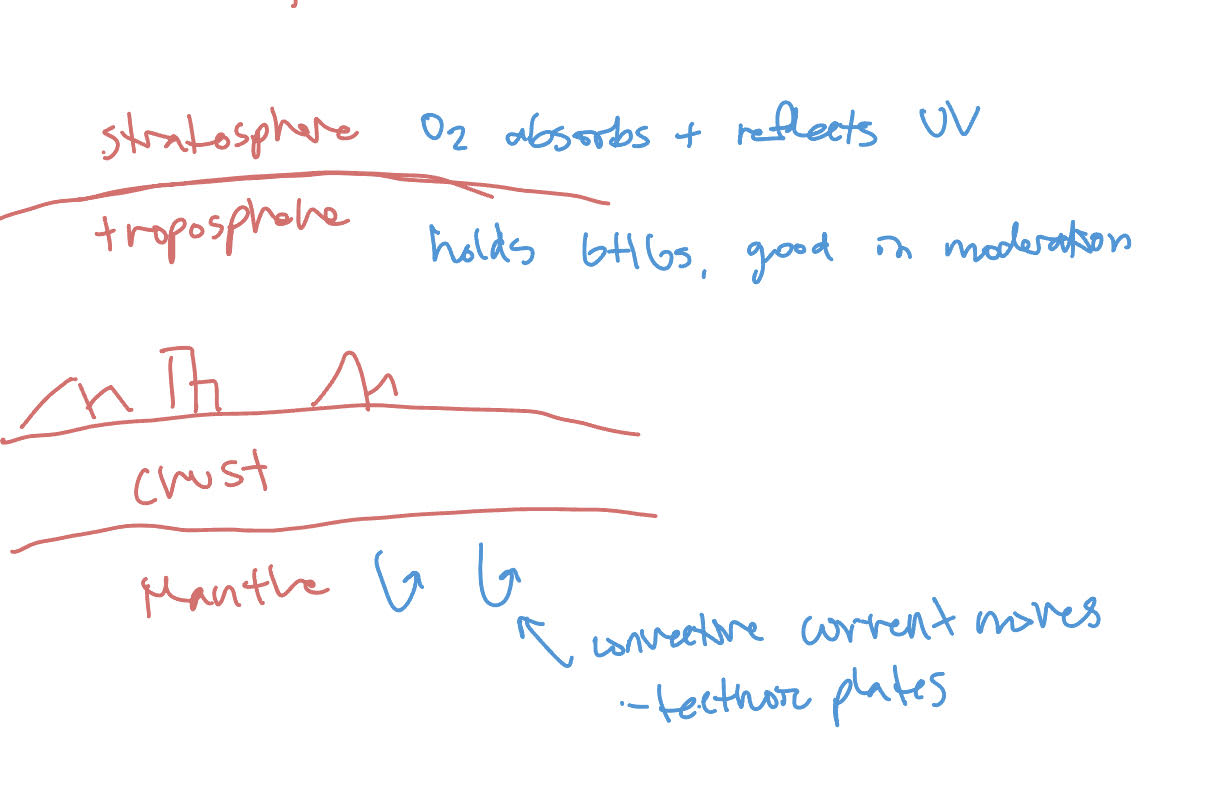
The stratosphere uses ozone to absorb and reflect solar radiation.
Radiation does most of the work and creates the greenhouse effect when shortwave UV is absorbed by the Earth and then re-emitted in form of long wavelength (infrared) when it doesn’t pass through the atm.
What are the natural and human drivers of climate change? Describe how both pre-human and modern climate change happen.
Natural: Milankovitch cycle (title, wobble, orbit), tectonic activity (erosion from mountain building + volcanos)
Humans: Industrialization (GHGs), agriculture (CH4, GHGs), deforestation
Pre-humans: volcanic activity, solar energy variations, tectonics
How does climate differ from weather and how do they interact? Give examples.
Climate: average weather in specific location over period of time.
e.g. snowy in January, hot/humid in July
Weather: daily, short-term
e.g. raining and then sunny
Climate affects weather by setting the baseline.
Draw a schematic of the inner earth and our atmosphere. Be prepared to describe how particular parts of each system impact climate/energy dynamics on earth.
What is the relationship between energy and power? Give an example of how it can be used to quantify something in everyday life.
How would you calculate your electricity consumption in your home?
Power is the action, energy is the product. energy = power * time
Power e.g. wattage on lightbulb is higher depending on how much work is done in a shorter amt of time.
Energy e.g. a moving car has kinetic energy
To calculate, multiply the watts of each energy-consuming thing, multiply it by the amount of time used, and add everything up.
How has US energy consumption and production trends changed over time?
What are the dominate/non-dominate sources and how have they changed over time. Why? Give examples.
Consumption + production has increased since the 1950s due to industrialization + globalization
Coal has decreased for both due to low public support because of dirtiness and cost-effectiveness. Petroleum and nat. gas has increased for consumption.
How is electricity produced in a power plant?
What is the typical fuel source and how does the fuel source get converted to electricity?
How efficient is that process?
Power plants usually work by turning energy to heat/movement + using that to rotate turbines, which are connected to generators that transform mechanical motion to electricity.
Natural gas - 30%-60% depending on the type of power plant.
How is kinetic and thermal energy related?
How do we measure that?
What is heat?
Thermal energy is a type of kinetic energy but with random motion.
Faster moving molecules have higher kinetic energy, thus higher thermal energy.
Heat: flow of energy as result of temp. difference.
Describe three types of energy transfer and give examples of each.
Conduction: direct collision of molecules (e.g. inside air transfers to window to outside)
Convection: bulk motion of fluid b/c of temp. difference (e.g. upwelling - heat rising from ocean current)
Radiation: electromagnetic radiation (e.g. bodies lose energy when it’s colder outside than us)
Which are the major greenhouse gases (GHGs) of concern and which sectors produce them? Give examples.
How have GHG emissions changed in the US overtime, how do they compare to other countries emissions?
CO2 (combustion of gas and diesel for vehicles), CH4 (nat. gas + petroleum), N2O (agriculture - fertilizer)
Emissions have gone down in the US, but we still use much more than other countries of similar size.
What is energy intensity and what does it not take into consideration in terms describing the impact of energy production/consumption on society?
Intensity is a country’s GDP to energy consumption. It doesn’t consider factors like type of energy (clean/renewable) and variety of uses.

