Community Ecology, Exam 1
 Studied by 0 people
 Call Kai
 Learn
Learn Practice Test
 Spaced Repetition
 Match
Match Flashcards
 Knowt Play
1/57

Earn XP
Description and Tags
Lectures 1-5 (last two slides of intro, idk what the hell I would put on here)
Name | Mastery | Learn | Test | Matching | Spaced | Call with Kai |
|---|
No analytics yet
Send a link to your students to track their progress
58 Terms
What is a community?
a group of populations living in the same area and
interacting with one another
What is community ecology?
The study of the interactions of species and their relationship to the
environment
What are the hierarchies in ecology?
Organism, Population, Community, Ecosystem, Biosphere
Why community ecology?
Organisms do not live in isolation
Cannot understand parrotfish without understanding prey, predators, competitors, and habitat
Ecosystems are not isolated
Coral reefs are affected by terrestrial and pelagic systems and are influenced by climate change
Biosphere is interconnected
Climate change is influenced by carbon flux and forest transpiration
what is habitat?
where an organism lives
• Physical features: climate, chemical environment, dominate plant and/or
animals species
What is niche?
what an organism does
• Tolerable conditions:
temperature ranges
• Interspecific interactions:
what it eats, what eats it
What are community interactions?
How organisms interact with each other and their environments
• Resource acquisition
• Energy and matter flow
What is a resource?
anything used or consumed by an organism
The act of consuming or using a resource manipulates, changes, or makes it unavailable for other organisms
Where do primary producer get their energy from? Where do they exist on the food web?
energy from inorganic sources
sources outside of the food web
base of the food web
where energy enters the food web
Where do primary producer get their energy from? Where do they exist on the food web?
Acquire energy from other organisms
Consuming organic molecules
Anywhere above the primary producers
What does a food web do?
Track energy in a community as it travels through species
What does a trophic pyramid do?
Track energy in a community as it travels through trophic levels
What are the different kinds of interspecific interactions? Aka multispecies interactions
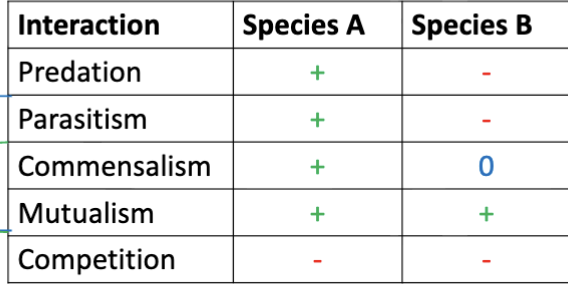
What kinds of multispecies interactions are facilitation, and which are symbiosis? (they overlap)
Facilitation: Commensalism, Mutualism
Symbiosis: Commensalism, Mutualism, Parasitism
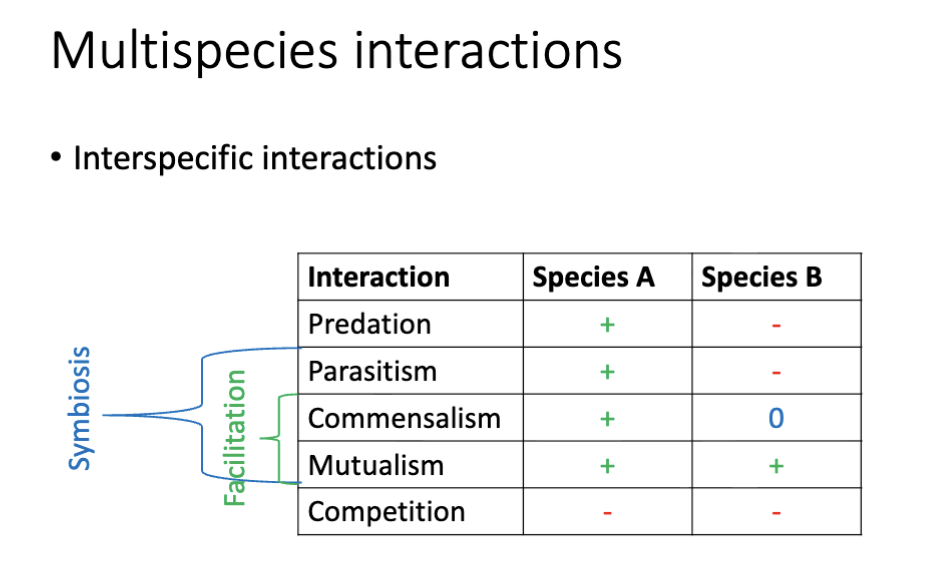
Describe predation in terms of Species A and Species B, who is who?
Species A consumes Species B
• Species A obtains resources, Species B is harmed or killed
• Species A = predator = all consumers plus some producers
• Species B = prey = organism consumed by a predator
What are the steps of predation?
Detecting prey
Pursuing prey
Capturing prey
Handling prey
Consuming prey
What is a consumer? Who is the consumer and who is the consumed?
Consume products or parts of other organisms
• Consumer = predator / parasite
• Consumed = prey / host
Are predators heterotrophs or autotrophs?
Predators can be heterotrophs or autotrophs
• Autotrophic predators are still classified as primary producers
• Vast majority of predators are heterotrophs
What are primary consumers classified as? What do they feed on? What do they do with their food? How are they specialized for this?
Primary consumers = herbivores
Feed on autotrophs/primary producers
Take organic molecules from primary producers and transform them into consumer tissue
Usually only possible via mutualistic microbes in digestive system
Animals: long digestive systems with specialized organs
What are secondary consumers classified as? What do they feed on? Can other feed on them? What is their hunting strategy?
Secondary consumers = carnivores, predators
Feed on other consumers
yes, they are prey for other consumers, so
Predator avoidance
optimal foraging
What are apex predators classified as? What do they feed on? Can other feed on them? What is their hunting strategy? Why do they matter?
Carnivore
Feed on consumers
are not (as adults) prey for consumers
But can still be hosts for parasites
No concern for predators, are aware of competitors
Often are keystone species
What are considered prey?
Everything except apex predators
What is optimal foraging?
Animals maximize net energy intake per unit of foraging time while minimizing energy expenditure (from google, if you can explain it you’re good)
What falls under the category primary producer consumers?
Carnivorous plants
Why do carnivorous plants exsist?
Obtain nutrients but not energy from prey
Live in habitats with poor soil quality
What are Hemiparasites? How do they obtain energy?
photosynthetic plants that obtain water and/or nutrients from a host
Some photosynthesize and use host as water supply
Some have limited photosynthetic ability
What is symbiosis?
Individuals of 2 or more species live in close physiological contact
Endosymbiosis and eukaryotic cells: what are the symbiotic features, and how do we know they are endosymbionts? How did Eukaryotes arise?
Mitochondria and plastids
Contain DNA
Divide separately from cell
Are the same size and shape as bacteria
Surrounded by double membrane
• Eukaryotes are Archaea that developed a mutualist association with bacteria
Secondary endosymbiosis (no way we need to know this)
Chloroplasts of alveolates, stramenopiles, and haptophytes are surrounded by a triple membrane
Red algal ancestor of chloroplasts
Describe parasitism in terms of Species A and Species B, who is who?
Species A obtains resources, Species B is harmed or killed
Species A = parasite = consumer that eats a portion of or extracts nutrition from another organism without initially killing it
Species B = host = prey of a parasite
What are the qualities of parasites in comparison to hosts? Who can be a parasite and who can have parasites?
Parasites are usually smaller with shorter generation times than host
All domains and major divisions/phyla have parasitic members
All domains and major divisions/phyla are infected by parasites
What do parasites do? How does this affect the host? Briefly explain their life cycles, like one word. Can parasites be hosts to parasites?
Impair their host
Infected prey are more likely to be consumed
Infected predators are less likely to catch prey
Complex life cycles
Yes, can be prey and host
What is a holoparasite?
heterotrophic plants that obtain all resources from the host
• Plants as primary consumers
What is the difference between a hemiparasite and a holoparasite?
Hemiparasites are plants that obtain water and/or nutrients from a host but still complete photosynthesis, while holoparasites are plants that obtain all resources from the host, plants as primary consumers
Describe parasitoids in terms of Species A and Species B, who is who? What animals are parasitoids? Who are their hosts?
Species A consumes Species B slowly
Species A obtains resources, Species B is killed
Species A = parasitoid = consumer that eats another organism slowly eventually killing it
Species B = host = prey of a parasitoid
• All known parasitoids are insects
• Hosts are arthropods
What is Entomopathogenic fungi? Who are their hosts? How do they spread and how do they impact their hosts?
parasitic fungi
insects
Spread via microscopic spores and penetrate insect cuticles
Host may be killed quickly and fungus decomposes corpse
Host may live until the fungus is ready to reproduce
Some influence host behavior, causing insect to seek out location favorable to the fungus
What is multiparasitism?
Hosts can host multiple species of parasites simultaneously
What is hyperparasitism?
Parasites can be hosts to parasites
Can parasitoids have parasitoids? Can hyperparasites be hosts to parasites? How many stacking levels of parasitism have we observed?
Yes, yes, and 3-5
What is a direct effect? In terms of species A and species B?
when 2 species interact directly with one-another
Species A eats, parasitizes, competes, facilitates species B
Only species A and B involved
What is an indirect effect?
when 2 species interact through an intermediate species
Species A eats, parasitizes, competes, facilitates species B
Species B eats, parasitizes, competes, facilitates species C
Species A has an indirect effect on species C
What are Cascading effects?
Indirect effects that control ecosystem structure
Web of indirect effects
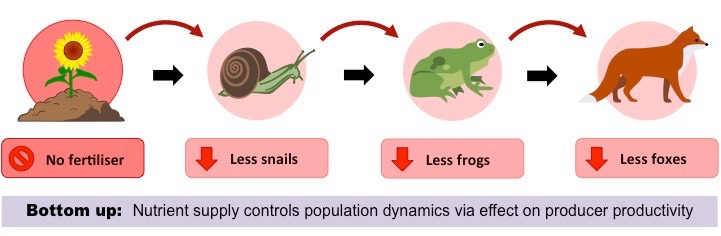
Are food webs controlled by producers or consumers?
Both
What is bottom up control? What happens if there are more/less primary producers?
When resources control ecosystem structure
Resources regulate primary producers
No primary producers, no organisms
More primary producers, more resources for higher trophic levels
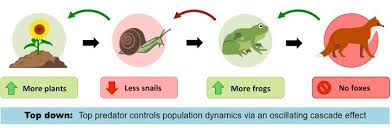
What is top down control? What happens if there are more/less predators?
predators control ecosystem structure
Predators suppress prey populations
Suppressed prey release own prey from control
Those prey then increase in abundance
Oscillating abundances as move to lower trophic levels
What is a density-mediated effect?
act through population density
Predators consume prey reducing prey population density
Top-down effect is through direct consumption
What is a trait-mediated effect?
act through phenotypic changes
Predator presence alters phenotype of prey
Alters how prey interact with environment and other species
Top-down effect is by changing prey traits
How often are bottom-up and top-down effects observed?
Bottom-up effects are always present
May only provide resources
Top-down effects are not always observed
Disrupted ecosystem function (humans like to kill apex predators and mess up ecosystems)
Describe commensalism in terms of Species A and Species B. What can be gained in commensalism? How are commensal species well-suited to that lifestyle?
Species A benefits, Species B is not affected
Species B (host) is facilitating Species A (commensal species)
Commensal species may gain
Food / nutrients
Shelter
Support
Transportation
Commensal species may be specialized and specifically adapted for relationship
Describe mutualism in terms of Species A and Species B. What can be gained in mutualism? How are mutualistic species well-suited to that lifestyle?
Species A and Species B benefit
Species A and B (mutualists) are facilitating one-another
Mutualists may gain
Food / nutrients
Shelter
Protection
Enhanced reproduction
Obligate vs facultative (necessary vs. optional)
Specialist vs generalist (specific vs. flexible)
Give some examples of plant & fungus mutualism
Legumes – nitrogen-fixing
Fabaceae and Rhizobia
Pollination
Angiosperms (mostly) and animals
Mycorrhizae
~90% of land plants and fungi
Lichens
Fungi and photoautotrophs
Give some examples of animal mutualism
with autotrophs
Coral and zooxanthellae
Riftia and chemoautotroph
Microfauna
Digestive
External
Cleaners
Explain competition in terms of Species A and Species B. How are they affected? + or - ?What are some reasons that one acquires the resource and the other doesn't?
Species A sequesters a resource before Species B
Species A and Species B (competitors) are both negatively affected
But Species B is more negatively affected
Species A may
Be better able to obtain or sequester the resource
Take the resource from Species B
Not require as much of the resource
What is competitive exclusion?
when a species is excluded from a habitat due to competition with another species
Competition can alter the ________ _______ bahviour of competeitors. This can lead to what kind(s) of control?
resource obtaining
Bottom-ish, Middle and Top
What 2 things cab competition lead to?
Competitive exclusion
Niche partitioning
What is a keystone species?
Species that have a disproportionate impact on community structure
May not be numerous
Can be
Predators/parasites
Competitors
Facilitators
Engineers
What are ecosystem engineers?
Species that significantly alter the physical structure of their habitat
Keystone species
Often define the habitat
Create, modify, or destroy habitat
 Note
Note  Flashcards (31)