Environment, health and well-being
 Call Kai
 Learn
Learn Practice Test
 Spaced Repetition
 Match
Match Flashcards
 Knowt Play
1/6

There's no tags or description
Looks like no tags are added yet.
Name | Mastery | Learn | Test | Matching | Spaced | Call with Kai |
|---|
No analytics yet
Send a link to your students to track their progress
7 Terms
Define health, morbidity, mortality, infant mortality rate, attack rate, case mortality rate, crude mortality rate, epidemic, pandemic and prevalence
Health is a state of complete physical, mental, and social well-being and not merely the absence of disease and infirmity.
Morbidity is an illness and the reporting of disease. Some diseases are so infectious that by law they must be reported e.g. plague and cholera.
Mortality is the death of people. It is measured by a number of indices including death rate, infant mortality, case mortality, and attack rate.
Infant mortality rate is the number of deaths of children under the age of 1 year expressed per 1000 live births per year.
Attack rate is the number of cases of a disease diagnosed in an area, divided by the total population, over the period of an epidemic.
Case mortality rate is the number of people dying from a disease divided by the number of those diagnosed as having the disease.
Crude mortality rate is the number of deaths per 1000 people in 1 year.
An epidemic is a widespread occurrence of an infectious disease in a community at a particular time.
A pandemic is an epidemic that becomes very widespread and affects a whole region, a continent, or the world.
Prevalence is the total number of cases of a disease in a given population at a specific time.
Why might there be a geography to health?
- there are patterns to the spread of diseases
- linked to physical and human factors that influence the health of people
- linked to the socio-economic, political, and environmental impacts of diseases and infections
- the spatial and societal patterns of response - investments in healthcare and welfare
- the impacts of an aging population and population structures generally
- local, regional, national, and global patterns of mortality
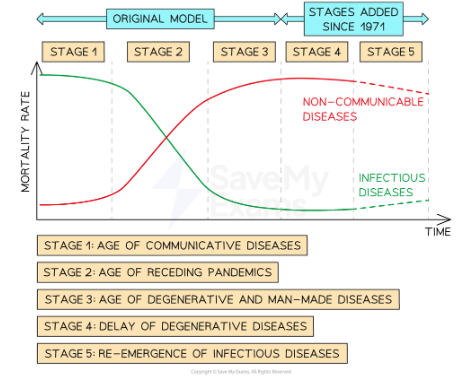
Describe the Epidemiological Transition Model
This is a model that explores the dominant causes of death at different stages of economic and social development. It was developed in 1971 by Abdel Omran.
It shows the pattern degenerative and man-made diseases (such as those related to smoking) that mostly effect the elderly.
The model says that as life expectancy increases, the major causes of death and disability in general shift from communicable, maternal causes, to chronic non-communicable ones.
What are exogenic deaths and what causes them?
e.g. parasitic diseases, infective disorders (gastro-enteritis, diarrhoea, tuberculosis), deficiency diseases (nutritional stress, malnutrition famine)
What causes them?
- socio-economic conditions- poverty, lack of clean water, sanitation, food deficiency, lack of health care, low levels of education
- climatic variables- warm, humid climates encourage infective micro-organisms and germs as well as transmission by animal vectors such as mosquitoes
- rapid spread of HIV/AIDS
What are endogenic deaths and what causes them?
e.g. heart diseases, strokes, circulatory diseases, cancer, chronic or deteriorative diseases associated with older adulthood.
- do not decline significantly with economic development
- influenced by lifestyle
How does climate, topography and drainage impact incidence of disease?
- drought can lead to crop failure, reduction in food consumption and the potential for famine
- flooding is caused by heavy rains or tropical storms and can lead to water-borne diseases and respiratory infections
- floodwater can contaminate freshwater supplies, creating breeding grounds for mosquitoes. there is also risk of drowning as severe disruption to medical and health services
- poor water supplies are estimated to case 842,000 diarrheal diseases such as cholera
- seasonal affective disorder is a type of depression that has a seasonal pattern, linked to reduced exposure to sunlight during shorter days
- hay fever and asthma can cause sneezing, streaming eyes and headaches due to pollen in the air ding spring in the UK
- people living on floodplains are at risk to death, as well as illnesses such as diarrhea, respiratory infections, hepatitis A and E, typhoid and weil’s disease.
- wetland areas are a breeding ground for mosquitoes which can spread malaria
- legionnaires disease is a waterborne disease which infects the lungs and causes pneumonia
- steep slopes can cause avalanches, landslides and mudslides (particularly during earthquakes) which can kill and injure people, as well as disrupting medical and health services
How does air quality and health affect incidence of disease?
- polluted air was linked to 3.7 premature deaths in 2012 worldwide, affecting cardiovascular and respiratory health.
- particulate matter, created by vehicle emissions, forest fires and industrial processes, can penetrate deep into the lungs
- smoke increases risk of respiratory diseases, lung cancer, cardiovascular disease and cataracts. 2.5 billion rural households use fuelwood to heat their homes and cook, putting them at risk
- smog is a mixture of smoke and fog, causing poor air quality in large cities
- unsafe levels of arsenic and fluoride in water can cause cancer and tooth/skeletal damage
Explore top notes

