PET: Quality Control
 Call Kai
 Learn
Learn Practice Test
 Spaced Repetition
 Match
Match Flashcards
 Knowt Play
1/57

There's no tags or description
Looks like no tags are added yet.
Name | Mastery | Learn | Test | Matching | Spaced | Call with Kai |
|---|
No analytics yet
Send a link to your students to track their progress
58 Terms
QC purpose
assess scanner performance over time
Verify scanner is operating properly
Identify problems prior to scanning patients
Provide validation of system corrections
What QC PET scans are done daily?
Blank (air) scan, Daily quality assurance, PMT gain adjustment
Blank scan:
short acquisition with Ge68 rod source or liquid phantom. Asses sinogram, attenuation correction functional? Like a daily flood.
Common Daily QC Report (GE PET): Coincidence; Singles; Dead time; Timing; Energy shift
Defective block shows up as __ on Daily Quality Assurance data
black
Daily Quality Assurance
Start of the day for “hybrid” (PET/CT) systems
Potential Daily Quailty assurace problems
• Scanner instability
• Detector module / PMT/ preamp failure
• Loose cables, connectors, boards
• Inoperable gantry motors, source loader
Daily Quality Assurance includes
PMT Gain adjustment, assessment of detector function
What QC PET scans are done weekly?
Coincidence timing check/calibration
Energy window calibration
What QC PET scans are done Quarterly?
Normalization, Activity/scanner calibration, tomographic uniformity, crystal map.
What QC PET scans are done annually?
PET/CT alignment
Normalization scan process
5-10+ hours
Ge68 rod source, solid phantom. F18 liquid phantom.
Assess sinogram
like gamma camera uniformity
Normalization scan purpose
Corrects for the variations in efficiency in lines of response in the PET sinograms
Activity Calibration:
External well counter or dose calibrator. F18 liquid phantom.
Phantom concentration
ROI count intensity (counts/voxel)
Calibration factor
Calibration factor:
Units of counts (or counts/second) → activity concentration (kBq/ml or uCi/ml) (SUV)* SUV accuracy? SUVs using NAC?
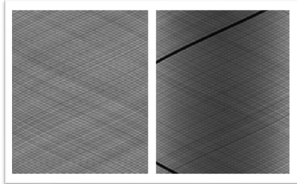
Linear diagonal defect from detector block failure
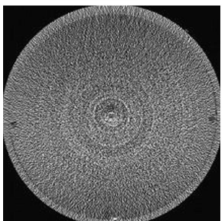
multiple ring artifacts from detector elements
PET SUV
1.0 ± 10% (or 15%)
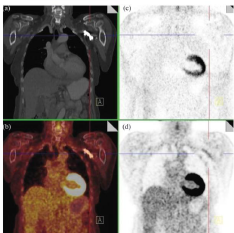
Attenuation correction artifact: Overcorrected (iodine contrast), False positive
What QC corrects for variation in efficiency in LOR in each slice of the sinogram?
Normalization corrections
Normalization scan
applied to sinograms to remove variations in event detection efficiencies along the LOR. Caused by detector electronic variations, geometrical variations, individual detector efficiencies. May lead to ring artifacts.
Normalization correction
multiplicative correction map is applied to acquired sinograms. Saved and applied to all patient studies. Needs to be 2D (directly with rod source or phantom) and 3D (component based).
T/F: An axial CT scan is a step-and-shoot type of CT scan.
True
The pixel values/CT numbers for compact bone is _____ HU
250-1000
The following image depicts _____ and could be remedied by _____.

noise/photon starvation; increasing the mA
Pitch =
Table Movement per 360 degree rotation (mm) / (# of slices) (slice width in mm)
How can partial volume averaging be reduced?
Scan with thinner slices
Presence of the non-collinearity of the annihilation photons and the finite positron range are inherent properties of positron emission tomography resulting in:
Positional innaccuracy
In PET scanning raw data is acquired and identified as coincidence events along their LOR are stored in the raw data format called:
sinograms
Property of PET detectors that allows them faster timing signals for coincidence detection and to work at high count rates is called
decay constant
Truncation artifacts in PET/CT imaging are produced by
Difference in size of FOV between PET and the CT
The process of aligning images so that corresponding features can easily be related is called:
image registration
The use of a low-dose CT scan in place of a conventional PET transmission scan
improves accuracy of the scan interpretation
The property of the scintillation detector described as the number of scintilla- tions produced by each incident photon is called:
light output
Which scintillators has the highest light output?
NaI (Tl) (thallium-doped sodium iodide)
A piece of equipment that sorts out photons of different radionuclides with different photon energies and to separate scattered photons from the useful ones is called
Pulse height analyzer
Which of the following scintillators commonly used in PET imaging has the highest stopping power?
BGO (bismuth germinate)
Radiochemical purity tests
HPLC and TLC
What does radio nuclidic purity measure
how much of a sample is the target isotope
Chemical purity QC tests for…
Raw materials
Solvents
Starting materials
By-products
Degradation products
F18 FDG radiochemical purity Limit
95% pure
Mo Breakthrough must be less than
<0.15 µCi Mo/mCi Tc
Mo/Tc99m chemical purity limit
10 ug / mL of Al3+ Aluminum ion
Sr-82/Rb-82 breakthrough limit
Sr-82 content must not exceed 0.02 uCi/mCi of Rb-82
Sr-85 content must not exceed 0.2 uCi/mCi of Rb-82
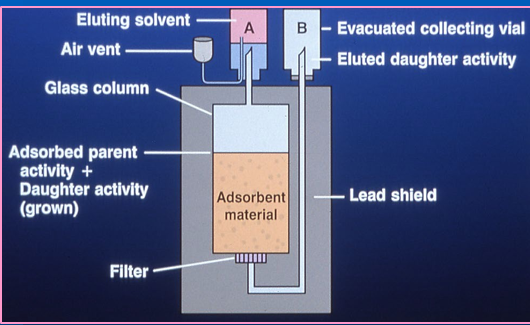
Generator System Diagram
How is a Sr-82/Rb-82 generator used?
Eluted straight into patients for cardiac perfusion exams
How is a Ge-68/Ga-68 generator used
attached to a localizer molecule via kit
Transient equilibrium generator
Parent Nuclide 10 -100 times half-life of Daughter
Secular equilibrium generator
Parent Nuclide 1000 times or more half-life of Daughter
What are the Secular equilibrium generators
Ge68/Ga68 Generator
Sr82/Ru82 Generator
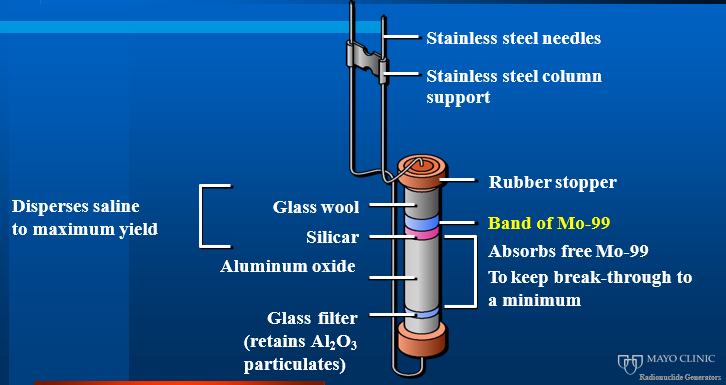
Molybdenum Column
Tech 99m Radionuclidic purity
Mo99
Tech 99m chemical purity
Aluminum
Magnets
bending momentum to accelerate particles, strength determines ion energy. Stronger magnet – more kinetic energy.
Dees
two flat electrons. In presence of magnetic field, negative ion particles are pushed and pulled, accelerating in circles. As kinetic energy increases, diameter increases. Strength of magnetic field determines the final energy of the ions.
Ion source
negative particles are hydrogen ions produced by ionizing hydrogen gas with tungsten filament.
Extraction foil
neg charge ions reach max diameter, carbon foil is used to strip off orbital electrons, creating a proton or deuteron (+).
Targets
Positive ions are ejected, striking a specific target causing a nuc reaction and creating a short-lived radionuclide. Desired radionuclide determines what ionizing particle and target material are used. Can be solid liquid or gas.
Diffusion pump
generates vacuum to accelerate negative ions.

