Formuals
 Call Kai
 Learn
Learn Practice Test
 Spaced Repetition
 Match
Match Flashcards
 Knowt Play
1/19

There's no tags or description
Looks like no tags are added yet.
Name | Mastery | Learn | Test | Matching | Spaced | Call with Kai |
|---|
No analytics yet
Send a link to your students to track their progress
20 Terms
How to use voltage drop formula?
Vd = mV x I x L
I = current
L = length
mV = millivolts per amp per metre
Lighting : Not to exceed 3% of a nominal voltage (6.9)
Power : Not to exceed 5% of the nominal voltage (11.5)
What is the current carrying capacity formula
Iz = It / C
It =
Cable size (mm2)
Installation method
Cable type
C = correction factor
Accounts for:
Temperature
Grouping
Installation conditions
How can I use ohms law formula?
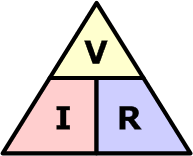
To find ohms law, its best to use the ohms law triangle
V = I x R
R = V / I
I = V / R
How can I use power formula?
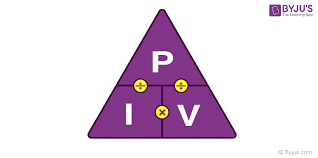
To find the power, use the power triangle
P = I V
I = P / V
V = P / I
How can I combine ohms law and power triangle?
Combine V = IR with P = VI to unlock I²R and V²/R
Replace V:
P = V × I
P = (I × R) × I
👉 P = I²R
Replace I:
I = V ÷ R
P = V × (V ÷ R)
👉 P = V² ÷ R
Earth Fault Loop Impedance (Zs) calculation
Zs = U₀ / Iₐ
U₀ = 230 V (UK nominal voltage to earth)
Iₐ = MCB rated current (In) × type of MCB
Iₐ = In × 5 (Type B)
Iₐ = In × 10 (Type C)
Iₐ = In × 20 (Type D)
If not using the formula:
Take the maximum Zs from tabulated values (BS 7671), then multiply by 0.8 temperature correction factor.
How to find parallel insulation resistance of each circuit connected in parallel.
Series
resistance add together
Rt = R1 + R2 +R3
Parallel
Step 1:
RT1 = R1/1 + R2/1 + R3/1
Step 2:
add each resistance value together
Step 3:
Rt = _Ω
What is the relationship between power and energy?
Energy is the total amount of electrical work done or energy transferred and is measured in joules (J).
Power is the rate at which electrical energy is transferred or work is done per unit time and is measured in watts (W).
The key difference between energy and power is time.
E = V × I × t (Total energy transferred)
E = P × t (Energy transferred depends on time)
P = V × I (Rate of energy transfer)
Ohm’s Law applies to DC and purely resistive AC circuits: V = I × R.
In AC circuits, the power triangle relates real power, apparent power, and reactive power
What is Charge and what is its formula?
Q = I × t
Where:
Q = charge (measured in coulombs, C)
I = current (amps, A)
t = time (seconds, s)
If current is flowing, charge is building up over time.
1 amp = 1 coulomb per second
What is periodic time and what is its formula? (AC basics)
Periodic time (T) is the time taken to complete one full cycle of a waveform.
If 50 cycles occur in one second (50 Hz), then one cycle takes:
T = 1 / f
So:
T = 1 / 50 = 0.02 s
How to find the CSA of a cable and how to find the volume of a cylinder?
For CSA:
Divide the diameter by 2 to get the radius, square the radius, then multiply by π (3.142) to get the cross-sectional area.
For volume of a cylinder:
Just multiply the CSA by the height of the cylinder.
What is efficiency and what is its formula?
Efficiency in electrical terms is about how much of the input energy or power actually becomes useful output.
Efficiency = (Useful Output ÷ Total Input) × 100
A heater takes 1000 W of electrical power but only produces 900 W of useful heat:
Efficiency = (900 ÷ 1000) × 100
Efficiency = 90%
What is a RMS value instantaneous value and how do you calculate this?
RMS (root mean square) is a value used in AC circuits to represent the equivalent DC value that would produce the same heating effect in a resistor; in DC circuits the current and voltage are constant so the RMS value is the same as the actual value, whereas in AC circuits the values continuously rise and fall in a wave, meaning the peak value only occurs momentarily and does not represent the overall effect. To obtain a useful value, RMS is calculated by squaring the instantaneous values, finding their average, and then taking the square root, and for a sinusoidal waveform this results in the RMS value being approximately 70.7% of the peak value, so Irms = Ipeak × 0.707 (and similarly Vrms = Vpeak × 0.707). This RMS value is then used in calculations such as the heating effect formula H = I²Rt, because it gives the equivalent DC current that would produce the same amount of heat.
What is heating affect for DC, AC and what is its formula?
When electrons move through a wire, they collide with atoms inside the material.
These collisions create friction-like resistance, which converts electrical energy into heat energy.
H = I² × R × t
Where:
H = heat energy (joules)
I = current (amps)
R = resistance (ohms)
t = time (seconds)
Although, when its an AC circuit you must include the rms value to the current so the formula becomes:
H = Irms2 x R x t
What are hertz and what is the equation for this?
When one cycle of emf is generated with one complete revolution of the loop over a period of one second, then we would express this as a frequency of 1 Hz. The frequency of the waveform is equal to speed of the loop’s rotation.
Frequency (f) = Number of revolutions (n) x Number of pole pairs (p)
If this is applied to the simple AC generator we looked at earlier, and the loop is rotated at 50 revolutions per second, then:
Frequency = 50 x 1 (there is 1 x pole pair) = 50 Hz
What is the basic Volt drop formula?
Vd = I x R
How is design current (IB) is calculated?
Single-phase current:
Ib = P ÷ V
Three-phase current:
Ib = P ÷ (√3 × V)
230 V = single-phase
400 V = three-phase (line voltage)
What is Coulomb & Joules?
Coulomb (C)
Coulomb = electric charge
Joule (J)
Joule = energy
key thing to remember:
1 amp = 1 coulomb per second
I = t Q
Charge = current × time
What is the 3 phase power formula?
I = P / √3 x cos θ
Example value:
P = 6000W
V = 400V
cos θ = 0.8 (motor power factor)
If power is not given just remove it
What is the equation for hertz?
Frequency (f) = Number of revolutions (n) x Number of pole pairs (p)
Example:
If we take a AC generator being rotated at 50 revolutions per second, then:
Frequency = 50 x 1 (there is 1 x pole pair) = 50 Hz

