Topic 12/13 - Magnetism, Motor Effect and Electromagnetic Induction
 Call Kai
 Learn
Learn Practice Test
 Spaced Repetition
 Match
Match Flashcards
 Knowt Play
1/92

There's no tags or description
Looks like no tags are added yet.
Name | Mastery | Learn | Test | Matching | Spaced | Call with Kai | Chat |
|---|
No analytics yet
Send a link to your students to track their progress
93 Terms
At which part of a magnet are the magnetic forces strongest?
Poles.
What happens when two magnets are brought close together?
They exert a force on each other.
What type of force is exerted if two like poles of a magnet are brought near each other?
A repulsive force.
What type of force is exerted if two unlike poles of a magnet are brought near each other?
An attractive force.
What is a magnetic field?
The region surrounding a magnet where another magnet or magnetic material experiences a non-contact force.
What is the difference between a permanent magnet and an induced magnet?
A permanent magnet produces its own magnetic field.
An induced magnet becomes magnetic when placed in a magnetic field.
What is a permanent magnet?
A permanent magnet produces its own magnetic field.
What is an induced magnet?
A magnet that becomes magnetic when placed in a magnetic field. When removed, it loses its magnetism.
What type of force does induced magnetism cause?
Force of attraction.
What is the effect when an induced magnet is removed from a magnetic field?
The induced magnet loses its magnetism.
Do induced magnets attract or repel?
Attract.
What happens when induced and permanent magnets are placed together?
Attract.
Give examples of magnetic metals.
Iron, Steel, Cobalt and Nickel.
Give examples of induced magnetic metals.
Electromagnet, Iron.
What do iron fillings become when placed in a magnetic field?
Iron fillings.
What can always be said about the force between a magnet and a magnetic material?
Always attractive.
How does the strength of a magnetic field alter as you move further away from the magnet producing it?
Magnetic field strength decreases.
In which direction does a magnetic field point?
From the north pole to the south pole of a magnet.
What does a magnetic compass contain?
A smaller bar magnet that points in the direction of the Earth’s magnetic field.
Where does the north pole of a compass needle point when not near a magnet?
Towards the north pole.
Where does the north pole of a compass needle point when near a magnet?
Towards the south pole.
What do iron filings do when placed around a bar magnet?
Sort themselves along field lines.
Where is a magnetic field generated in the Earth?
Outer core.
What causes a magnetic field in the Earth’s core?
Movement of molten iron.
Earth’s magnetic field is similar to what?
Bar magnet.
Where on a bar magnet is there a uniform magnetic field?
Poles.
What is the direction of the Earth’s magnetic field?
North to South.
What does the Earth’s magnetic field protect the planet from?
Harmful solar radiation.
What is produced when a current flows through a conducting wire?
A magnetic field is produced around the wire.
What shapes does the magnetic around a current carrying wire form?
Circular.
What is the circular pattern around a current carrying wire?
Magnetic field.
What determines the strength of the magnetic field around a current carrying wire?
The magnitude of the current flowing through the wire.
Does a high concentration of field lines mean the field is strong or weak?
Strong.
Do magnetic field lines ever cross, touch or overlap?
No.
How is a plotting a compass used to map out a magnetic field?
Place a compass (containing a needle magnet) on a piece of paper near the field.
Draw an arrow in the direction the compass points.
Repeat at different points on the paper.
Join the arrows to make a complete field pattern.
What is a region around a magnet or electric current where magnetic forces are exerted called?
Magnetic field.
What is a solenoid?
A coil of wire which when current passes through creates a strong magnetic field.
Describe the magnetic field found inside a solenoid.
Strong and uniform.
Is the field outside of a solenoid strong or weak?
Weak.
What is an electromagnet?
A solenoid with an added iron core.
How does an iron core affect the strength of a magnetic field?
Increases.
What is the motor effect?
When a force is exerted current carrying conductor placed in a magnetic field.
What shape does the magnetic field around a current carrying wire form?
Circular.
Which rule is used to determine the force produced by the motor effect?
Fleming’s Left Hand Rule.
When using Fleming's left hand rule, what does the forefinger represent?
Magnetic field direction.
When using Fleming's left hand rule, what is used to represent the direction of magnetic field?
First/Index finger.
When using Fleming's left hand rule what does the second finger represent?
Current flow direction.
When using Fleming's left hand rule, what is used to represent the direction of current flow?
Second finger.
When using Fleming's left hand rule what does the thumb represent?
Direction of the force produced by the motor effect.
When using Fleming's left hand rule, what is used to represent the direction of the force produced by the motor effect?
Thumb.
Which angle is the direction of each component of Fleming’s left hand rule?
Right angle.
At what angle must a wire by to a magnetic field to experience full force?
Right angle.
What factors affect the size of the force on a current carrying wire in a magnetic field?
The magnitude of the current flowing through the conductor.
The strength of the magnetic field that the conductor is placed in.
If the direction of current in a current-carrying wire placed in a uniform magnetic field is reversed, what happens to the force?
Direction of the force is reversed.
If the strength of current in a current-carrying wire placed in a uniform magnetic field is increased, what happens to the force?
Increases strength.
What happens to the motor force when the magnetic field strength increases?
Increases.
What happens to the motor force when the angle between the conductor and magnetic field is 90 degrees?
It is at its maximum.
State the equation linking forces, current, length and magnetic flux density.
Force = Magnetic Flux Density x Current x Length.
State the symbols for forces, current, length and magnetic flux density.
Force = F
Magnetic Flux Density = B
Current = I
Length = L
State the units for forces, current, length and magnetic flux density.
Force = Newtons
Magnetic Flux Density = Tesla
Current = Amperes
Length = Metres
What does magnet flux density measure?
Flux likes per metre squared.
Which criteria must be met for the equation linking forces, current, length and magnetic flux density?
The conductor must be placed at right angles to the magnetic field it is placed in.
If current and magnetic field are parallel to each other, which direction would the force act in?
No force will act.
How does an electric motor work?
A coil of wire, carrying a current, is placed in a magnetic field.
The forces on the two sides perpendicular to the field experience forces in opposite directions. This causes a rotational effect.
How are electric motors kept rotating?
A split ring commutator is used. This switches the current direction every half turn, which ensures that the coil keeps spinning.
What does the split ring commutator do?
Switches the current direction every half turn, which ensures that the coil keeps spinning.
What happens when an electrical conductor moves relative to a magnetic field?
A voltage is induced across the conductor.
What happens to an electrical conductor when there is a change to the magnetic field that it is placed in?
Voltage is also changed.
How do you produce an electric current using a magnet and a conductor on a small-scale?
Moving a coil of wire between magnetic poles.
Moving a magnet within a coil of wire.
Once a voltage is induced, if there is a complete circuit, a current will also be induced.
How is electrical current produced on a large scale?
An electromagnet is rotated around a coil.
Which factors affect the size of an induced voltage?
The number of turns on the coil of wire.
How strong the magnetic field is.
The speed of the movement.
What is the requirement for an induced potential difference to cause a current flow?
The conductor must form a closed loop or be part of a complete circuit.
What can be said about the direction of the magnetic field produced by an induced current?
The direction of the field is such that it opposes the change that induced the current.
This change is either the movement of the conductor or a change to the field.
What are two ways that the generator effect is used to generate different types of current?
In an alternator to produce alternating-current.
In a dynamo to produce direct-current.
How does a dynamo generate current?
A coil of wire rotates inside a magnetic field. A commutator is used to ensure it continues rotating in the same direction, therefore keeping the current flowing in the same direction (d.c. current).
How is electromagnetic induction used in alternators to generate alternating current?
A coil of wire rotates in a magnetic field.
The end of this coil is connected to slip rings which will cause the current to change direction while rotating. This means AC is produced.
What electromagnetic effect does a microphone take advantage of and how?
The generator effect. It converts the pressure variations in sound waves into alternating current.
How do loudspeakers make use of the motor effect?
The motor effect is used to convert variations in the current of an electrical circuit into the pressure variations which produce audible sound.
Explain how a loudspeaker works.
A cone wrapped in wire is connected to an a.c power supply and is placed in a permanent magnetic field.
When current flows through the wire, it creates a magnetic field which interacts with the permanent field.
This produces a force which causes the cone to vibrate, producing sound.
How is the pitch of the sound from a loudspeaker changed?
The frequency of the AC current is altered. This creates a different frequency of vibration in the cone.
How do microphones convert sound into electrical signals?
Sound produces pressure variations which cause the diaphragm to vibrate.
A coil of wire is connected to the diaphragm, so as the diaphragm moves, the coil also moves.
Movement in a magnetic field = a p.d. is induced.
As there is a complete circuit a current is also created.
Describe the makeup of a basic transformer.
A primary coil and a secondary coil of wire wrapped around an iron core.
Why is iron used as the core for a transformer?
It’s easily magnetised.
Explain how a transformer works.
An alternating current flows through the primary coil.
This induces a changing magnetic field in the core.
This changing magnetic field induces an emf, which produces a current in the secondary coil.
Why must the current flowing through the primary coil of a transformer be alternating?
For current to be induced in the secondary coil, the magnetic field in the core must be continuously changing.
For the magnetic field to be changing, the current in the primary coil must be alternating.
What can be said about the electrical power input and output of a 100% efficient transformer?
The electrical power input is equal to the electrical power output.
Give an equation liking number of turns with potential difference in transformers.
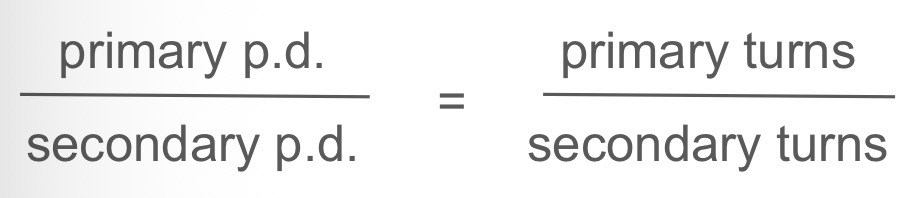
State the power equation for transformers with 100% efficiency.
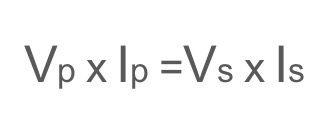
On a step down transformer, does the secondary coil have more or fewer turns?
The secondary coil has fewer turns.
What is an advantage of a step down transformer in the national grid?
It means the voltage can be reduced to a value safe enough to be used in houses.
Why is it important to have step up transformers in the national grid?
It can increase efficiency.
For the same power, a higher voltage will lead to a lower current (P=Vxl).
The lower the current, the less energy that is lost.
Used for transmission across power lines.
How does a step up transformer work?
The primary coil has fewer turns.
An a.c. current produced a magnetic field in the primary coil.
The iron core passes the magnetic field to the secondary coil.
The magnetic field induces a higher voltage in the secondary coil.
Power is conserved, so this produces a lower current.
Where are step-up and step-down transformers used in the national grid?
Step-up transformers are used at power stations, whilst step-down transformers are used domestically.