Addiction
 Call Kai
 Learn
Learn Practice Test
 Spaced Repetition
 Match
Match Flashcards
 Knowt Play
1/16

There's no tags or description
Looks like no tags are added yet.
Name | Mastery | Learn | Test | Matching | Spaced | Call with Kai |
|---|
No analytics yet
Send a link to your students to track their progress
17 Terms
What is addiction?
Use of a substance
- at high doses
- when it is dangerous to do so
- despite harmful effects on self or others
What three factors interact with addiction
Psychological, biological, sociological
Rat Park Experiments
enriched v deprived environment
rats choose to drink morphine or plain water
looked at willingness to consume morphine or water
rats raised in deprived environment went for morphine, while enriched rats did not. They tried morphine sometimes but prefered water.
suggests that social enrichment plays a large role in likelihood of developing an addiction in animal models.
Effects of addiction on brain
Target mesolimbic reward system (nucleus accumbens, ventral striatum, amygdala, orbitofrontal cortex)
Dopaminergic pathway in brain - crucial for rewarding and reinforcing behaviour
Methamphetamine
mental effects (alertness, increased confidence, no appetite)
physical effects (fast heartbeat, increased bp, dilate pupils
how is methamphetamine addictive?
impacts nucleus accumbens, the primary reward centre in brain.
increases dopamine release by affecting presynaptic neurons - causes strong and longer high.
it damages dopamine terminals and causes shutdown of dopamine synapses - reduced function in brain centers needed for craving control and behavioural regulation
loss of dopamine transporters and meth dependence
participants in late abstinence had more available dopamine transporters that those in early abstinence.
negative correlation between the amount of methamphetamine consumed, years of use, and dopamine transporter availability
how does meth impact behaviour?
anhedonia - can’t experience positivity
reward seeking - searching for drug
motivational hijacking - manipulation of others, stealing to get money for drug
role disruption - neglect of social responsibilities in favour of drug seeking
cannabis effects
mental effects (euphoria, anxiety, impaired coordination and concentration, heightened sensory exp)
physical effects (dry mouth, nausea and vomiting, rapid heartbeat)
cannabis and the brain
cannabinoids act on endocannabinoid system eCS - plays a role in homeostasis and neuroplasticity
Effects mediated by CB1 and CB2 receptors in brain
CB1 receptors - cerebral cortex, hippocampus, caudate/putamen, substantia nigra, cerebellum
CB2 receptors - dopamine neurons of ventral tegmental area
case control study on cannabis
patients with psychosis - measured frequency and potency of cannabis use
found daily use of THC increases odds of psychotic disorder AND increased potency
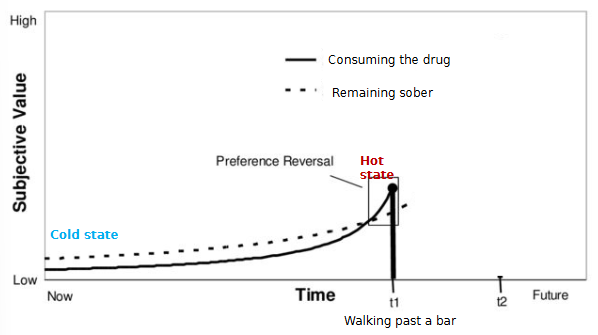
Intertemporal choice
Addictions are problems of intertemporal choice.
Preference reversal can be applied to addiction to explain experience of someone with an addiction.
Cold v hot state
Situations where individual wants to stop but still consumes the substance
Intention is formed in cold state, but behaviour is executed in hot state- temptation completely changes behaviour.
Delay discounting
perceived decline in value of a reward based on the amount of time it takes to be released.
Those with opioid dependence have a higher delay discounting than healthy controls.
Temptation and abstinence
abstinent individuals believe they are not susceptible to environmental temptations
people who are not dependent on a substance cannot empathize with how difficult a temptation is
leads to belief that willpower determines likelihood of relapse rather than environment
COVID 19 and addiction
increase in overdose mortality, men higher
35-44 have highest prevalence, black people have the highest peak - non hispanic white and black swap pre covid
Overdose and type of drug
Illicit fentanyls and synthetics exponentially increase past 2015, especially after covid begins.
Explore top notes

Explore top flashcards
