Art History Midterm (Early to Late Renaissance)
 Studied by 0 people
 Call Kai
 Learn
Learn Practice Test
 Spaced Repetition
 Match
Match Flashcards
 Knowt Play
1/12

There's no tags or description
Looks like no tags are added yet.
Name | Mastery | Learn | Test | Matching | Spaced |
|---|
No study sessions yet.
13 Terms
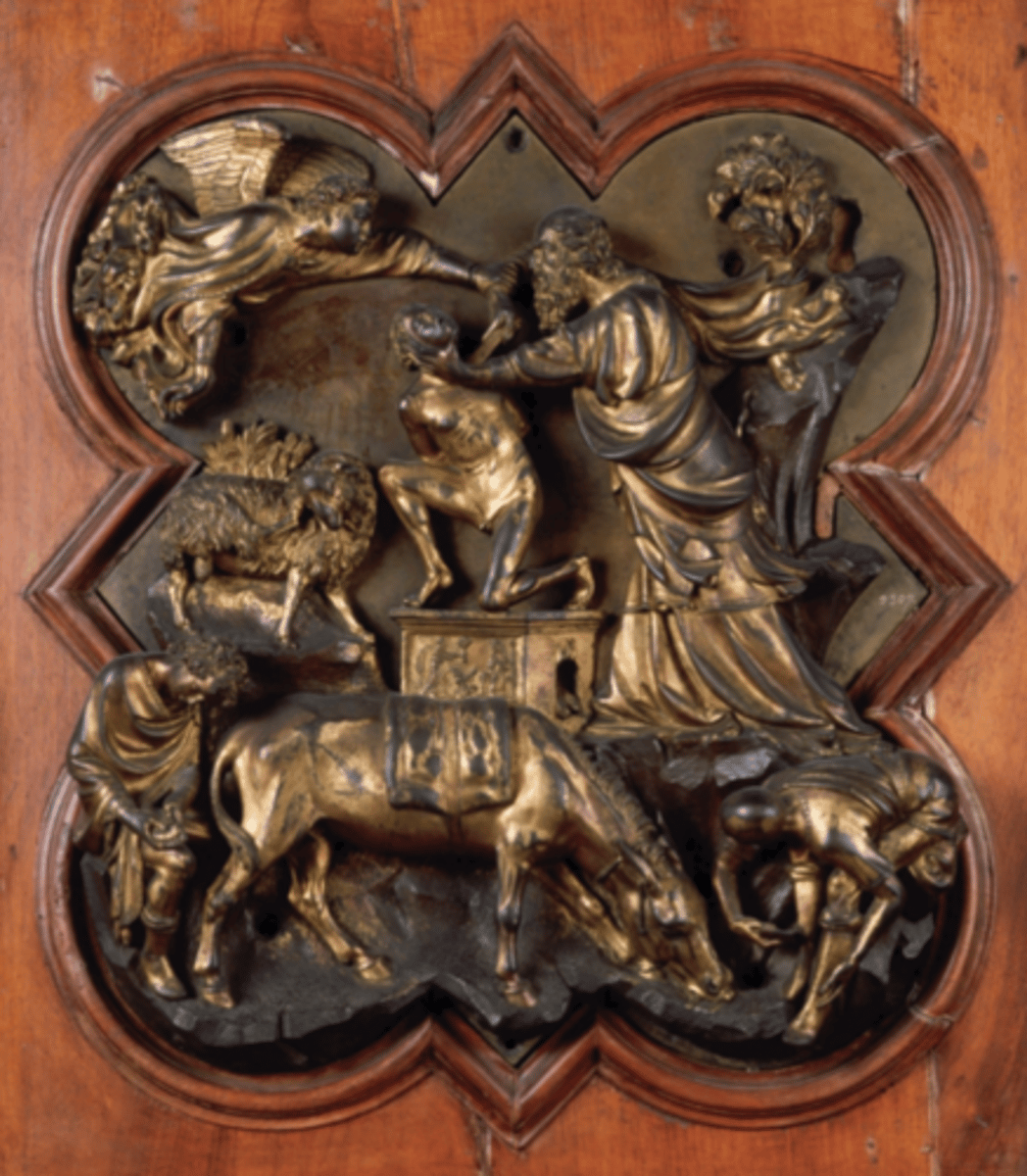
Filippo Brunelleschi, "Sacrifice of Isaac", 1401-02, Early Renaissance
∙ Competition for bronze doors of Florentine baptistery
∙ based Gen. 22
∙ Artistic Differences Btwn Ghiberti's:
- 24 years old
- Cast panel in several pieces
- Focus on Biblical implic./ raw emotion
- Conveys emotion, agitation of figures
- Artist expresses skills of careful observation and focus
- Issac= appears as weak young boy not a strong tough man
- Abraham= chokes Issac w/ bare hands, doesn't threaten him w/ sword
- Conveys more pictorial illusionism, than naturalism (in it's: landscape, proportions, composition, & portrayal of human form)
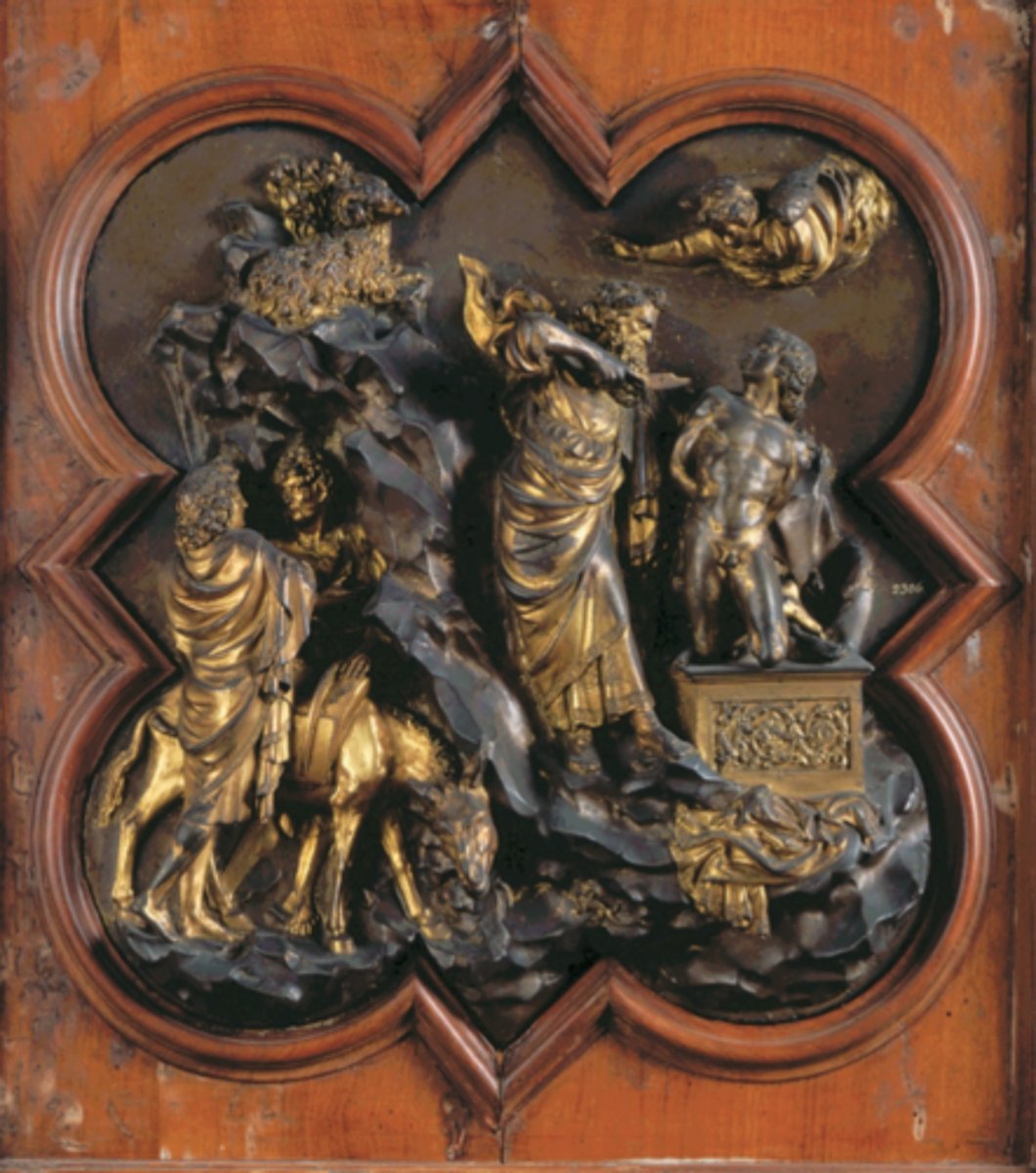
Lorenzo Ghiberti, "Sacrifice of Isaac", 1401-02, Early Renaissance
∙ Competition for bronze doors of Florentine baptistery
∙ based Gen. 22
∙ Artistic Differences Btwn Brunelleschi's:
- 23 years old, winner of contest
- Only cast panel in two pieces
- Focus on Humanism
- Violent mvnt, high emotion
- Artist expresses his genuine appreciation of human form
- Abraham= lunging forward contemplates actions, drawing back arm to strike; clothed in swirling Gothic robes
- Issac= classically posed like Greco-Roman statue, 1st classical nude since antiquity; kneeling figure w/ torsion of body, dramatic turn of head w/ posture of ancient Gaul
- Spacial illusion= rocky landscape emerges from panel towards viewer; foreshortening of figures
- More stylized and technical
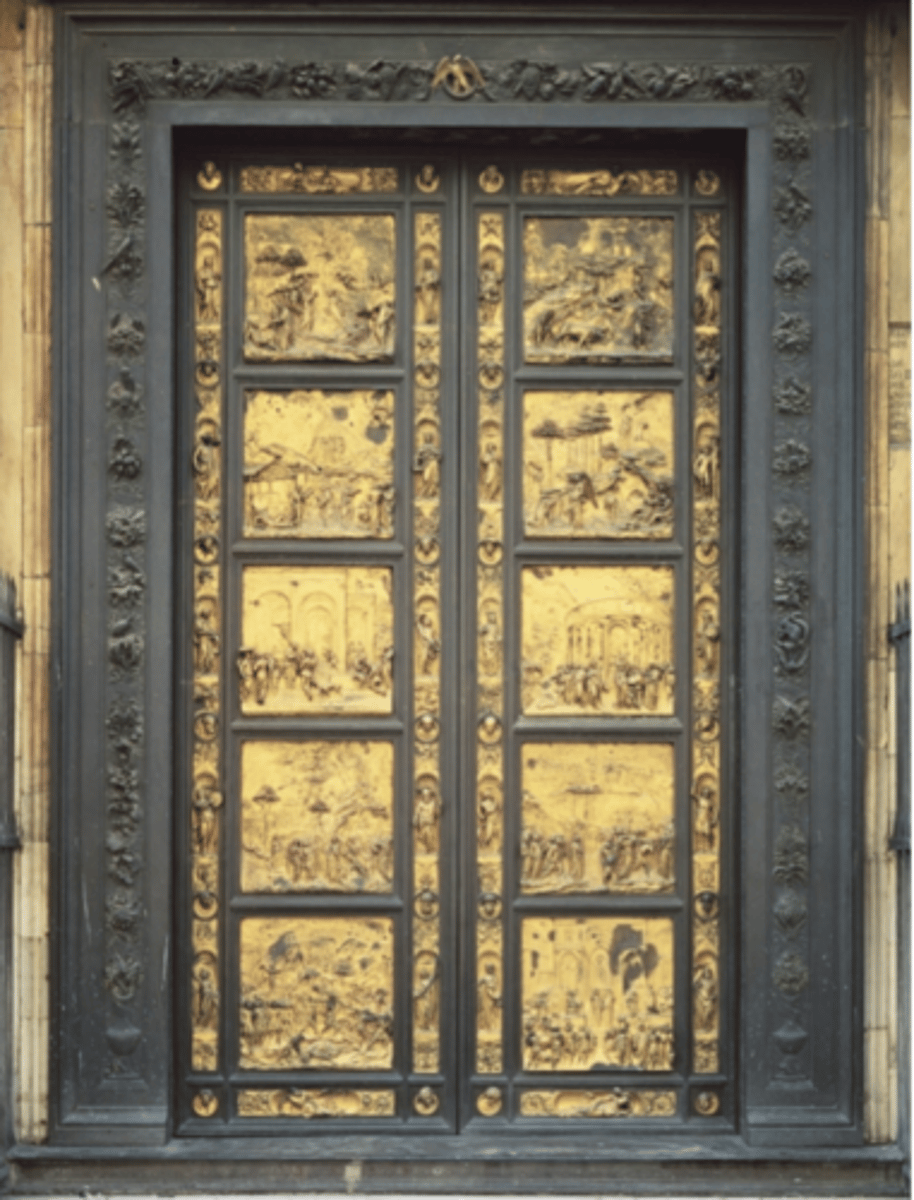
Lorenzo Ghiberti, "Gates of Paradise", 1425-52, Early Renaissance/Humanism
∙ Nickname created by Michelangelo
∙ Commissioned by officials to create new Cathedral doors for Florence's baptistery
∙ Artistic Significance:
- 10 Panels of Reliefs
- Depicts OT narratives
- Hybrid of: Gothic patterns, Classical motifs/sculpture
- Narratives start from bottom
- Meant to be read right to left
- Mathematical order & design
- Intricate surface texture & detail
- Dymatic depth w/ graceful mvmnt
- One-point perspective= clear horizon lines ; distinct vanishing points @ ctr; structured orthogonal lines leading from vanishing points
- Scentific system & representation of space
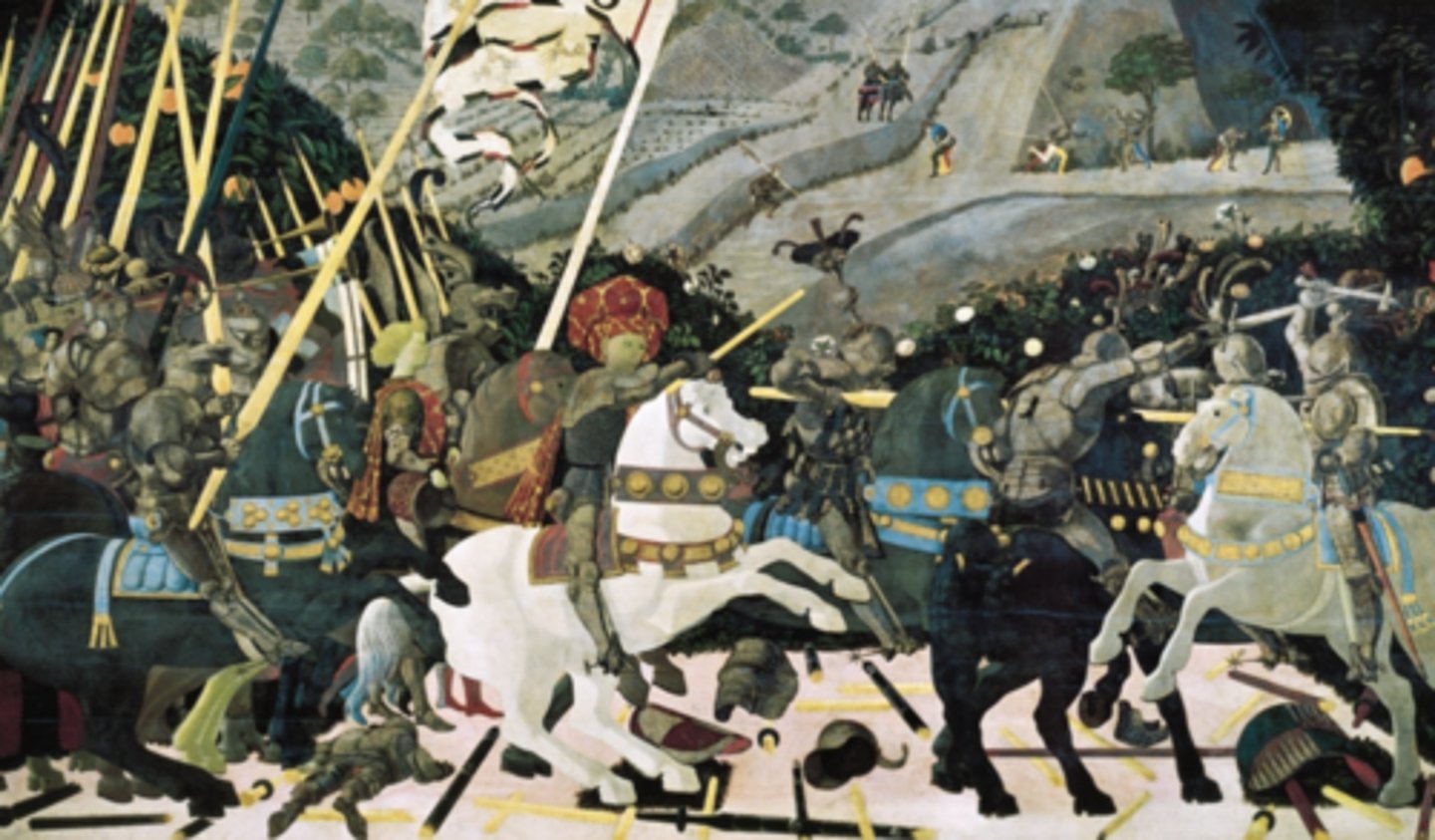
Paolo Uccello, "Battle of San Romano" 1455, Early Renaissance/Humanism
∙ Secular side of Florentine Ren. Art
∙ Depicts famous battle of San Romano between Florence and Siena
∙ Bartolini-Salimbeni commissioned Uccello to paint this work for the three arches bedchamber, so the artist originally design the panels with curved tops
∙ Heirs of Lionardo's family eventually sold the works to Lorenzo de Medici to be displayed in his palace. Therefore, in order to fit into their new space, Uccello had to trim the works into perfect rectangles
∙ Artistic Significance:
- Large three-paneled work
- Inc. Late International Gothic & early Renaissance painting techniques
- Realm of Quattrocento Florentine art in a rarer genre of this style called history painting
- Originally owned by Bartolini-Salimbeni family
- After purchase by Medici family artist was also instructed to integrate emblem, "mala medica" or orange leaves
- Combines realism & artifice
- Vivid realism= setting of the battle in the rural hillside, between Florence and Lucca
- Historical accuracy= depicting the real-life setting of this gory and gruesome battle
- Artifice= imaginative interpretation by depicting each and every one of the horses without the protection of metal armor; central figures in ornate caps
- Mathematical grid to create one-point linear perspective, which outlines the vanishing point of the scene
- Manner in which he postions the equestrian soldiers, with waving banners and drawn lances, enhances this perspective
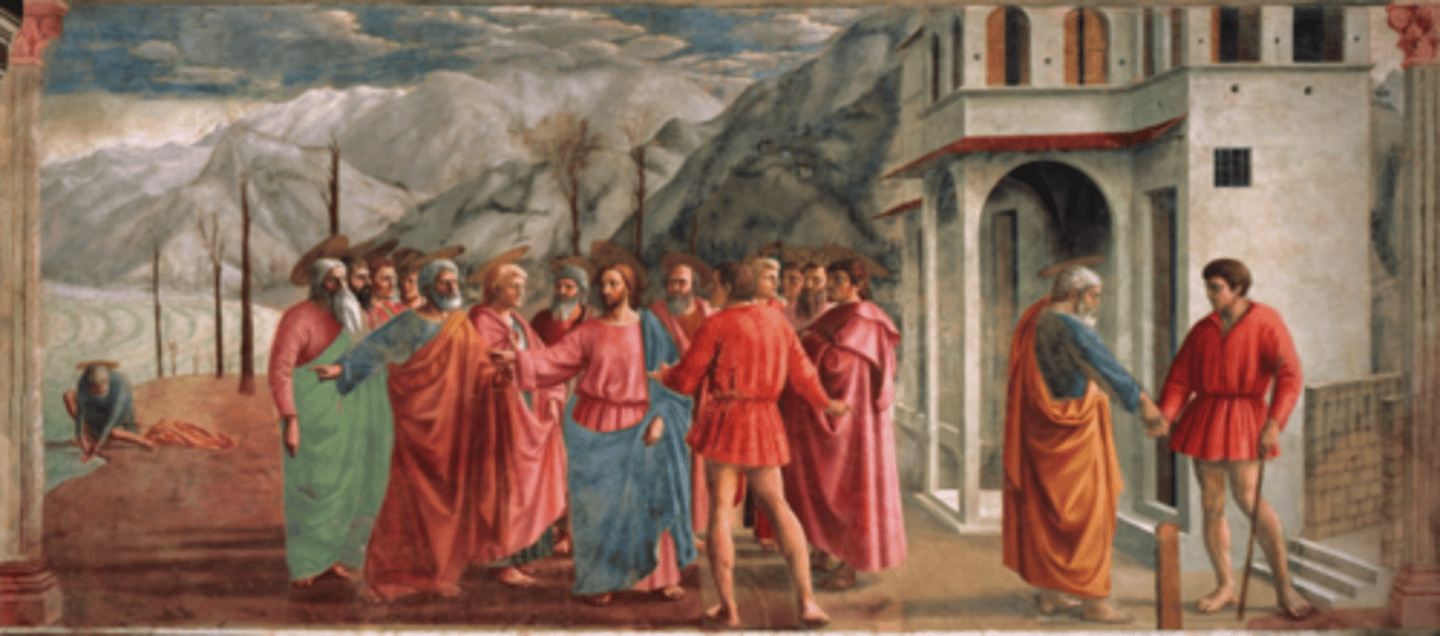
Masaccio, "Tribute Money", 1427, Early Renaissance/Humanism
∙ Brancacci Chapel, in Santa Maria del Carmine Florence, Italy
∙ Frescos sponsored by Felice Brancacci
∙ Tribute to ceremony in Mat. 17:24-27 "Temple Tax"
∙ Part of longer series on this NT narrative
∙ Commission for private family chapel, sponsored by Felice Brancassi in Santa Maria del Carmine in Florence
∙ Artistic Significance:
- Classical human form, sense heaviness & weight of figures
- breaks International style
- Recall simple, solemn graduer of Gitto
- illusionistic effects= specifically thru 3-D forms & deep sculptural relief
- rich detail
- vivid color
- chiaroscuro
- smoky sumato
- symmetrical compostion
- very elaborate costumes
- secular and religious overtones
- spacious, naturalistic landscape & architecture
- atmospheric & linear perspective
- St. Peter= figure in green & orange
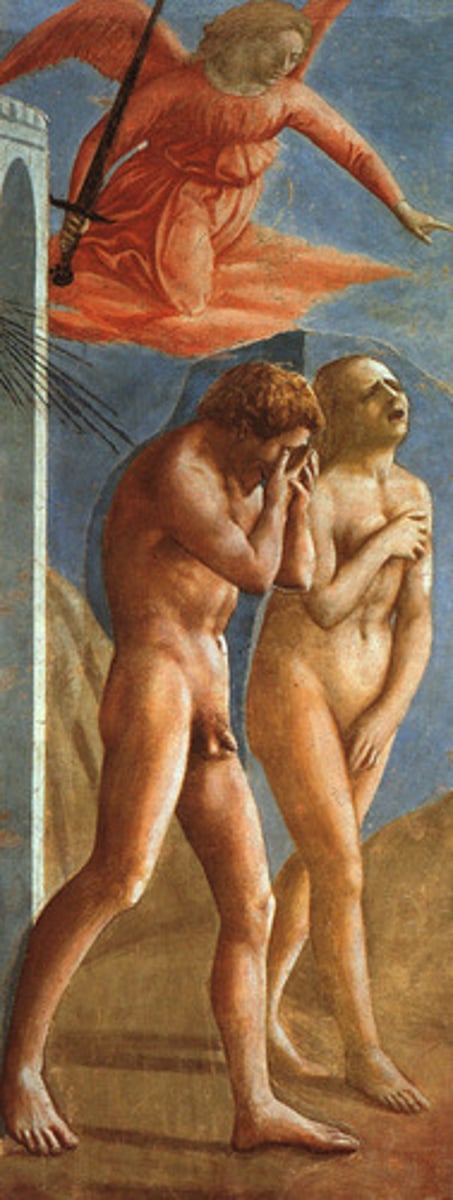
Masaccio, "Expulsion of Adam and Eve from Eden", 1424 - 27, Early Renaissance/Humanism
∙ Brancacci Chapel, in Santa Maria del Carmine Florence, Italy
∙ Frescos sponsored by Felice Brancacci
∙ OT Narrative w/ Classical Greco-Roman inspired motifs/sculpture
∙ Dispair/Anguish of Adam & Eve, driven by angels disappointment, cast out of Eden
∙ Artistic Significance:
- Slanted outside light source
- Unfication of dark & light
- Hazy background specifies no locale
- Modeled like deep relief
- Classical human form, sense heaviness & weight of figures
- breaks International style
- Recall simple, solemn graduer of Gitto
- illusionistic effects= specifically thru 3-D forms & deep sculptural relief
- rich detail
- vivid color
- chiaroscuro
- smoky sumato
- symmetrical compostion
- secular and religious overtones
- atmospheric & linear perspective
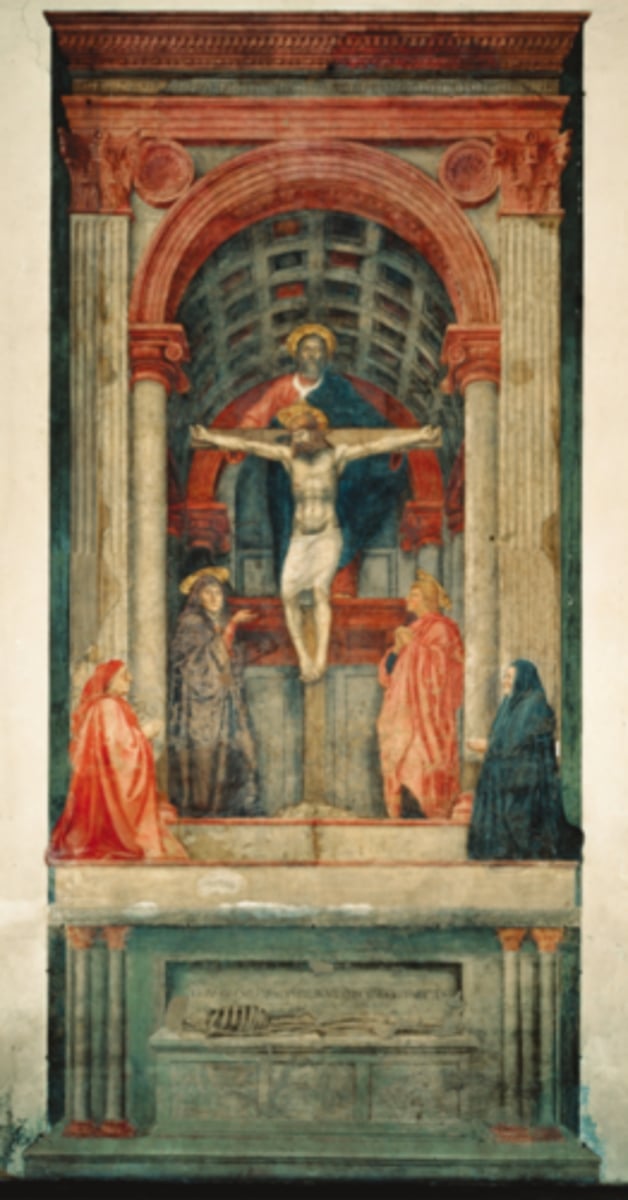
Masaccio, "Holy Trinity, 1424 - 27, Early Renaissance/Humanism
∙ Frescos for altar in Santa Maria Novella in Florence, Italy
∙ OT Narrative w/ Classical Greco-Roman inspired motifs/sculpture
∙ Crucifixion of Christ, God stands behind supporting his arms, flanked by Virgin Mary & St. John; all w/ w/ golden halos
∙ Donors Lorenzo Lenzi depicted kneeling/ praying in foreground
∙ Inscription on painted altar w/ skelton "I was once what you are, and what I am you will become"
∙ Artistic Significance:
- Recall simple, solemn graduer of Gitto
- Recall math. design/prespective by Burnellchi; draws eye throughout
- illusionistic effects= specifically thru 3-D forms & deep sculptural relief
- illusion of 3-d space, everything is painted including the altar
- Vanishing point @ Christ's feet?
- rich detail
- vivid color
- chiaroscuro
- smoky sumato
- symmetrical compostion
- secular and religious overtones
- atmospheric & linear perspective
smoky sumato
- symmetrical compostion
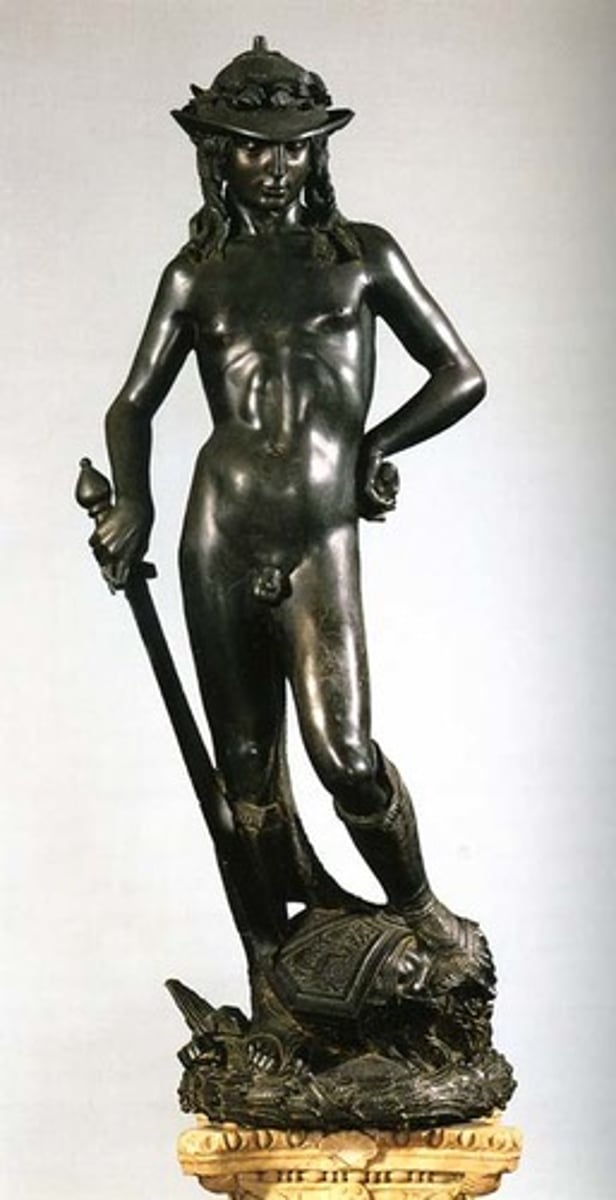
Donatello, "David", 1440 - 60, Early Renaissance/Humanism
∙ From the Plaza Medici in Florence, Italy
∙ Commissioned by Medici family
∙ Brozen sculpture free-standing nude of David after he slays Goliath, head @ his feet
∙ 1st free standing nude since antiquity/ fall of Rome
∙ David was a heroic symbol of Florence's Republic
∙ Artistic Significance:
- free standing nude
- relaxed, contraposto pose
- Humanist
- Quiet Classicalism
- Medici family loved classical Greco-Roman influence
- shows both complexity of human form & biblical narrative
- However, moreso to represent Greco-Roman God/hero/athlete, but young boy as in bib. narrative
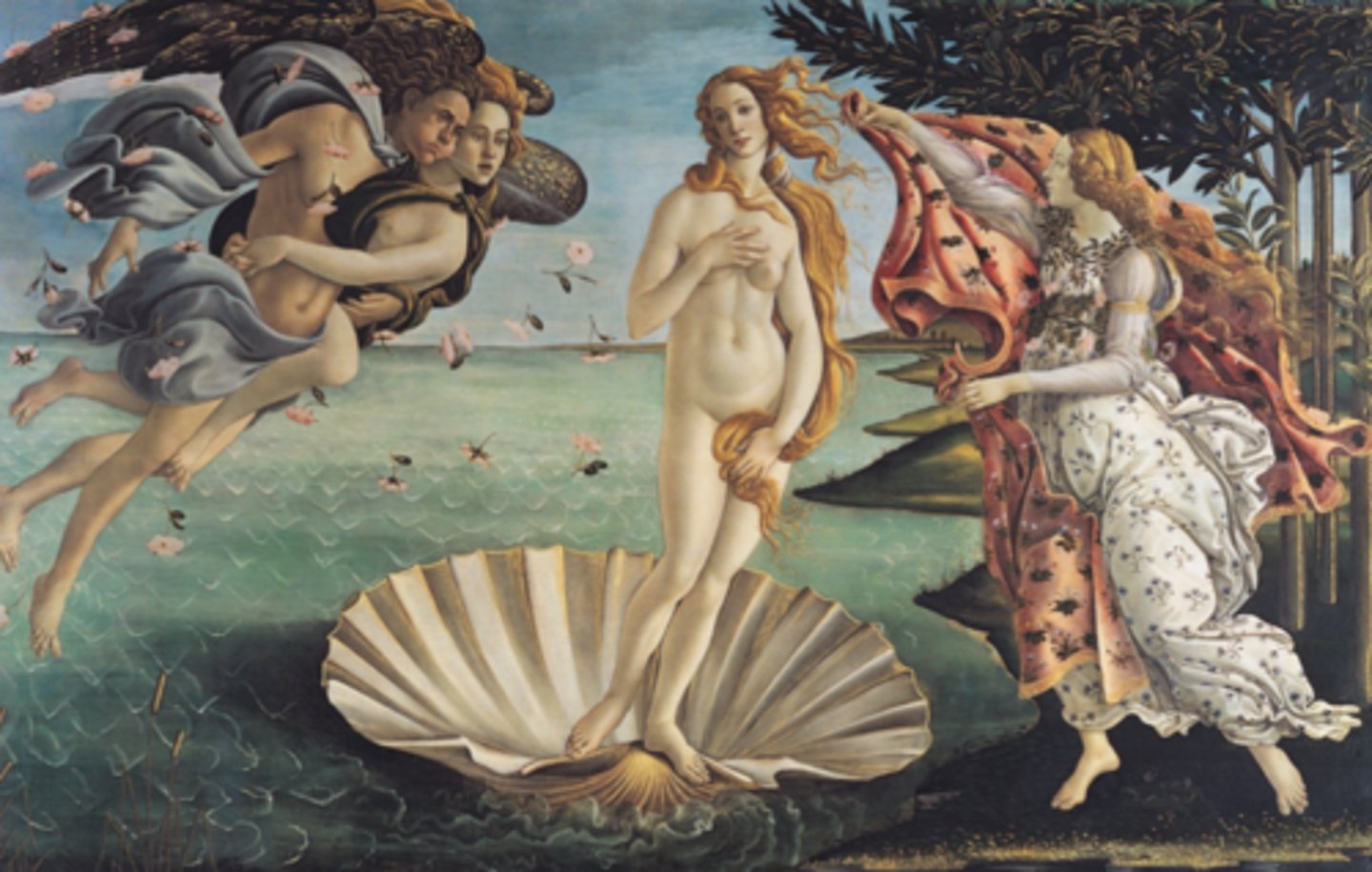
Sandra Botticelli, "Birth of Venus", 1484 - 86, Early Renaissance/Humanism
∙ Commission by Medici family
∙ One of his most famous works
∙ Venus goddess of Love born from cockle shell in full-form, Zephyrus god of western wind carries Flora goddess of Spring swirling spring flowers, nymph Pomona runs to meet them @ shore w/ robe for Venus
∙ Artistic touches:
- rare classical nude pose
- pure/crisp outline
- delicate shadows
- rich/vivid color
- Greek myth
- light/airiness
- not about naturalism of human form or of landscape
- not about wrld thru rational order
- instead appreciates beauty/graduer of myths & honors God
- yet has linear prespective, but less defined
Donatello, "Gattamelata", 1445-50, Early Renaissance/Humanism
∙ In Padua, Italy city square
∙ Most grand/costly Quattrocentro portrait
∙ Equestrian statue of Venetian soldier Erasmo da Marti aka "Sweet Honey Cat" = nickname by his troops
∙ Venetian soldier described as sitting "w/
great magnificence like a triumphant Ceaser"
∙ Rep. victory/pride of Florence
∙ Artistic touches:
- Based on Greco-Roman model
- overwhelming image of human ability/strength
- Ren 15th c revival portraiture
- Humanism
- Focus on figure's fame/duty/moral honor
- Descriptive sculpting of animal & human form
- Ref. to antiquity
- Not to scale as horse is over-sized

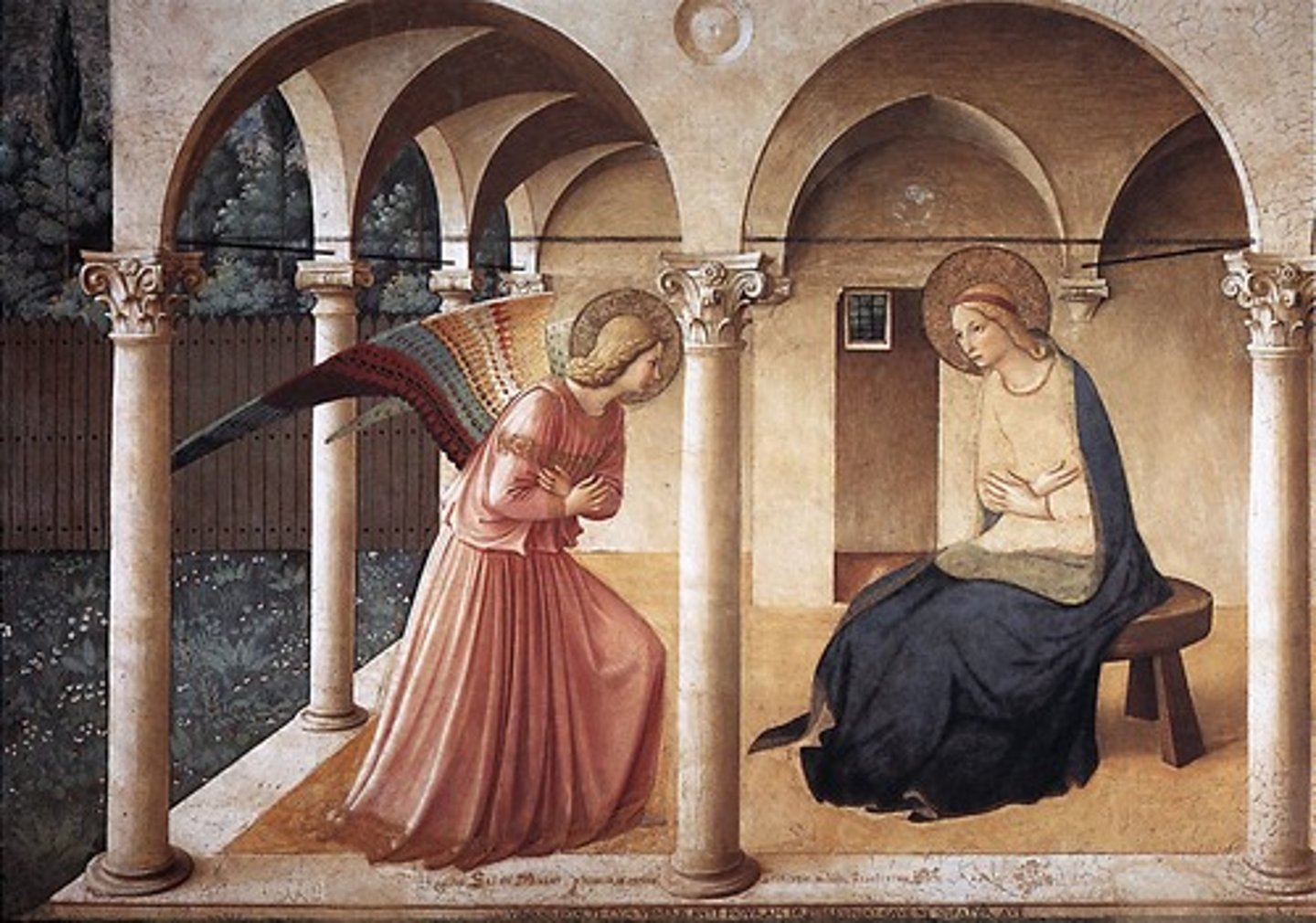
Fra Angelico, "Annunciation", 1438-47, Early Renaissance/Humanism
∙ Commission for Dominican monks of San Marco @ top of staircase
∙ Christian devotional image of critical OT narrative
∙ Artistic touches:
- simple/direct
- serenity/clarity
- universal appeal reflects artists humble character
- pristine clarity, fitting of devout image
- muted, pastel colors
- atmosphere similat to monestary
- plain, logica-like portico
- inscription "As you venerate while passing before it this figure of the intact Virgin Mary beware lest you omit to say Hail Mary."
- lit by singular source
- stark contrast of highlight & shadow
- Humanism
- Classical Greco-Roman influence, espec. in arch.
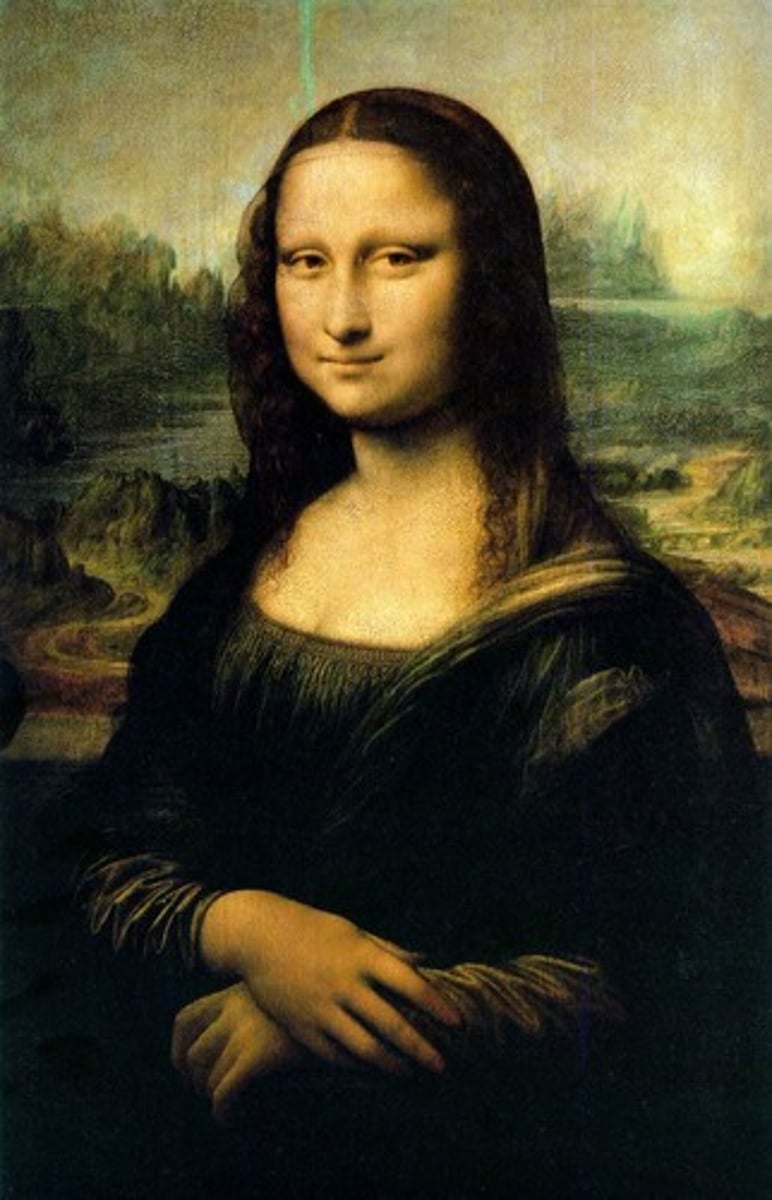
Leonardo da Vinci, "Mona Lisa", 1503-1505, High Renaissance
∙ He was a Renaissance man aka a Jack of All Trades= math, science, poetry, sculpture, drawing, painting
∙ Wanted to rediscovered laws of nature
∙ Intuitive thinker w/ intellectual/analytical mind
∙ Another ground-breaking work, arguably his most famous
∙ One of wrld's most famous works of art
∙ Sitter may be Lisa di Antionio Gheradini, wife of wealthly Florentine banker= sits quietly, hands folded, gentle smile
∙ One 1st portrait since antiquity/fall of Rome to engage viewer w/ full eye contact
∙ Now in the Louvre in Paris, France
∙ Artistic touches:
- demo of his ability to rep. all fig. sharing same light-infused eniv.
- individuality of sitter/her personality who engages viewer w/ direct eye contact
- emphasis on observation
- careful study of human anatomy & psychology
- grasping reality in all forms
- loved chiaroscuro
- smokey smfamot
- Mannerist painterly style known as tenebrism
- pyramidal structure of composition= key to Ren. art
- unified harmony
- representional obj. & fig. in same space/atmospheric setting
- visual unity of fig. thru their gestures
- tenderness/raw emotion & complex/math. design
- rich & complex colors
- singular light source
- atmospheric perspective is key
- mysterious landscape
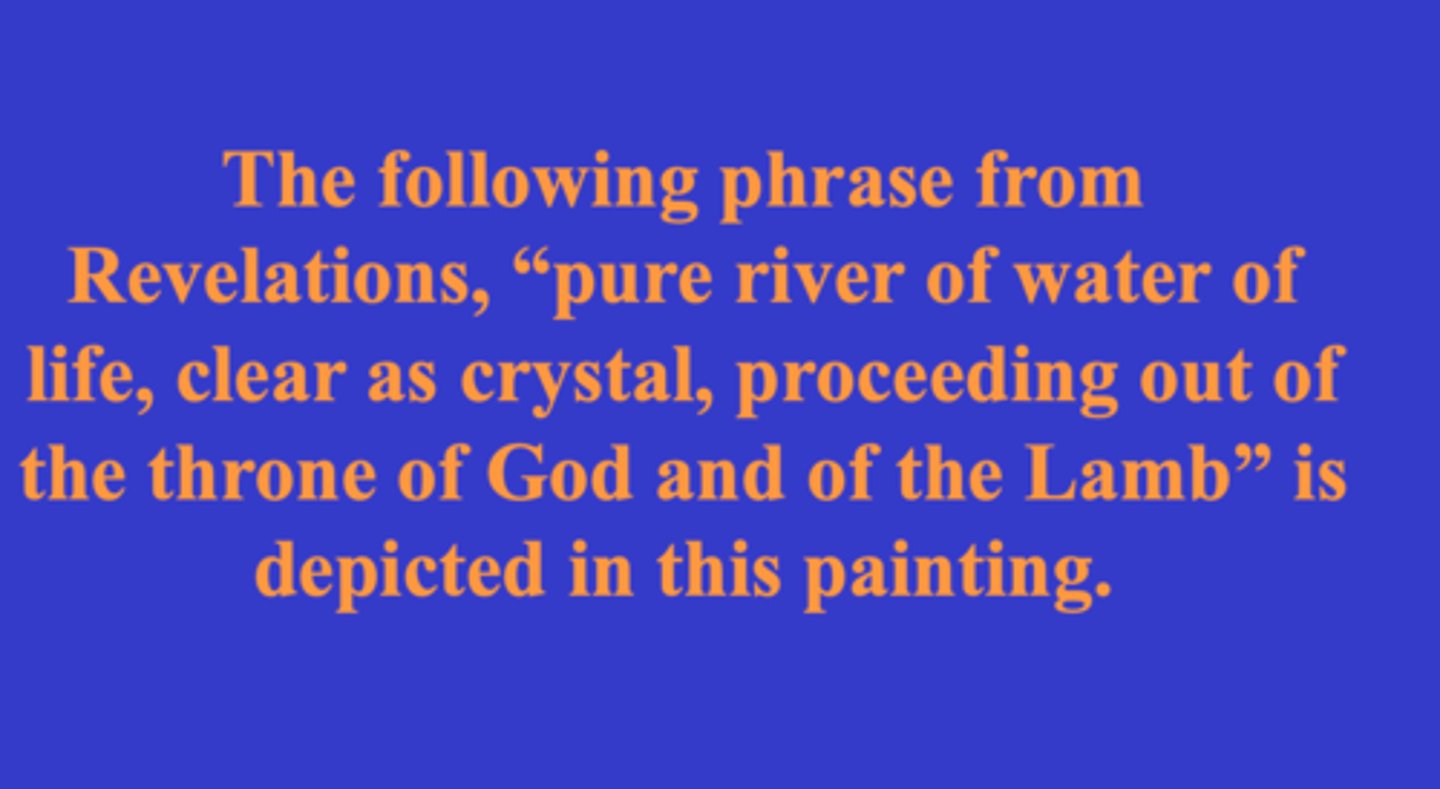
Jeopardy Review Questions:
What is "Altar of the Lamb" from "the Ghent Altarpiece"
 Note
Note  Flashcards (47)