Biochemistry Chp.1 LOs
 Studied by 0 people
 Call with Kai
 Learn
Learn Practice Test
 Spaced Repetition
 Match
Match Flashcards
 Knowt Play
1/16

There's no tags or description
Looks like no tags are added yet.
Name | Mastery | Learn | Test | Matching | Spaced | Call with Kai |
|---|
No study sessions yet.
17 Terms
1. Define what biochemists study.
Explain biological processes at the molecular and cellular levels —understanding the structure and function of biological molecules —brings together many concepts from chemistry, cell bio, and physiology.
2. Explain Buchner’s work and how it demonstrates both the serendipity of science and the careful methodology
Buchner's work involved discovering enzymes in yeast extracts that could ferment sugars into alcohol, demonstrating that biological processes could occur outside living cells.
Used a yeast cell-free extract to covert glucose into ethanol and CO2, which provided the first compelling evidence that a “vital force” wasn’t required for alcoholic fermentation
Pasteur had tried to accomplish the fermentation process but used materials that would kill off the yeast cells (glass, preservation to prevent coagulation, bad strain of yeast from Paris)
3.Identify the basic elements found in biomolecules, the common functional groups these elements form, and the functional groups’ chemistry—polarity, solubility, common NCF each possess.
Basic Element: Carbon, Hydrogen, Oxygen, Nitrogen, Phosphorus, and Sulfur
Functional Groups:
Amino (R-NH3+): Polar, soluble, Hydrogen bonds, ionic interactions (when ionized to -NH₃⁺), dipole-dipole interactions, LDF
hydroxyl (R-OH): Polar, soluble, h-bond and LDF, dipole-dipole
sulfhydryl (R-SH): Polar, soluble, Dipole-dipole interactions, LDF; important for disulfide bonds in proteins
phosphoryl (R-PO32-): Polar, soluble, Hydrogen bonds, ionic interaction
carboxyl (R-COO-): Polar, soluble, Hydrogen bonds, ionic interactions (when ionized to -COO⁻), dipole-dipole interactions, LDF
methyl (R-CH3): Nonpolar, insoluble, LDF
4. Define the 4 basic biomolecules, the monomers of each, and the primary function of each biomolecule.
Proteins
monomers: Amino Acids
function: Protein function/synthesis, neurotransmission, nitrogen metabolism, energy conversion
bonds: peptides bonds
Nucleic Acids
monomers: Nucleotides
function: energy conversion, signal transduction, enzyme catalysis, genetic material, formation of nucleic bases (A,G,C,T,U)
Bond: Phosphodiester
Carbohydrates
monomers: Simple sugars/monosaccharides
function: Energy conversion, cell wall structure, cell recognition, Nucleotide structure
Fatty Acids
monomers:
function: Cell membranes, energy conversion, cell signaling, energy storage
5. State the advantage of organizing biochemical reactions into pathways, why reactions in pathways are linked, and identify the 3 types of linked reactions.
Biochemical reactions are organized into pathways to allow efficient, regulated, and energy-coupled metabolism, with each reaction linked so that the product of one step becomes the substrate for the next, ensuring controlled flow and favorable energetics.
Linear pathway: A metabolic pathway in which each reaction generates only a single product, which is a reactant for the next reaction in the pathway
Forked pathway: A metabolic pathway that generates two products, each of which undergoes a different metabolic fate
Cyclic pathway: A metabolic pathway containing several metabolites that regenerate during each turn of the cycle, serving as both reactant and product

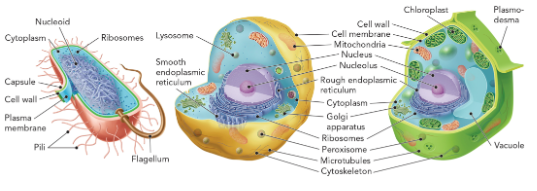
6. Compare and contrast prokaryotic and eukaryotic cells.
prokaryotic: A single-celled organism that lacks a nucleus and other membrane-bound organelles; this category includes all bacteria
Smaller than euk and surrounded by a cell wall (capsule or slime layer) that aid in attaching to other bacteria
the chromosomes of bacteria are circular and localized to the nucleoid—> bacteria have plasmid (circular DNA that replicates independently of the chromosomes- encode for genes for cell mating, antibiotic resistance and pathogenesis)
has flagella/pili that aid in their movement
eukaryotic: A cell that contains a nucleus and other organelles bounded by membranes, creating microenvironment for biochemical reaction: yeast is in this category
10-100x larger in size and genome than bacteria
More complex organisms - chromosomes are linear and are package in chromatins within the nucleus
Has a cytoskeleton (a network of intracellular filaments, consisting of oligomeric proteins, that maintain cell structure
Both
Have genetic information, has ribosomes
7. Identify primary function of each organelle found in eukaryotic cells.
Nucleus: contains chromosomes (chromatids) and the Nucleolus (assembles ribosomes)
Mitochondria: Responsible for many of the metabolic reactions involved in energy conversion and production of ATP, peroxisomes and lysosomes (has their own DNA)
Lysosome: involved in degradation and detoxification of macromolecules
Peroxisomes: contains enzymes for forming or destroying peroxides
Chloroplasts: organelles that converts light energy into chemical energy (has their own DNA)
Vacuole: stores metabolites and also isolates molecules that might be harmful to the cell—similar to lysosomes
Ribosomes: A large RNA-protein complex that mediates protein synthesis
Cytoskeleton: A network of intracellular filaments, consisting of oligomeric proteins, that maintains cell structure.
Microtubules: Cable-like component of the cytoskeleton that enables an animal cell to move by extending the plasma membrane in one direction while retracting it at the opposite end of the cell
Endoplasmic reticulum: sequester ribosomes for protein synthesis
Golgi apparatus: membrane structure required for protein translocation within the cell and in facilitating protein secretion at the plasma membrane
8. Explain how changes in the DNA sequence are connected to protein function and human diseases
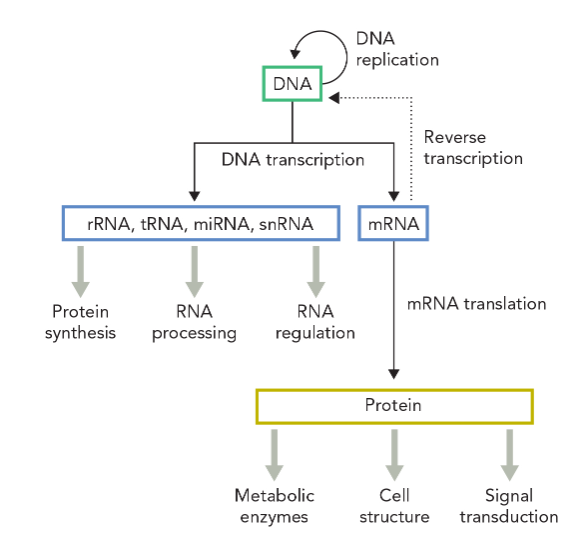
Central dogma states that the DNA has genes that is transcribes into mRNA which is is the template for protein synthesis. The mRNA will be translated (where the ribosomes decodes a molecule of mRNA and synthesizes a corresponding protein. The protein express a specific function from the specific gene with they are encoded with.
If the DNA has mutation within the gene, the way that it is transcribe and translated with cause the protein to have a different function— the mutation can inhibit the protein activity
9. Define the following: natural selection, germ-line cell, somatic cell, bioinformatics, orthologous genes, gene duplication, and paralogous genes.
natural selection: The changes in the frequency of genes in a population under conditions that favor some genes over other
germ-line cell: produce gametes and transmit genetic information to offspring
somatic cell: All other body cells (non-reproductive)
Involved in growth, repair, and normal body function
bioinformatics: The use of computational tools to probe and analyze large data sets of biological information, typically whole genomes or proteomes
orthologous genes: One of a set of highly conserved gene sequences that arose from a common ancestral gene and encode proteins with the same function in different species—genes conserved across species which descended from a common ancestral gene and serve the same function in DIFFERENT species
gene duplication: A mechanism by which duplication of a region of DNA containing a gene can lead to evolution of new genetic material—appearance of new genes in the genome
paralogous genes: Highly conserved genes within the SAME species; most often derived from the process of gene duplication
1. Provide examples where biochemistry made advancements in human lives
2. Given a biomolecule, you should be able to identify what type of biomolecule it is, identify its component monomer, whether the molecule has directionality(polarity), what functional groups the biomolecule has, and if the molecule is water soluble.
3. Provided a pathway, you should be able to explain the logic of it as well as the type of linked reactions occurring within the pathway.
4. Given a cell structure, you should be able to identify it, state its function, and identify whether it is located in a prokaryotic or eukaryotic cell or both.
5. Given 2 proteins with similar structures and given the function of one protein, surmise the function of the other providing rationale for your reasoning.
6. Connect the occurrence of random mutations in DNA to the process of natural selection and how protein function can be impacted by mutations in the gene coding for it.
7. Explain why the frequency of mutation in genes is generally lower than the frequency of mutation in the regions flanking the gene sequence.
8. Using examples to support your explanations, explain how evolutionary processes affect protein structure and function.
 Note
Note  Flashcards (27)