NC learners permit | Quizlet
 Studied by 0 people
 Call Kai
 Learn
Learn Practice Test
 Spaced Repetition
 Match
Match Flashcards
 Knowt Play
1/97

There's no tags or description
Looks like no tags are added yet.
Name | Mastery | Learn | Test | Matching | Spaced |
|---|
No study sessions yet.
98 Terms
A driver's license is required for which of the following? I. Sitting in the driver's seat of a car while the engine is running II. Steering a car while it is being pushed or towed by another vehicle.
Both
If a law enforcement officer swears that a driver has refused a legal chemical test, the Division of Motor Vehicles must
A.Place the driver on probation.
B. Wait for a court decision before taking action
C. Assign the driver to the Driver Improvement Clinic
D. Revoke the driver's license for at least 12 months.
D
Which of the following happen(s) under the point system .I. A driver is sent a warning letter when he gets 4 points within 3 yrs. II. A driver who gets 12 points within 3 yrs may lose his license.
I only
II only
Both I and II
Neither I nor II
B
When a driver has a total of 7 points, which of the following may happen? I. The driver can be required to file proof of financial responsibility. II. The driver can have 3 points deducted if he satisfactorily completes a Driver Improvement Clinic.
1/1
I only
II only
Both I and II
Neither I nor II
B
Conviction for which of the following carries the highest number of points?
A. Reckless driving
B. Hit and run with property damage
C. Driving without a license
D. Passing a stopped school bus unloading children.
D
A driver will lose his license if he is convicted of
A. Driving without a license
B. Passing a stopped school bus
C. Failing to yield the right of way
D. Speeding more than 70 mph in a 55 mph zone.
D
To get a revoked driver's license restored, a person must do which of the following? I. Obtain permission from the Driver License Section in Raleigh to reapply for a license .II. Go to a driver license office, pay a restoration fee, and reapply for a license.
I only
II only
Both I and II
Neither I nor II
B
Roughly half of all traffic fatalities involve which of the following? I. A drunken person II. More than one car.
I only
II only
Both I and II
Neither I nor II
A
The percentage of highway deaths caused by drunken persons is about
10
38
59
67
B
Which of the following statements about pedestrian deaths is(are) correct? I. In cities, 2 out of 5 people killed in motor vehicle accidents are pedestrians. II. Most of the pedestrians killed in all traffic accidents are teenagers.
I only
II only
Both I and II
Neither I nor II
A
When you are walking at night along a road without sidewalks, you should do which of the following? I. Wear or carry something white. II. Keep your back to oncoming traffic
I only
II only
Both I and II
Neither I nor II
A
At an intersection where there are no traffic lights. Who has the right of way?
A. The person walking
B. The driver of the car
C. No one
D. Whoever reaches the intersection first.
A
If you are walking along a road at night, what should you do? I. Walk on the right hand side with the traffic .II. Wear or carry something white.
I only
II only
Both I and II
Neither I nor II
B
A safe driver does which of the following?
A. Watches the side of the road over the hood to stay in lane.
B. Frequently checks the rear view and side mirrors.
C. Drinks coffee while driving at night to stay alert.
D. Keeps 2 car lengths between his car and the next car on the expressway.
B
As you approach an intersection to make a right turn, you should turn on your car's right turn signal and do which of the following? I. Steer slightly toward the center of the road to give yourself room to clear the corner. II. Hold your arm straight out the window.
I only
II only
Both I and II
Neither I nor II
D
If you begin to feel sleepy while driving on a long trip, you should do which of the following? I. Open a window or vent to let in fresh air. II. Increase your speed
I only
II only
Both I and II
Neither I nor II
A
When driving on a long trip, you should
A. Rest your eyes from time to time by rubbing them
B. Avoid looking at any one thing for more than a few seconds
C. Keep your eyes on the center of the road straight ahead
D. Spend as much time looking in your mirrors as you do looking in front of you
B
In order to avoid being hit in the rear by another vehicle, you should do which of the following? I. Drive cautiously and use your brake often. II. Check your rearview mirrors often.
1/1
I only
II only
Both I and II
Neither I nor II
B
Studies have shown which of the following to be a serious traffic hazard? I. Middle aged driversII. Slow drivers
I only
II only
Both I and II
Neither I nor II
B
Very slow driving is especially dangerous in which of the following situations? I. Just after passing the crest of a hill .II. Just after rounding a curve.
1/1
I only
II only
Both I and II
Neither I nor II
C
Which of the following statements concerning speed limits on the open road in North Carolina is (are) correct? I. Unless otherwise posted, the speed limit for passenger cars and pickup trucks is 65mph . II. The speed limit for a school activity bus is 35mph?
1/1
I only
II only
Both I and II
Neither I nor II
D
Which of the following statements about speed limits for cars in North Carolina is (are) true? I. The speed limit outside a city is 55mph unless otherwise posted .II. The speed limit inside a city is 25mph unless otherwise posted.
I only
II only
Both I and II
Neither I nor II
A
Which of the following statements about speed limits in North Carolina is (are) correct? I. Unless otherwise posted, the speed limit inside a city is 35mph. II. Unless otherwise posted, the speed limit for a school activity bus is 25mph.
I only
II only
Both I and II
Neither I nor II
A
The car rounding the curve shown has a tendency to follow which path?
Path A
Path B
Path C
Path D
C
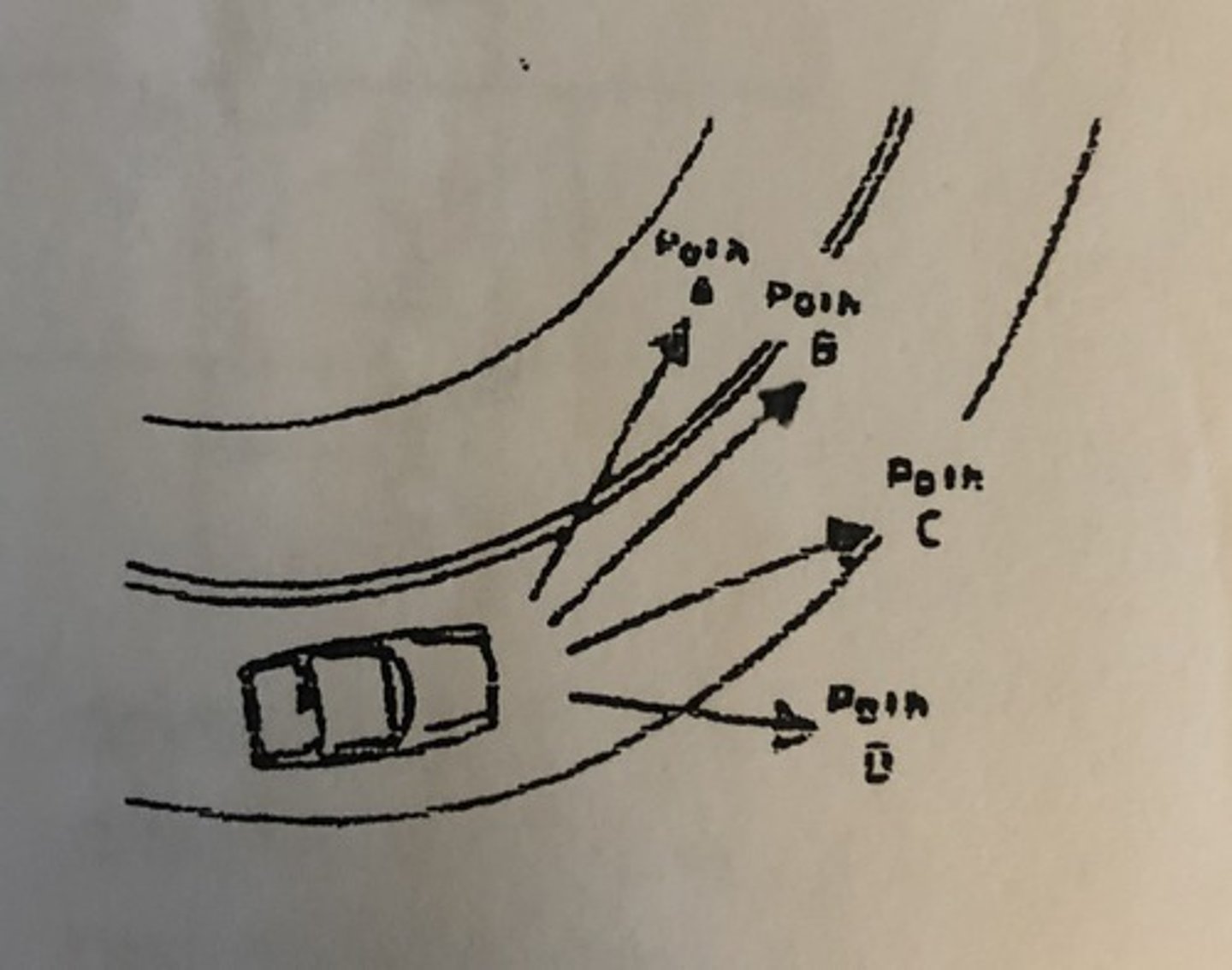
When rounding a curve, a car tends to
A. Speed up
B. Move to the inside of the curve
C. Stay in the center of the lane
D. Move to the outside of the curve
D
When rounding a sharp curve, you should do which of the following? I. Stay as far to the left of your lane as possible. II. Apply your brake in the sharpest part of the curve.
I only
II only
Both I and II
Neither I nor II
D
The driver of the car shown should
A. Use a low gear when coming down the hill
B. Pump his brake when he reaches the curve
C. Apply the brake firmly and steadily going down the hill
D. Speed up slightly on the curve to maintain control of the car
A
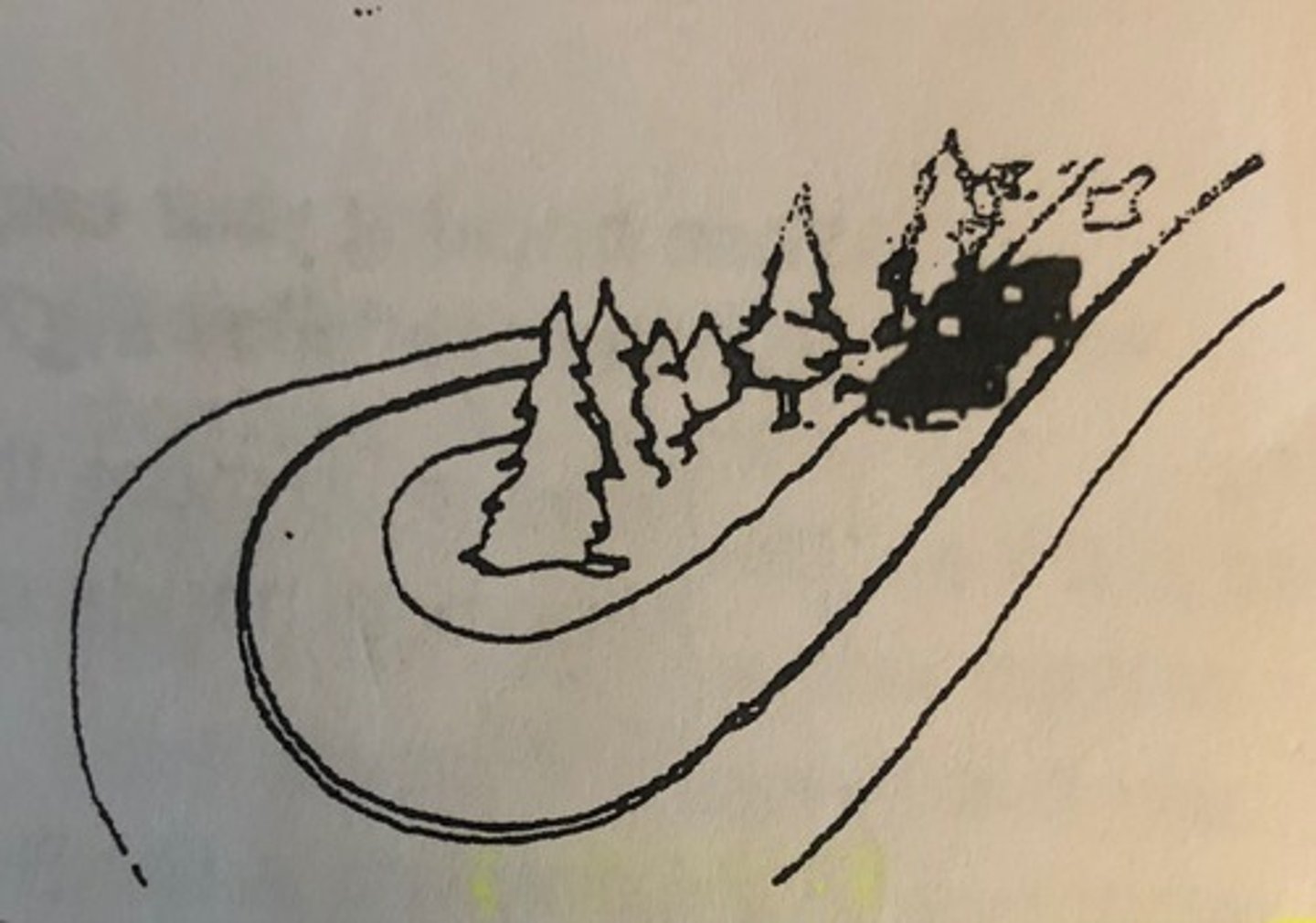
To reduce speed while going down a steep hill, you should do which of the following? I. Use a lower gear II. Drive in a zigzag pattern
I only
II only
Both I and II
Neither I nor II
A
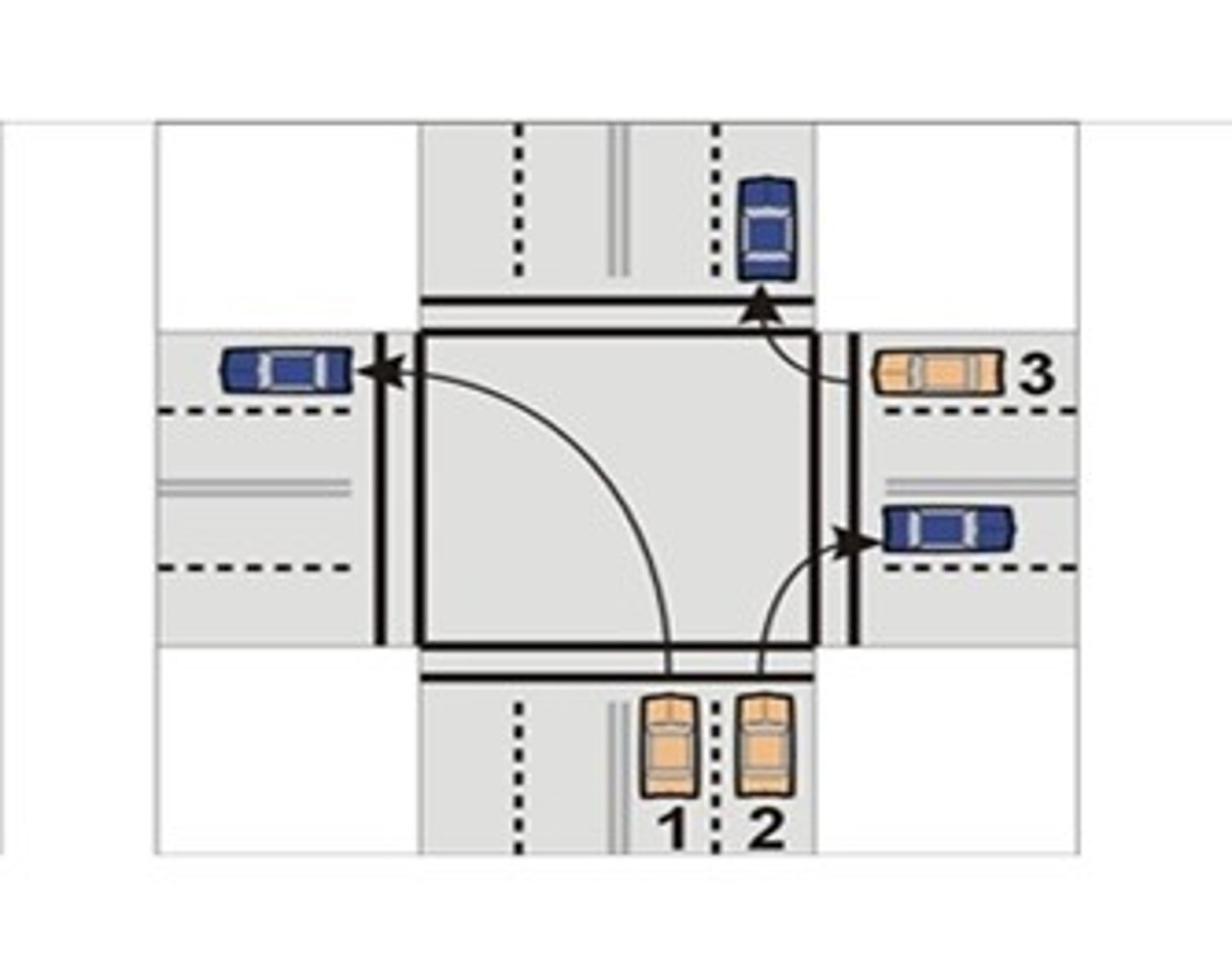
Which of the cars shown has made a correct turn?
Car 1
Car 2
Car 3
None of the cars
C
If you wish to pass the car ahead on a two-lane road, you should do which of the following? I. Blow your horn to signal your intention to the driver of the cars ahead II. Give a left turn signal to let the driver behind you know your intention
I only
II only
Both I and II
Neither I nor II
C
Which of the cars shown may pass?
car 1 only
car 2 only
both cars
neither car
C
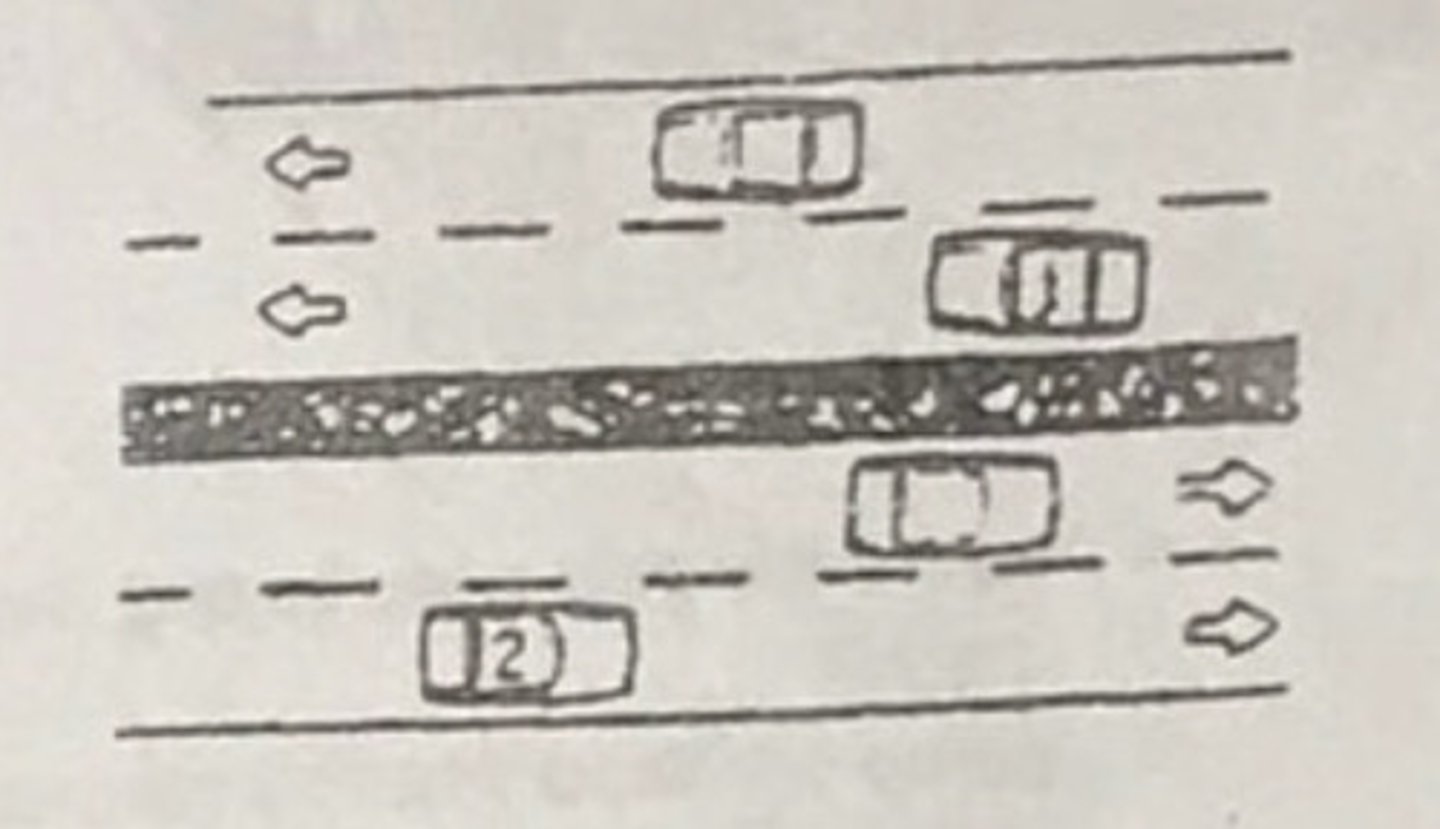
Passing on the right is legal on which of the following? I. A four-lane highway with 2 lanes going in each direction. II. On a one-way street
I only
II only
Both I and II
Neither I nor II
C
When backing your car, you should do which of the following? I. Move at no more than 10mph II. Keep both hands on the steering wheel.
I only
II only
Both I and II
Neither I nor II
A
Accidents occur most frequently at which of the following?
A Curve
B Hills
C Bridge
D Intersection
D
Which car must yield?
Car A
Car B
Car C
Car D
D
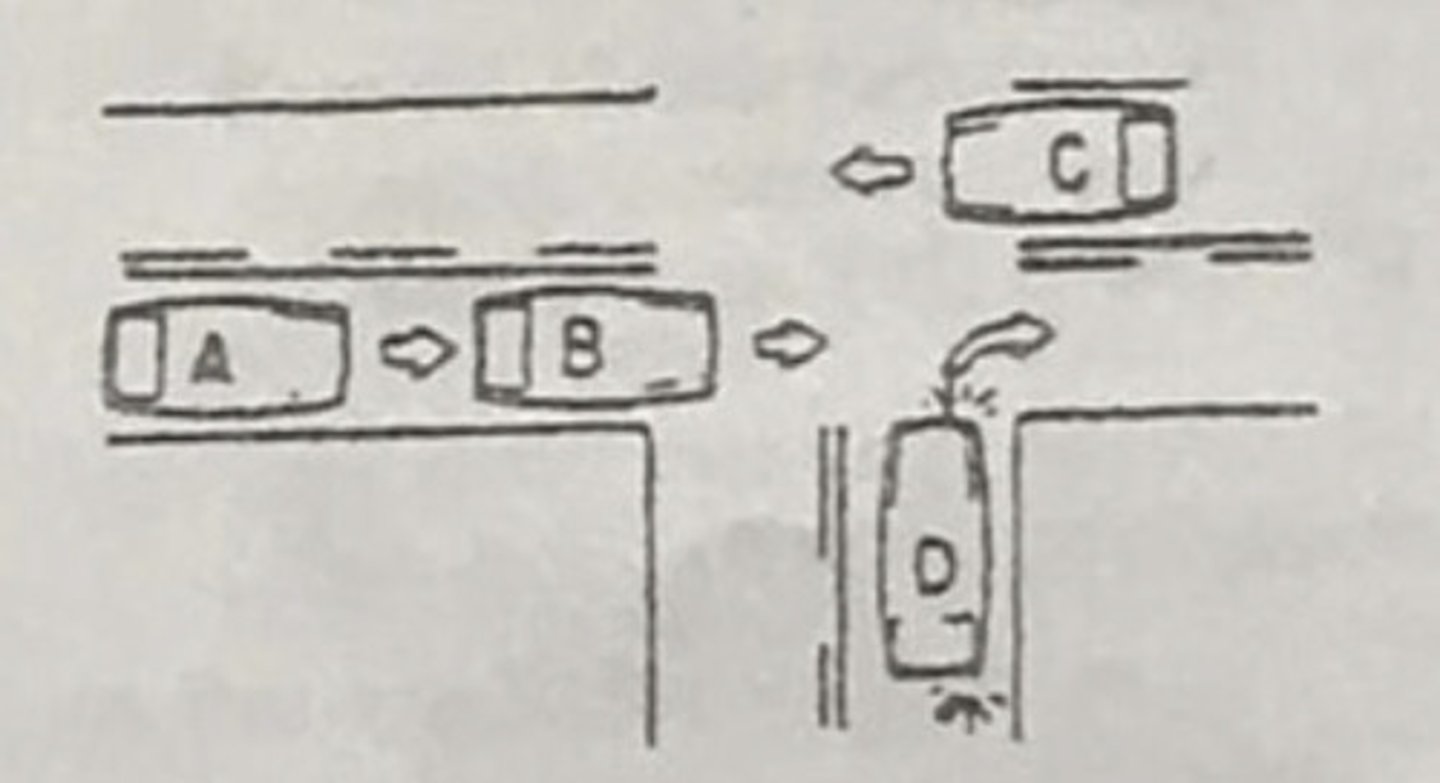
Highway accidents occur most frequently
on hills
on curves
at intersections
at bridges
C
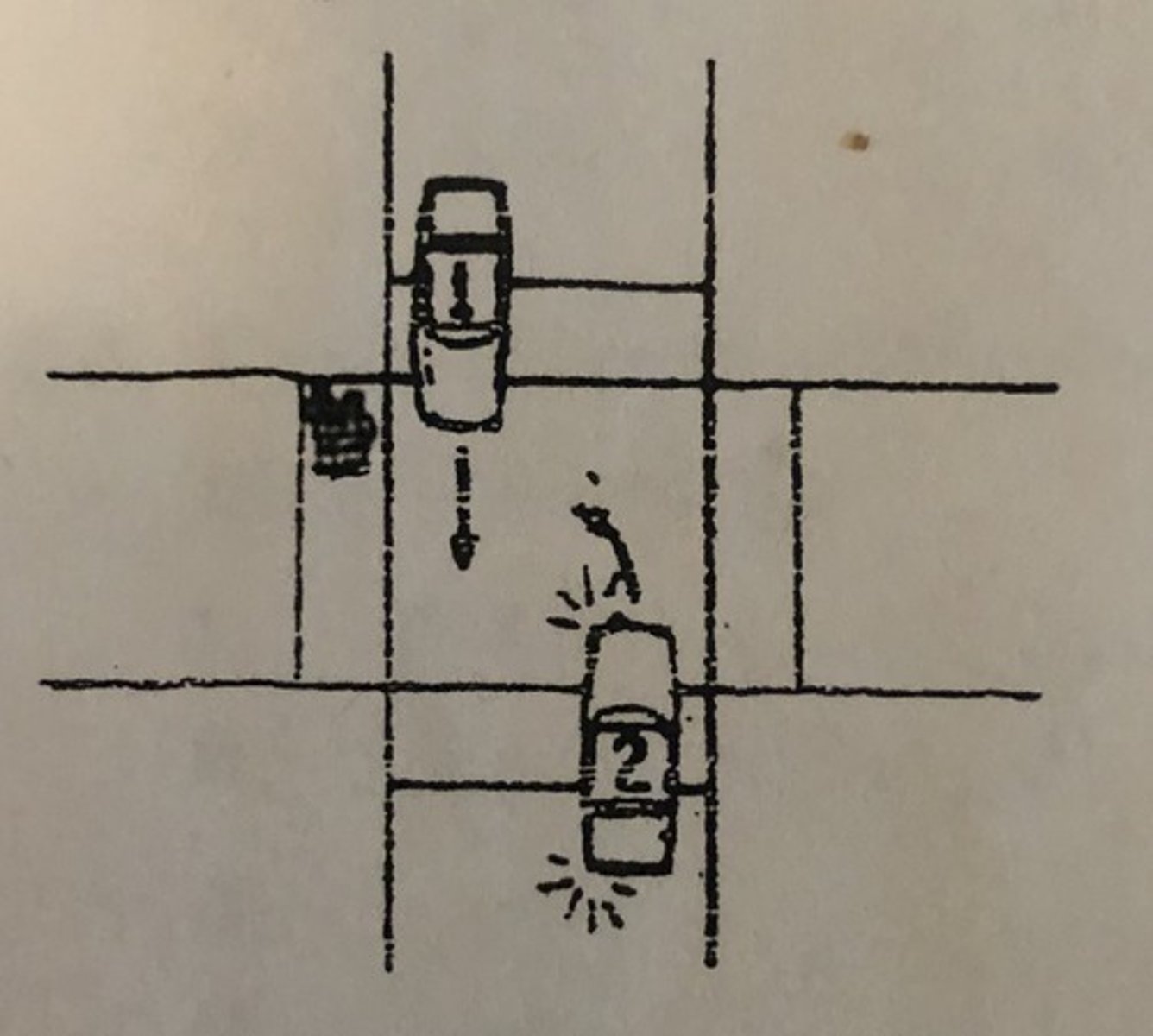
In the situation shown, the right-of-way belongs to the
1/1
A. Driver of the car 1 only
B. Driver of car 2 only
C. Pedestrians only
D. Driver of car 1 and the pedestrians
D
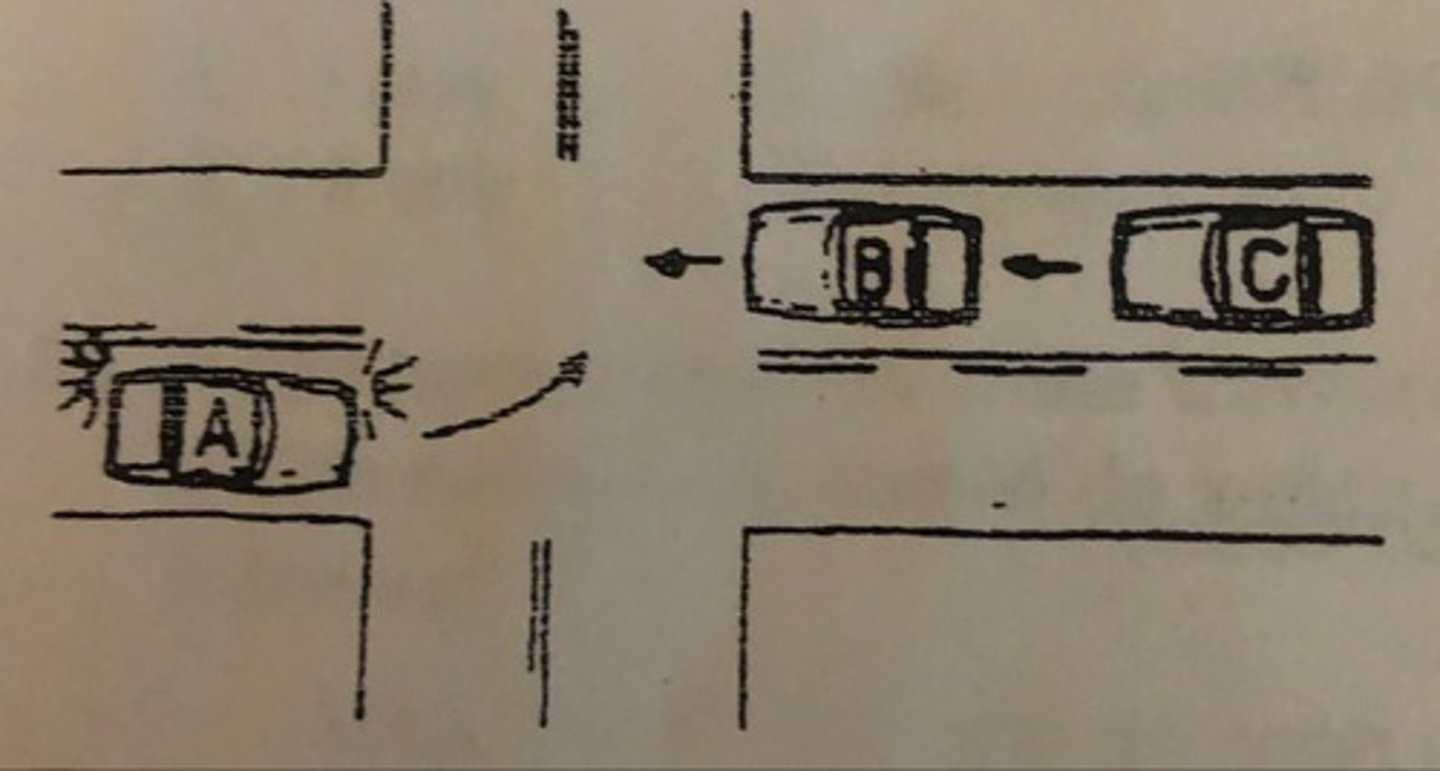
The intersection shown has no traffic lights or signs. The law gives the right of way to
A. Car A only
B. Car A and then car B
C. Car B and then car A
D. Car B
D
If you come to an unmarked intersection where it is hard to see in all directions because of trees or buildings, you should
A. Drive at the posted speed limit
B. Stop near the center of the intersection and continue if it is safe
C. Slow down and blow your horn to warn drivers who cannot see you
D. Stop at the intersection and move forward slowly
D
When driving on a city street, you should watch out for which of the following ?I. Traffic coming from side streets II. Animals or small children darting from between parked cars.
1/1
I only
II only
Both I and II
Neither I nor II
C
When driving in heavy traffic, you should do which of the following? I. Watch out for drivers who make quick stops .II. Yield to pedestrians only at marked crosswalks.
I only
II only
Both I and II
Neither I nor II
A
If you are in the wrong lane for making a left turn at an intersection, you should
A. Go to the next intersection and turn there
B. Back up and move into the correct lane for turning
C. Wait until all other cars have cleared the intersection and turn
D. Signal the driver in the car beside you that you intend to turn in front of him
A
The most frequent type of accident on Interstate highways is
A. Sideswipe collision
B. Running off the road
C. Rear-end collision
D. Head-on collision
C
When taking a long trip on an interstate highway, you should plan on doing what ?I. Stopping every 100 miles to rest II. Scheduling some night hours to avoid heavy traffic.
I only
II only
Both I and II
Neither I nor II
A
You are driving on an interstate highway when a breakdown forces you to the shoulder. You should
A. Sit in the car until help arrives
B. Tie a handkerchief to the left door handle and stand beside the left front fender
C. Raise the hood and tie a white handkerchief to the left door handle
D. Raise the hood and stand behind the car so drivers of on-coming cars can see you
C
Studies have shown that under normal conditions the chance of a car being involved in an accident on an interstate highway is greater if the driver
A. Maintains a steady speed
B. Travels considerably below the posted speed limit
C. Travels at the posted speed limit
D. Maintains his positions relative to cars in front and behind him in his lane
B
If you miss your exit on an interstate highway, you can do which of the following I. Make a u-turn II. Go on to the next exit
I only
II only
Both I and II
Neither I nor II
B
A driver may be temporarily blinded at night by which of the following? I. Glare from the headlights of other cars .II. Flame from a match he strikes to light a cigarette.
I only
II only
Both I and II
Neither I nor II
C
In which of the following situations should you use your low beams? I. At night in the city II. In foggy or misty weather
I only
II only
Both I and II
Neither I nor II
C
If the driver of an approaching car fails to dim his headlights, you should do which of the following? I. Watch the road ahead to avoid looking at the lights of the other car II. Flick your headlight beams up and down one time
I only
II only
Both I and II
Neither I nor II
C
When driving on a highway at night, you should never use your high beam headlights if you are
A. Slowing down for a turn
B. Traveling on a road with no median
C. Going down a hill
D. Following another car
D
If it starts to drizzle while you are driving, you should do which of the following: I. Slow down because oil will come to the surface. II Increase your following distance
1/1
I only
II only
Both I and II
Neither I nor II
C
Roads are likely to be especially slick
A. Just after they have been paved
B. Just after it has begun to rain or drizzle
C. After it has been raining for several hours
D. In exceptionally cold, dry weather
B
When driving through heavy fog, you should
A. Turn on your bright lights
B. Slow down
C. Follow the car in front of you closely
D. Turn on your parking lights
B
When driving in a heavy snowstorm during the day, you should use
A. Parking lights
B. Low-beam headlights
C. Four-way flashers
D. High-beam headlights
B
The best way to get good traction on hard packed snow is to
A. Put chains on your tires
B. Use snow tires
C. Have lower than usual air pressure in your tires
D. Carry heavy weights in your truck
A
When trying to pull away from a slippery surface in a car with a manual shift, you should do which of the following? I. Start in second or high gear II. Accelerate rapidly.
1/1
I only
II only
Both I and II
Neither I nor II
A
When pulling a trailer down a long, steep hill, you should do which of the following? I. Driver in a lower gear II. Keep in the right lane
I only
II only
Both I and II
Neither I nor II
C
If your brakes fail, you should do which of the following? I. Shift into a lower gear II. Use the emergency brake
I only
II only
Both I and II
Neither I nor II
C
Wet brakes can be dried out by doing which of the following? I. Turning on the heater II. Shifting into a lower gear and keeping light pressure on the brake pedal.
1/1
I only
II only
Both I and II
Neither I nor II
B
If you have a blowout while traveling at a high speed, you should do which of the following? I. Apply the brake firmly as soon as you notice the blowout. II. Grip the steering wheel firmly to keep the car from swerving.
I only
II only
Both I and II
Neither I nor II
B
When changing a flat tire, you should do which of the following? I. Put the vehicle in neutral gear. II. Block the wheels.
I only
II only
Both I and II
Neither I nor II
B
If your car breaks down on the highway at night, what should you do? I. Park the car completely off the road II. Turn on the high-beam lights.
I only
II only
Both I and II
Neither I nor II
A
If your car breaks down on a highway at night, you should do which of the following? I. Raise the hood and tie a white handkerchief to the left door handle .II. Switch on the parking lights.
1/1
I only
II only
Both I and II
Neither I nor II
C
If your vehicle has run off the road onto the shoulder, you should
A. Shift quickly to a lower gear
B. Brake with heavy constant pressure
C. Apply the emergency brake
D. Take your foot off the gas pedal gradually
D
Skids are likely to occur on which of the following roads? I. One on which snow has become packed II. One that has just been paved.
I only
II only
Both I and II
Neither I nor II
A
If you have to come to a stop on an icy road, you should
A. Use your hand brake
B. Put the brake on hard
C. Apply the brake in short hard jabs
D. Pump the brake pedal lightly
D
What should you do when you begin to skid? I. Turn the steering wheel in the direction in which the rear end of the car is skidding .II. Reduce pressure on the gas pedal.
I only
II only
Both I and II
Neither I nor II
C
A driver who is involved in an accident with injuries should do which of the following? I. stop II. call 9-1-1
1/1
I only
II only
Both I and II
Neither I nor II
C
A flashing red traffic signal at an intersection means which of the following? I. Slow down and proceed with caution .II. Stop only if it is necessary to yield the right-of-way
I only
II only
Both I and II
Neither I nor II
D
A flashing yellow traffic signal at an intersection means
A. No right turn
B. Yield the right-of-way
C. No left turn
D. Slow down and proceed with caution.
D
A diamond-shaped sign would be used to warn drivers of which of the following driving hazards? I. A railroad crossing II. A deer crossing
I only
II only
Both I and II
Neither I nor II
B
A diamond-shaped traffic sign means
A. No left turn
B. Come to a full stop
C. Yield the right-of-way
D. Slow down and drive with care
D
When can you disregard a signal given by a police officer directing traffic? I. An emergency vehicle is approaching .II. The officer's signal is in conflict with a traffic signal.
I only
II only
Both I and II
Neither I nor II
D
What is the main color for signs in highway work zones?
A. Red
B. White
C. Orange
D. Green
C
When does the law give a blind pedestrian special consideration at intersections where there are no traffic lights? I. Only when he is alone II. If he holds out a white cane or has a guide dog with him
I only
II only
Both I and II
Neither I nor II
B
Which of the following statements about bicycle riders is (are) correct? I. They must ride their bicycles facing traffic .II. They are likely to be seriously injured in almost any collision with a car.
I only
II only
Both I and II
Neither I nor II
B
In North Carolina, which of the following are required on all cars?
A. License plate lights
B. Courtesy lights and back up lights
C. Fender lights and courtesy lights
D. Backup lights and license plate lights
D
Your brakes need checking if
1/1
A. There is a strong smell of gasoline in the car
B. The engine stalls at stoplights
C. Light gusts of wind make the car difficult to control
D. There is a squeaking noise when you step on the brake
D
Which of the following statements about horns and sirens is (are) correct? I. Every licensed motor vehicle must have a horn. II. Only law enforcement and emergency vehicles may have sirens.
I only
II only
Both I and II
Neither I nor II
C
Every motor vehicle must be equipped with
A. A muffler
B. 4-ply tires
C. Mudguards
D. Shoulder harnesses
A
The system that carries harmful fumes from the engine to the rear of the car and releases them is called the
A. Ignition system
B. Fuel system
C. Suspension system
D. Exhaust system
D
A leaky exhaust system should be repaired because it
A. Wastes gas and oil
B. Causes the engine to run hot
C. May allow dangerous fumes to enter the car
D. Makes the engine hard to start and likely to stall
C
A car that pitches and tosses in normal driving and leans heavily to the side in turns is likely to have trouble in which of the following systems?
A. Ignition
B. Steering
C. Brake
D. Suspension
D
Which traffic is required to stop if a school bus makes a passenger stop in the far right lane on a five lane street?
A. All lanes of traffic
B. Lanes going in the same direction as the school bus
C. Lanes going in opposite direction of bus
D. Turning lane only
B
Maximum speed limit for a full size public school bus in North Carolina is:
A. 55mph
B. 45mph
C. 35mph
D. 25mph
B
You must stop for a school bus with flashing red lights
If you are following the bus
Only if you see children getting off the bus
If you are in an oncoming lane of a multilane roadway with a median
If the bus intends to turn left
A
You hear a siren or see the flashing lights of an emergency vehicle behind you. You should
Quickly pull to the left and stop
Quickly pull to the right and stop
Proceed slowly and stop if the emergency vehicle needs more room
Stop immediately where you are
B
A driver-education course
Teaches you everything you will ever need to know about safe driving
Guarantees that you will become a safe driver
Gives you a good start toward becoming a skillful driver
Is not necessary if you already know how to drive
C
The purpose of a rumble strip is to
Wake up drivers who are falling asleep
Alert you through the noise your tires make when driving over them
Warn you that are driving too close to the roadway edge
B and C above are correct
D
A driver that follows too closely is called a
Bumpersticker
Tailgater
Cargater
Tailodile
B
A traffic signal that has been green for some time is a
Stable green light
Sequential green light
Stale green light
Fresh green light
C
A drug that speeds up the central nervous system is called a
Depressant
Prescription drug
Downer
Stimulant
D
When stopped by a law enforcement officer you should
Stop your vehicle and silence any electronic devices
Remain in your vehicle
Put both hands on the steering wheel
All of the above
D
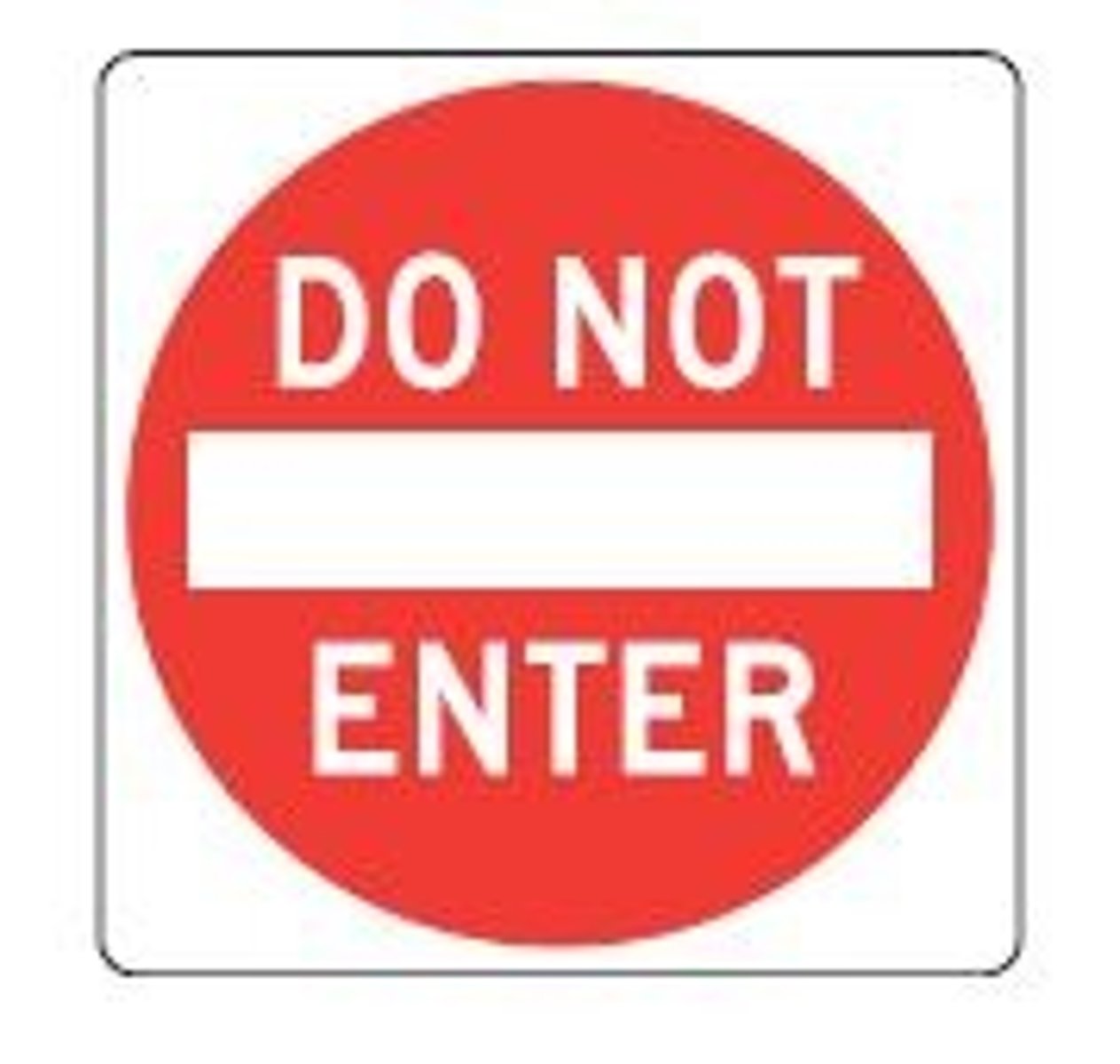
What sign is this
Do Not Enter Sign
What is a white rectangle sign called
regulatory sign
What is a yellow dimond sign called
warning sign
What shape are school signs?
pentagon
 Note
Note  Flashcards (27)