AP Gov Review
0.0(0)
 Studied by 5 people
 Call Kai
 Learn
Learn Practice Test
 Spaced Repetition
 Match
Match Flashcards
 Knowt Play
Card Sorting
1/106

Earn XP
Description and Tags
Last updated 2:49 AM on 5/1/23
Name | Mastery | Learn | Test | Matching | Spaced | Call with Kai |
|---|
No analytics yet
Send a link to your students to track their progress
107 Terms
1
New cards
1st Amendment
Freedom of Religion, Speech, Press, Assembly, and Petition
2
New cards
2nd Amendment
Right to keep and bear arms
3
New cards
3rd Amendment
No quartering of soldiers
4
New cards
4th Amendment
Freedom from unreasonable searches and seizures
5
New cards
5th Amendment
Criminal Proceedings; Due Process; Eminent Domain; Double Jeopardy; Protection from Self-incrimination;
6
New cards
6th Amendment
The right to a Speedy Trial by jury, representation by an attorney for an accused person
7
New cards
7th Amendment
Right to jury in civil trials.
8
New cards
8th Amendment
No cruel or unusual punishments
9
New cards
9th Amendment
Citizens entitled to rights not listed in the Constitution (enumerated powers)
10
New cards
10th Amendment
The powers not delegated to the United States by the Constitution, nor prohibited by it to the States, are reserved to the States respectively, or to the people.
11
New cards
Tinker v. Des Moines
* Tinker v. Des Moines: Several students wore black armbands to protest the Vietnam War and were suspended by the school board.
* The case involved a conflict between students' right to free speech (1st Amendment) and a school's authority to maintain discipline and order.
* The Supreme Court ruled 7-2 that the school district's policy violated the students' First Amendment rights, establishing the principle that students have free speech rights in schools and that schools cannot suppress speech they disagree with unless it would cause a substantial disruption of school activities or invade the rights of others.
* The case involved a conflict between students' right to free speech (1st Amendment) and a school's authority to maintain discipline and order.
* The Supreme Court ruled 7-2 that the school district's policy violated the students' First Amendment rights, establishing the principle that students have free speech rights in schools and that schools cannot suppress speech they disagree with unless it would cause a substantial disruption of school activities or invade the rights of others.
12
New cards
Schenck v. United States
* Schenck v. United States: Charles Schenck was convicted of violating the Espionage Act of 1917 by mailing anti-draft leaflets to men eligible for military conscription.
* The case involved a conflict between freedom of speech (1st Amendment) and the government's power to restrict speech in the interest of national security.
* The Supreme Court upheld Schenck's conviction, ruling that the First Amendment did not protect speech that posed a clear and present danger of causing harm to the country, and establishing the principle that free speech rights are not absolute and may be limited in certain circumstances.
* The case involved a conflict between freedom of speech (1st Amendment) and the government's power to restrict speech in the interest of national security.
* The Supreme Court upheld Schenck's conviction, ruling that the First Amendment did not protect speech that posed a clear and present danger of causing harm to the country, and establishing the principle that free speech rights are not absolute and may be limited in certain circumstances.
13
New cards
Wisconson v. Yoder
* Facts of the case: Jonas Yoder and two other parents refused to send their children to public high school after 8th grade, citing religious beliefs as they were part of the Amish community in Wisconsin.
* Constitutional principle at play: Free Exercise Clause of the First Amendment.
* Court ruling: The Supreme Court ruled in favor of Yoder, stating that Wisconsin's compulsory school attendance law violated the Free Exercise Clause and that Amish children could not be forced to attend school beyond the 8th grade.
* Constitutional principle at play: Free Exercise Clause of the First Amendment.
* Court ruling: The Supreme Court ruled in favor of Yoder, stating that Wisconsin's compulsory school attendance law violated the Free Exercise Clause and that Amish children could not be forced to attend school beyond the 8th grade.
14
New cards
Gideon v. Wainwright
* Facts of the case: Clarence Earl Gideon was charged with breaking and entering a Florida pool hall and was unable to afford a lawyer, but was denied a request for court-appointed counsel.
* Constitutional principle at play: Sixth Amendment right to counsel, which is incorporated to the states through the Fourteenth Amendment's Due Process Clause.
* Court ruling: The Supreme Court unanimously ruled in favor of Gideon, stating that the Sixth Amendment guarantees the right to counsel for all criminal defendants and that states must provide counsel for those who cannot afford one. (6th Amendment is selectively incorporated to the states through the 14th emendment)
* Constitutional principle at play: Sixth Amendment right to counsel, which is incorporated to the states through the Fourteenth Amendment's Due Process Clause.
* Court ruling: The Supreme Court unanimously ruled in favor of Gideon, stating that the Sixth Amendment guarantees the right to counsel for all criminal defendants and that states must provide counsel for those who cannot afford one. (6th Amendment is selectively incorporated to the states through the 14th emendment)
15
New cards
NY Times Co. v. US
* Facts of the case: The New York Times published classified documents known as the "Pentagon Papers" related to U.S. involvement in the Vietnam War, and the government sought to enjoin their publication.
* Constitutional principle at play: First Amendment freedom of the press, and the government's power to restrict speech or publication on national security grounds.
* Court ruling: The Supreme Court ruled in favor of the New York Times, stating that the government had failed to meet the "heavy burden" of proving that publication of the documents would cause direct and immediate harm to national security, and that the First Amendment's freedom of the press protects the right to publish information on matters of public concern, even if it is classified.
* Constitutional principle at play: First Amendment freedom of the press, and the government's power to restrict speech or publication on national security grounds.
* Court ruling: The Supreme Court ruled in favor of the New York Times, stating that the government had failed to meet the "heavy burden" of proving that publication of the documents would cause direct and immediate harm to national security, and that the First Amendment's freedom of the press protects the right to publish information on matters of public concern, even if it is classified.
16
New cards
McCulloch v. Maryland
* Facts of the case: The state of Maryland attempted to impose a tax on the Second Bank of the United States, a federally-chartered institution.
* Constitutional principle at play: Supremacy Clause of article 1 of the U.S. Constitution and the implied powers of the federal government under the Necessary and Proper Clause.
* Court ruling: The Supreme Court ruled in favor of the Second Bank of the United States, stating that the federal government had the power to create a bank, and that Maryland's attempt to tax the bank was unconstitutional because it interfered with the operations of the federal government and violated the Supremacy Clause. Additionally, the Court held that the Necessary and Proper Clause of the Constitution implied powers to the federal government that are not explicitly stated in the Constitution.
* Constitutional principle at play: Supremacy Clause of article 1 of the U.S. Constitution and the implied powers of the federal government under the Necessary and Proper Clause.
* Court ruling: The Supreme Court ruled in favor of the Second Bank of the United States, stating that the federal government had the power to create a bank, and that Maryland's attempt to tax the bank was unconstitutional because it interfered with the operations of the federal government and violated the Supremacy Clause. Additionally, the Court held that the Necessary and Proper Clause of the Constitution implied powers to the federal government that are not explicitly stated in the Constitution.
17
New cards
US v. Lopez
* Facts of the case: Alfonzo Lopez, a high school student, was charged and convicted of possessing a firearm at school, which violated the Gun-Free School Zones Act of 1990.
* Constitutional principle at play: Commerce Clause of Article 1 of the U.S. Constitution and the extent of Congress's power to regulate interstate commerce.
* Court ruling: The Supreme Court ruled in favor of Lopez, stating that the Gun-Free School Zones Act exceeded Congress's authority under the Commerce Clause because possession of a firearm in a school zone did not have a substantial effect on interstate commerce.
* Constitutional principle at play: Commerce Clause of Article 1 of the U.S. Constitution and the extent of Congress's power to regulate interstate commerce.
* Court ruling: The Supreme Court ruled in favor of Lopez, stating that the Gun-Free School Zones Act exceeded Congress's authority under the Commerce Clause because possession of a firearm in a school zone did not have a substantial effect on interstate commerce.
18
New cards
Marbury v. Madison
* Facts of the case: William Marbury was appointed as a court justice by President John Adams in the final hours of his presidency, but his commission was not delivered before Thomas Jefferson assumed office, and his successor as Secretary of State, James Madison, refused to deliver it.
* Constitutional principle at play: Judicial review, which is not explicitly stated in the U.S. Constitution.
* Court ruling: The Supreme Court ruled in favor of Madison, but the case is significant because it established the principle of judicial review, which gives the Supreme Court the power to declare acts of Congress unconstitutional. Specifically, Chief Justice John Marshall's opinion held that the Judiciary Act of 1789, which gave the Supreme Court the power to issue writs of mandamus, was unconstitutional because it expanded the original jurisdiction of the Supreme Court beyond what was permitted by article 3 of the Constitution.
* Constitutional principle at play: Judicial review, which is not explicitly stated in the U.S. Constitution.
* Court ruling: The Supreme Court ruled in favor of Madison, but the case is significant because it established the principle of judicial review, which gives the Supreme Court the power to declare acts of Congress unconstitutional. Specifically, Chief Justice John Marshall's opinion held that the Judiciary Act of 1789, which gave the Supreme Court the power to issue writs of mandamus, was unconstitutional because it expanded the original jurisdiction of the Supreme Court beyond what was permitted by article 3 of the Constitution.
19
New cards
Baker v. Carr
* Facts of the case: Charles W. Baker, a Tennessee citizen, brought a lawsuit against Joe C. Carr, the Tennessee Secretary of State, alleging that the state had not reapportioned its legislative districts in several decades, resulting in underrepresented urban areas and overrepresented rural areas.
* Constitutional principle at play: Equal Protection Clause of the Fourteenth Amendment and the concept of "one person, one vote."
* Court ruling: The Supreme Court ruled in favor of Baker, holding that the Equal Protection Clause of the Fourteenth Amendment provided federal courts with the power to review challenges to legislative apportionment and that the concept of "one person, one vote" required that each district have approximately the same number of people, thus protecting the principle of equal representation. This case established the principle that federal courts could hear challenges to state redistricting plans and played a significant role in shaping modern election law.
* Constitutional principle at play: Equal Protection Clause of the Fourteenth Amendment and the concept of "one person, one vote."
* Court ruling: The Supreme Court ruled in favor of Baker, holding that the Equal Protection Clause of the Fourteenth Amendment provided federal courts with the power to review challenges to legislative apportionment and that the concept of "one person, one vote" required that each district have approximately the same number of people, thus protecting the principle of equal representation. This case established the principle that federal courts could hear challenges to state redistricting plans and played a significant role in shaping modern election law.
20
New cards
Brown v. Board of Education
* Facts of the case: A group of African American students were denied admission to public schools in Topeka, Kansas, because of their race, and filed a lawsuit challenging the constitutionality of racial segregation in public schools.
* Constitutional principle at play: Equal Protection Clause of the Fourteenth Amendment and the concept of "separate but equal" established by the Supreme Court in Plessy v. Ferguson.
* Court ruling: The Supreme Court ruled unanimously in favor of the plaintiffs, stating that racial segregation in public schools violated the Equal Protection Clause of the Fourteenth Amendment because it had a detrimental effect on the education and development of African American students. The Court rejected the "separate but equal" doctrine established in Plessy v. Ferguson, declaring that separate educational facilities were inherently unequal and could never provide equal educational opportunities. This landmark decision marked a significant victory for the Civil Rights Movement and set a precedent for desegregation in all aspects of American life.
* Constitutional principle at play: Equal Protection Clause of the Fourteenth Amendment and the concept of "separate but equal" established by the Supreme Court in Plessy v. Ferguson.
* Court ruling: The Supreme Court ruled unanimously in favor of the plaintiffs, stating that racial segregation in public schools violated the Equal Protection Clause of the Fourteenth Amendment because it had a detrimental effect on the education and development of African American students. The Court rejected the "separate but equal" doctrine established in Plessy v. Ferguson, declaring that separate educational facilities were inherently unequal and could never provide equal educational opportunities. This landmark decision marked a significant victory for the Civil Rights Movement and set a precedent for desegregation in all aspects of American life.
21
New cards
McDonald v. Chicago
• Facts of the case: Otis McDonald and other residents of Chicago challenged a city ordinance that banned handguns and required all firearms to be registered with the city.
• Constitutional clause/principal at play: The Second Amendment's right to bear arms, and whether it applies to state and local governments through the Due Process Clause of the Fourteenth Amendment's incorporation of the Bill of Rights (selective incorporation).
• Court ruling: The Supreme Court held that the Second Amendment applies to state and local governments through the Due Process Clause of the Fourteenth Amendment, thus striking down Chicago's gun ban and affirming the right to bear arms for self-defense.
• Constitutional clause/principal at play: The Second Amendment's right to bear arms, and whether it applies to state and local governments through the Due Process Clause of the Fourteenth Amendment's incorporation of the Bill of Rights (selective incorporation).
• Court ruling: The Supreme Court held that the Second Amendment applies to state and local governments through the Due Process Clause of the Fourteenth Amendment, thus striking down Chicago's gun ban and affirming the right to bear arms for self-defense.
22
New cards
Shaw v. Reno
\n • Facts of the case: White voters in North Carolina challenged the state's congressional districting plan, which they claimed was drawn to create a majority-minority district that discriminated against white voters.
• Constitutional clause/principal at play: The Equal Protection Clause of the Fourteenth Amendment, which prohibits racial discrimination in the drawing of electoral districts (racial gerrymandering).
• Court ruling: The Supreme Court held that the districting plan was unconstitutional because it was drawn based primarily on race, rather than legitimate redistricting principles, and thus violated the Equal Protection Clause.
• Constitutional clause/principal at play: The Equal Protection Clause of the Fourteenth Amendment, which prohibits racial discrimination in the drawing of electoral districts (racial gerrymandering).
• Court ruling: The Supreme Court held that the districting plan was unconstitutional because it was drawn based primarily on race, rather than legitimate redistricting principles, and thus violated the Equal Protection Clause.
23
New cards
Engel v vitale
• Facts of the case: The Board of Regents for the State of New York authorized a short, voluntary prayer to be recited by students in public schools at the start of each school day, and a group of parents challenged the constitutionality of this practice.
• Constitutional clause/principal at play: The First Amendment's Establishment Clause, which prohibits the government from establishing an official religion.
• Court ruling: The Supreme Court held that the practice of having public school students recite a prayer in school violated the Establishment Clause of the First Amendment, and therefore was unconstitutional.
• Constitutional clause/principal at play: The First Amendment's Establishment Clause, which prohibits the government from establishing an official religion.
• Court ruling: The Supreme Court held that the practice of having public school students recite a prayer in school violated the Establishment Clause of the First Amendment, and therefore was unconstitutional.
24
New cards
Citizens United v. FEC
• Facts of the case: Citizens United, a conservative non-profit organization, wanted to air a film critical of Hillary Clinton during the 2008 Democratic primary election, but the Federal Election Commission (FEC) determined that the film was an electioneering communication and therefore subject to federal campaign finance laws.
• Constitutional clause/principal at play: The First Amendment's protection of freedom of speech, and the question of whether corporate spending on political speech is a form of protected speech.
• Court ruling: The Supreme Court held that corporate spending on political speech is a form of protected speech under the First Amendment, and that restrictions on such spending by corporations or labor unions are unconstitutional. The ruling in effect lifted limits on independent expenditures made by corporations and unions in support of political candidates.
• Constitutional clause/principal at play: The First Amendment's protection of freedom of speech, and the question of whether corporate spending on political speech is a form of protected speech.
• Court ruling: The Supreme Court held that corporate spending on political speech is a form of protected speech under the First Amendment, and that restrictions on such spending by corporations or labor unions are unconstitutional. The ruling in effect lifted limits on independent expenditures made by corporations and unions in support of political candidates.
25
New cards
The declaration of independence
The influence of enlightenment ideals (such as natural rights of life, liberty, and pursuit of happiness, social contract, etc…) on the role of government.
26
New cards
The articles of confederation
1. Extremely weak central government with very strong state governments.
2. Only branch was legislative branch
3. Federal government in charge of international commerce, and resolves disputes between states
4. federal government cannot raise an army or collect taxes, these abilities go to the states
5. Every state must agree if the articles are to be amended
6. Shay’s rebellion exemplifies how bad the articles were
27
New cards
US Constitution
1. Much more federal power than the AOC
2. Bicameral legislature
3. 3 branches
4. Strengths of the constitution exemplified by the whiskey rebellion
28
New cards
Fed 10
1. __***Factions***__ are bad because of tyranny of the majority (they might try to dominate government in order to impose their own interests on the whole society)
2. Factions are inevitable in a democracy
3. James Madison argued that a large, diverse republic would better protect individual liberties than a small, homogenous republic. He believed that a larger republic would have a greater diversity of interests, making it more difficult for any one faction to gain control and infringe upon the rights of others.
29
New cards
Brutus 1
1. ==__***A confederacy is better than a republic for the US***__==
2. argues that state governments are useless and mean nothing compared to federal government (with necessary and proper clause + supremacy clause)
3. One example of this is taxes
1. argues that the fed will take most of the taxes, leaving nothing for state govt’s
2. will further lead to an increase in fed power and a decrease in state power
4. Argues that the US is too big for a republic
1. elected officials will have too many ppl to represent, impossible to represent them all
30
New cards
Fed 51
1. __***Seperation of power + checks and balances***__
2. each branch must maximize independent power, which should be equal to the other branches
3. the legislature has more power than other branches, so divide it in 2
4. Federalism (power is split between federal and state)
31
New cards
Fed 70
1. __***Justifies the need for a single executive***__
2. an executive is defined by his energy, or his ability to get stuff done
3. a single executive maximizes energy because the more ppl you add, the longer stuff takes, also reduces internal conflict and division
4. It’s easier to blame a single executive if something goes wrong; multiple executives will be able to shift blame, concealing who is actually at fault
32
New cards
Fed 78
1. __***All judges are to be appointed by the president and will serve for life***__
2. lifetime appointments make it easier for judges to rule impartially without worrying about pleasing anyone
1. also makes them more independent
3. Judges check and balance other branches, especially the legislature
33
New cards
Letter from Birmingham Jail
Uses the equal protection clause to advocate for civil rights
34
New cards
Civil Rights Act
This law ended segregation in public places and banned employment discrimination based on race, color, religion, sex, or national origin.
35
New cards
Voting Rights Act
Legislation passed in 1965 to prohibit racial discrimination in voting. It outlawed literacy tests and other discriminatory practices used to prevent African Americans from voting in the South. The act was later amended to protect the voting rights of language minorities.
36
New cards
Title IX
Federal law that prohibits discrimination on the basis of sex in any educational program or activity receiving federal funding.
37
New cards
17th Amendment
Direct election of senators
38
New cards
Shay’s Rebellion
Shays Rebellion was a 1786-87 uprising by farmers in Massachusetts against high taxes and debt. The rebellion showed the weakness of the Articles of Confederation because the federal government was unable to raise an army to put down the rebellion. It also highlighted the inability of the government to regulate commerce and enforce laws.
39
New cards
Elitist
A theory that government is run by a small, powerful elite group
40
New cards
Participatory
A theory that emphasizes the broad participation of citizens in government
41
New cards
Pluralist
A theory that emphasizes the role of groups in the policymaking process
42
New cards
Factions
Groups of people who share common interests and work together to influence government policy
43
New cards
Feds/Anti-Feds
Supporters and opponents of the US Constitution
44
New cards
Compromises at the Convention
The Great Compromise, Three-Fifths Compromise
45
New cards
Checks and Balances
The ability of each branch of government to limit the power of the other two branches
46
New cards
legislature checks on executive
* Override a presidential veto with a two-thirds majority vote in both the House of Representatives and the Senate
* Limit funding for the executive branch
* Impeach and remove the president and other officials from office
* Limit funding for the executive branch
* Impeach and remove the president and other officials from office
47
New cards
legislature checks on judciary
* Impeach and remove judges from office
* Determine the jurisdiction of the courts
* Determine the jurisdiction of the courts
48
New cards
executive checks on legislature
* Veto legislation passed by Congress
* Propose legislation to Congress and influence its passage
* Appoint federal judges and executive branch officials with the advice and consent of the Senate
* Propose legislation to Congress and influence its passage
* Appoint federal judges and executive branch officials with the advice and consent of the Senate
49
New cards
executive checks on judiciary
* Appoint federal judges with the advice and consent of the Senate
* Responsible for enforcing the law and defending the nation
* Responsible for enforcing the law and defending the nation
50
New cards
judiciary checks on executive
* Declare executive actions unconstitutional
* Rule on the constitutionality of actions taken by the executive branch
* Rule on the constitutionality of actions taken by the executive branch
51
New cards
judiciary checks on legislature
* Declare laws passed by Congress unconstitutional
* Rule on the constitutionality of actions taken by Congress
* Rule on the constitutionality of actions taken by Congress
52
New cards
Federalism
The sharing of power between the national and state governments
53
New cards
Fiscal Federalism
The pattern of spending, taxing, and providing grants in the federal system (mostly applies to taxes)
54
New cards
Commerce Clause
Article I, Section 8, Clause 3 of the Constitution, which gives Congress the power to regulate interstate commerce
55
New cards
Supremacy Clause
Article VI of the Constitution, which establishes the Constitution and federal law as the supreme law of the land
56
New cards
Necessary and Proper Clause
Article I, Section 8, Clause 18 of the Constitution, which gives Congress the power to make all laws necessary and proper for carrying out its other powers
57
New cards
Enumerated (written) powers of congress
1. To lay and collect taxes, duties, imposts and excises, to pay the debts and provide for the common defense and general welfare of the United States
2. To regulate commerce with foreign nations, and among the several states, and with the Indian tribes
3. To coin money, regulate the value thereof, and of foreign coin, and fix the standard of weights and measures
4. To declare war, grant letters of marque and reprisal, and make rules concerning captures on land and water
5. To raise and support armies, but no appropriation of money to that use shall be for a longer term than two years
58
New cards
Enumerated (written) powers of the executive branch
1. The power to serve as commander-in-chief of the US military and to use military force to defend the nation against threats, as granted by Article II, Section 2 of the Constitution.
2. The power to make treaties with foreign nations, subject to the advice and consent of the Senate, as granted by Article II, Section 2 of the Constitution.
3. The power to appoint federal judges, ambassadors, and other officials, subject to Senate confirmation, as granted by Article II, Section 2 of the Constitution.
4. The power to grant reprieves and pardons for federal crimes, except in cases of impeachment, as granted by Article II, Section 2 of the Constitution.
59
New cards
Structure, rules, etc. of Senate/House
The organization and procedures of the two chambers of Congress
60
New cards
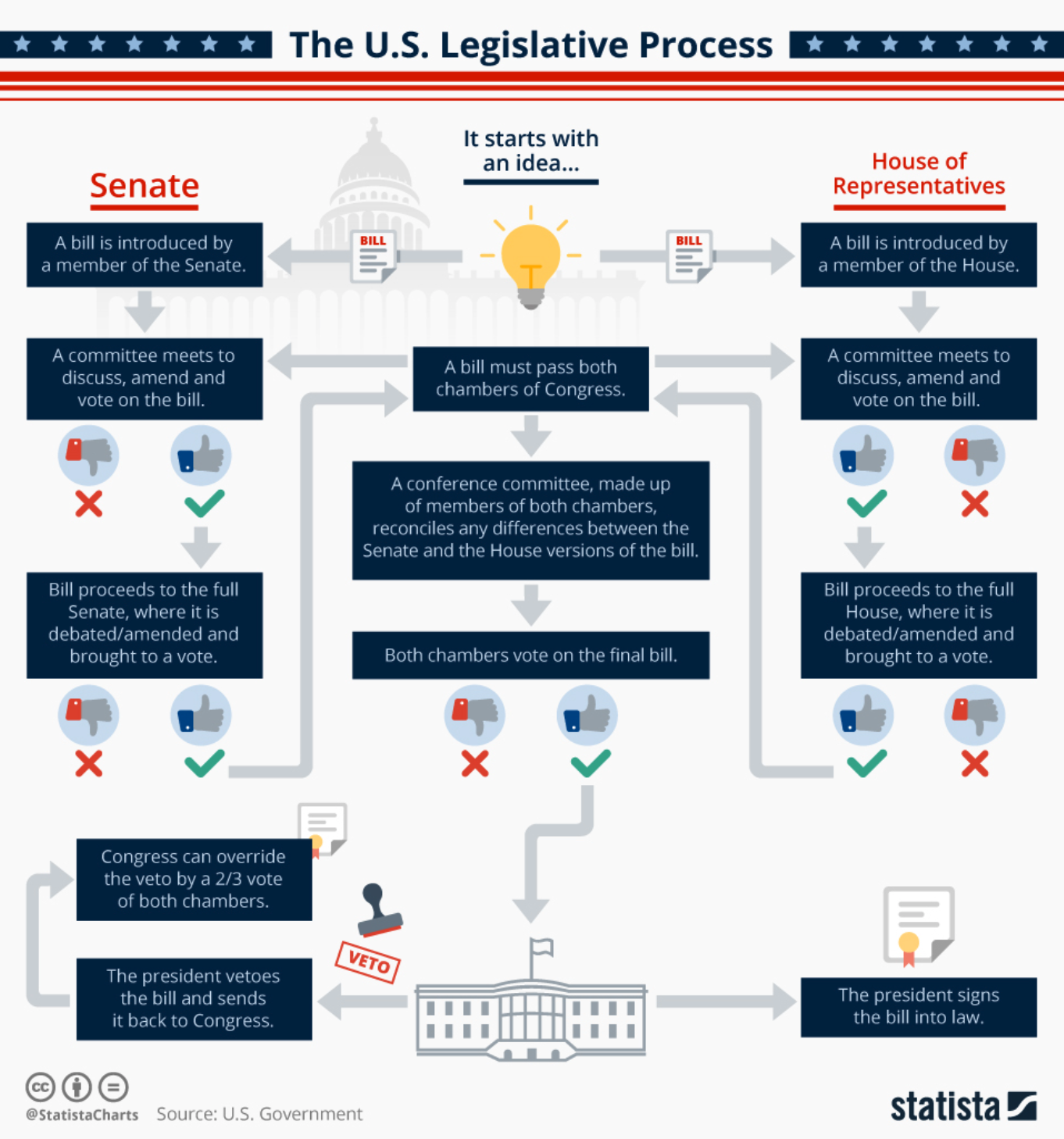
Legislative process
\
61
New cards
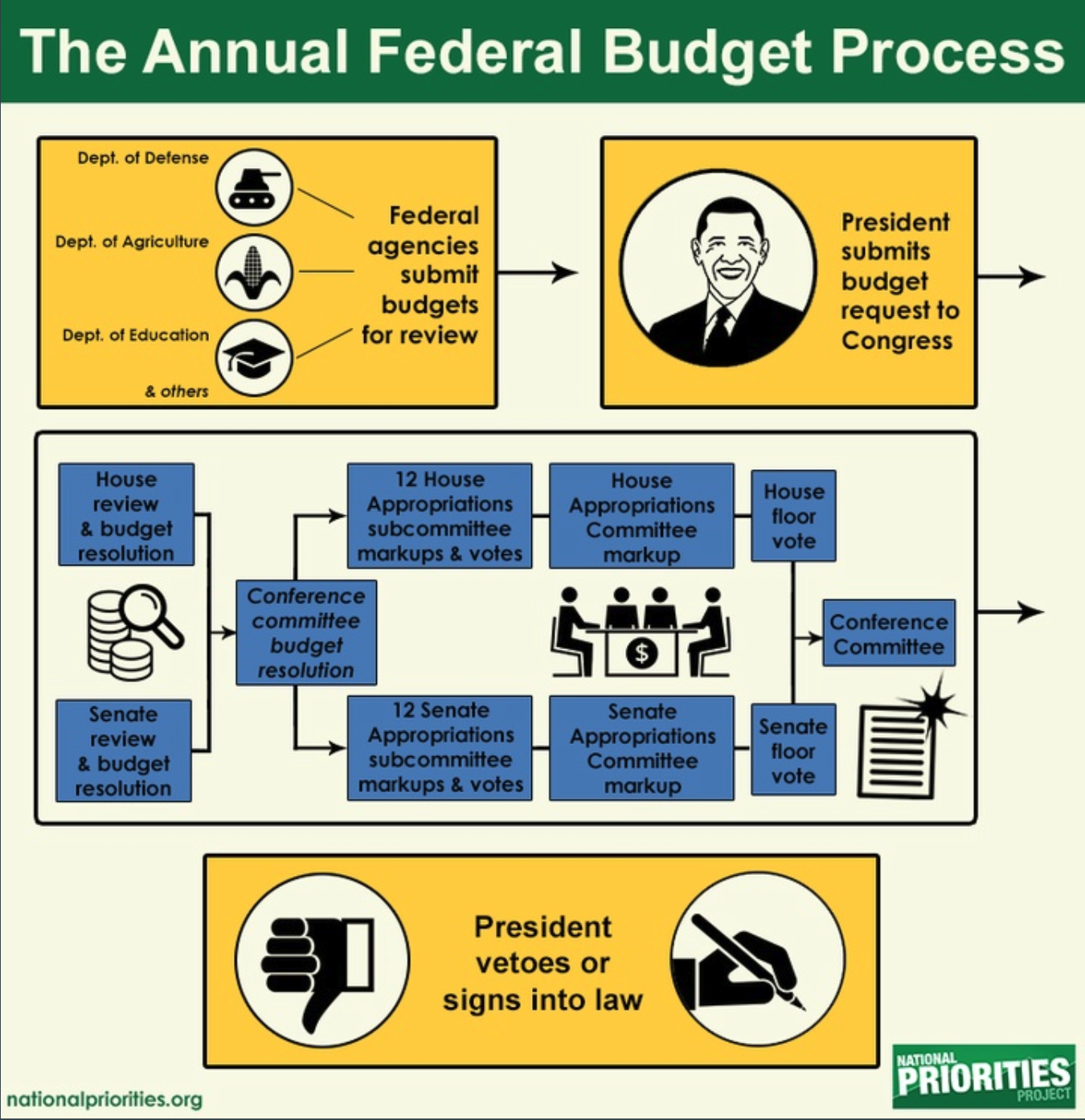
Budget
\
62
New cards
Discretionary spending
Government spending that is determined through the annual appropriations process and is subject to annual budget limits. This includes spending on programs and activities that are not required by law, such as __funding for education, national parks, and scientific research__.
63
New cards
Mandatory Spending
Government spending that is authorized by law and is not subject to annual appropriations. This type of spending includes entitlement programs such as __Social Security, Medicare, and Medicaid__, which provide benefits to eligible individuals or groups.
64
New cards
Models of representation
The different ways representatives can represent their constituents
65
New cards
Delegate representation
Elected officials act solely on behalf of their constituent’s wishes.
66
New cards
Politico representation
Elected officials balance their own judgment and expertise with the preferences of their constituents.
67
New cards
Trustee representation
Elected officials make decisions that will most benefit their constituents, even if the constituents are opposed to it. The politician knows best. You don’t know what you want.
68
New cards
Judicial activism
This approach involves judges interpreting the law based on their own personal or political beliefs, often leading to striking down laws they deem unconstitutional or reading new rights into the Constitution. Supporters believe this approach promotes social and political change, while critics argue it undermines the separation of powers and the democratic process.
69
New cards
Judicial restraint
This approach involves judges generally deferring to the decisions of the elected branches of government and being hesitant to strike down laws or read new rights into the Constitution. Supporters argue this approach respects the role of the elected branches and promotes stability and predictability in the legal system, while critics argue it can lead to the courts failing to protect individual rights and liberties.
70
New cards
Selective Incorporation
The process by which the Bill of Rights has been applied to the states
71
New cards
Affirmative Action
Policies that give preferential treatment to historically disadvantaged groups
72
New cards
Civil Rights Movement
This movement, led by prominent activists such as Martin Luther King Jr., pushed for equal rights for Black Americans, resulting in landmark legislation like the Civil Rights Act of 1964 and the Voting Rights Act of 1965.
73
New cards
Women's Suffrage Movement
The movement to secure women's right to vote culminated in the passage of the 19th Amendment to the US Constitution in 1920.
74
New cards
Equal protection clause of the 14th amendment
A constitutional provision that requires states to treat all individuals within their jurisdiction equally under the law. It prohibits discrimination based on race, gender, religion, and other protected characteristics.
75
New cards
Liberal vs. Conservative vs. Libertarian ideology
Different political ideologies with different beliefs about the role of government
76
New cards
Liberal
Economic: Liberals support free markets with government intervention, progressive taxation, and investment in education, healthcare, and infrastructure.
Social: Liberals prioritize individual liberties and civil rights, advocate for marginalized groups, support social welfare programs, and advocate for secularism in government.
Political: Liberals support democracy, political reforms, individual freedoms, civil liberties, international cooperation, and environmental protection.
Social: Liberals prioritize individual liberties and civil rights, advocate for marginalized groups, support social welfare programs, and advocate for secularism in government.
Political: Liberals support democracy, political reforms, individual freedoms, civil liberties, international cooperation, and environmental protection.
77
New cards
Conservative
Economic: Conservatives generally support free markets with limited government intervention, lower taxes, deregulation, and a focus on individual responsibility and self-reliance.
Social: Conservatives tend to prioritize traditional values and norms, support individual freedoms and liberties, advocate for strong national defense, and may oppose some social welfare programs.
Political: Conservatives support limited government, individual liberties, strong national defense, free speech, and traditional values, and may advocate for a strict interpretation of the Constitution and a focus on states' rights.
Social: Conservatives tend to prioritize traditional values and norms, support individual freedoms and liberties, advocate for strong national defense, and may oppose some social welfare programs.
Political: Conservatives support limited government, individual liberties, strong national defense, free speech, and traditional values, and may advocate for a strict interpretation of the Constitution and a focus on states' rights.
78
New cards
libertarian
Economic: Libertarians advocate for free markets with little or no government intervention, low taxes, and limited regulation, and may support privatization of public services.
Social: Libertarians prioritize individual liberties and civil rights, advocate for personal responsibility, support freedom of speech and expression, and may oppose government involvement in social issues.
Political: Libertarians support limited government, individual liberties, free speech, and a strict interpretation of the Constitution, and may oppose foreign intervention and military involvement.
Social: Libertarians prioritize individual liberties and civil rights, advocate for personal responsibility, support freedom of speech and expression, and may oppose government involvement in social issues.
Political: Libertarians support limited government, individual liberties, free speech, and a strict interpretation of the Constitution, and may oppose foreign intervention and military involvement.
79
New cards
Equality of Opportunity
Everyone should have the same chance to succeed regardless of personal characteristics, but the outcome of their efforts may vary based on individual abilities, effort, and luck.
80
New cards
Equality of Outcome
Everyone should have the same level of success and achievement, regardless of individual differences, and resources and opportunities should be distributed equally to ensure equal outcomes.
81
New cards
Elements of a good poll
1. Clear and concise question
2. Relevant and specific topic
3. Unbiased language
4. Representative sample
5. Appropriate sample size
82
New cards
Liberty vs. order
The tension between individual freedoms and societal stability
83
New cards
Free market theory
believes in minimal government intervention in the economy, emphasizing individual freedom, private property, and competition.
84
New cards
Keynesian theory
advocates for government intervention in the economy, especially during times of economic downturns, to stimulate economic growth and employment.
85
New cards
Regulation theory
believes that government intervention is necessary to correct market failures, protect the public interest, and ensure fair competition in the market.
86
New cards
Retrospective voting
voting based on the evaluation of past performance of the incumbent candidates or parties
87
New cards
Prospective voting
Voting based on the assessment of the expected future performance of the candidates or parties
88
New cards
Rational choice voting
Voting based on the careful consideration of self-interest, preferences, and beliefs, and selecting the candidate or party that aligns with them the most
89
New cards
Party-line voting
Voting based on loyalty to a political party or ideology, rather than the individual candidates or their policies
90
New cards
Barriers to voting
* Registration
* Time
* Suppression
* Time
* Suppression
91
New cards
Political parties
Organizations that seek to gain and maintain political power
92
New cards
Linkage institutions
Institutions that connect citizens to the government and shape public opinion. Examples include political parties, interest groups, and the media.
93
New cards
contributions
Contributions are donations made directly to a political candidate or party, or to a political action committee (PAC) that supports a candidate or party. These contributions are subject to strict limits under federal law, and individuals and organizations are required to disclose the amount of their contributions and the identity of the recipient.
94
New cards
Independant expenditures
expenditures made by individuals or organizations that are not coordinated with a candidate or party. These expenditures can take many forms, such as television ads, mailings, or other forms of political advertising. Unlike contributions, there are no limits on the amount that can be spent on independent expenditures, but the spender must disclose the amount and recipient of the expenditure to the Federal Election Commission (FEC).
95
New cards
Bipartisan Campaign Reform Act (BCRA)
* Legislation passed in 2002 to regulate campaign finance in federal elections.
* BCRA banned soft money donations to political parties and increased disclosure requirements for campaign ads.
* The law also restricted the ability of corporations and unions to run issue ads in the weeks leading up to an election.
* BCRA banned soft money donations to political parties and increased disclosure requirements for campaign ads.
* The law also restricted the ability of corporations and unions to run issue ads in the weeks leading up to an election.
96
New cards
Super PAC (political action committee)
* Can raise and spend unlimited amounts of money on independent expenditures.
* Not allowed to donate money directly to candidates or parties.
* Can only be formed by individuals or other independent organizations.
* Must disclose their donors but not necessarily their donations.
* Not allowed to donate money directly to candidates or parties.
* Can only be formed by individuals or other independent organizations.
* Must disclose their donors but not necessarily their donations.
97
New cards
PAC (political action committee)
* Subject to strict limits on the amount of money they can raise and donate to candidates or parties.
* Can donate directly to candidates or parties.
* Can be formed by individuals, corporations, labor unions, or other groups.
* Must disclose their donors and donations to the FEC.
* Can donate directly to candidates or parties.
* Can be formed by individuals, corporations, labor unions, or other groups.
* Must disclose their donors and donations to the FEC.
98
New cards
Bully pulpit
Implied power of the president that basically says the people will listen to what he has to say
99
New cards
Stare decisis
“Let the decision stand” basically cements the idea to agree with precedent
100
New cards
Iron triangle
Relationship between bureaucratic agencies, congressional committees, and interest groups
 Note
Note  Flashcards (81)