CPR Part 4: Starting at MATERIALS, C&B Cements, Provisional materials, Bonding agents, Temporary restorative materials (IRM)
 Call Kai
 Learn
Learn Practice Test
 Spaced Repetition
 Match
Match Flashcards
 Knowt Play
1/109

There's no tags or description
Looks like no tags are added yet.
Name | Mastery | Learn | Test | Matching | Spaced | Call with Kai |
|---|
No analytics yet
Send a link to your students to track their progress
110 Terms
Starting at MATERIALS on slide 37 of Kelsey's & slide 120 of Julia's
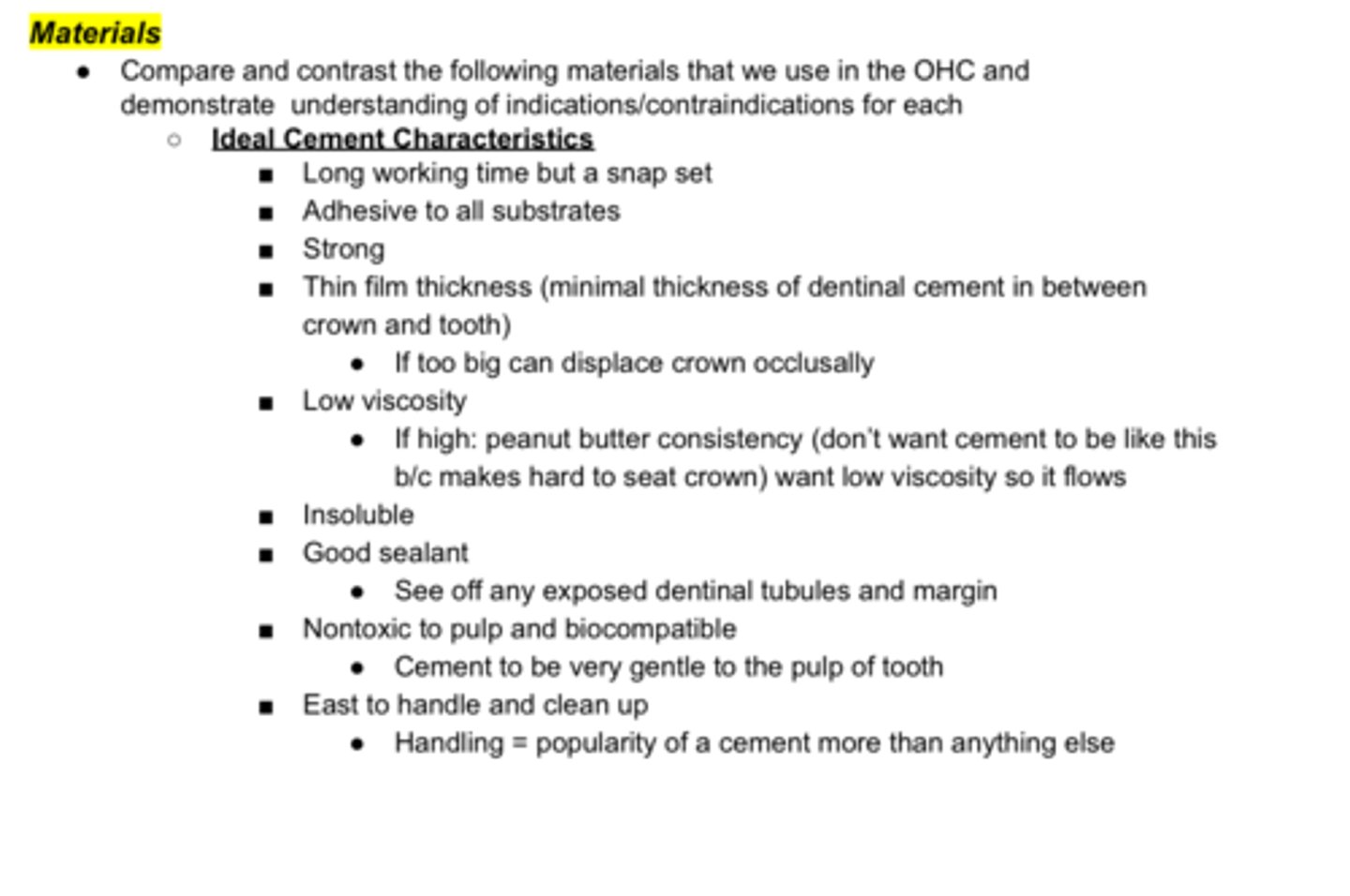
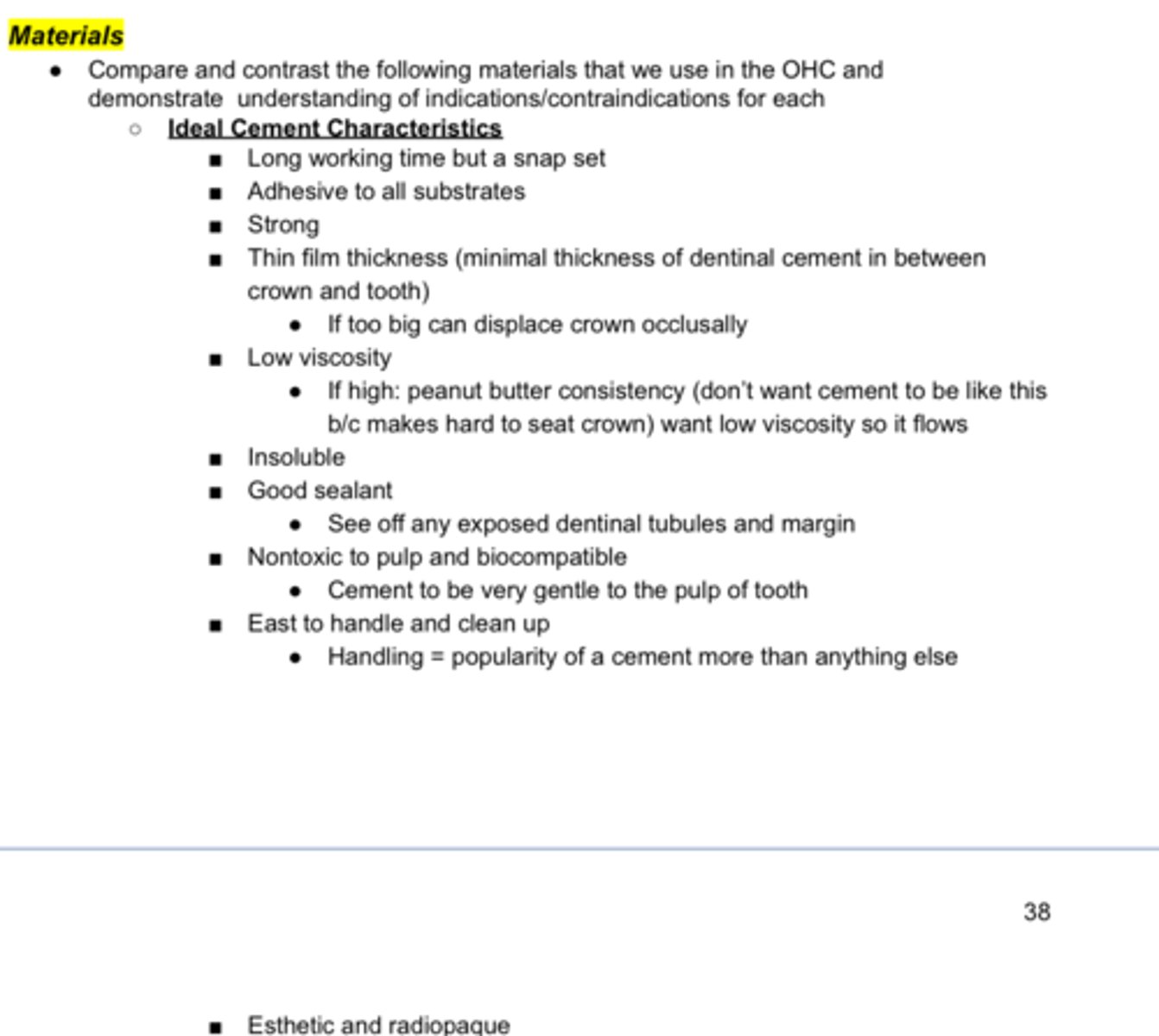
Ideal Cement Characteristics
Crowns & Bridges
These are all Cements for ____ & ____
Temporary cements
Zinc oxide Eugenol (ZOE)
Zinc Polycarboxylate
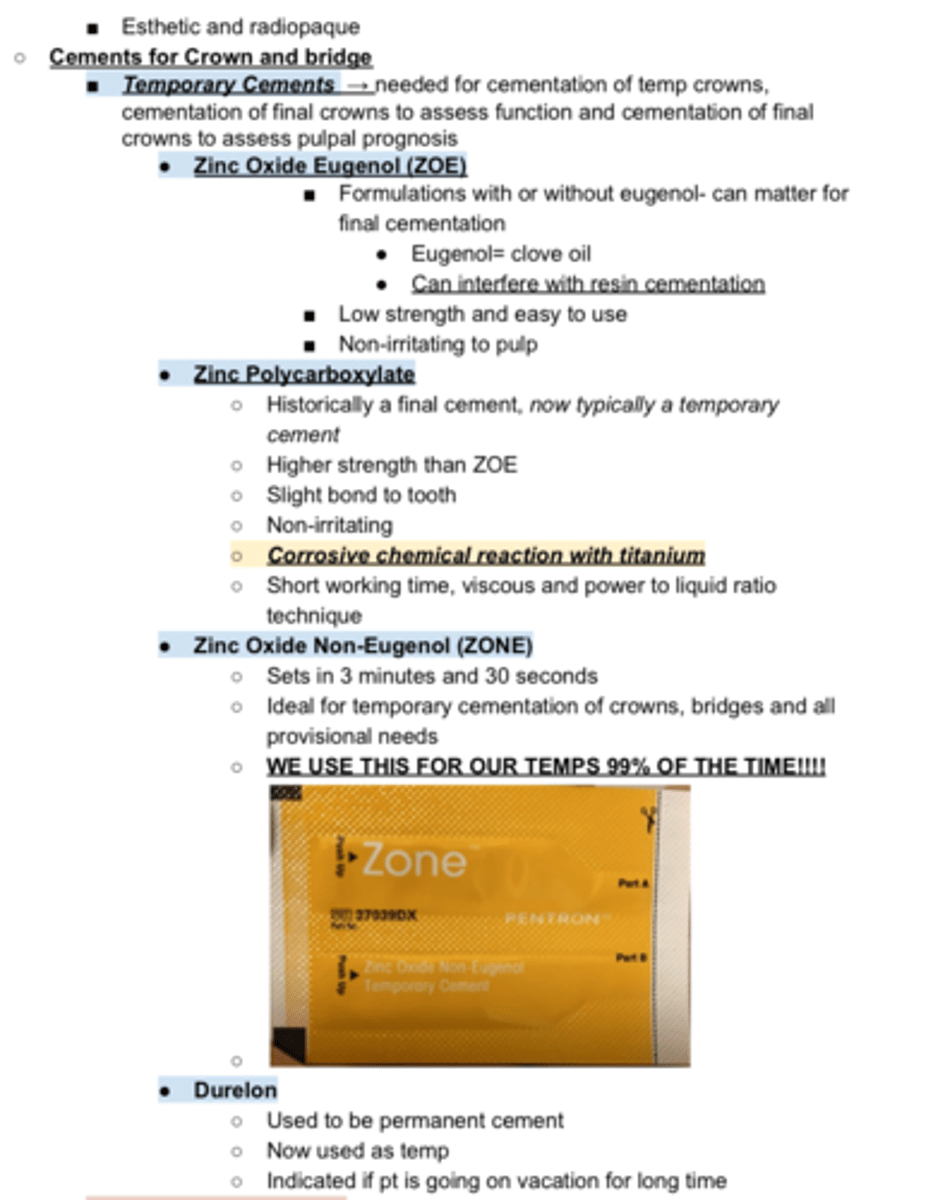
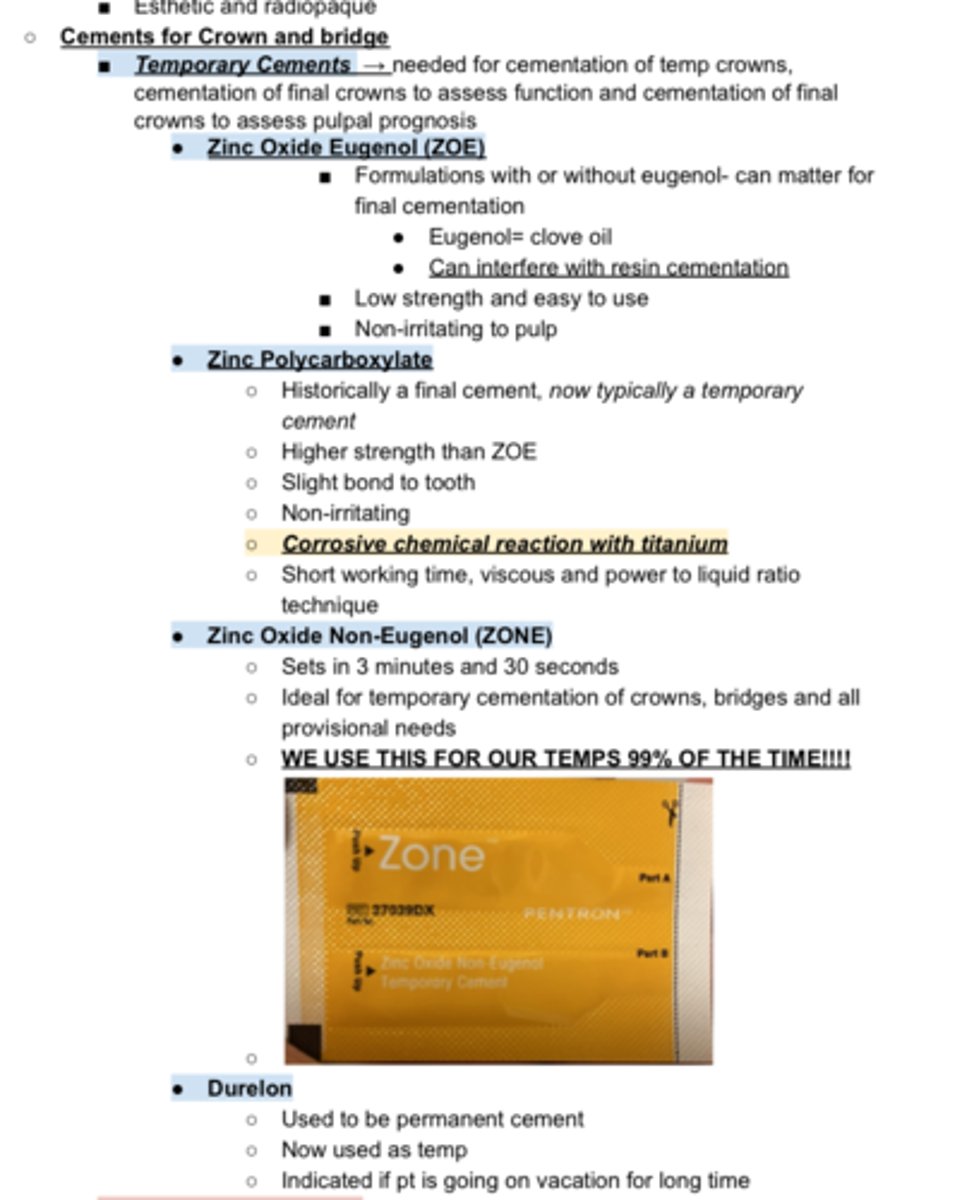
Zinc Oxide Non-Eugenol (ZONE)
Durelon
Final Luting cements
Glass Ionomers
RMGI (peoples cement)
Bonding cements:
Light cure resin cement
Dual cure resin cement
Total etch resin cement
Self etch resin cement
Self adhesive resin cement
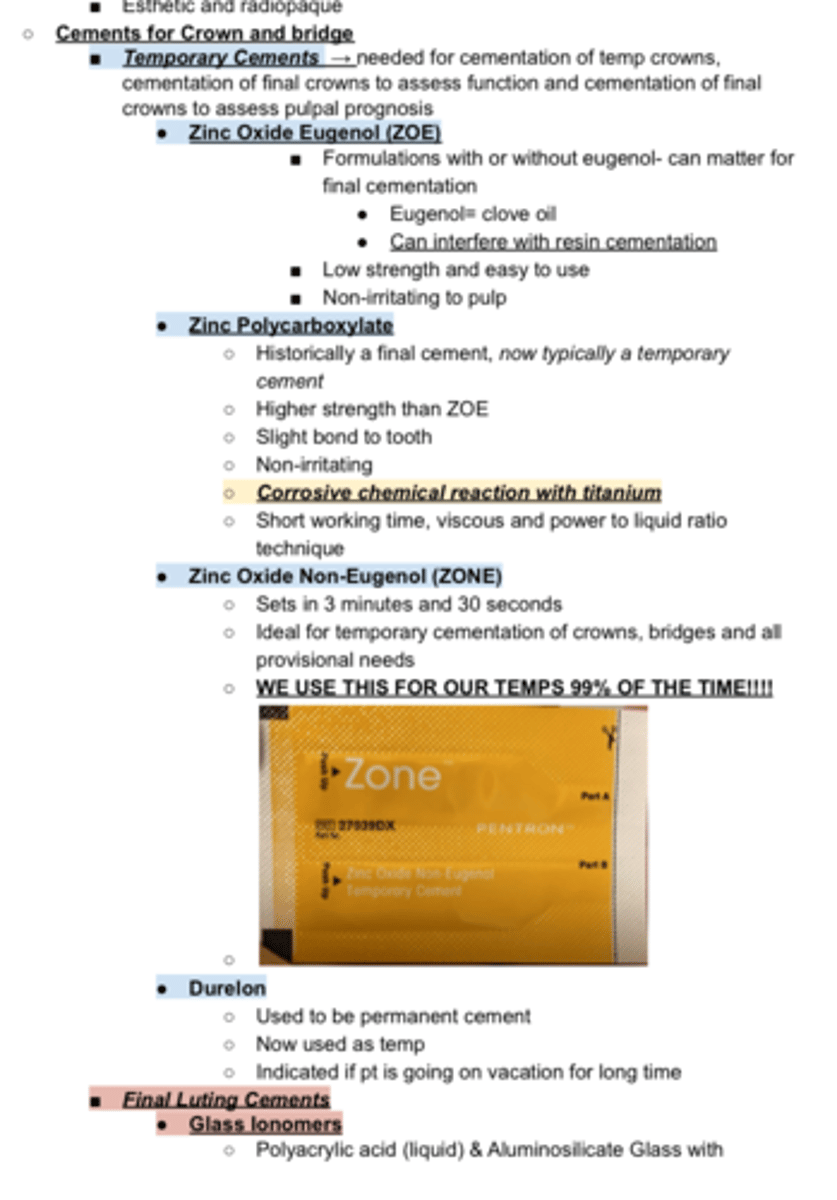
read what temp cements are for at the top
Temporary
These are ____ Cements that could be used to Temporarily cement a Crown or Bridge
Zinc Oxide Non-Eugenol (ZONE)
Zinc oxide Eugenol (ZOE)
Zinc Polycarboxylate
Durelon
Zinc Oxide Non-Eugenol (ZONE)
Zinc oxide Eugenol (ZOE)
Zinc Polycarboxylate
Durelon
List 4 Temporary cements that could be used to Cement a Crown/Bridge
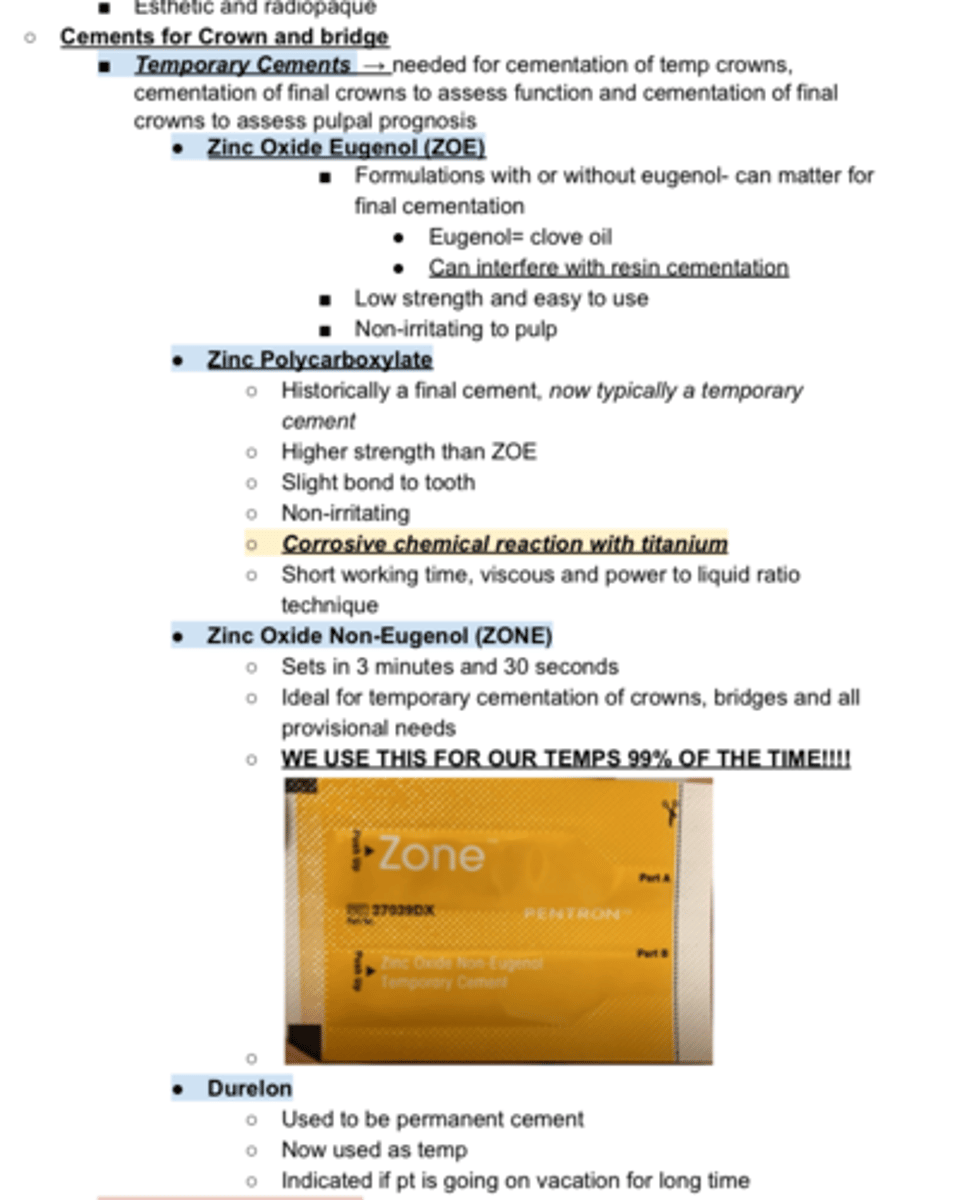
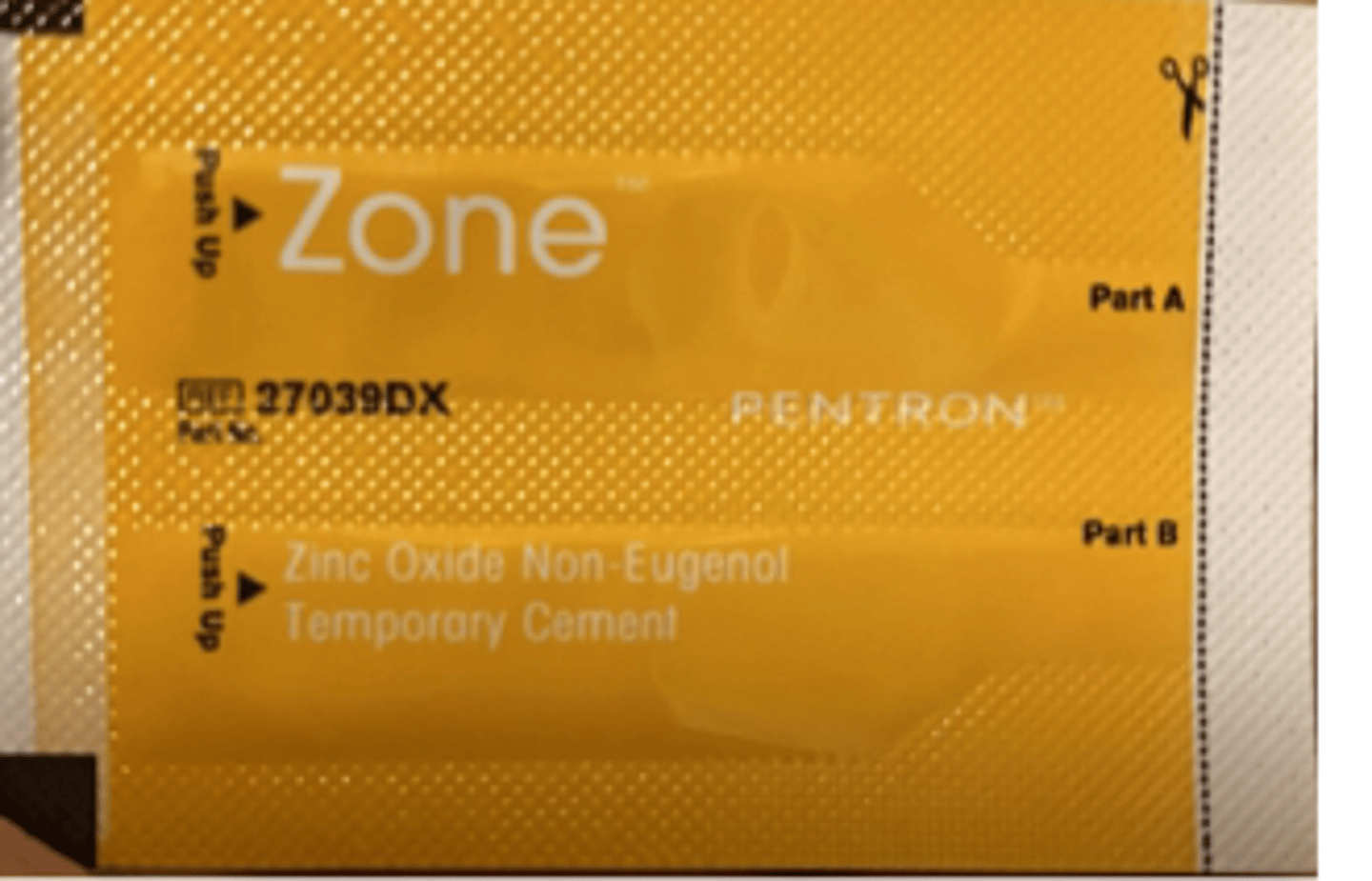
Zinc Oxide Non-Eugenol (ZONE)
Type of temporary cement
Sets in 3 minutes and 30 seconds
Ideal for temporary cementation of crowns, bridges and all provisional needs
WE USE THIS FOR OUR TEMPS 99% OF THE TIME!!!!
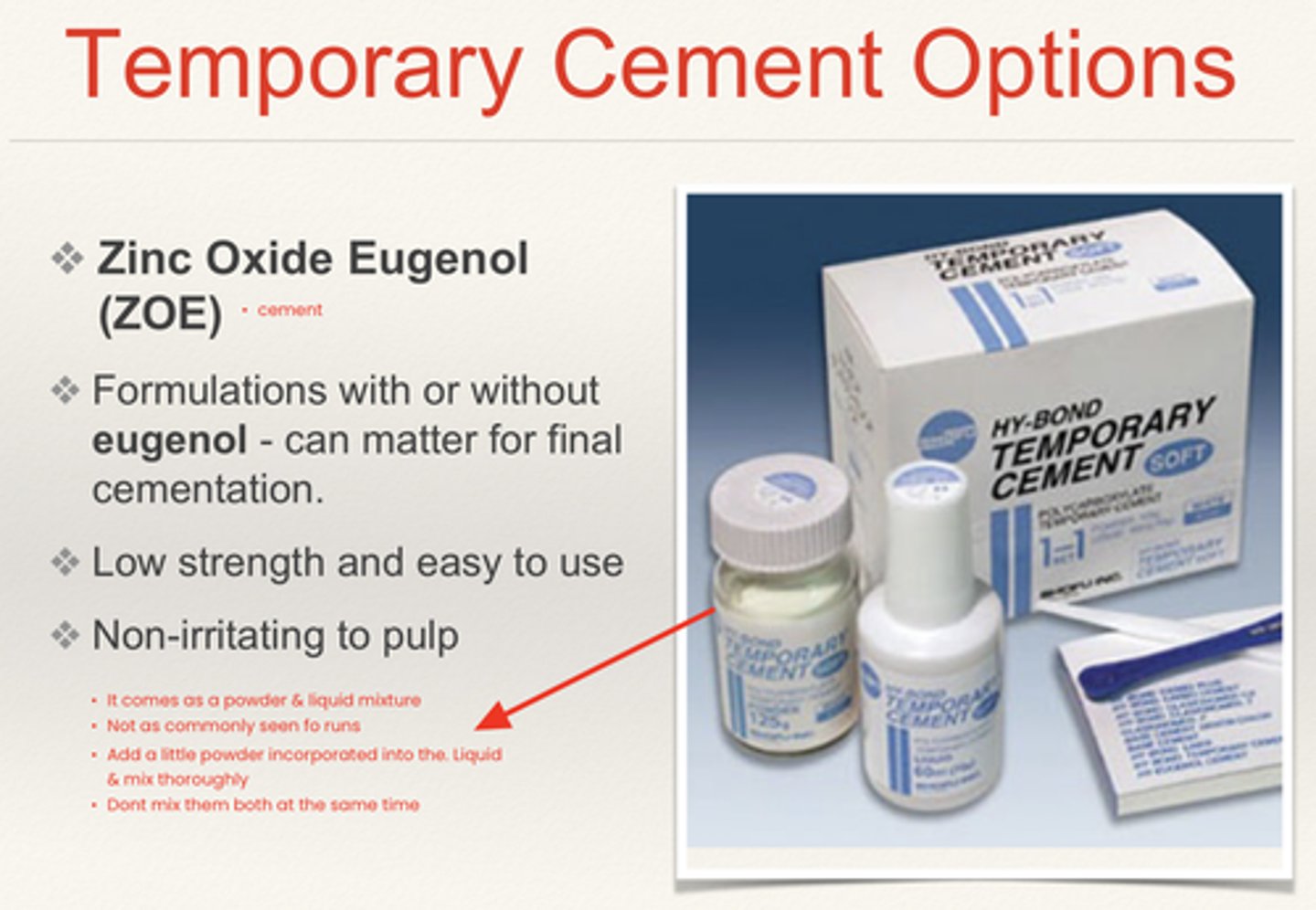
Zinc Oxide Eugenol (ZOE
Type of temporary cement
Formulations with or without eugenol
Therefore CAN interfere w resin cementation
Low strength
Easy to use
Non-irritating to pulp
Eugenol= clove oil
- Can ALSO be used as a a Cavity BASE
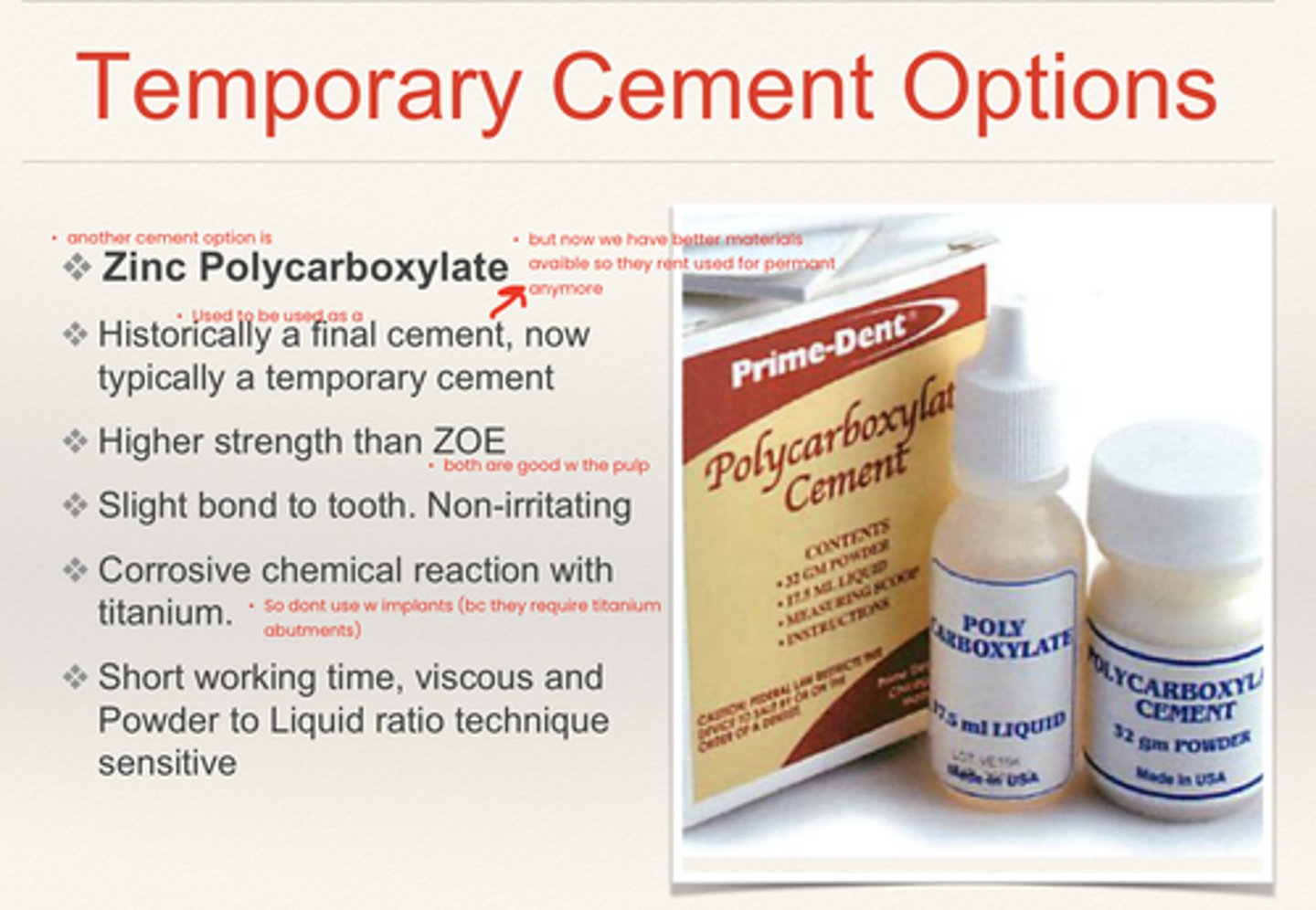
Zinc Polycarboxylate
- (now we have better options for perm cements)
Type of temporary cement
Historically used to be a final cement, now is a temp cements
Slight bond to tooth
Non-irritating to pulp
Corrosive chemical reaction with titanium
Short working time
Viscous
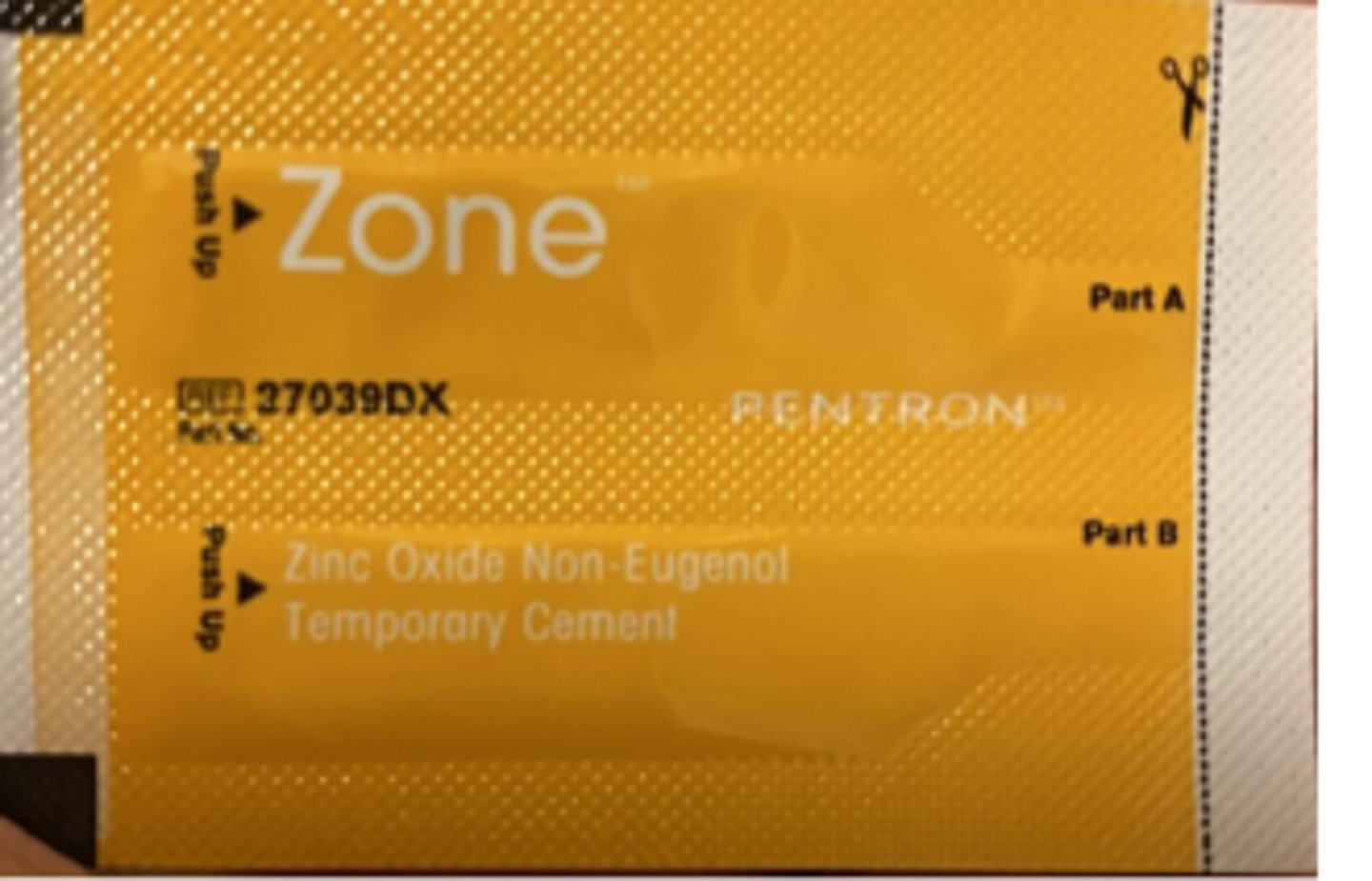
Zinc Oxide Non-Eugenol (ZONE)
Ideal cement for temporary cementation of crowns, bridges and all provisional needs
WE USE THIS FOR OUR TEMPS 99% OF THE TIME!!!!
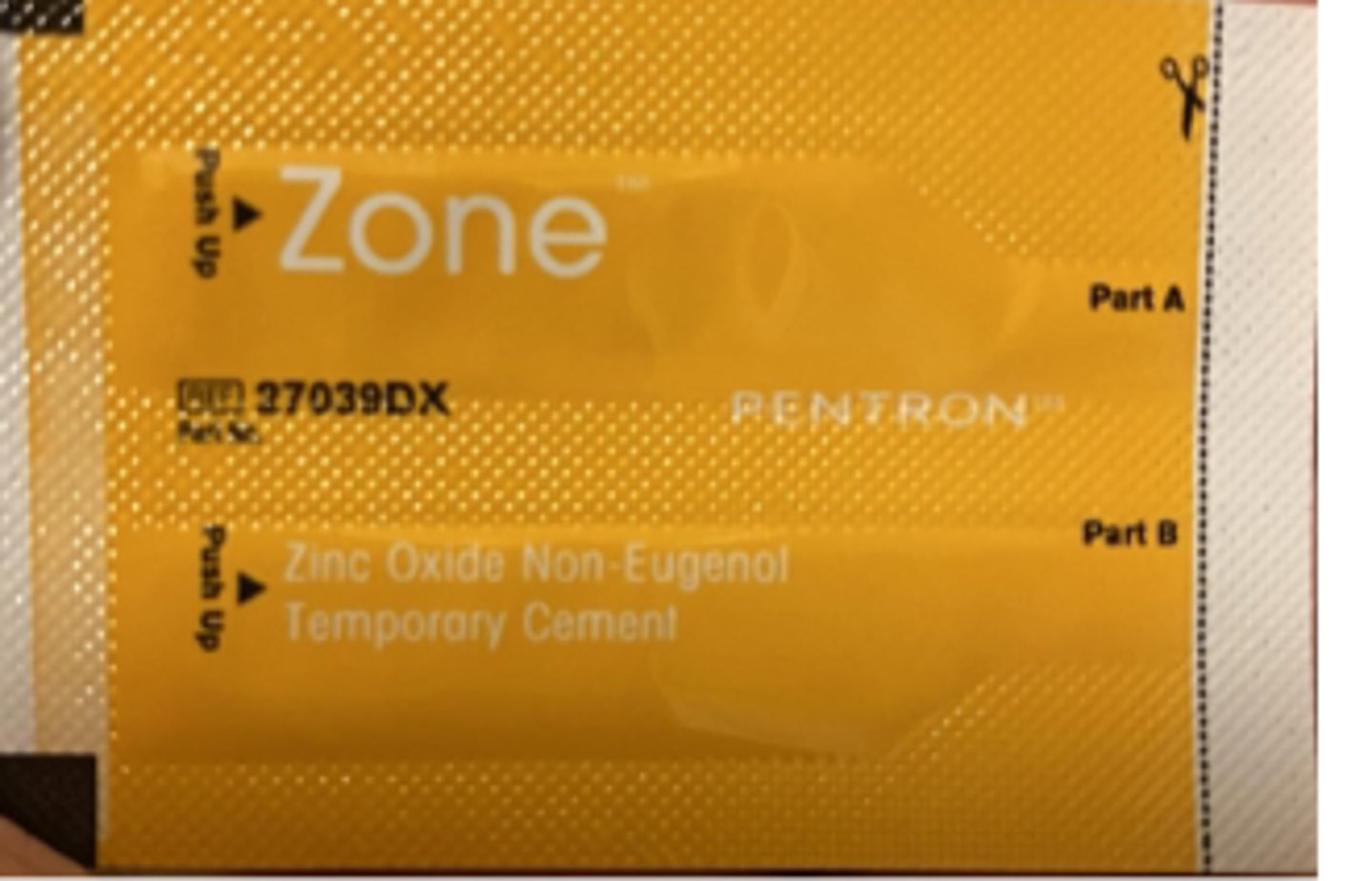
Zinc Oxide Non-Eugenol (ZONE)
OHC MOST COMMON Temporary Cement we uses for crowns, bridges, & all provisional needs
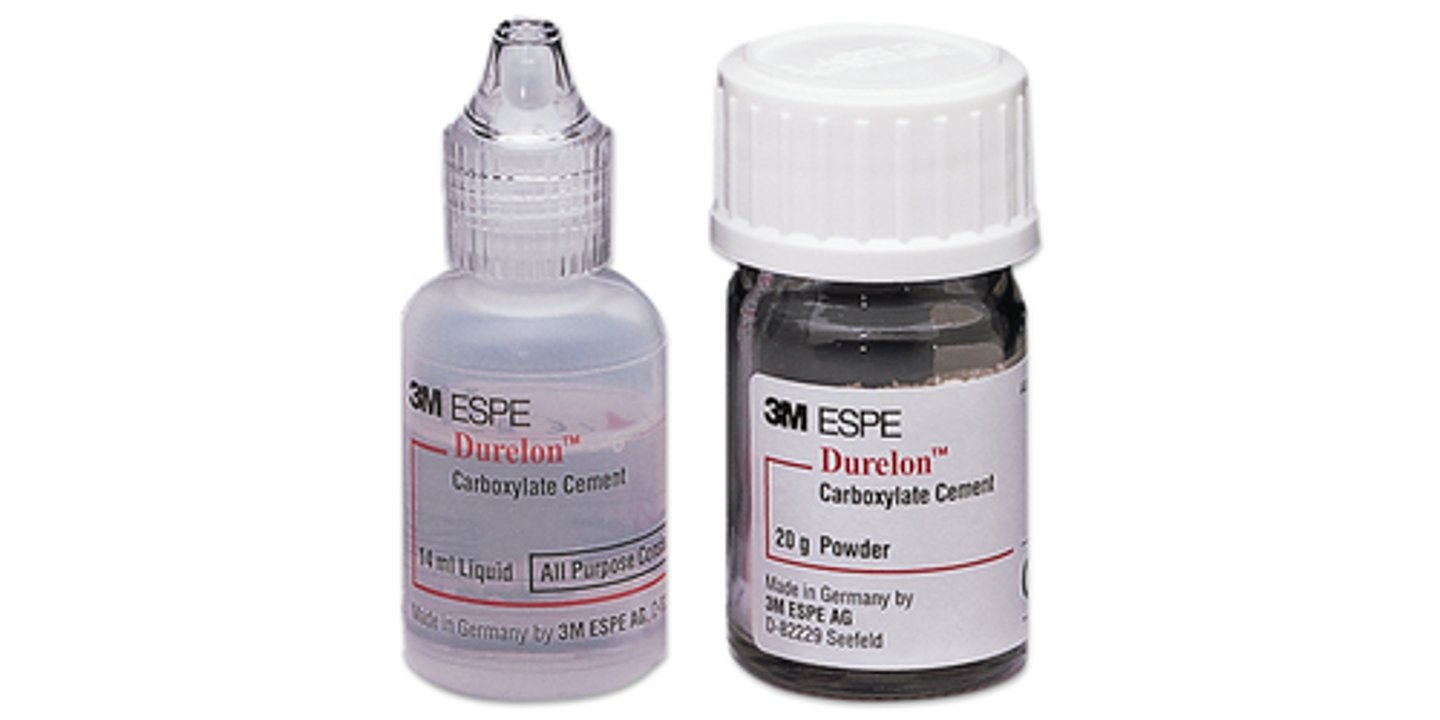
Durelon
Type of temporary cement
Used to be permanent cement
Now used as temp
Indicated if pt is going on vacation for long time
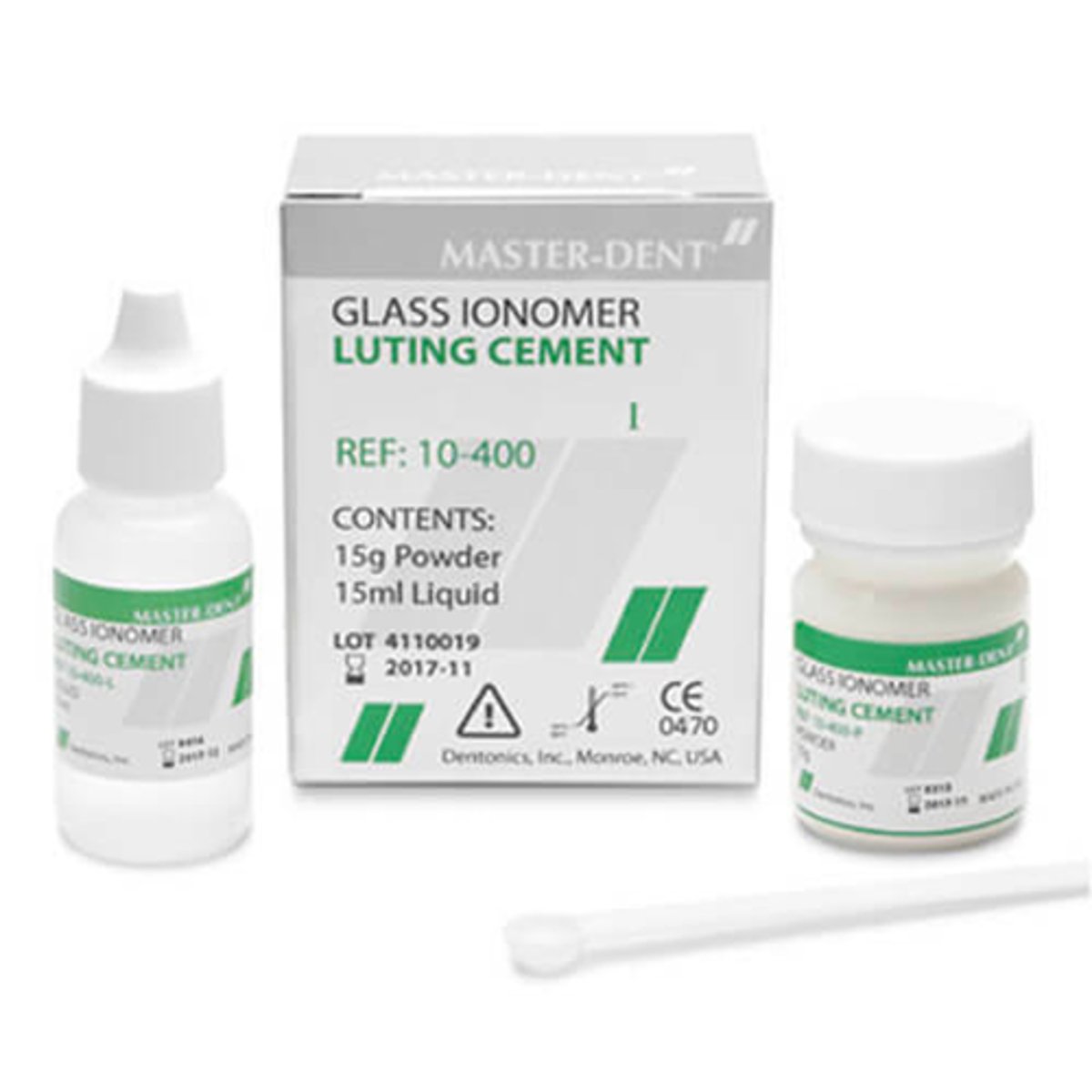
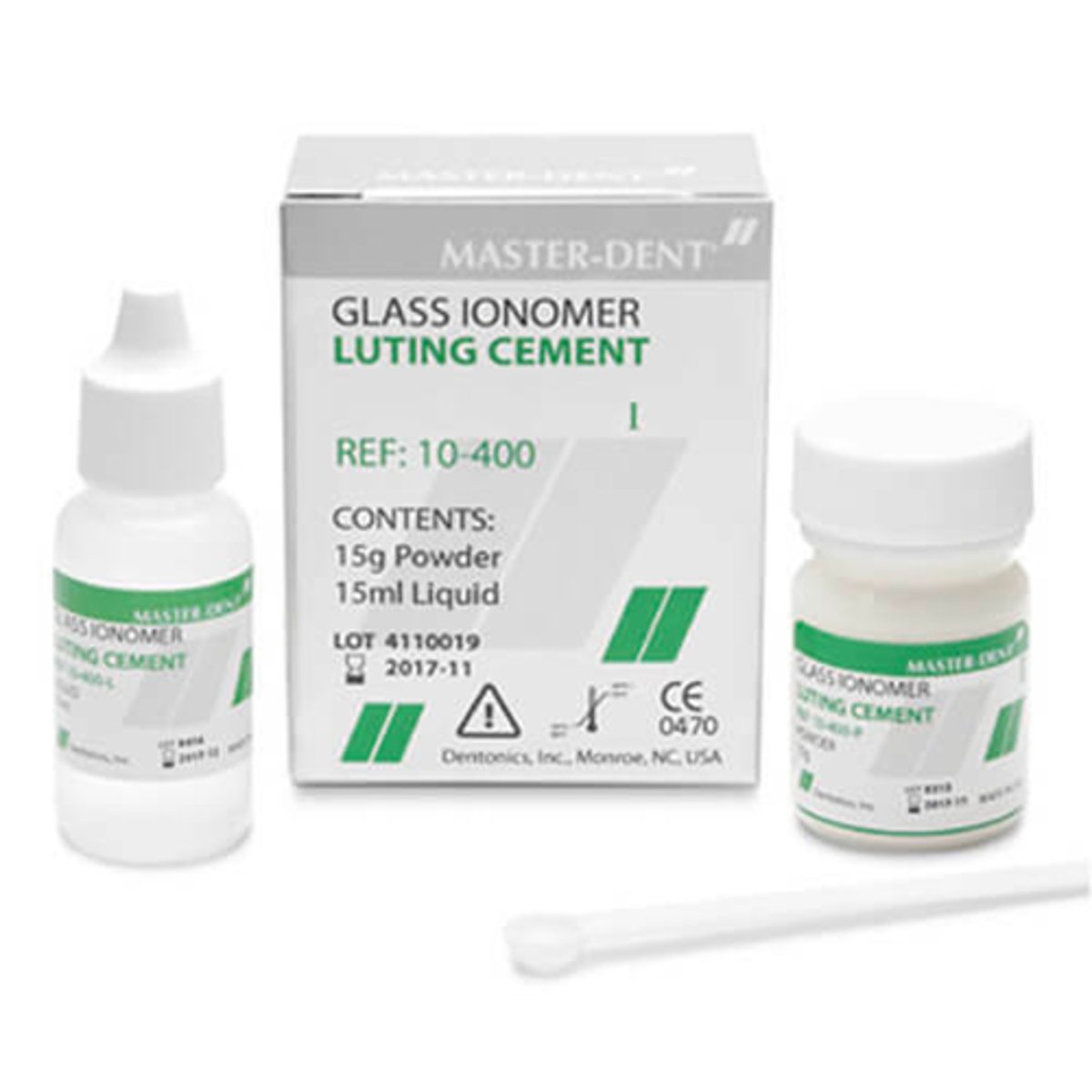
Glass Ionomers
Final Luting cement for C&B's
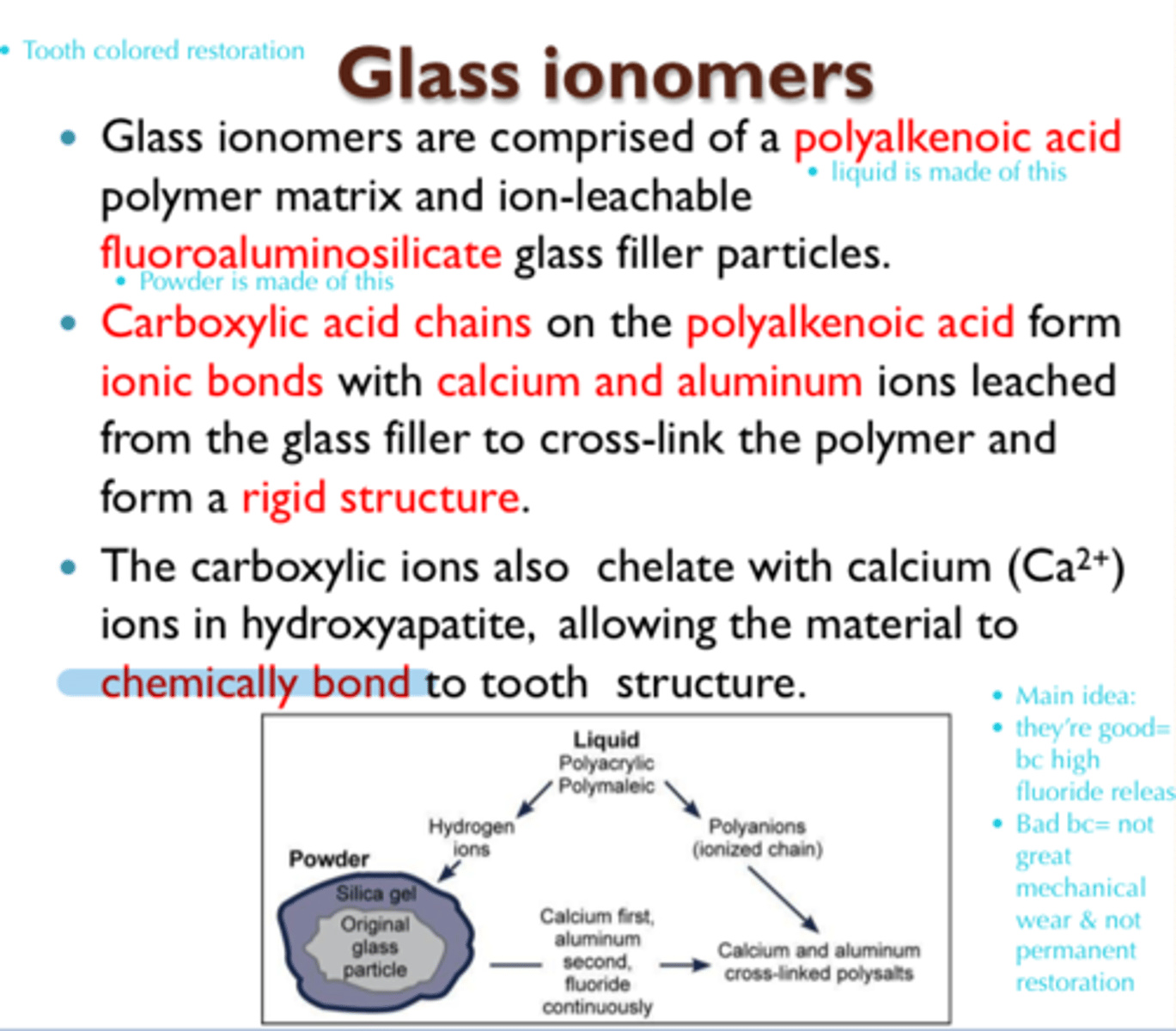
Acid - Base chemistry
Liquid is Polyacrylic Acid
Powder is Aluminosilicate Glass with Fluoride releasing properties
Advantages: chemical adhesion to the tooth, fluoride release, high strength, hydrophilic
Disadvantages: low pH,mildly moisture sensitive before set, low wear resistance
(bc its more soluble to water & liquid environments)
Polyacrylic Acid
Aluminosilicate Glass
For Glass Ionomers C&B cements:
Liquid is _____ _____
Powder is ____ ______ with Fluoride (releasing properties)
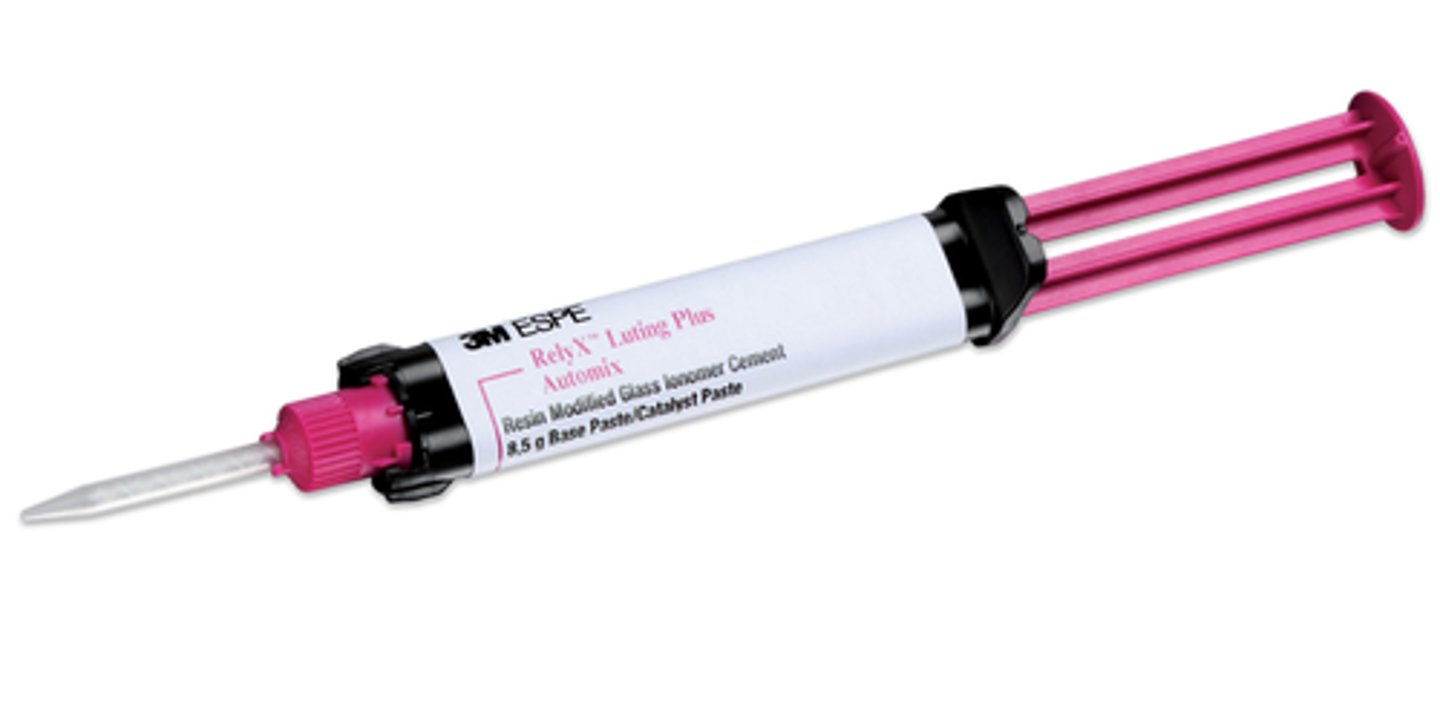
Resin Modified Glass Ionomer ("people's cement")
- RelyX Luting Plus
Final Luting cement for C&B's
Most commonly used/most popular cement used today!!
Acid - Base chemistry
Liquid is monomer and polyacrylic acid
Powder is the same as GI plus initiators
Advantages: very low solubility, fluoride release, high strength, thin film, easy clean-up
Disadvantages: absorbs water
(So there is a risk that a crown seated w this type of cement can pop out of the pts mouth)
Used for restorations which are not bonded in place: PFM, Gold, Zirconia (with some expectations)
(bc its a luting cement!!)
Resin Modified Glass Ionomer ("people's cement")
Most commonly used/most popular cement used today!!
Example:
RelyX Luting Plus
Used for restorations which are not bonded in place: PFM, Gold, Zirconia (with some expectations)
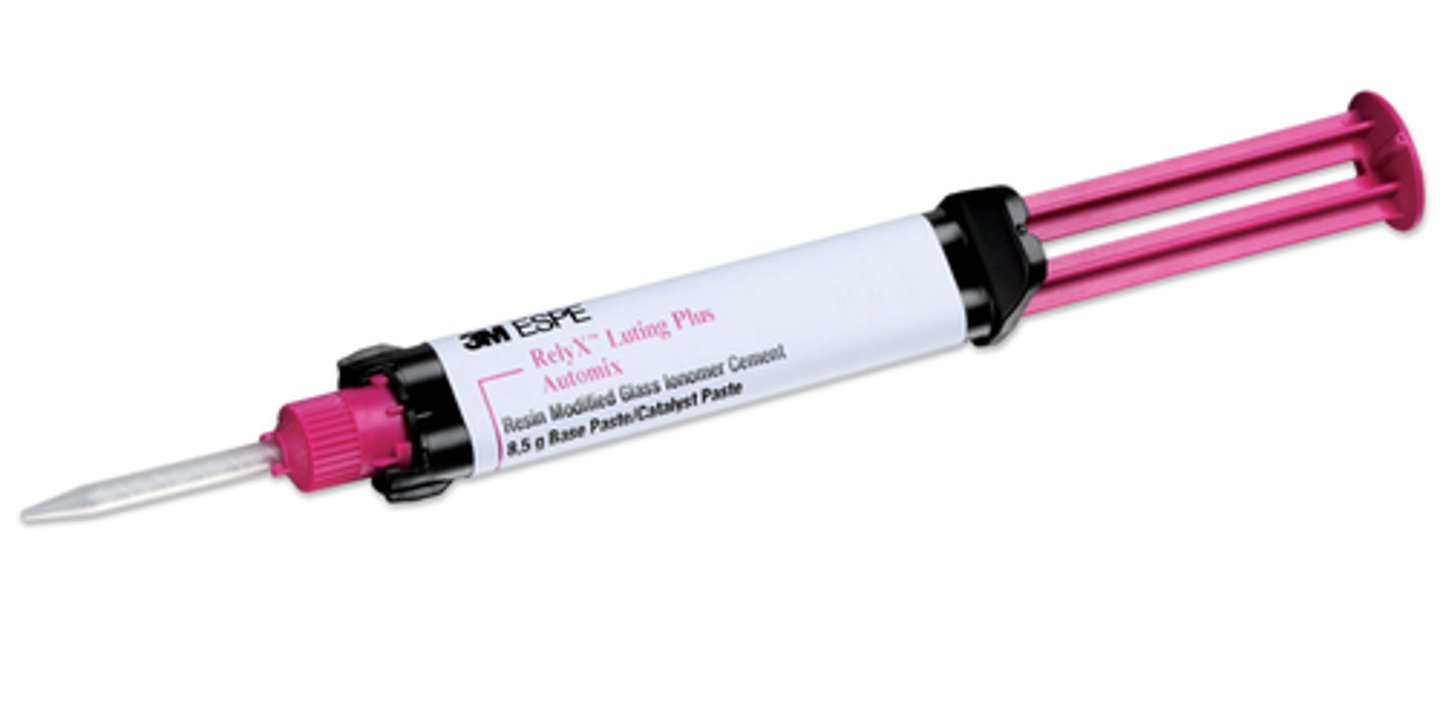
Resin Modified Glass Ionomer ("people's cement")
Cement used for restorations which are not bonded in place: PFM, Gold, Zirconia (with some expectations)
- bc its a luting cement!!
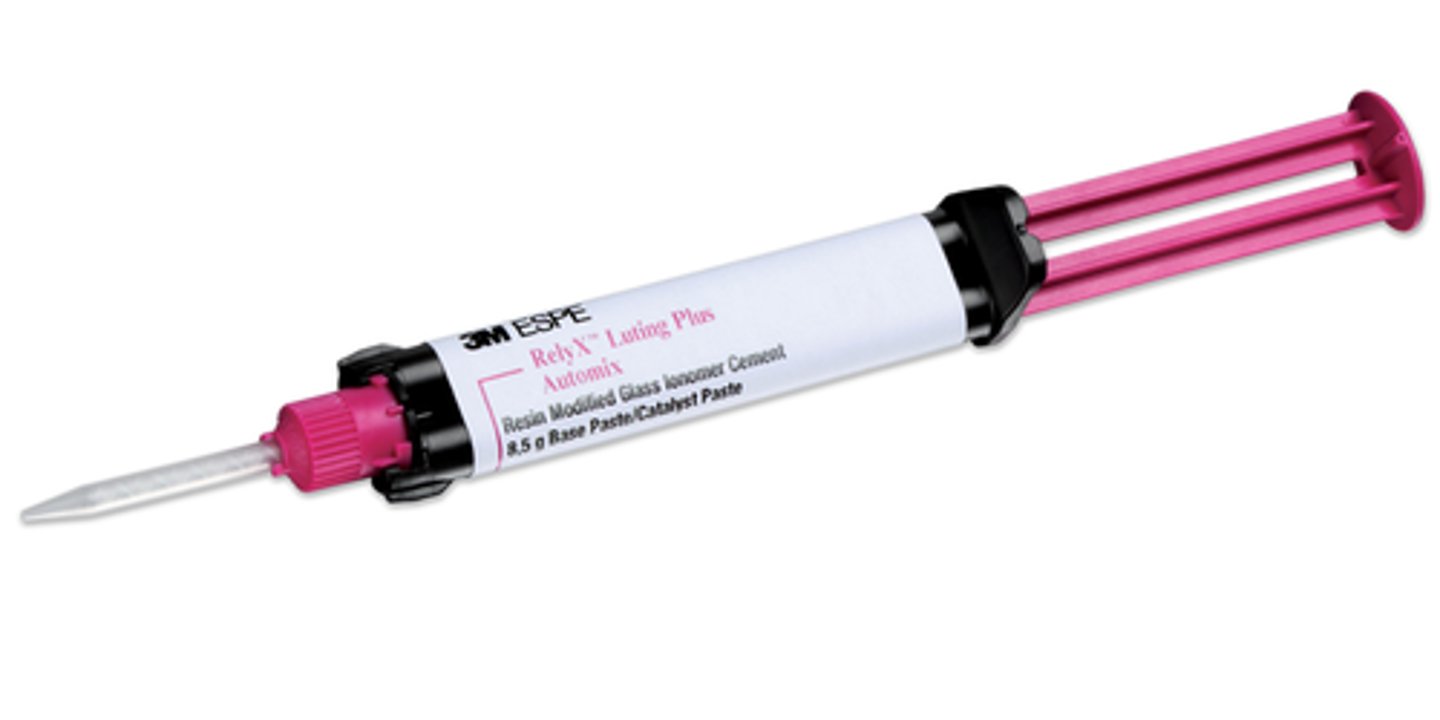
Resin Modified Glass Ionomer ("people's cement")
Most commonly used/most popular cement used today!!
Example:
RelyX Luting Plus
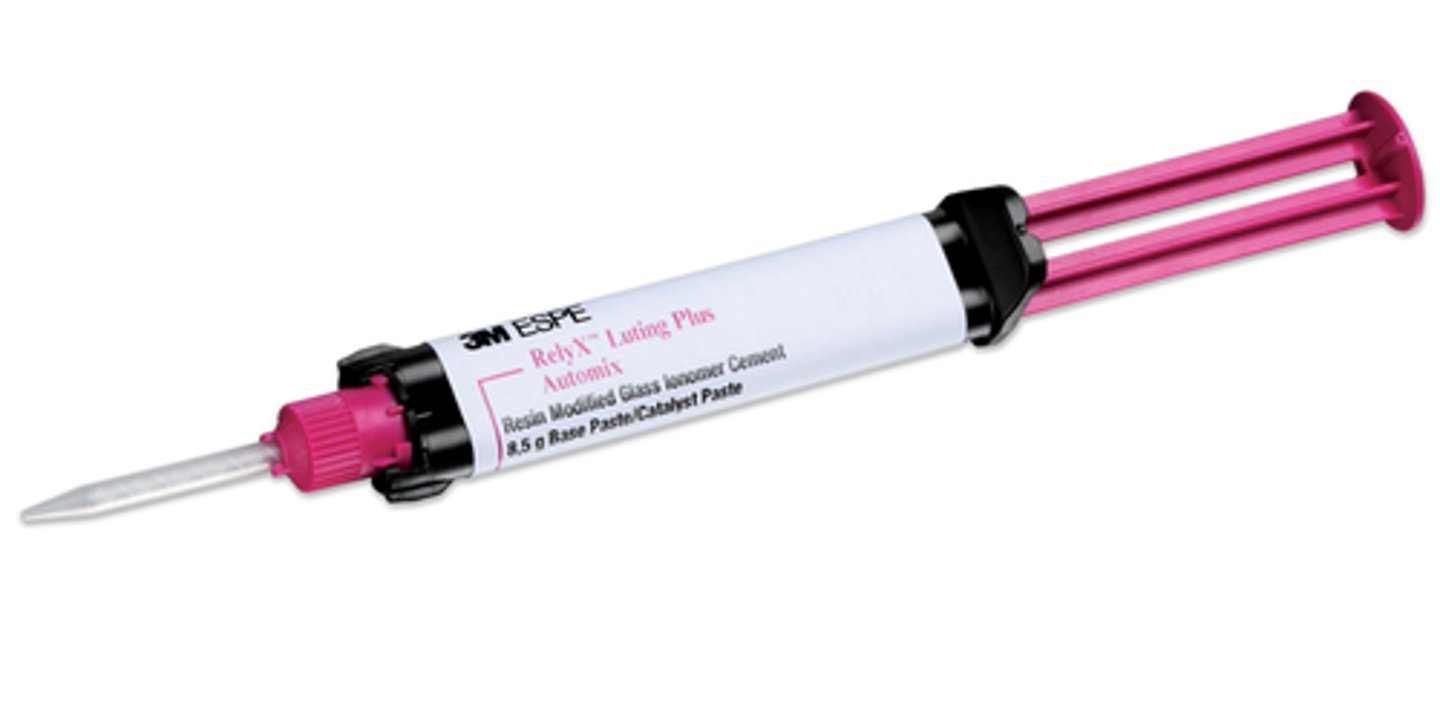
a RMGI cement= RelyX Luting Plus
- most commonly used cement
What Final Cement would you use to cement a Zirconia crown?
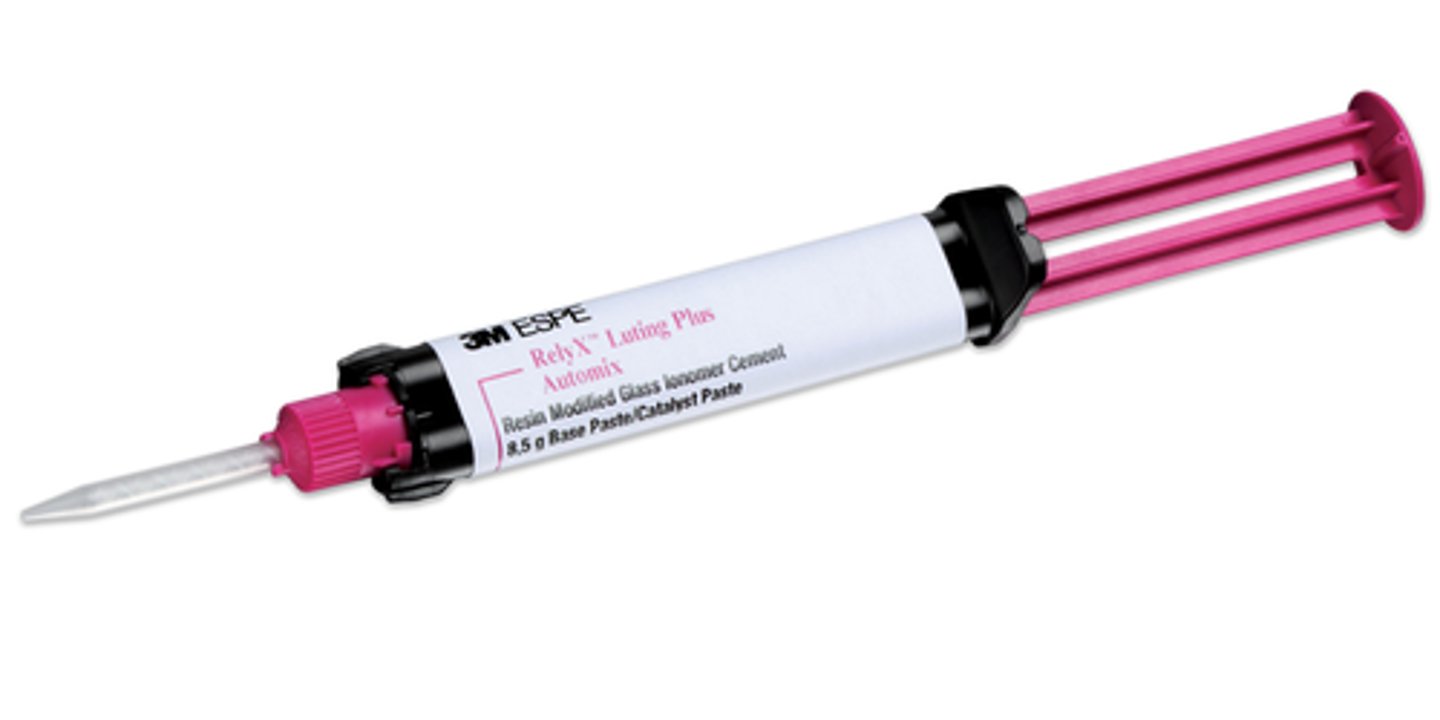
review top section about Bonding cements
- theyre all covered already in Part 3
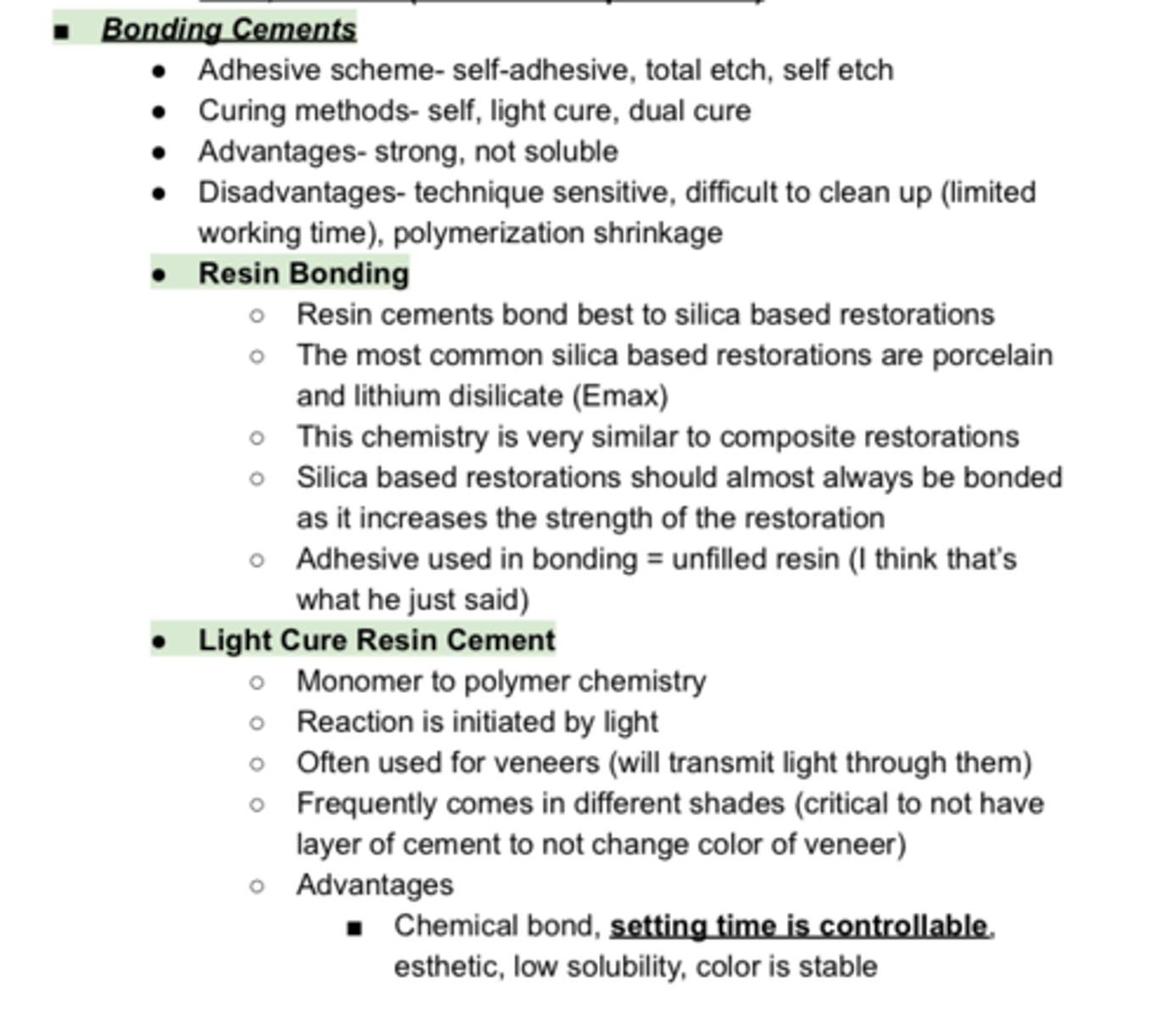
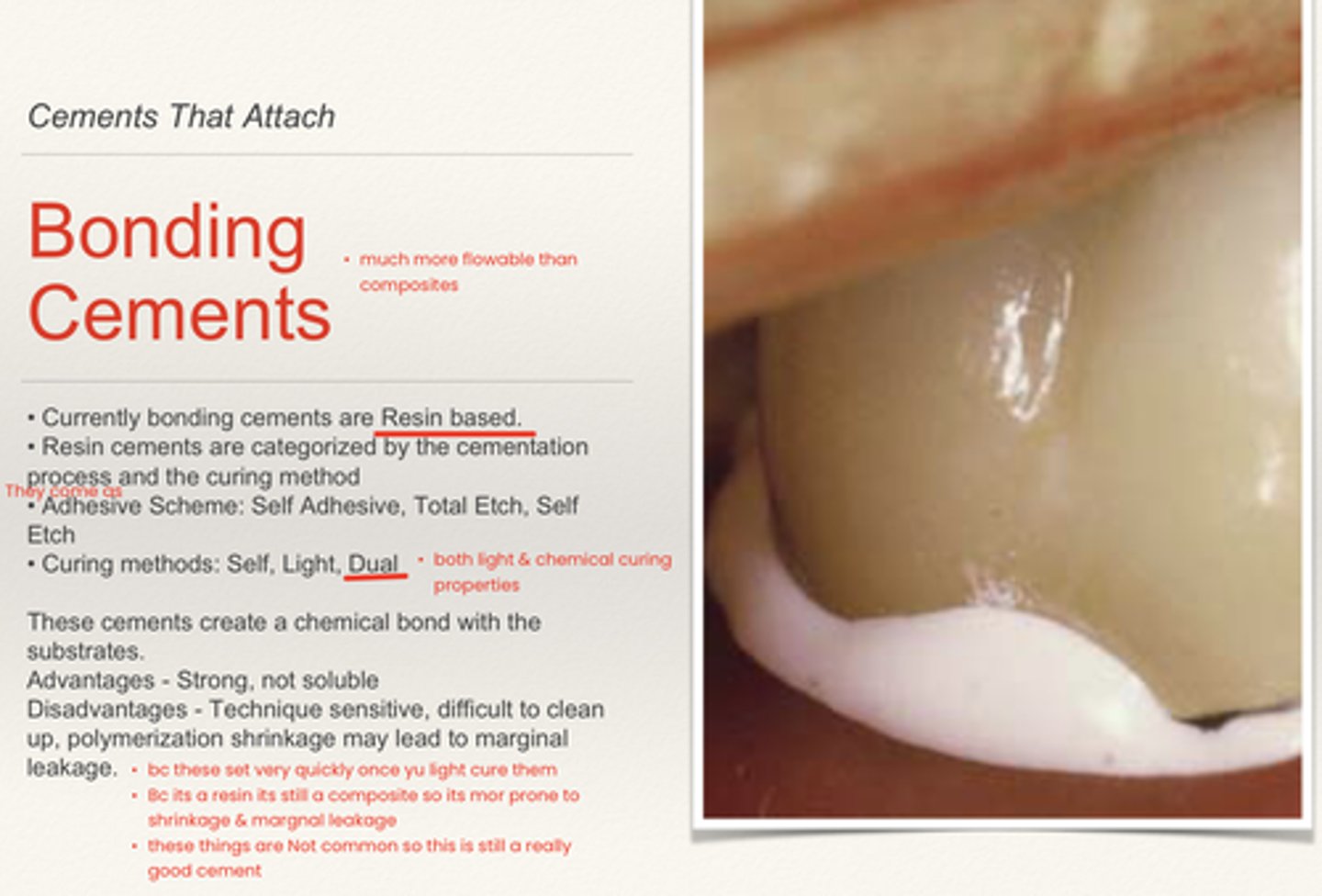
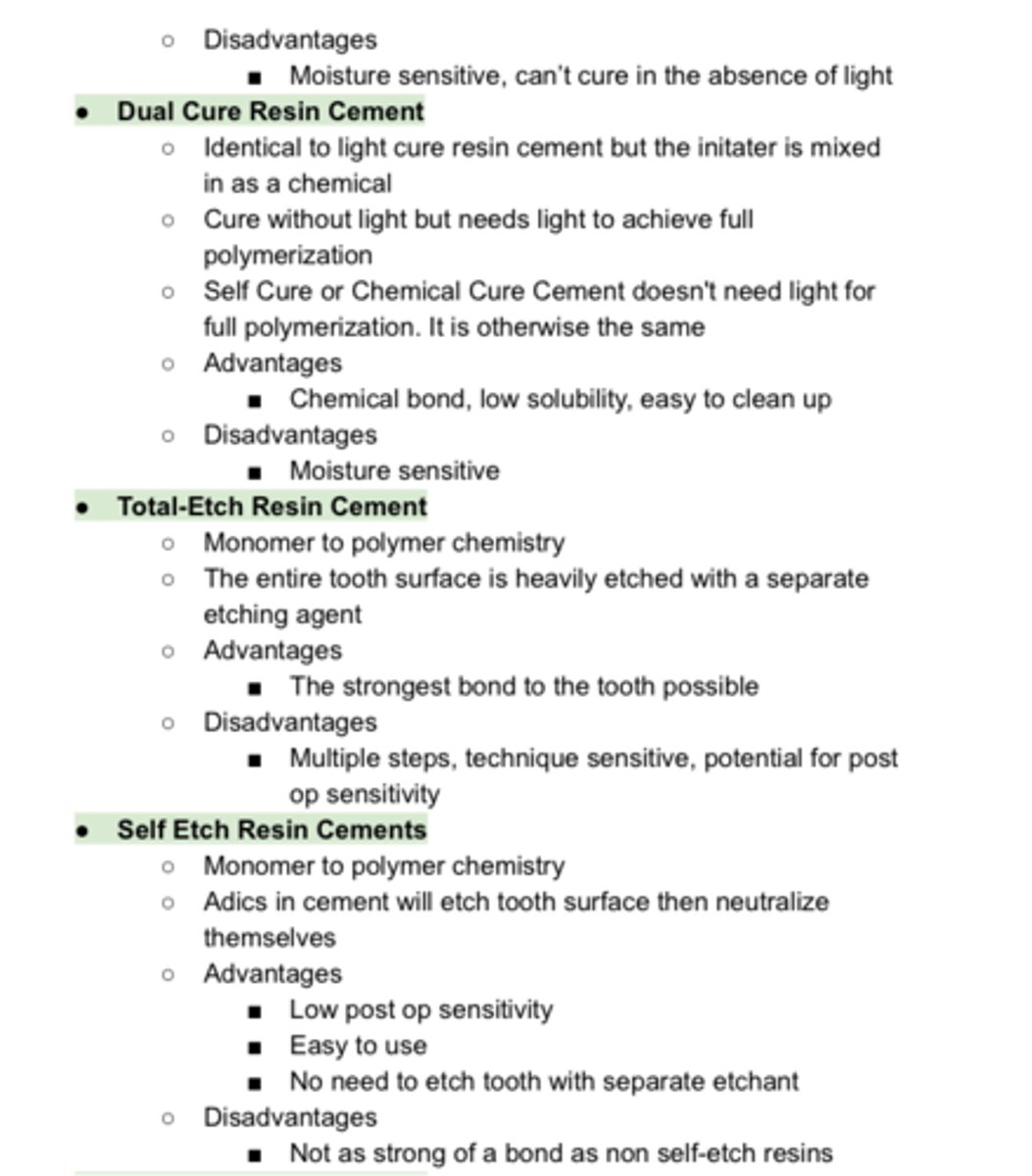
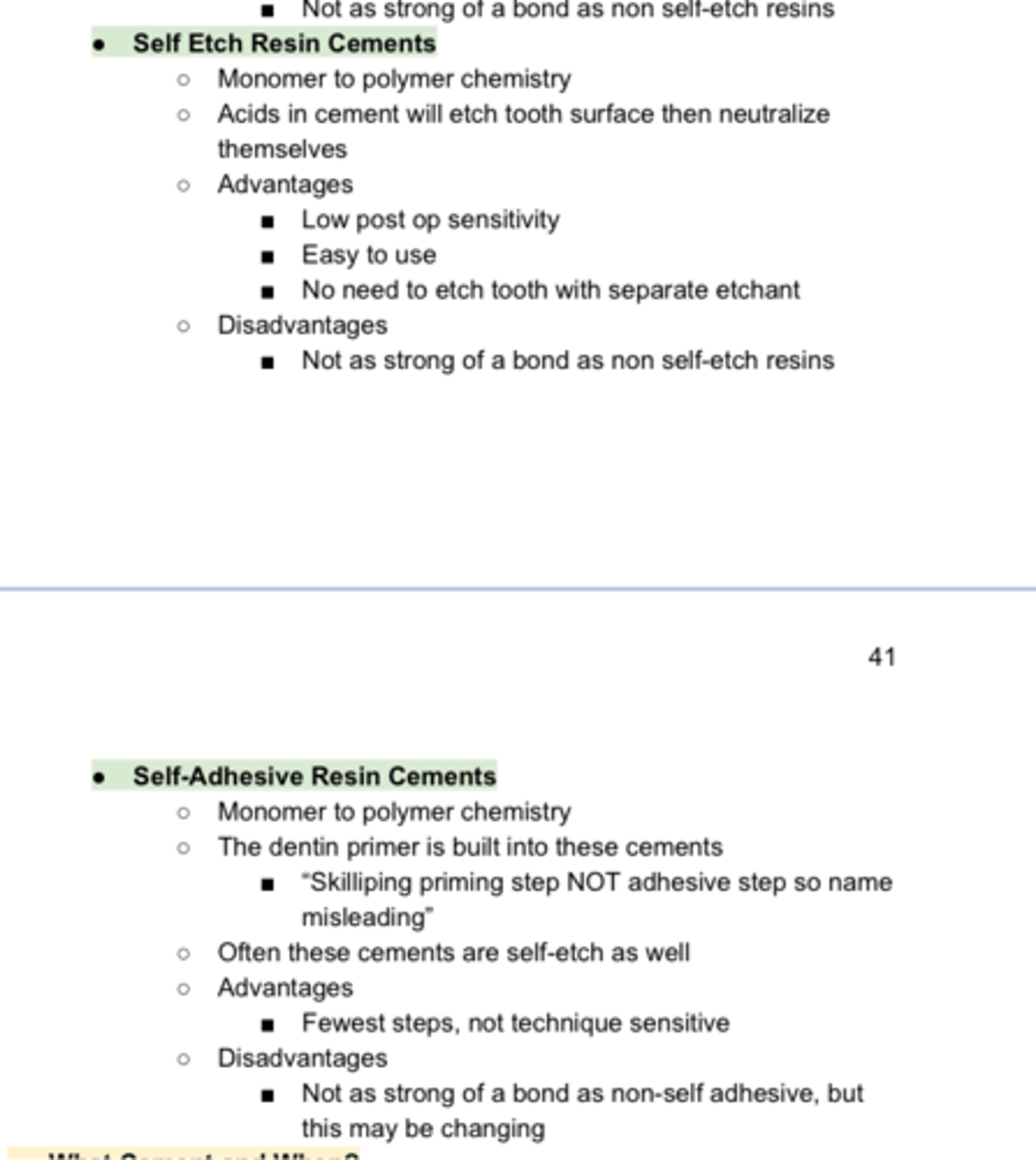
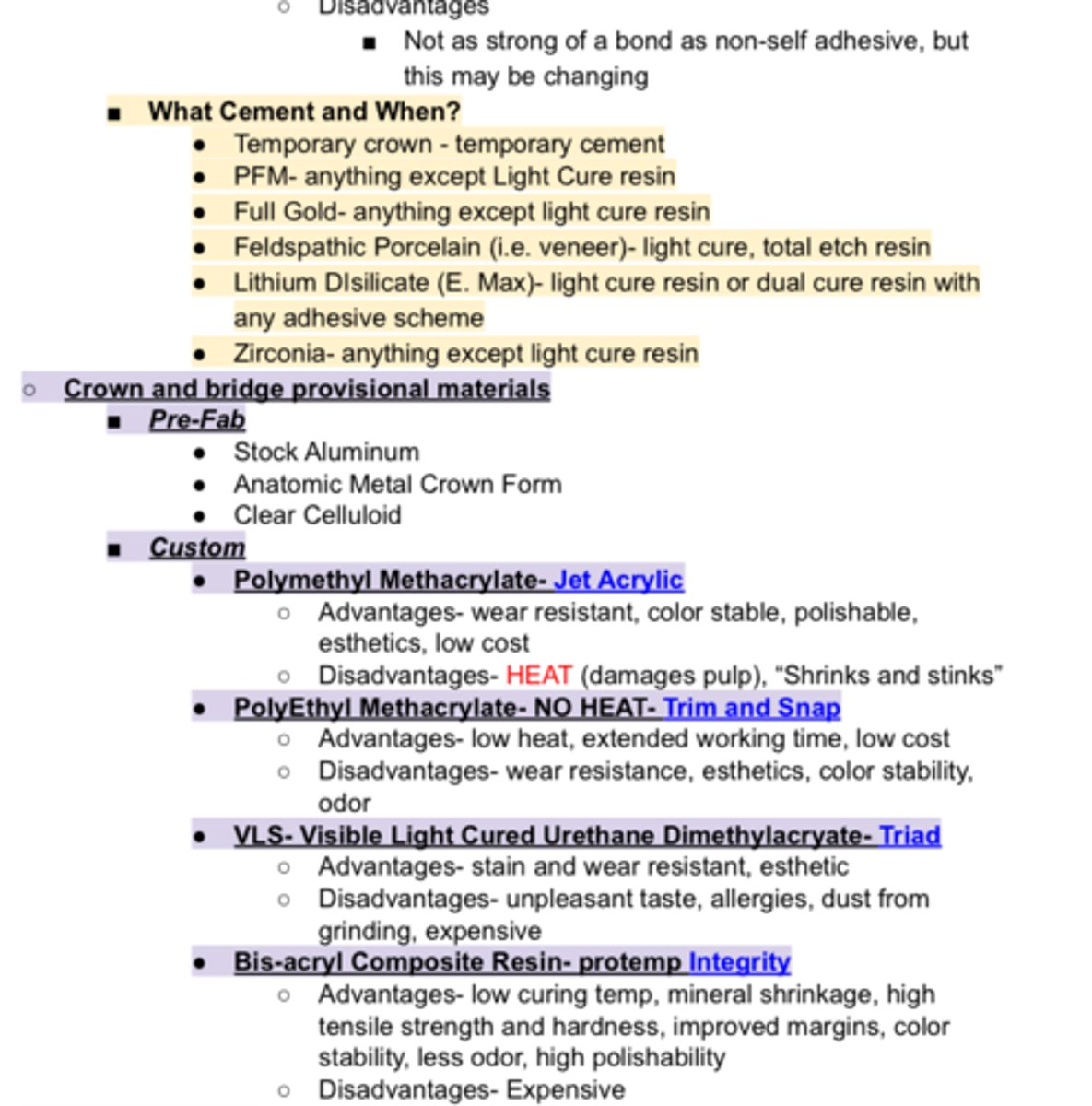
Silica based restorations
Resin cements bond best to what based restorations?
which contain silica?
- Porcelain
- E.Max crowns (Lithium Disilicate)
- Feldspathic
- Zirconia (NO SILICA at all)
◦So for these 2 its great to use a completely resin cement bc you will get COMPLETE bonding btw the 2 structure !
- most cements used today are RESIN CEMENTS
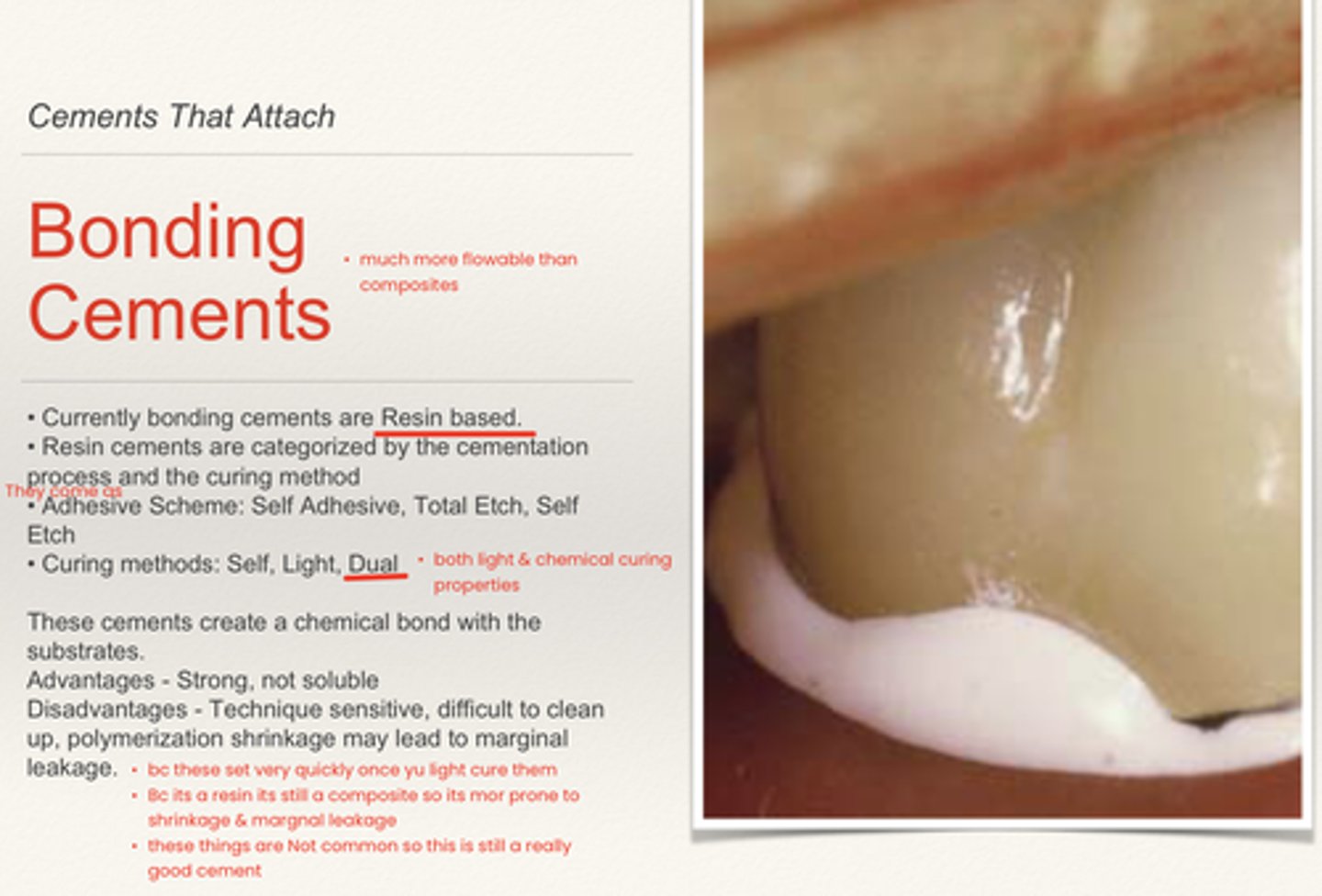
Porcelain
Lithium disilicate (eMax)
◦So for these 2 its great to use a completely resin cement bc you will get COMPLETE bonding btw the 2 structure !
The most common silica based restorations are _____ and ____ ______
• This chemistry is very similar to composite restorations
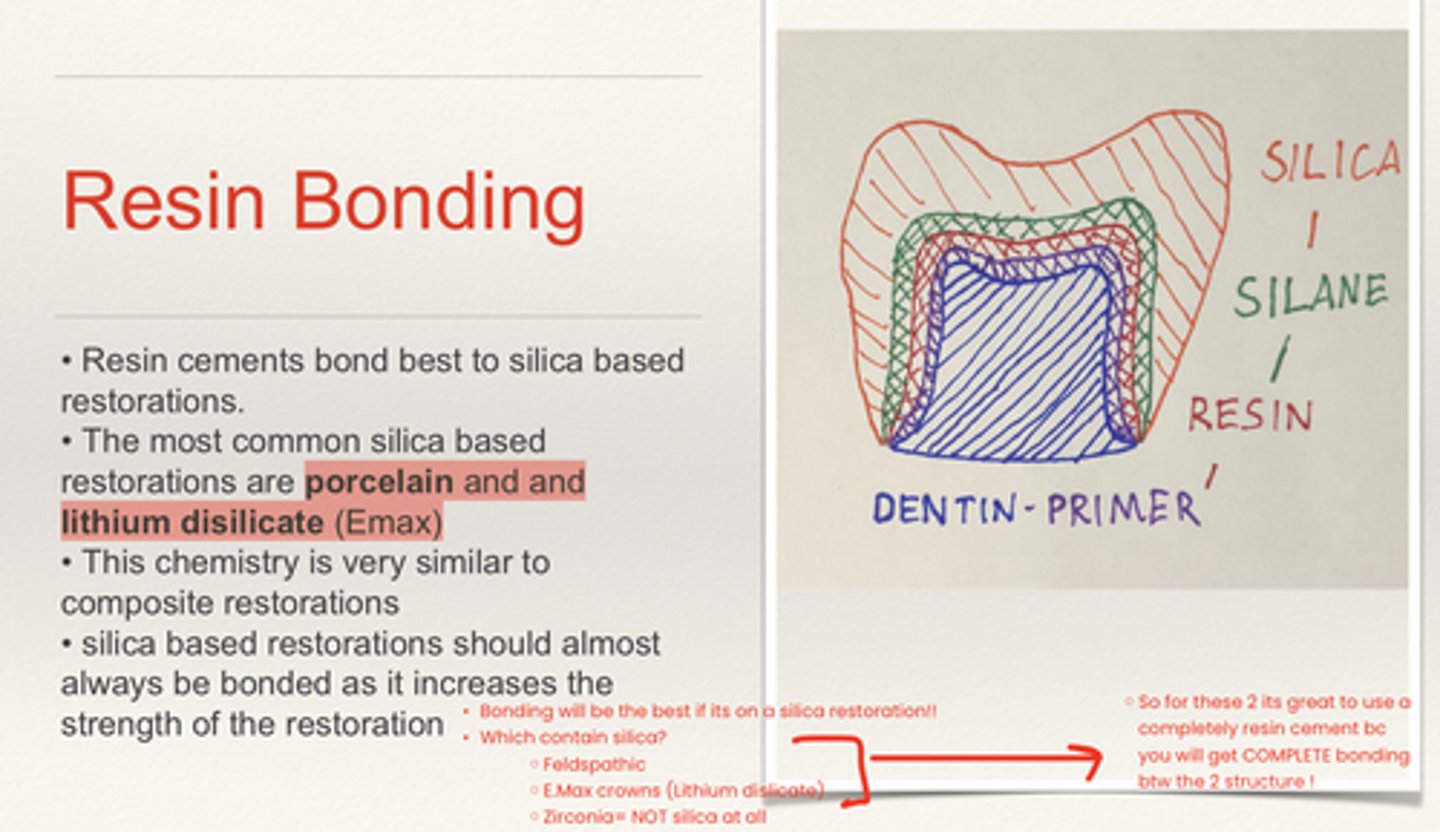
Total-Etch Resin Cement
Crown & Bridge Provisional Materials
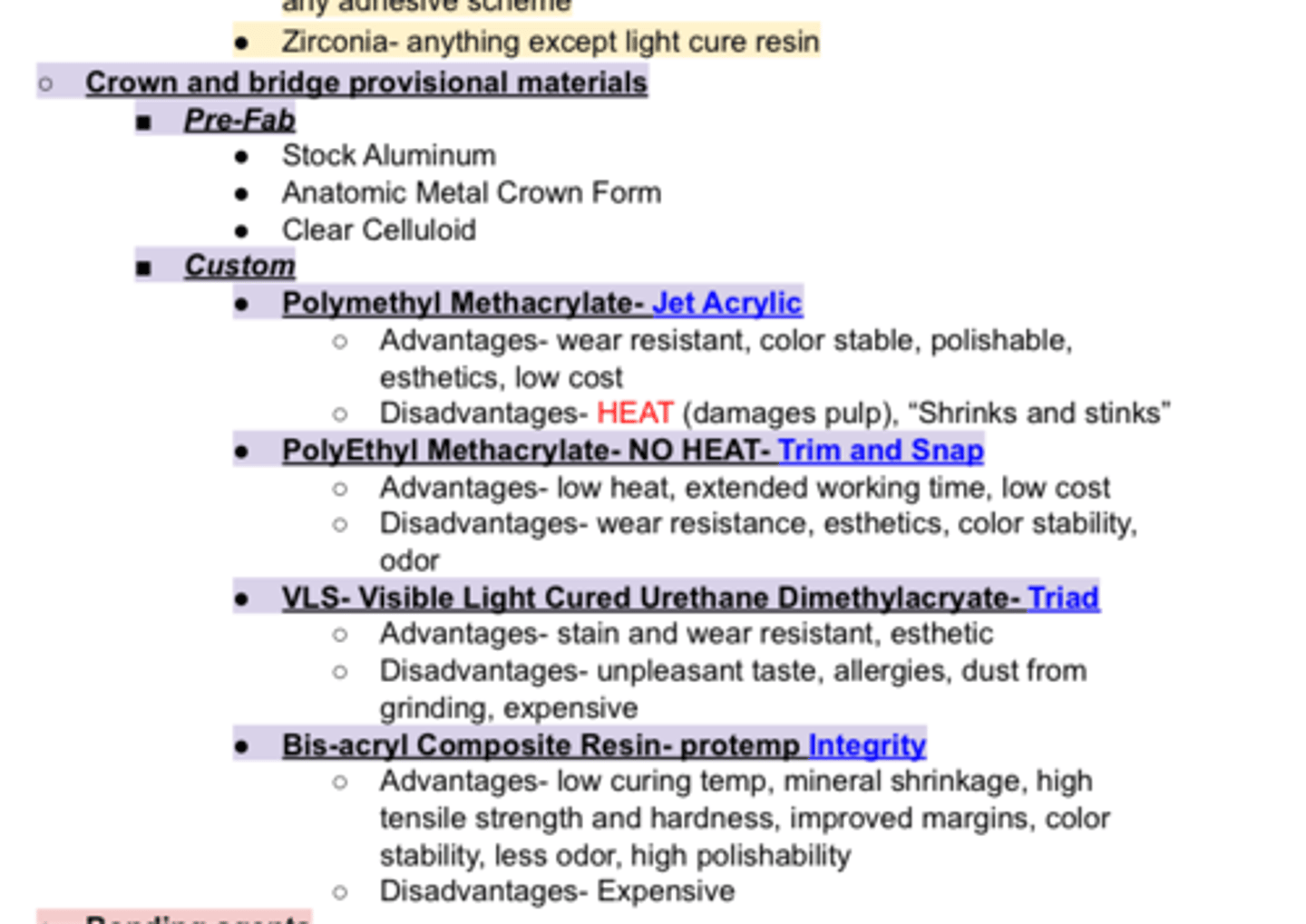
Provisional
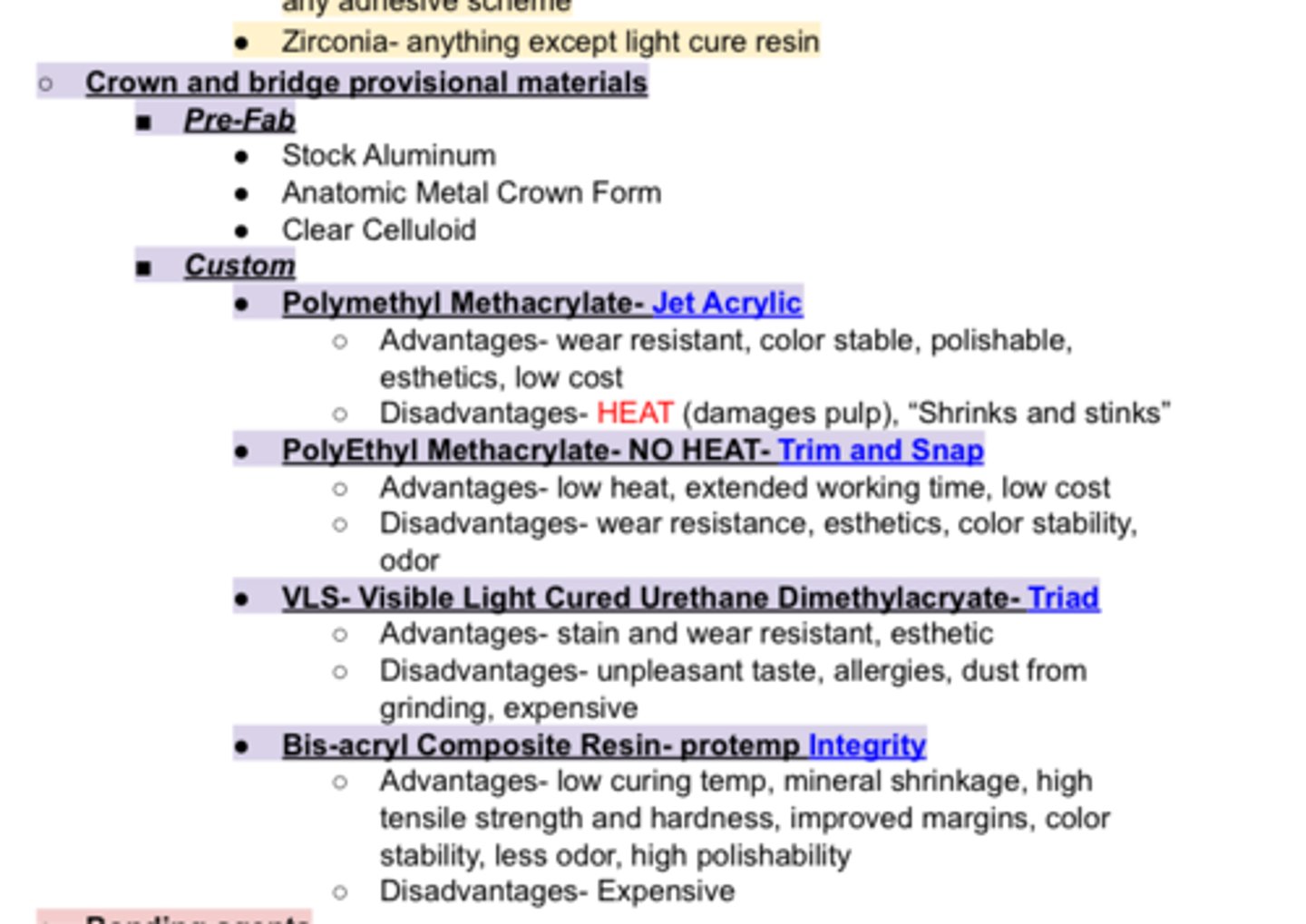
These are Custom Crown & Bridge _____ Material Options:
Polymethyl Methacrylate (PMMA)- Jet Acrylic
PolyEthyl Methacrylate- NO HEAT- Trim and Snap
VLS- Visible Light Cured Urethane Dimethylacryate- Triad
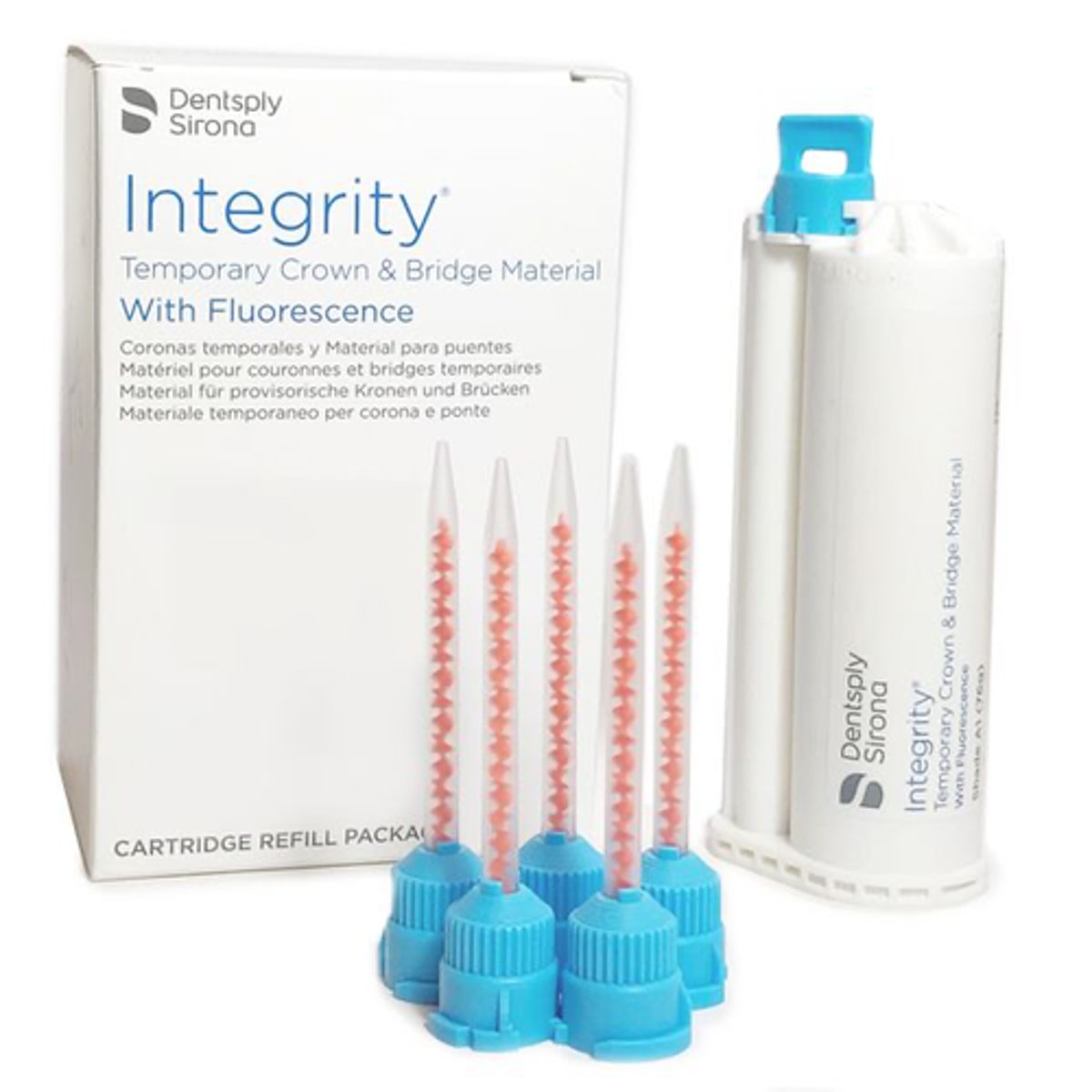
Bis-acryl Composite Resin- Protemp Integrity
Pre-Fabricated
Custom
These are _____ Crown & Bridge Provisional Material Options
Stock Aluminum
Anatomic Metal Crown Form
Clear Celluloid
These are _____ Crown & Bridge Provisional Material Options
Polymethyl Methacrylate- Jet Acrylic
PolyEthyl Methacrylate- NO HEAT- Trim and Snap
VLS- Visible Light Cured Urethane Dimethylacryate- Triad
Bis-acryl Composite Resin- Protemp Integrity
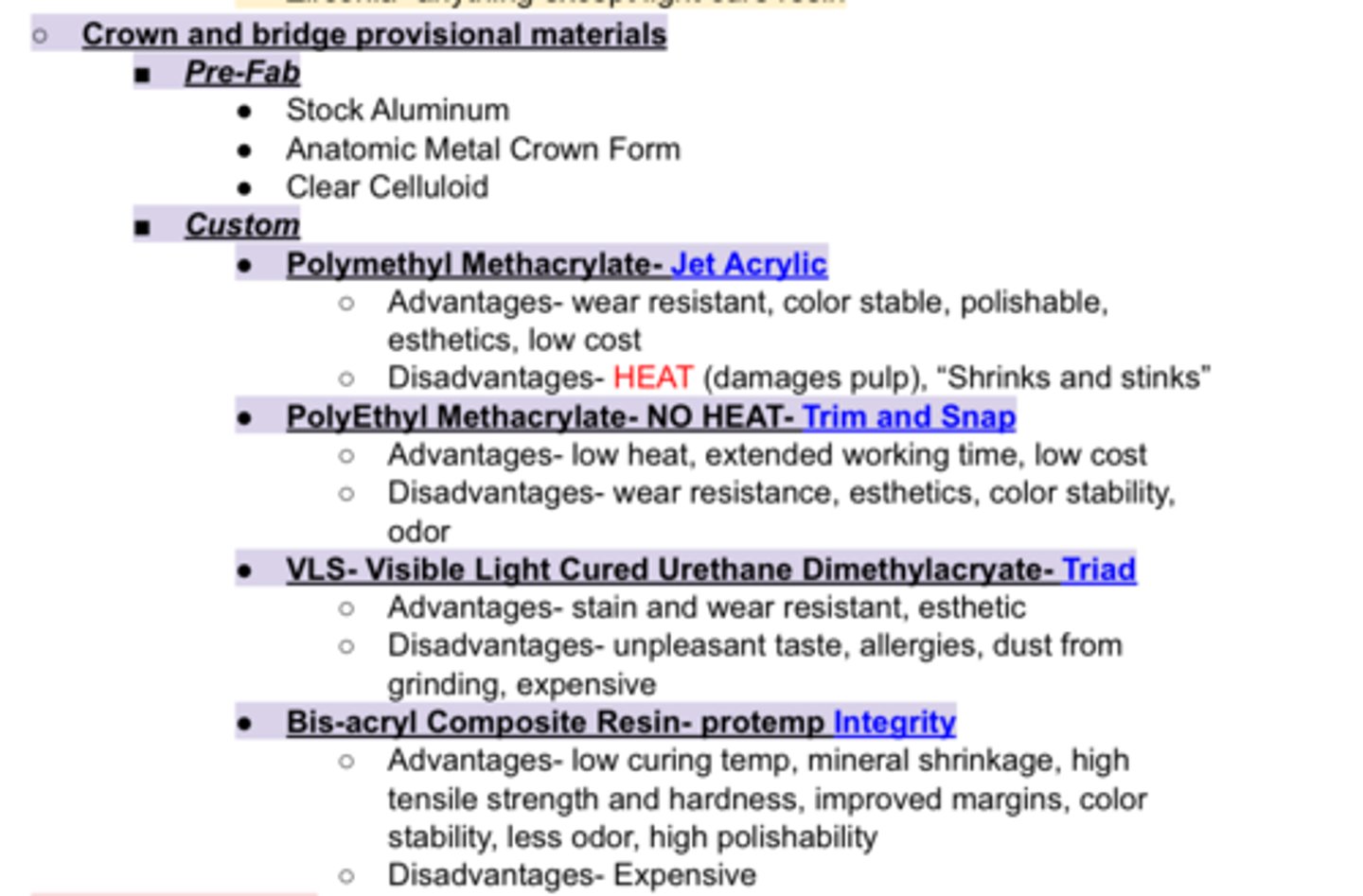
Polymethyl Methacrylate (PMMA)- Jet Acrylic
PolyEthyl Methacrylate- NO HEAT- Trim and Snap
VLS- Visible Light Cured Urethane Dimethylacryate- Triad
Bis-acryl Composite Resin- Protemp Integrity
List 4 Materials that could be used to make a Provisional Crown & Bridge
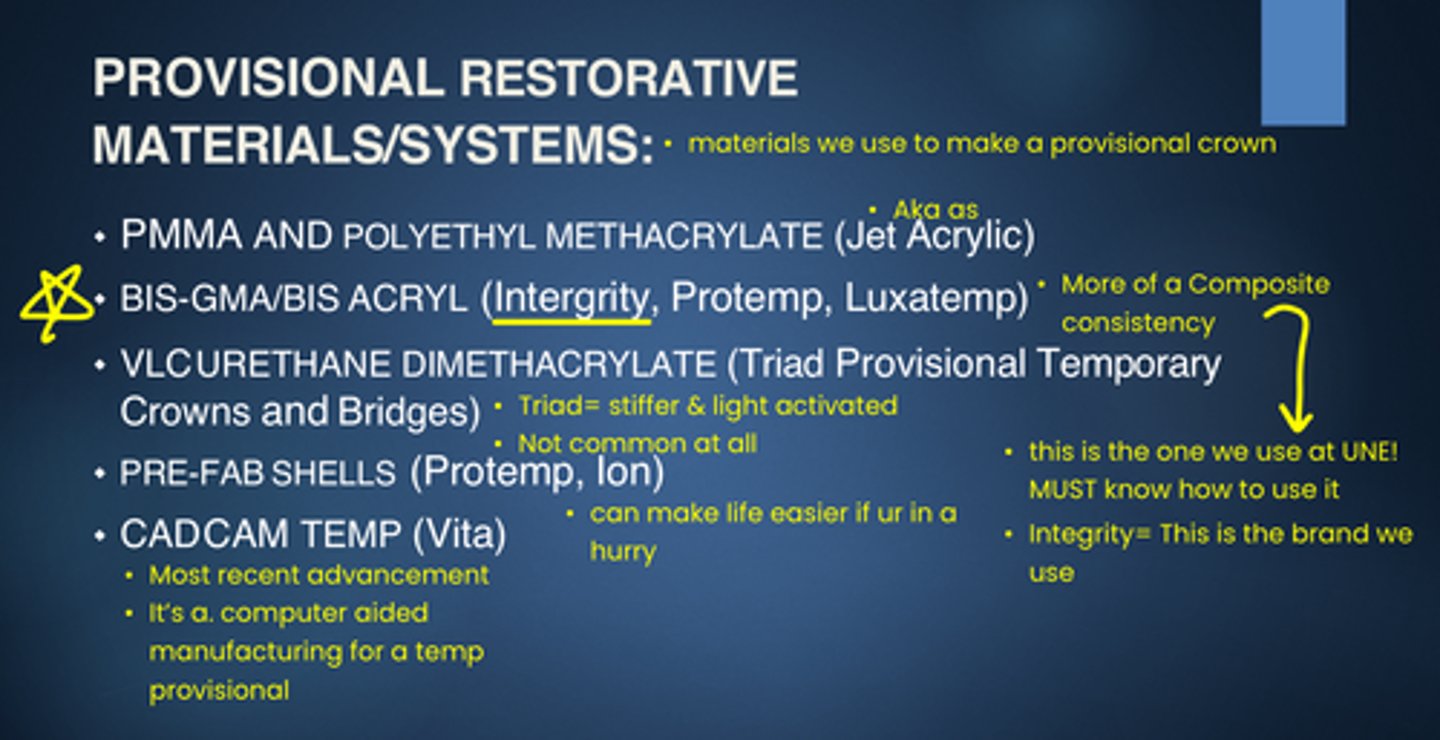
Jet acrylic
Heat & Snap
Triad
Protemp Integrity
Custom Crown & Bridge Provisional Material Options:
Polymethyl Methacrylate-
PolyEthyl Methacrylate-
VLS- Visible Light Cured Urethane Dimethylacryate
Bis-acryl Composite Resin-
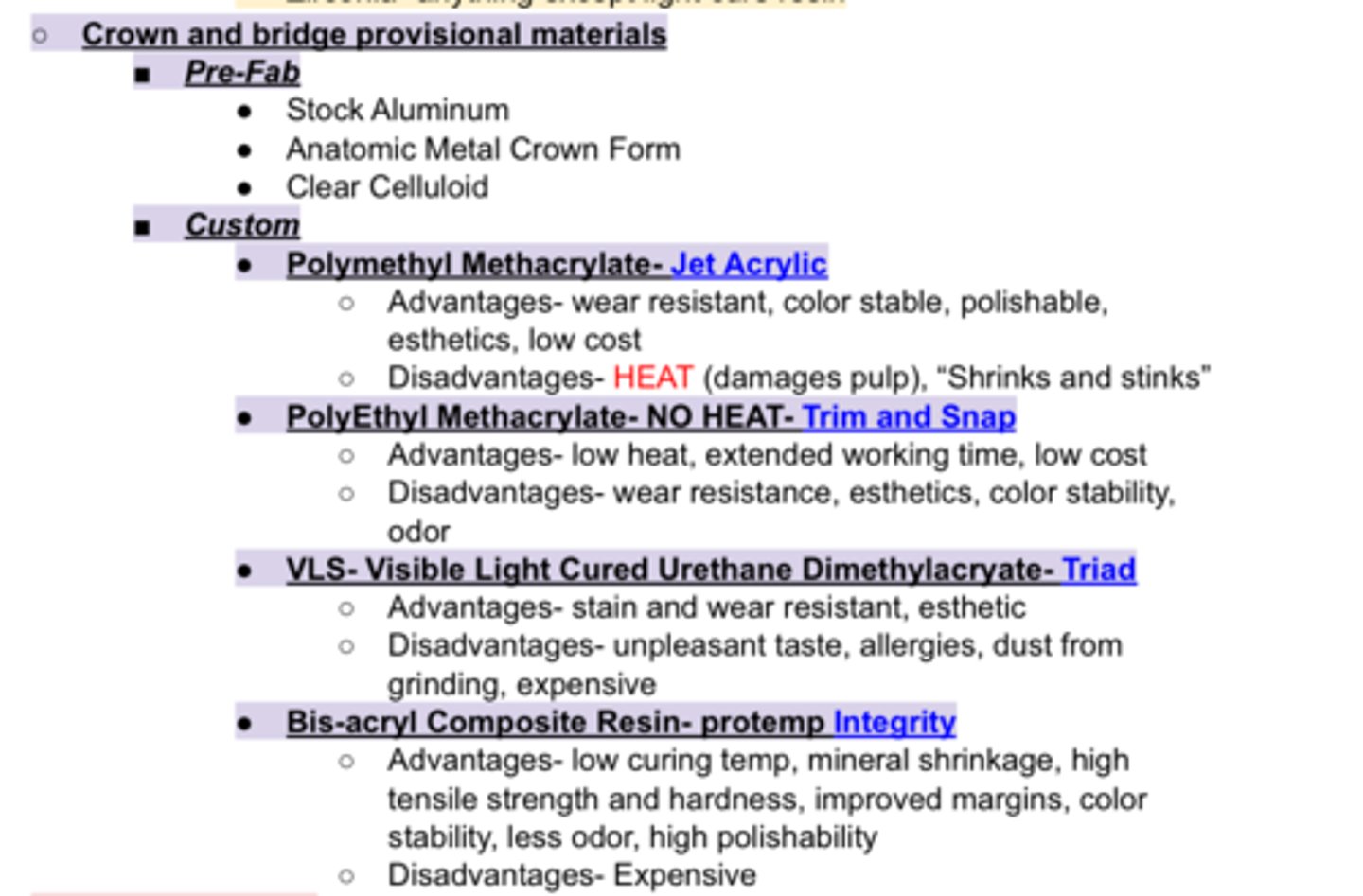
Polymethyl Methacrylate- Jet Acrylic
Custom Crown & Bridge Provisional Material Options:
Advantages- wear resistant, color stable, polishable,
esthetics, low cost
Disadvantages- HEAT (damages pulp)!!!, “Shrinks and stinks”
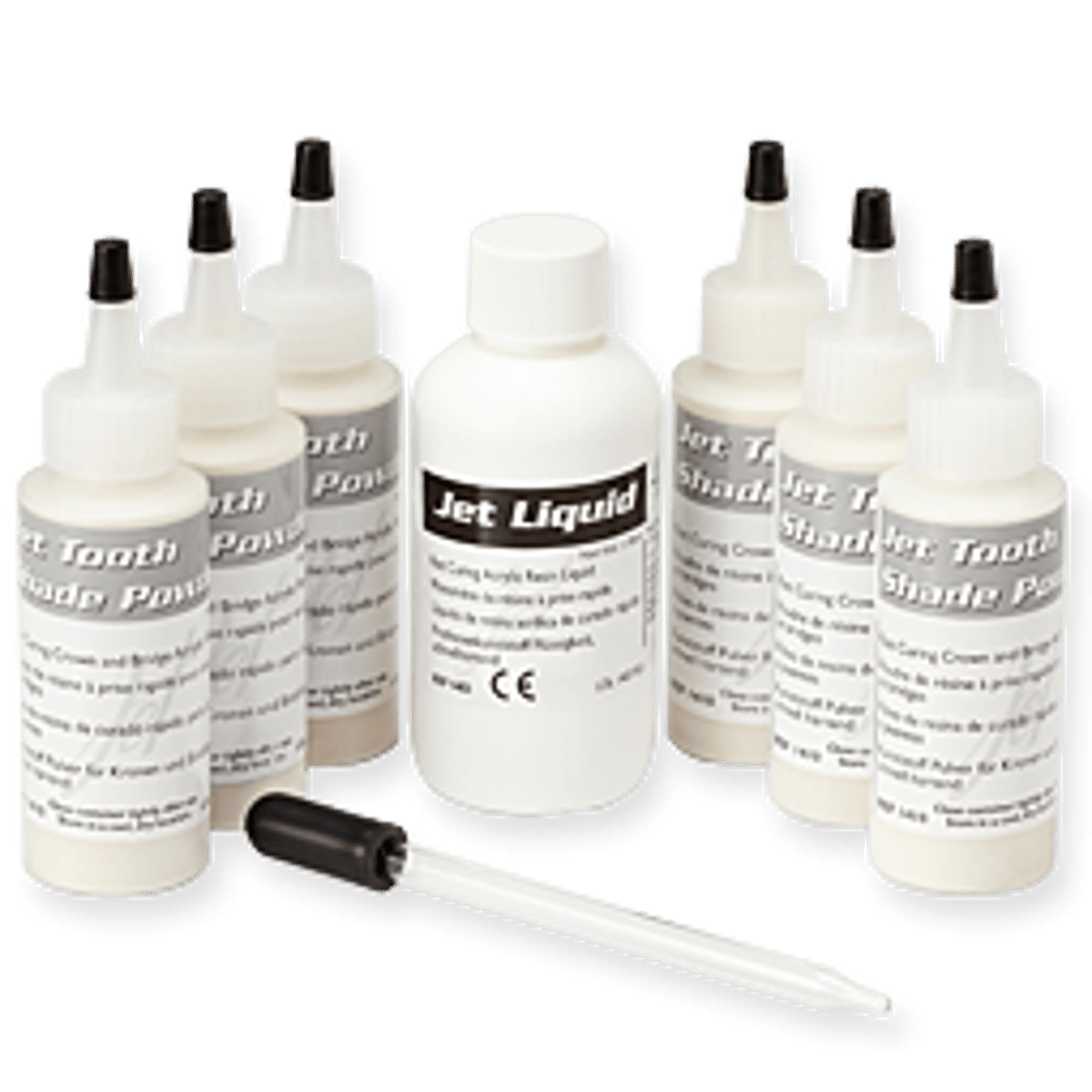
Polymethyl Methacrylate- Jet Acrylic
Custom Crown & Bridge Provisional Material Options:
Disadvantages- HEAT (damages pulp)!!!, “Shrinks and stinks”
PolyEthyl Methacrylate (PMMA)- NO HEAT- Trim and Snap
Custom Crown & Bridge Provisional Material Options:
Advantages- LOW heat, extended working time, low cost
Disadvantages- wear resistance, esthetics, color stability,
odor
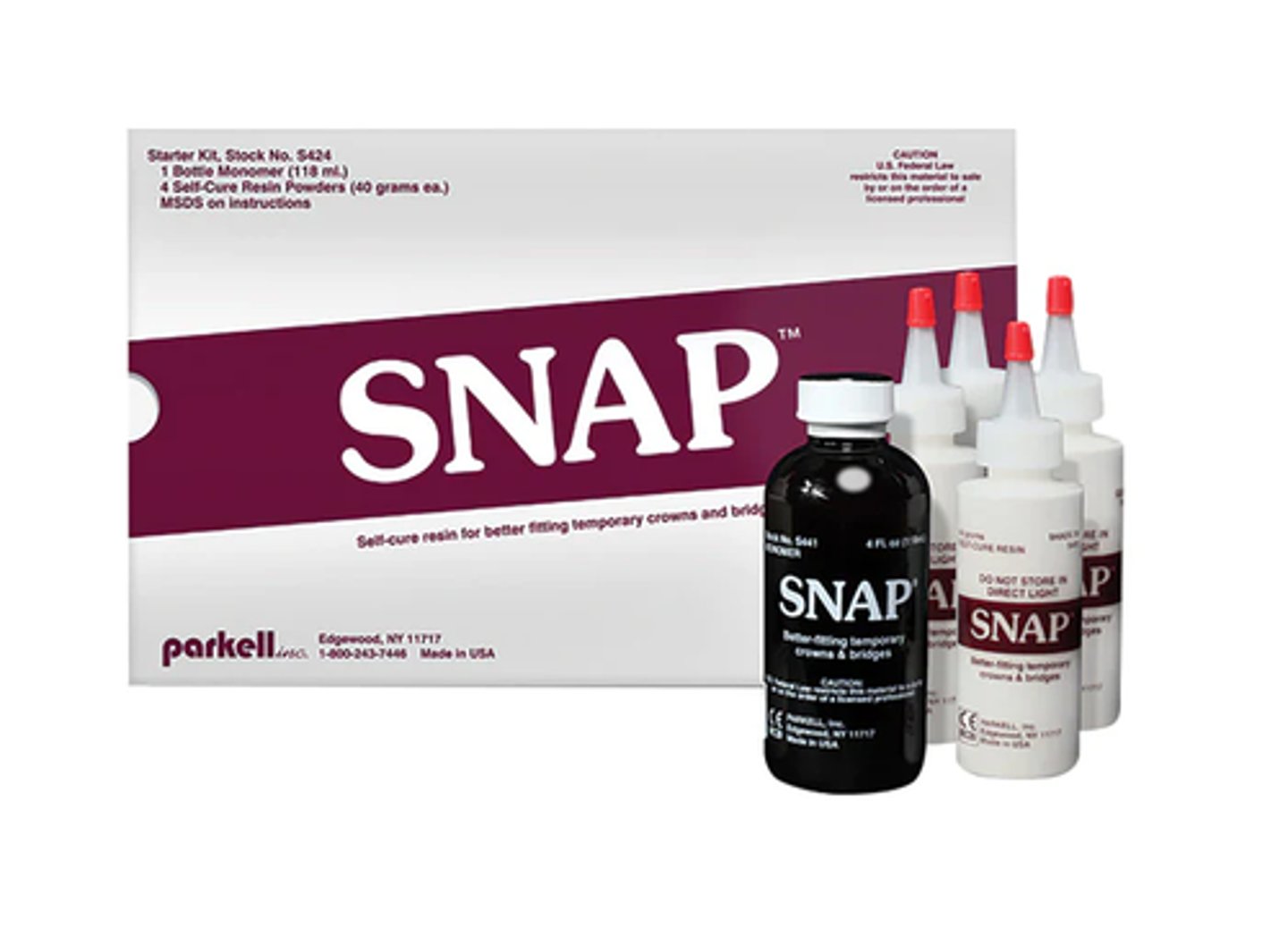
VLS- Visible Light Cured Urethane Dimethylacryate- Triad
Custom Crown & Bridge Provisional Material Options:
Advantages- stain and wear resistant, esthetic
Disadvantages- unpleasant taste, allergies, dust from
grinding, expensive
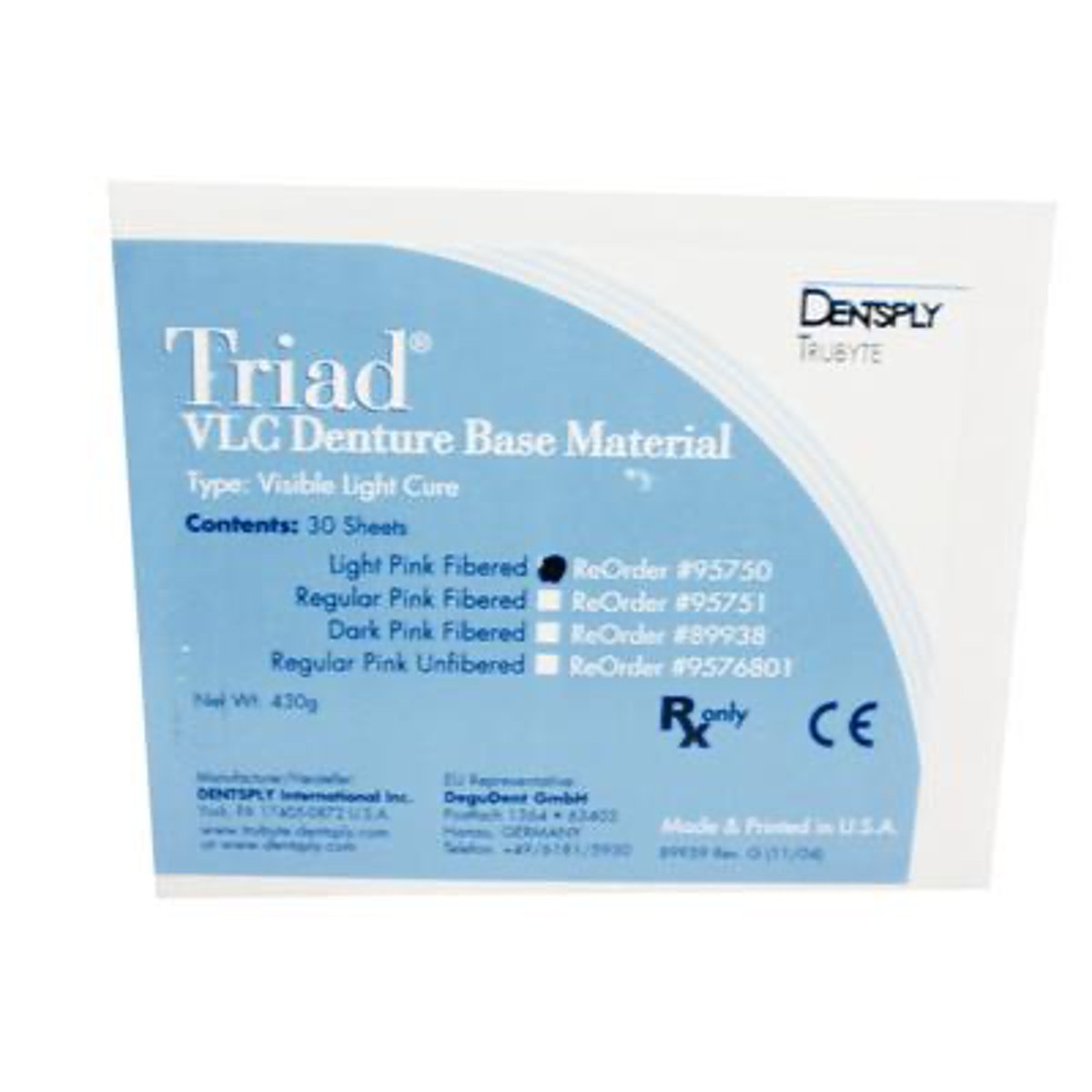
Bis-acryl Composite Resin- Protemp Integrity
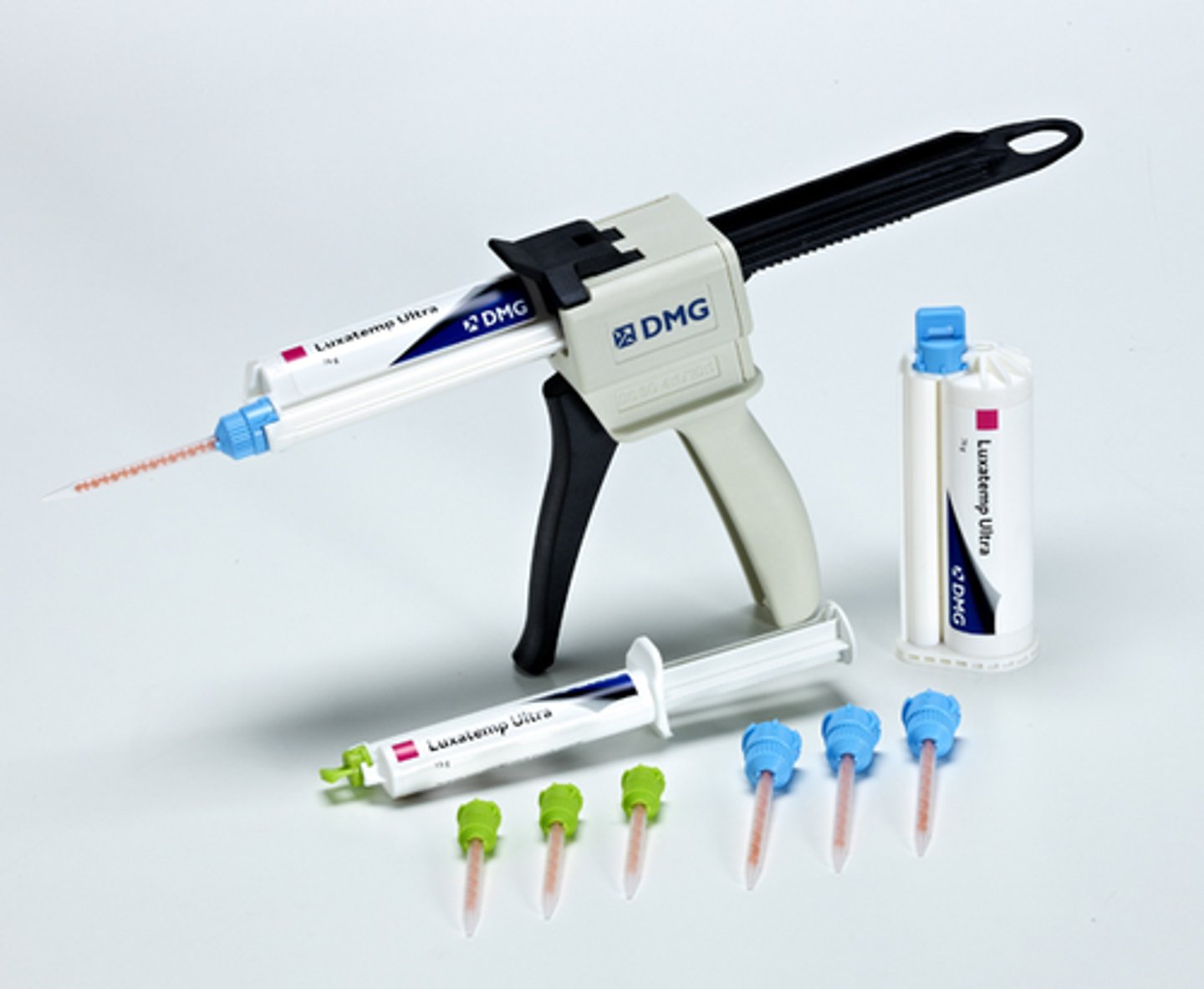
- Luxatemp
Custom Crown & Bridge Provisional Material Options:
Advantages- low curing temp, minimal shrinkage, high
tensile strength and hardness, improved margins, color
stability, less odor, high polishability
Disadvantages- Expensive
- This is the Provisional material we use at school!!
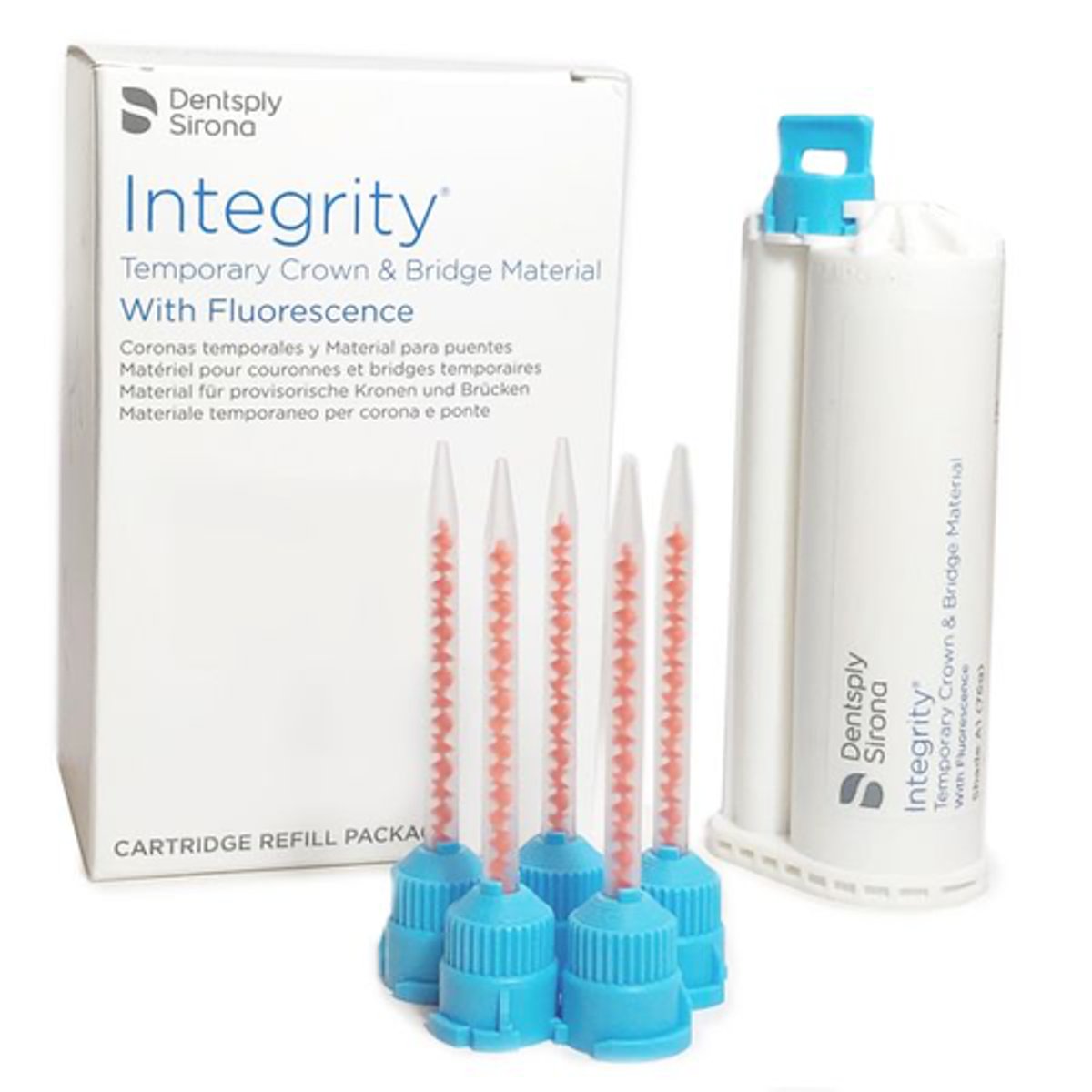
BIS-GMA/BIS ACryl (Integrity)
- more of a composite consistency
Provisional material we use at UNE
- name & brand
- review from another Q
NO
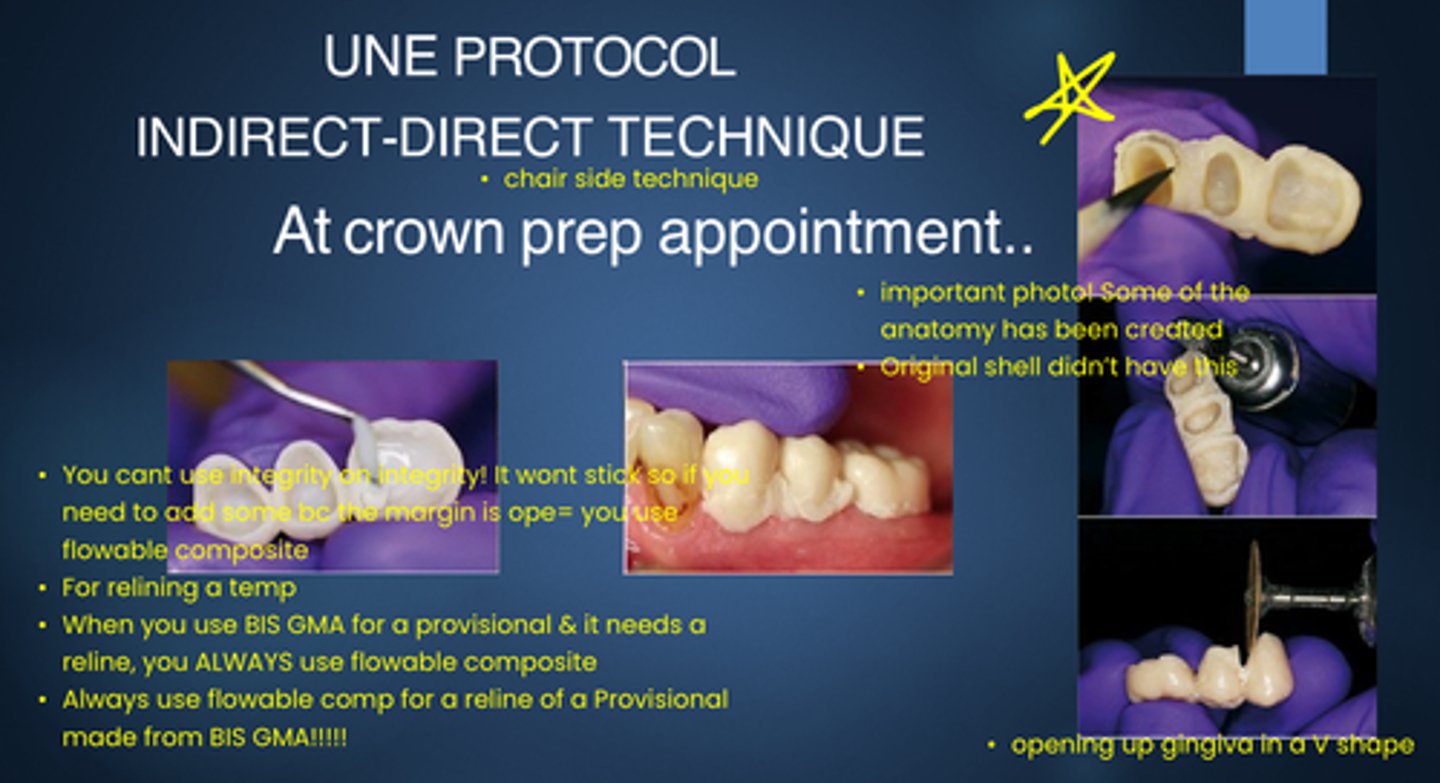
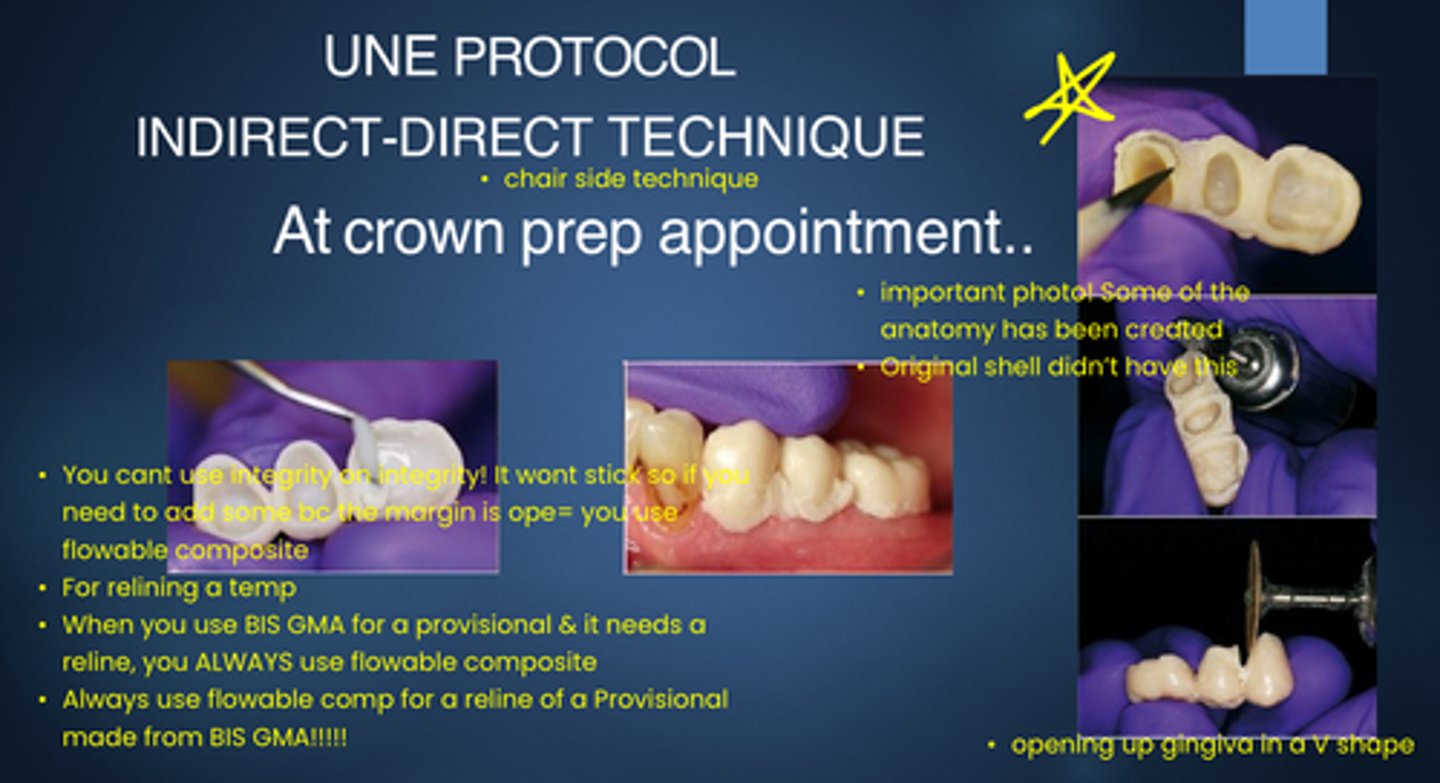
- integrity wont stick to integrity
- you will have to bond & use Flowable composite to readjust/reline a provisional
After you create the Provisional crown using BIS GMA (Integrity) and it needs a reline can you just add some more integrity to make it fit better?
- review from another Q
flowable composite
- Always use flowable composite for a reline of a Provisional made from BIS GMA!!!!!
When you use BIS GMA for a provisional & it needs a reline, you ALWAYS use _____ ____ to make any adjustments!!!
- NEVER use Integrity
- Integrity will NOT stick to integrity
- review from another Q
Bis-acryl Composite Resin- Protemp Integrity
- Luxatemp
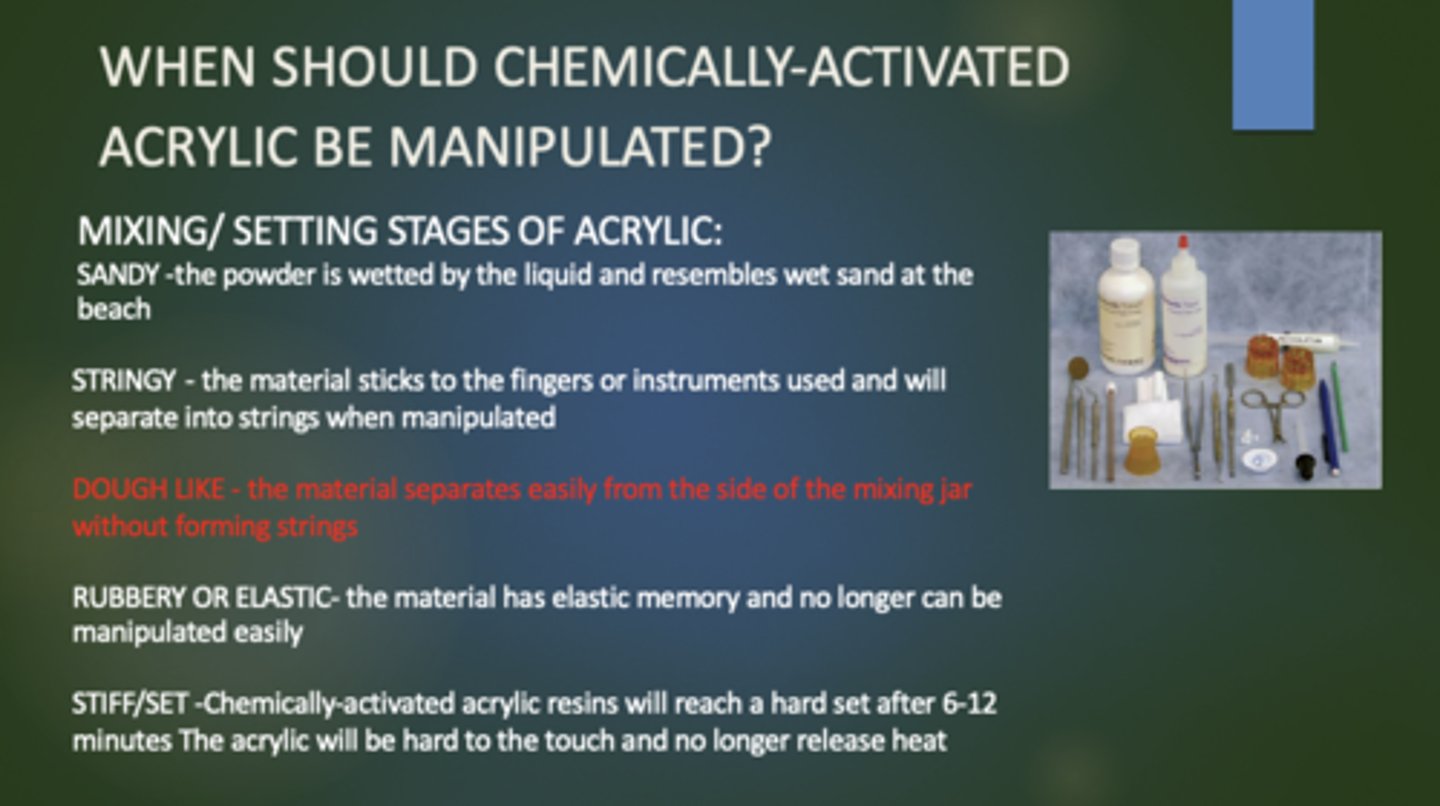
Sandy
(when u mix them tg it will be like a sandy mix)
(sand + water= dry rough mix)
Stringy
(material sicks to the fingers or instruments & will separate into strings)
Dough-Like
(this is the stage where you adapt the material into a provisional crown)
Rubbery/Plastic
(material useless @ this stage)
Stiff/Set
Custom Crown & Bridge Provisional Material Options:
5 stages that happen while mixing Jet Acrylic (PMMA)
- Mixing/setting stages of Acrylic
- review from other Q
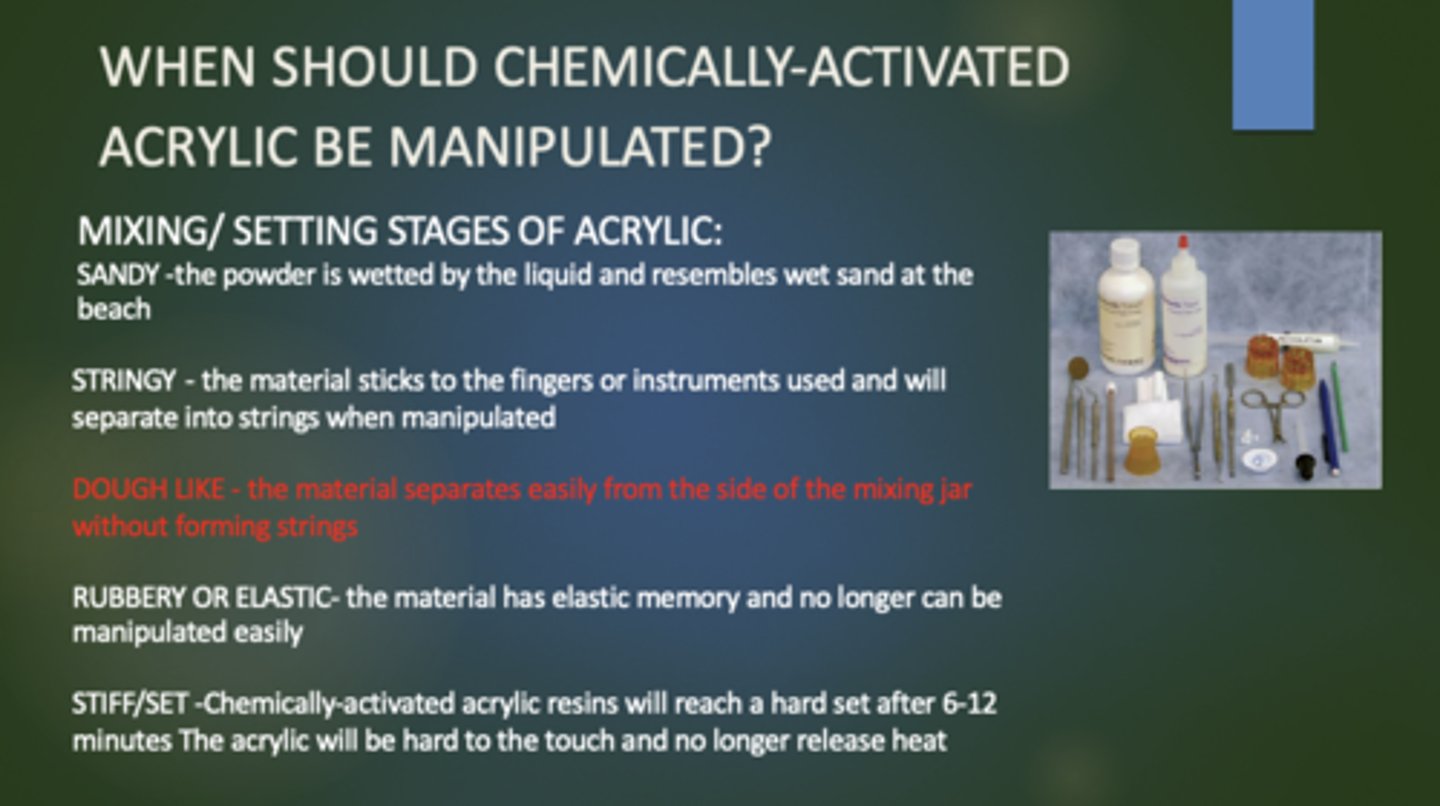
Stiff/Set stage of mixing Jet Acrylic
Custom Crown & Bridge Provisional Material Options:
Chemically-activated acrylic resins will reach a hard set after 6-12 minutes
- The acrylic will be hard to the touch and no longer release heat
- review from other Q
Bonding
These are the 3 ____ Agents we use at the OHC
ScotchBond Universal (we use this one in sim)
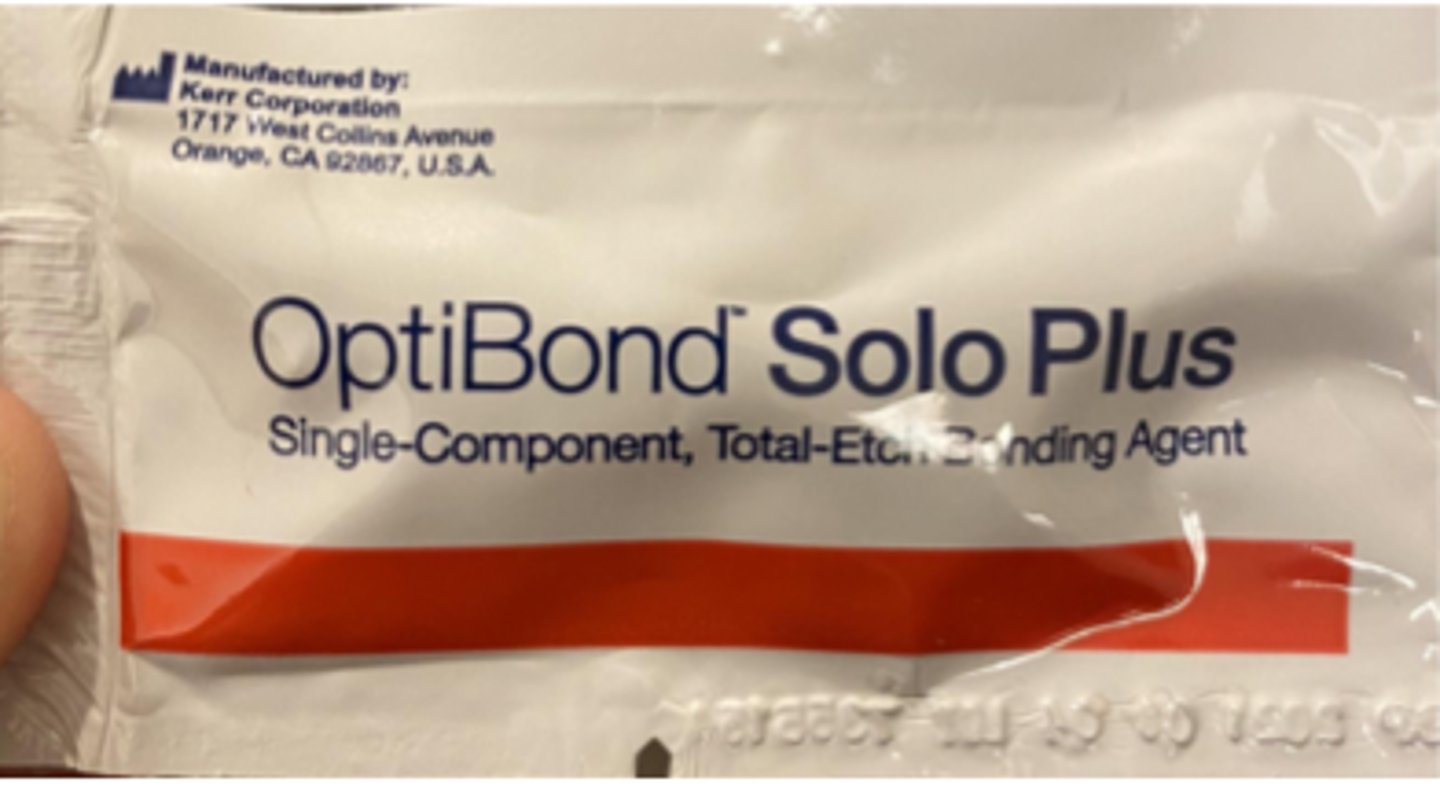
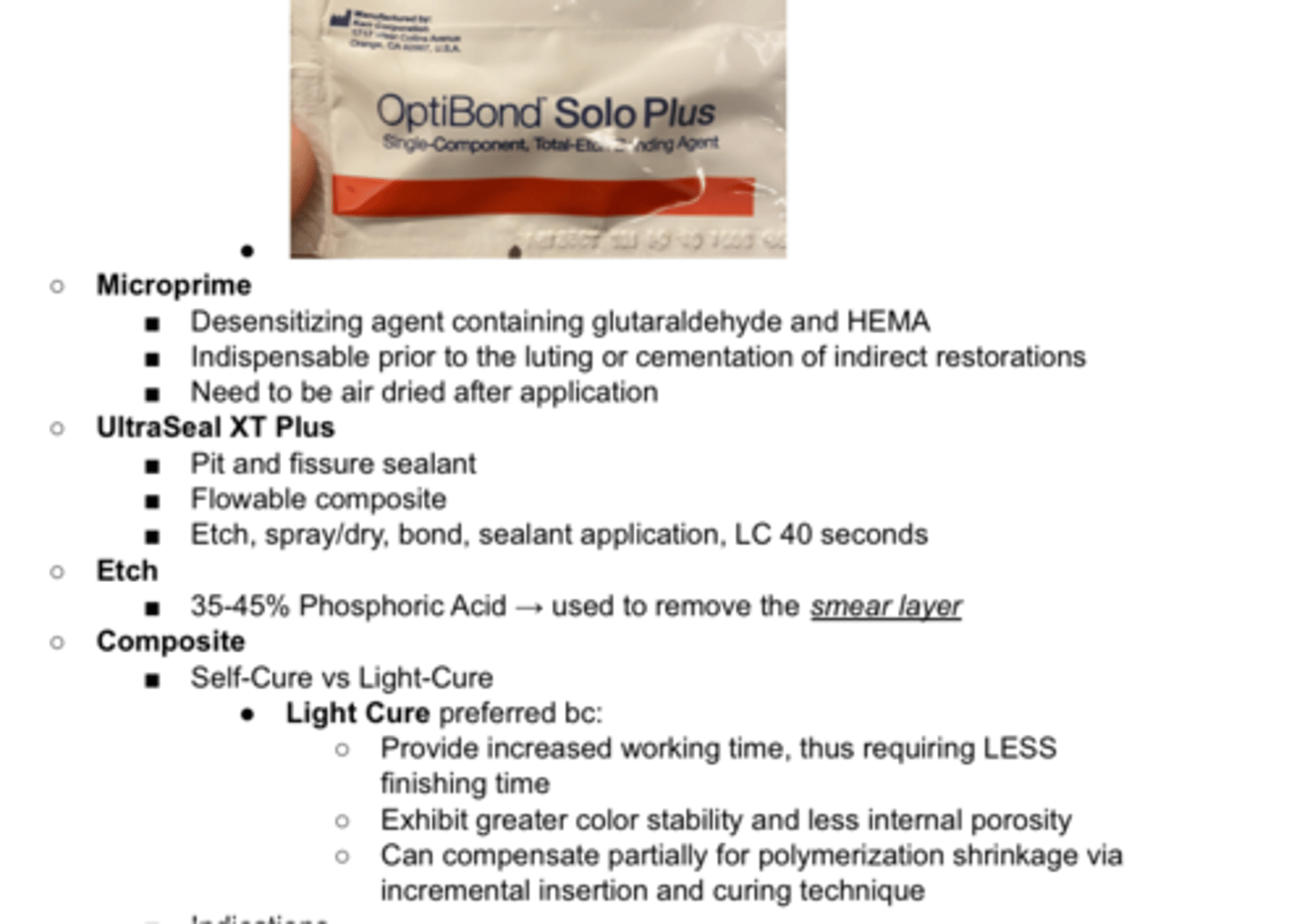
Optibond Solo Plus
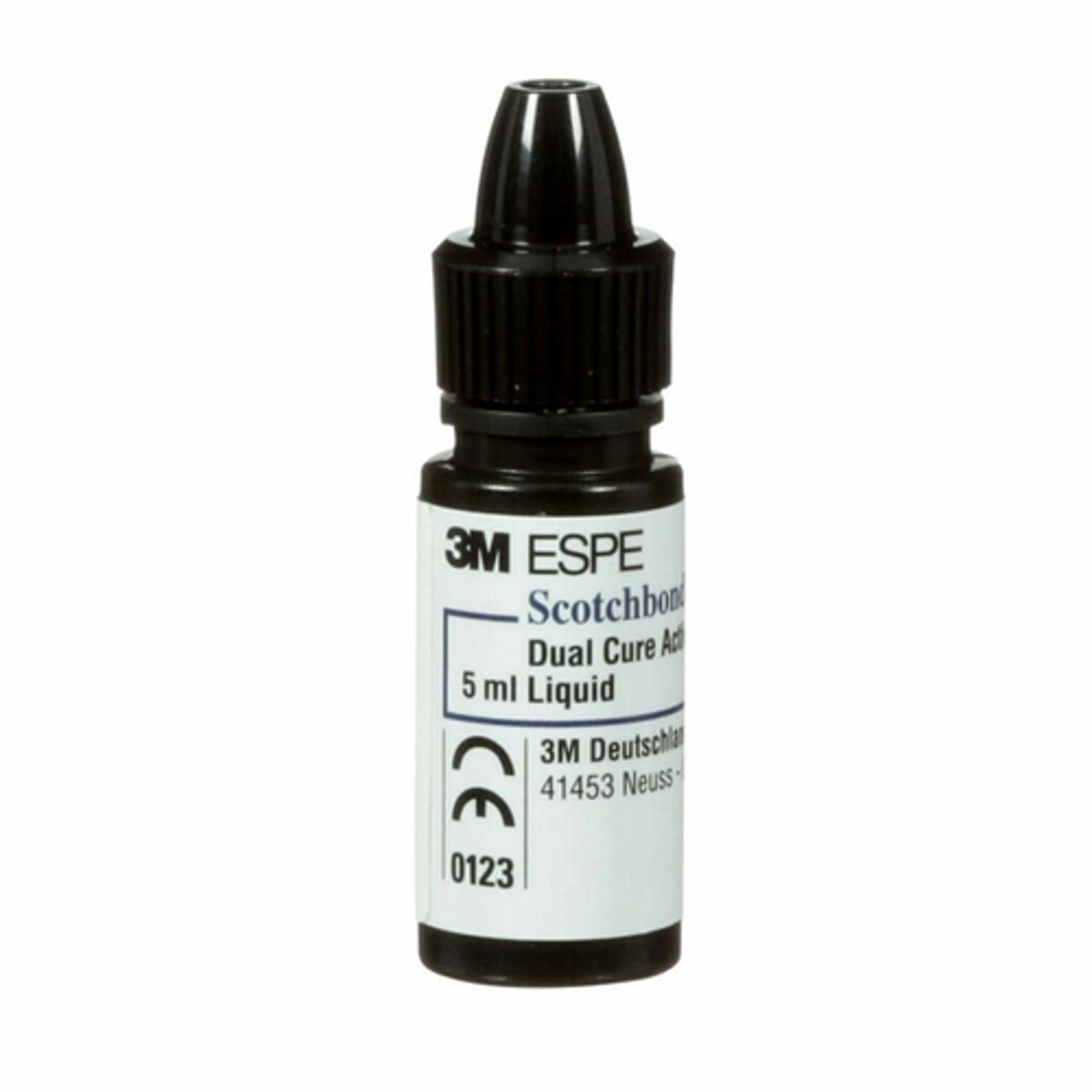
Scotchbond Universal Dual Cure (use din clinic for Luxacore temp material)
- read about each in photo!!
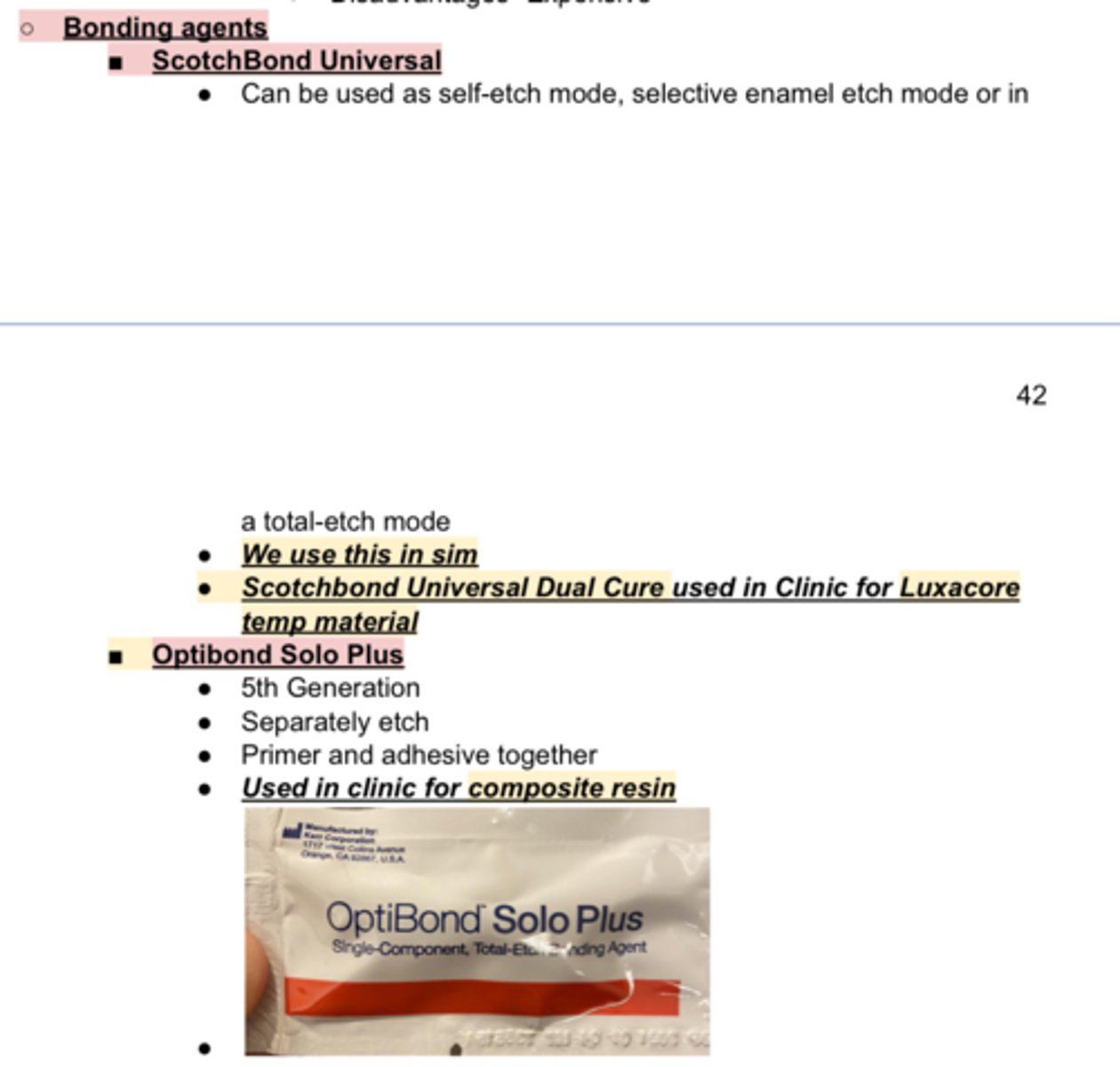
Scotchbond Universal Dual Cure (use din clinic for Luxacore temp material)
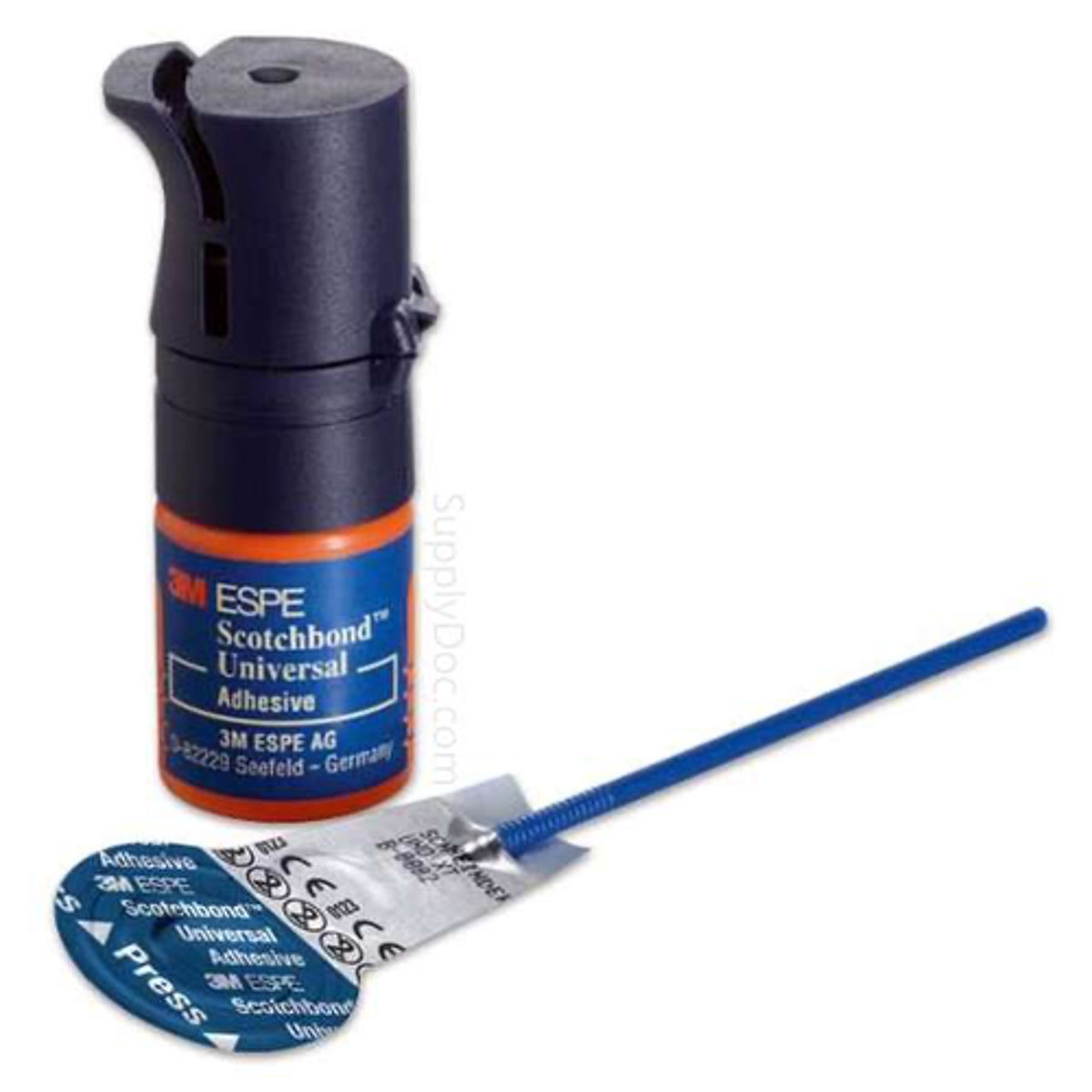
ScotchBond Universal (we use this one in sim)
Optibond Solo Plus (composite)
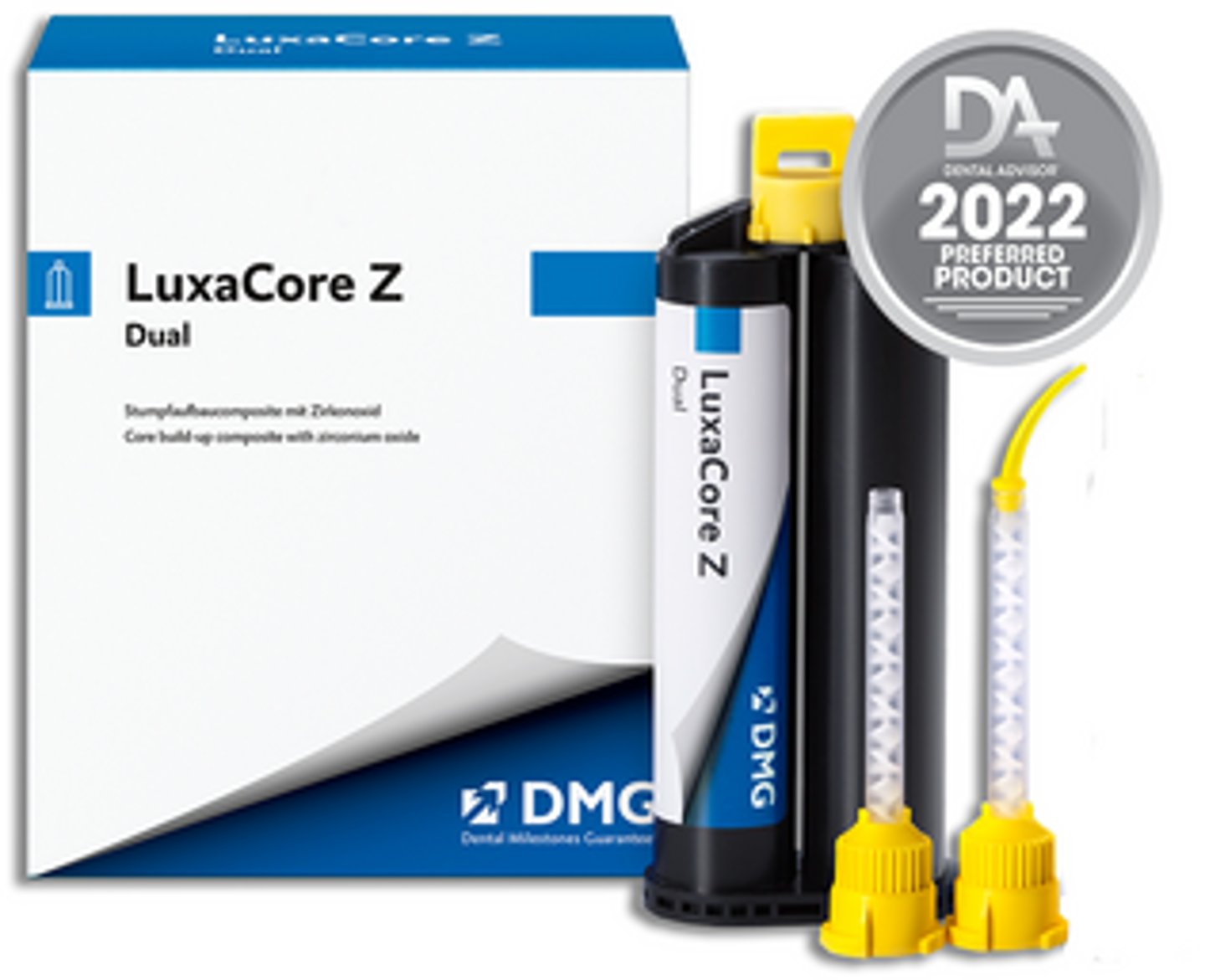
Scotchbond Universal Dual Cure (Luxacore Core BLD-UP temp material)
List 3 Bonding Agents we use at the OHC
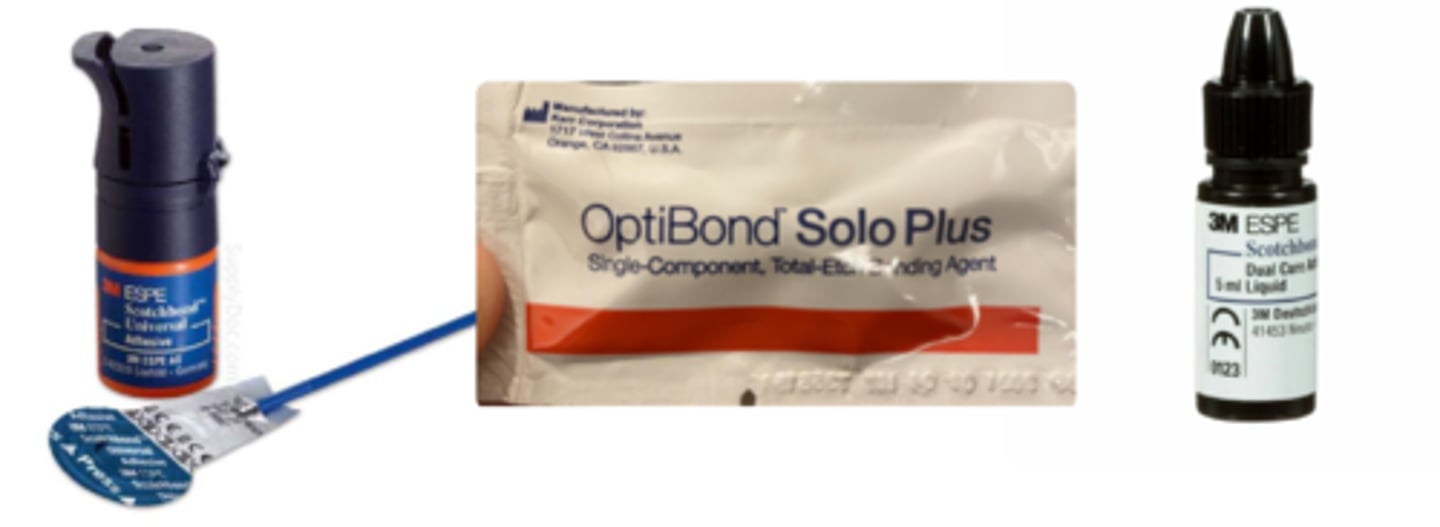
Scotch Bond Universal
Optibond Solo Plus
Scotchbond Universal Dual Cure
Bonding agent used in SIM=
Bonding agent used in Clinic for Composite Resin=
Bonding agent used for Luxacore temp material=
(Most common material for Core BLD-UP)
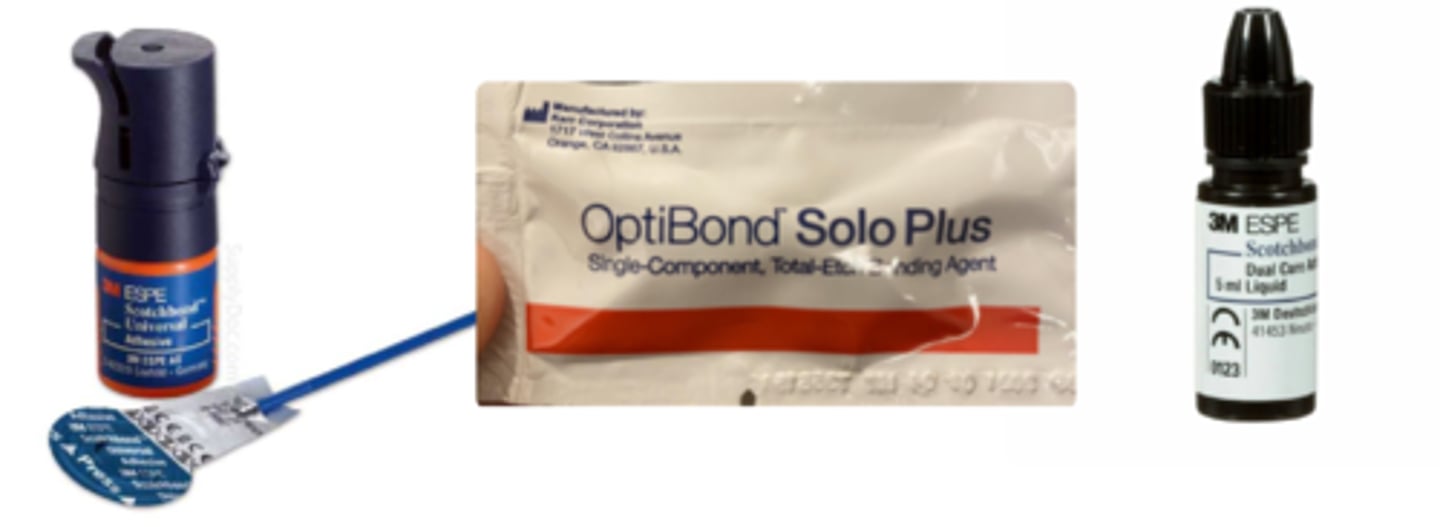
Scotch Bond Universal
Bonding agent used in SIM=
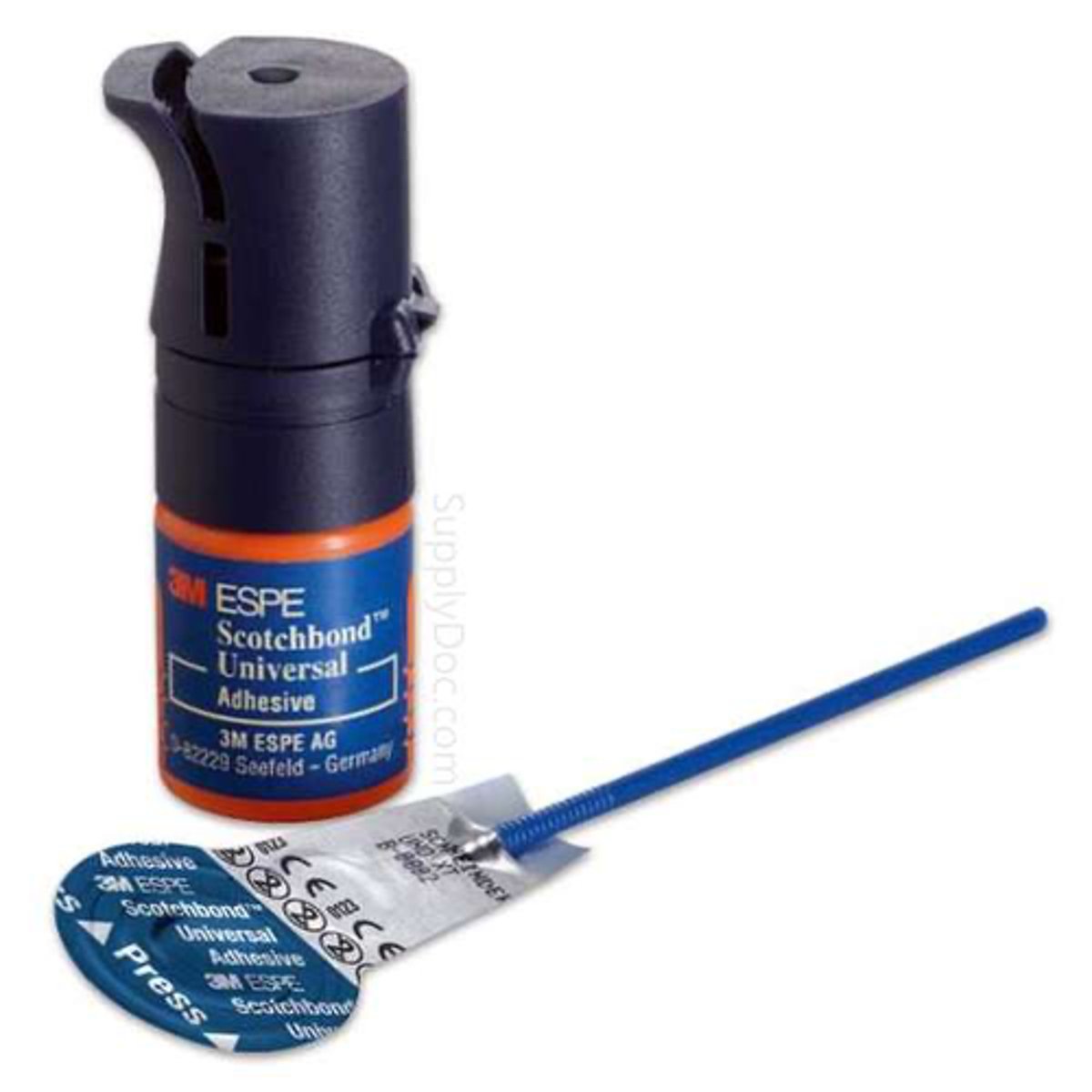
Optibond Solo Plus
Bonding agent used in Clinic for Composite Resin=
Scotchbond Universal Dual Cure
Bonding agent used for Luxacore temp material=
(Most common material for Core BLD-UP)
Luxacore temp provisional material
Scotchbond Universal Dual Cure (use din clinic for Luxacore temp material)
More dental materials
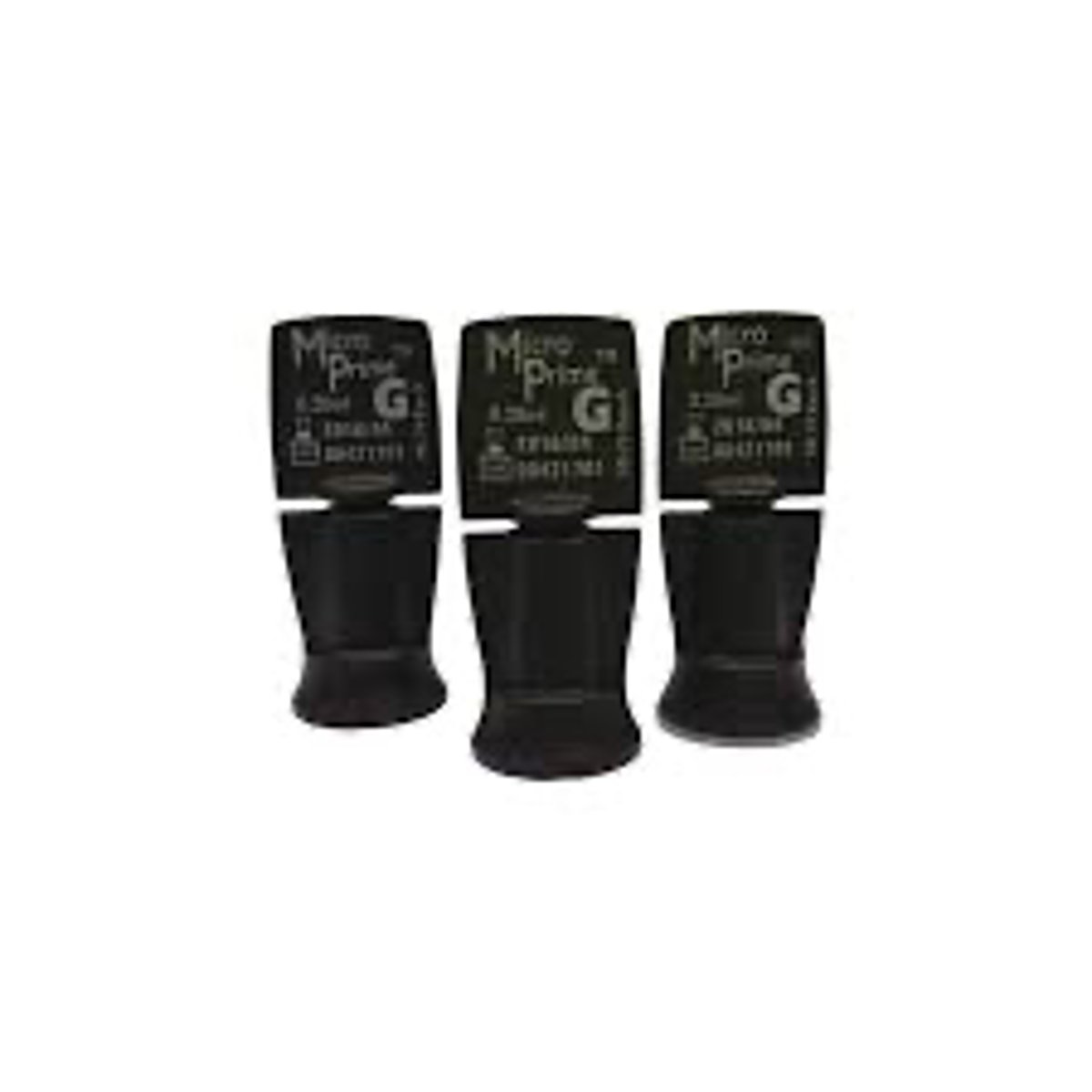
Microprime
Desensitizing agent containing Glutaraldehyde and HEMA
Apply Two-1 Minute coats & air dry inbetween
Indispensable prior to the luting or cementation of indirect restorations
Need to be air dried after application
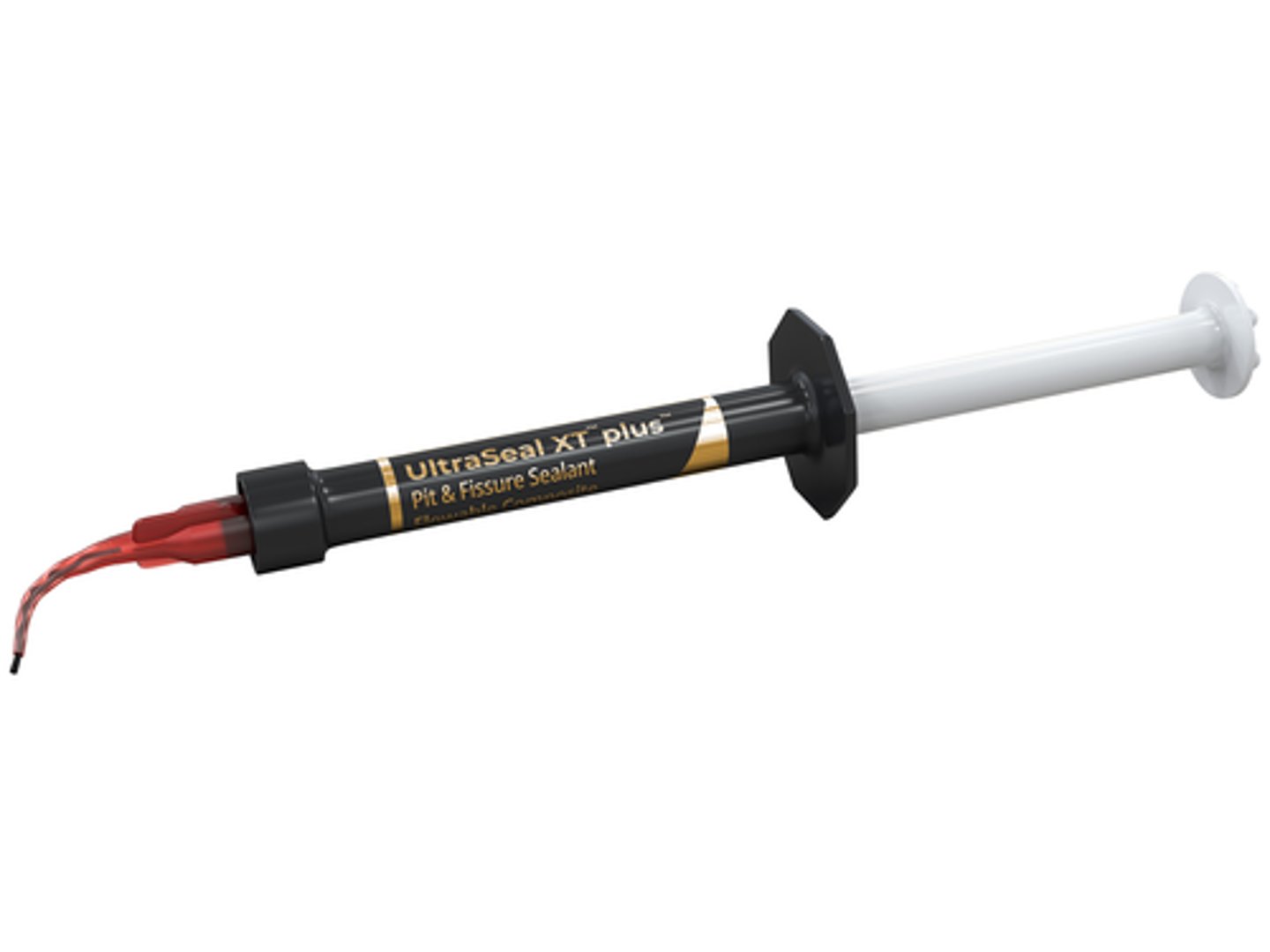
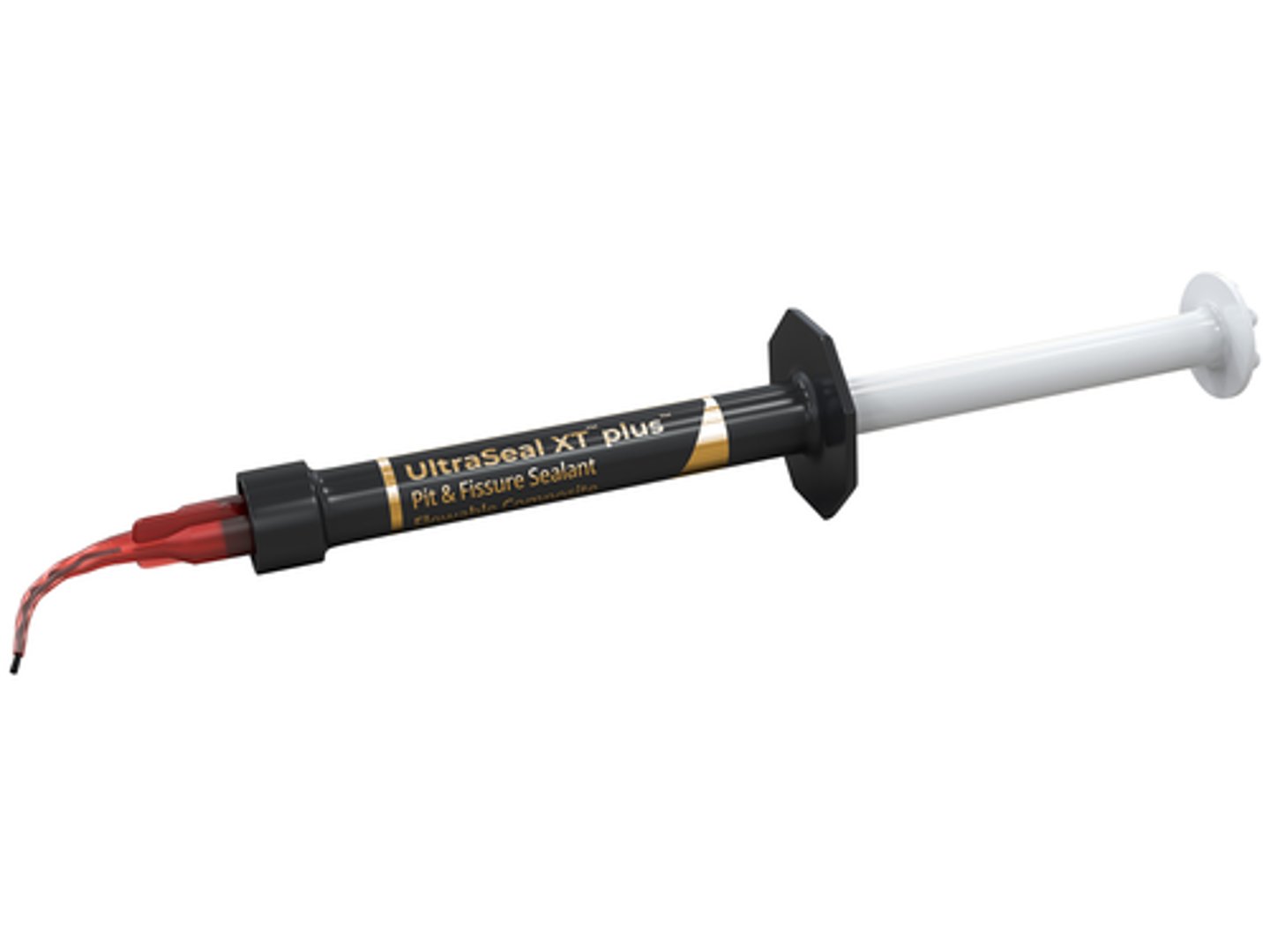
UltraSeal XT Plus
Pit and fissure sealant
Flowable composite
Etch, spray/dry, bond, sealant application, LC 40 seconds
40s
How long do you light cure UltraSeal XT Plus for?
Etch
35-45% Phosphoric Acid → used to remove the smear layer
read top part
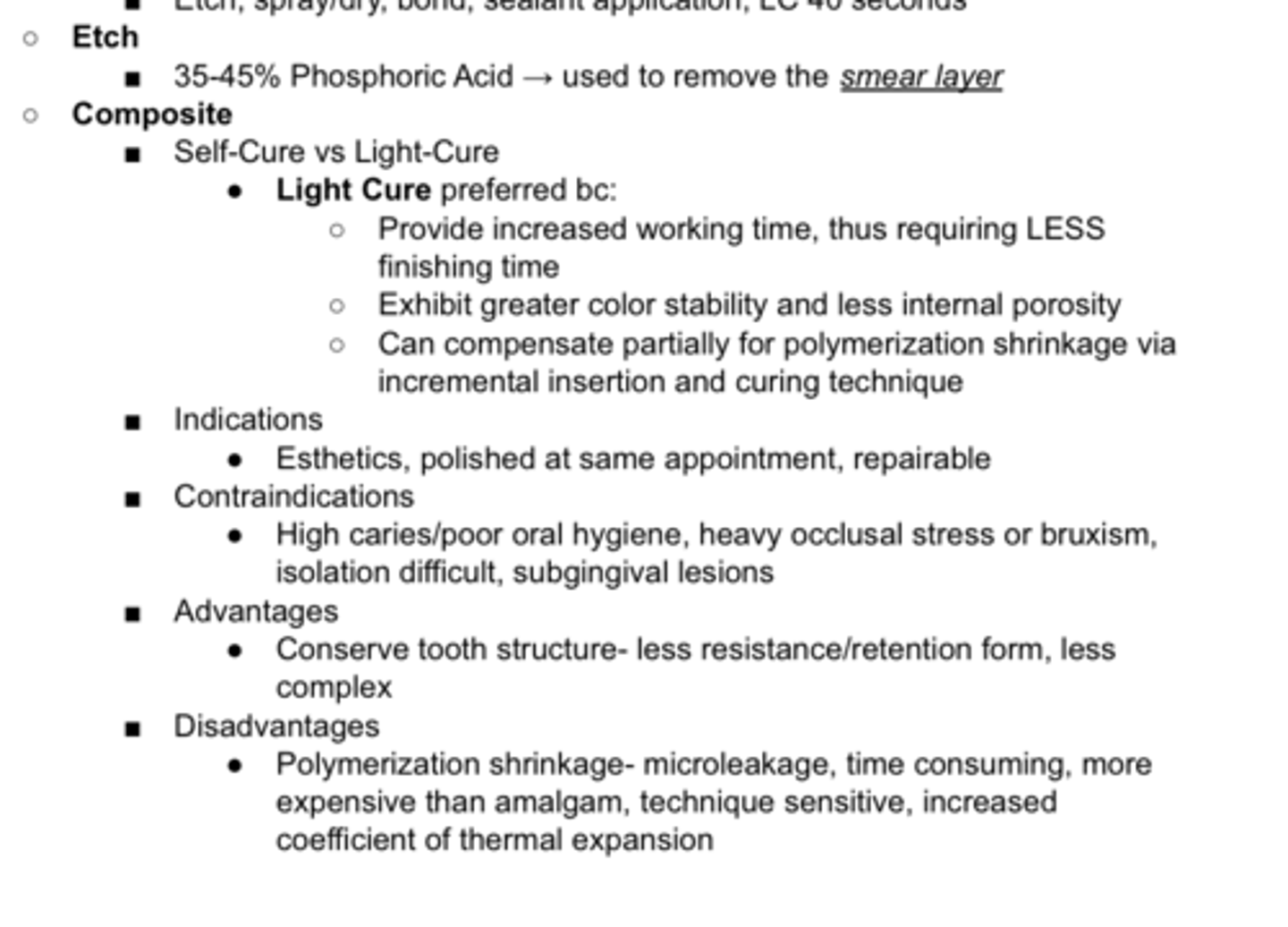
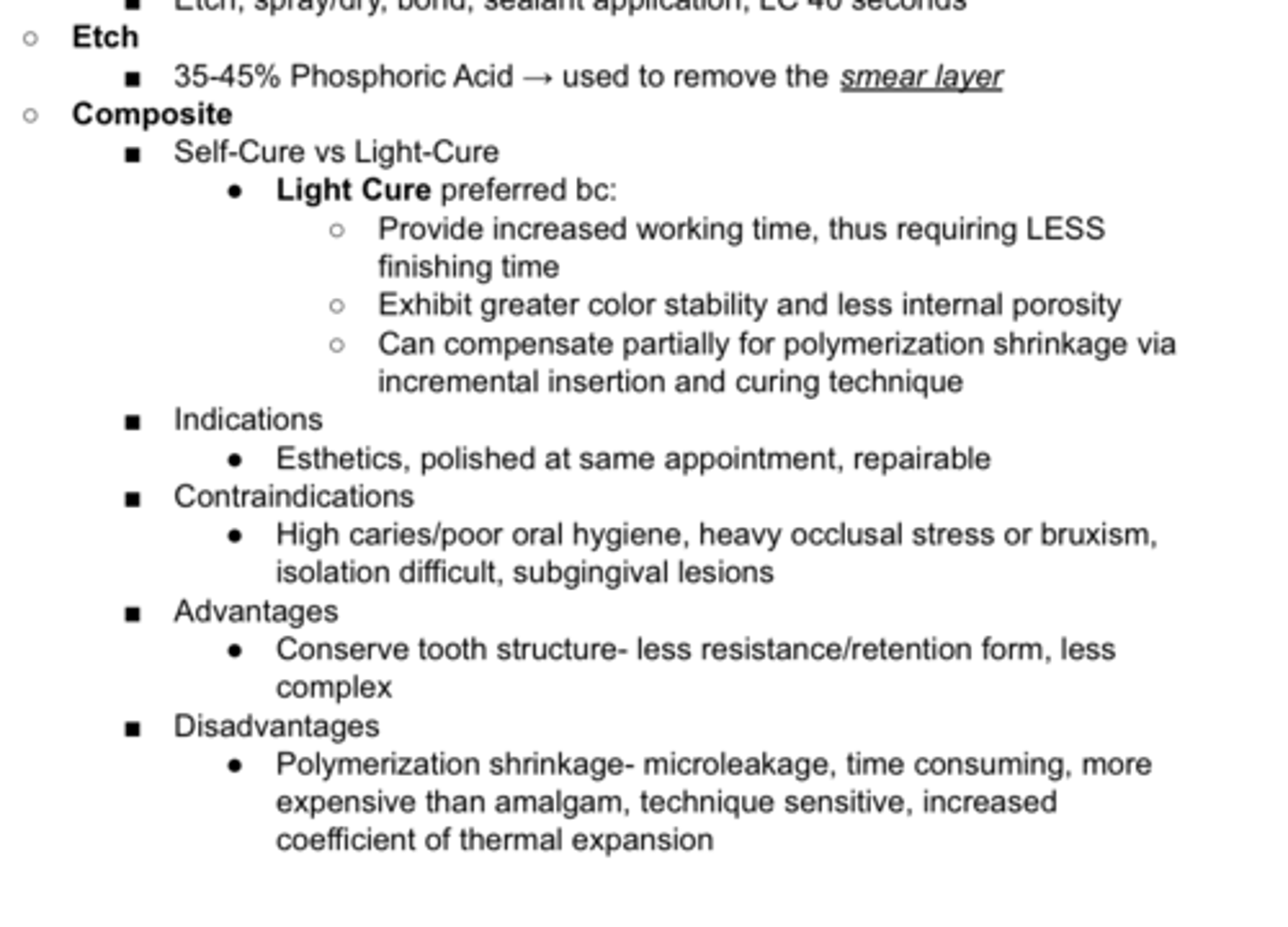
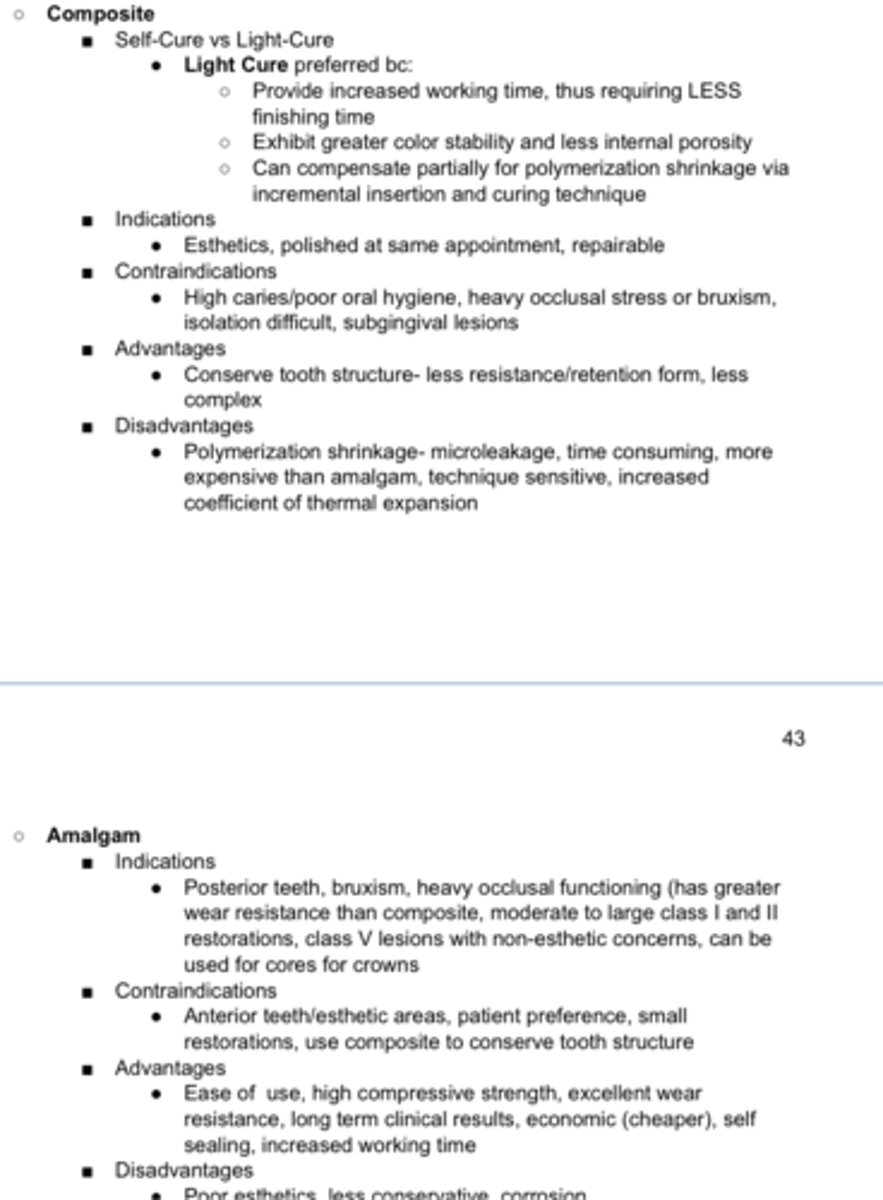
Composite
Indications
- Esthetics, polished at same appointment, repairable
Contraindications
- High caries/poor oral hygiene, heavy occlusal stress or bruxism, isolation difficult, subgingival lesions
Advantages
- Conserve tooth structure- less resistance/retention form, less complex
Disadvantages
- Polymerization shrinkage- microleakage, time consuming, more expensive than amalgam, technique sensitive, increased
coefficient of thermal expansion
Amalgam
Indications
- Posterior teeth, bruxism, heavy occlusal functioning (has greater wear resistance than composite, moderate to large class I and II restorations, class V lesions with non-esthetic concerns, can be used for cores for crowns
Contraindications
- Anterior teeth/esthetic areas, patient preference, small
restorations, use composite to conserve tooth structure
Advantages
- Ease of use, high compressive strength, excellent wear
resistance, long term clinical results, economic (cheaper), self sealing, increased working time
Disadvantages
- Poor esthetics, less conservative, corrosion
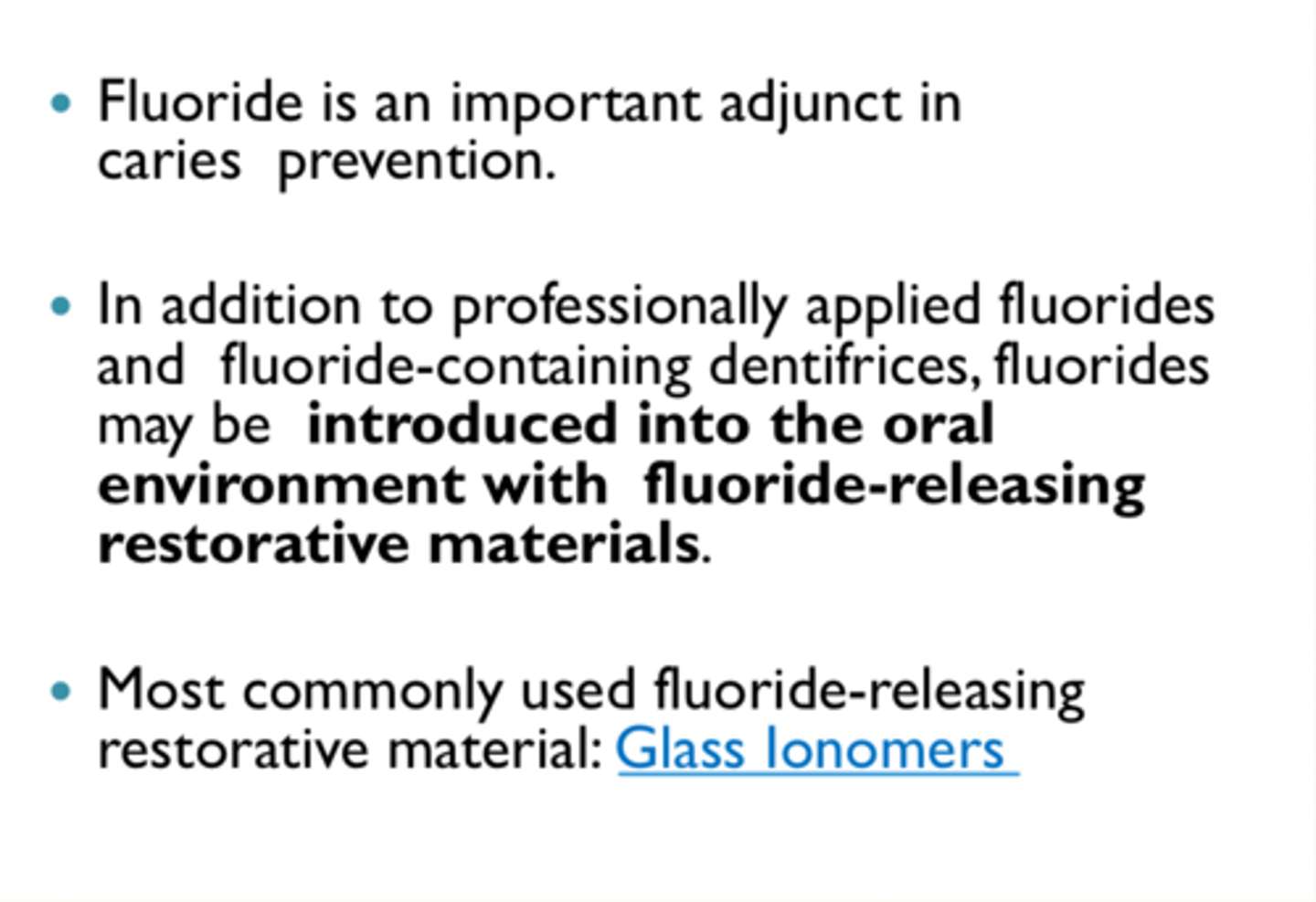
Glass ionomers
Most commonly used Fluoride releasing material
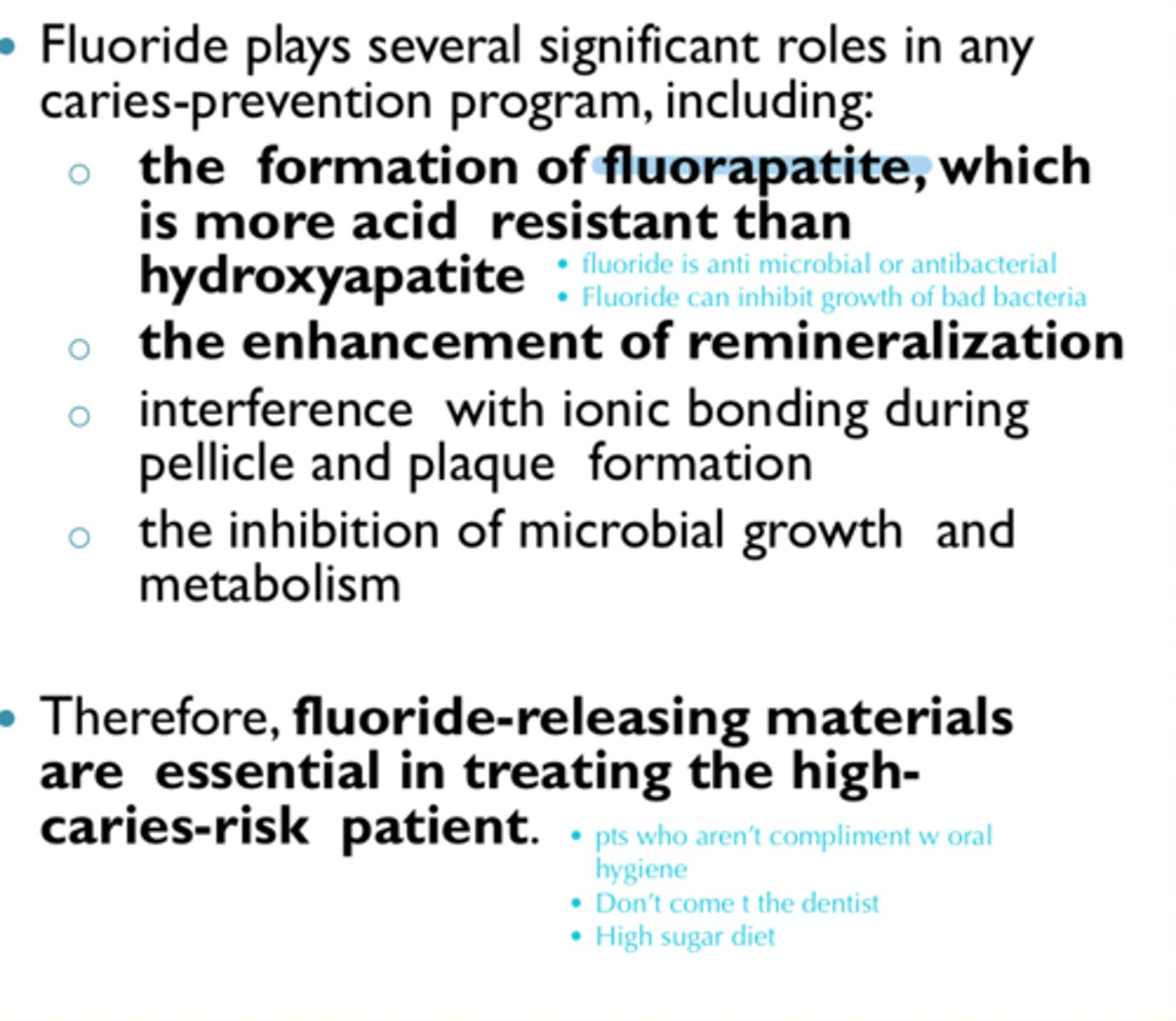
Critical pH!! 5.5
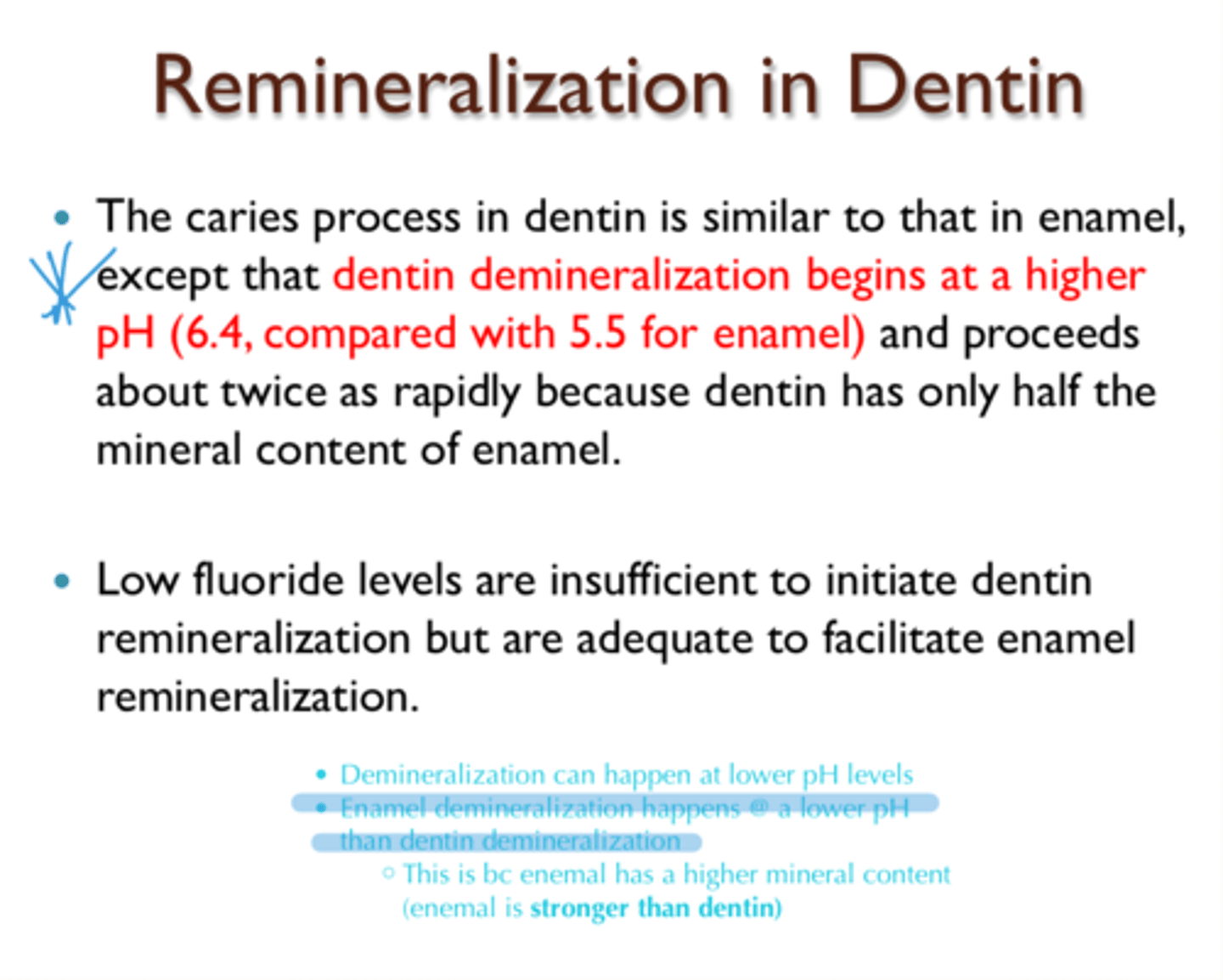
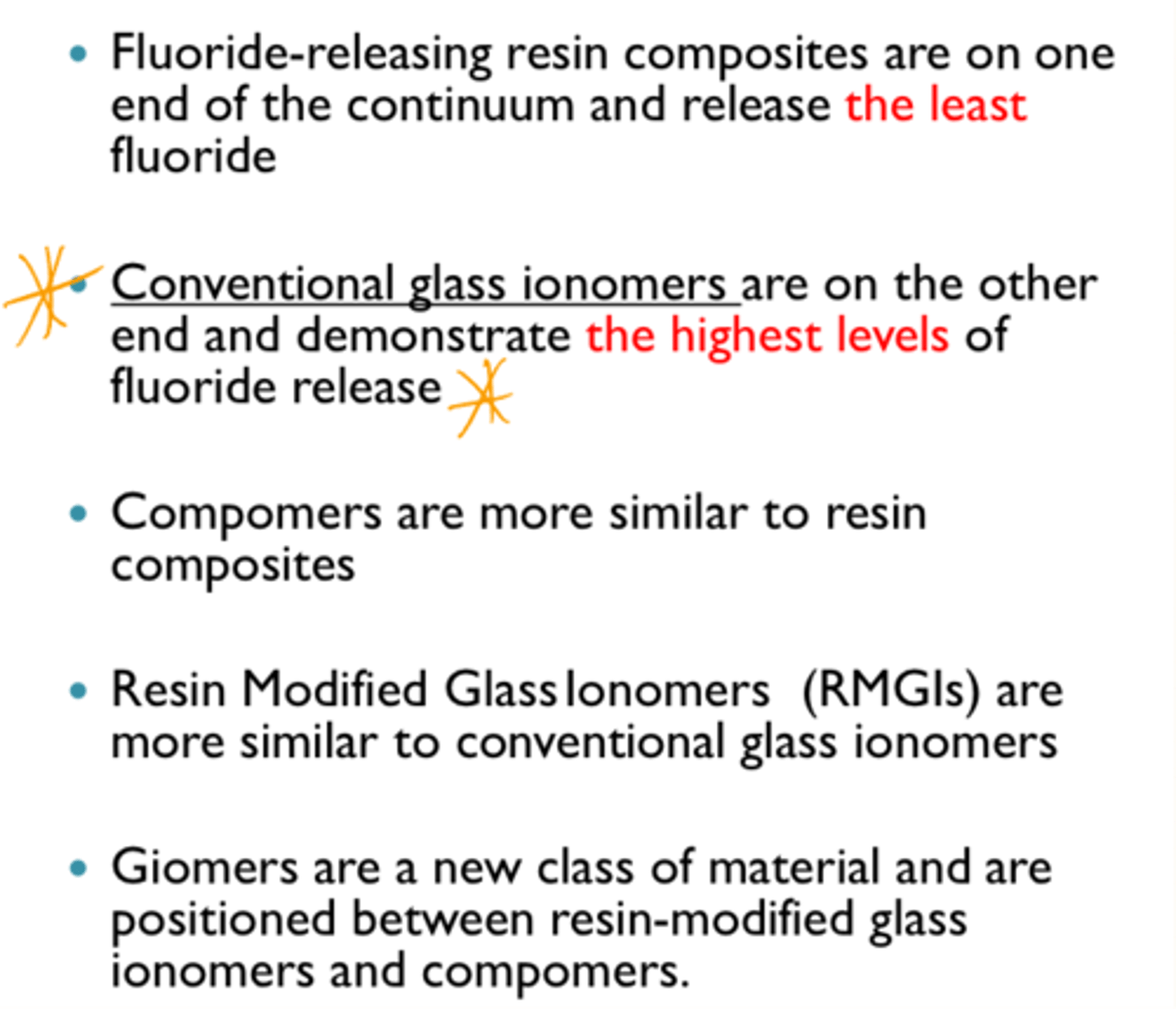
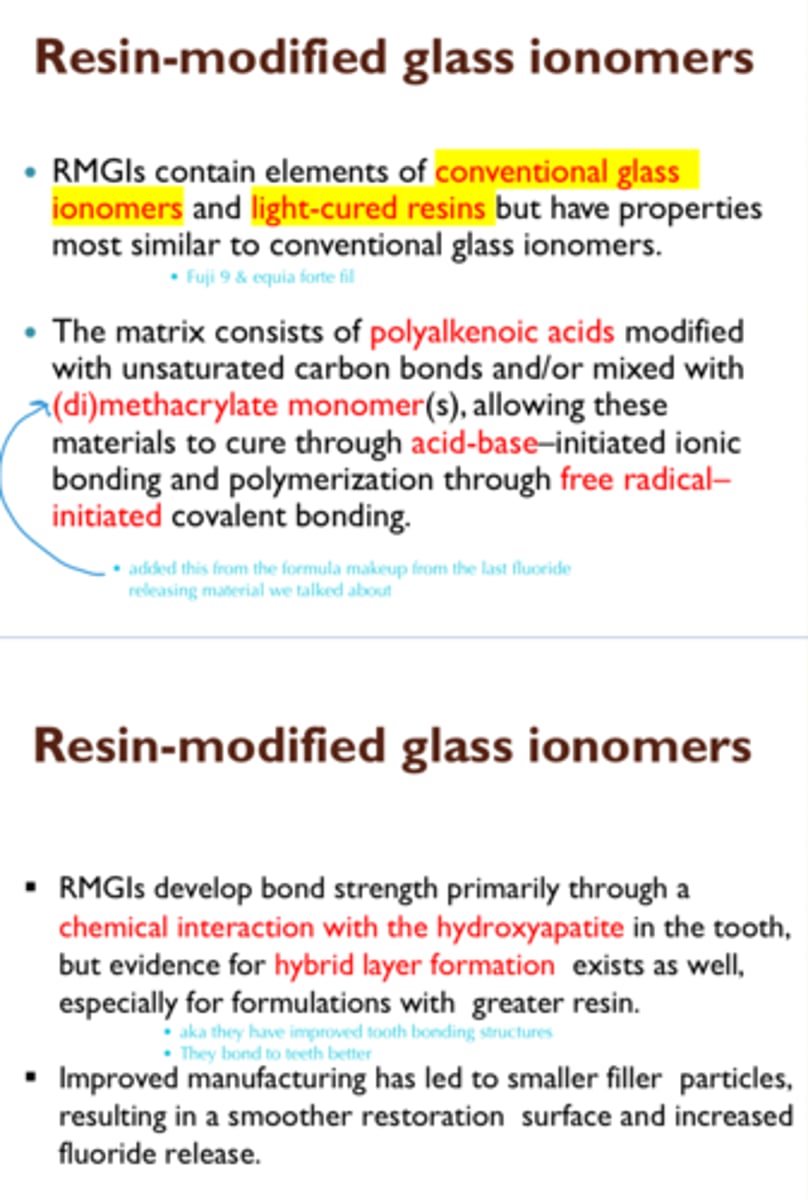
Rechargeable Fluoride releasing restorative material that is more moisture tolerant than composite resin
Rechargeable Fluoride releasing restorative material that is a Hybrid of GI's and resin composites that is usually used for root caries
(bc they release fluoride & are less sensitive to moisture than comp)
What is a Glass Ionomer?
What is a Resin Modified Glass Ionomer RMGI?
Glass Ionomers
Resin Modified Glass Ionomers
These are _____ ___
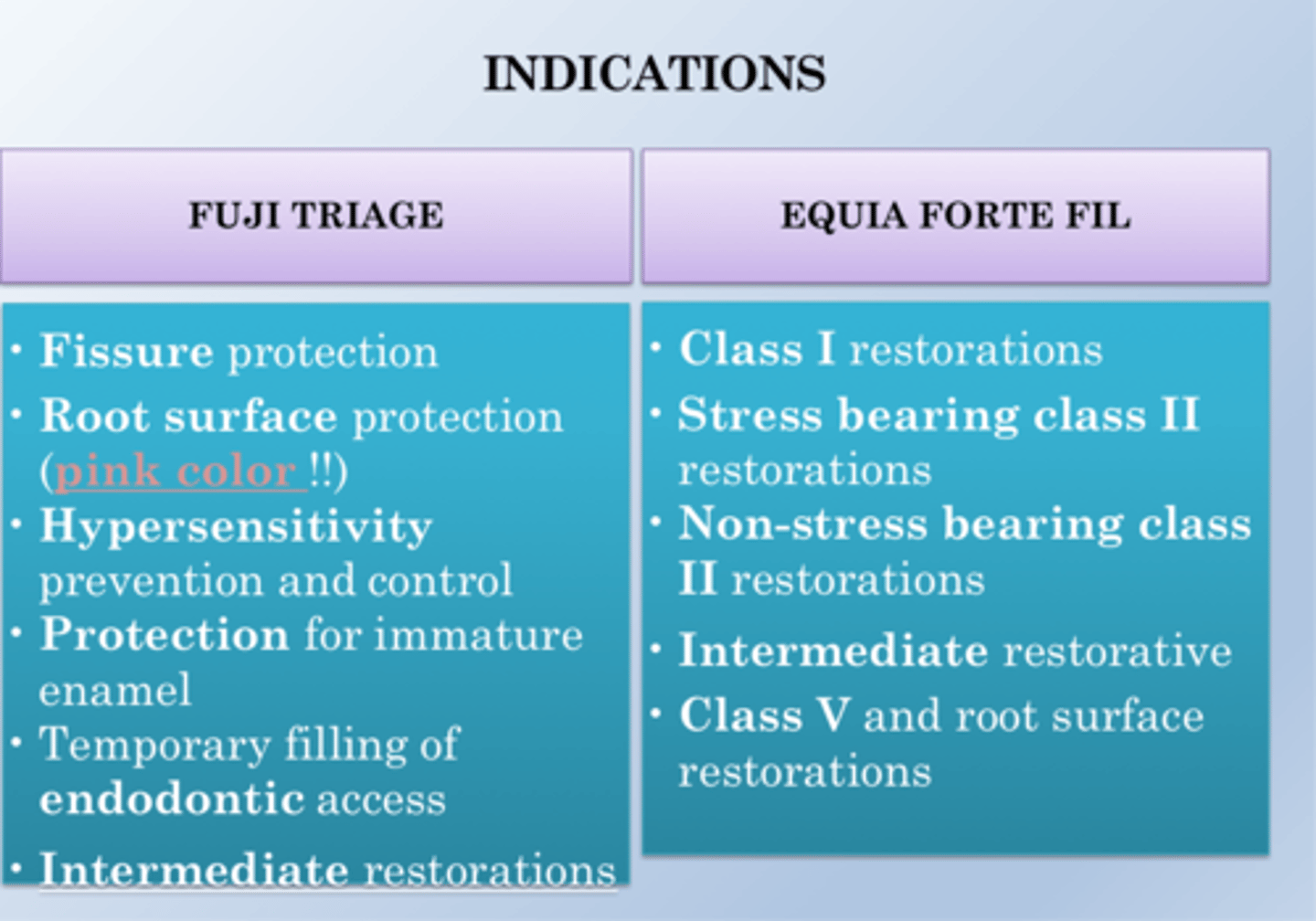
Fuji Triage (pink)
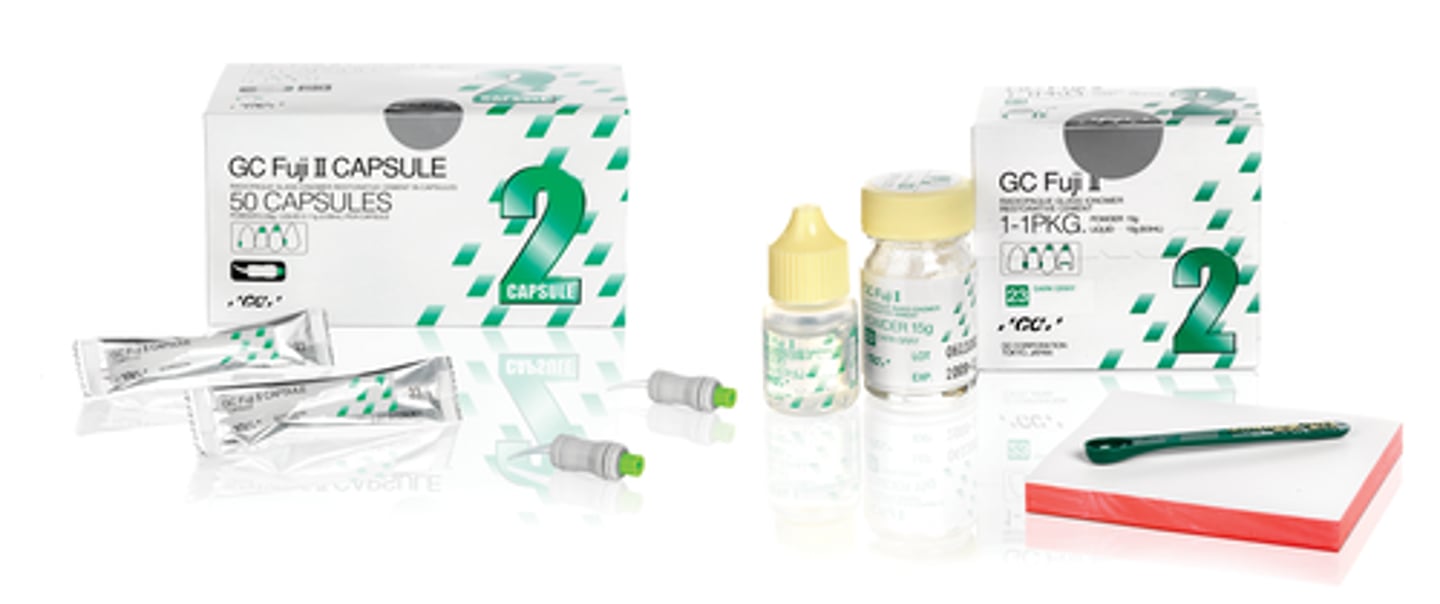
Fuji II
Fuji IX
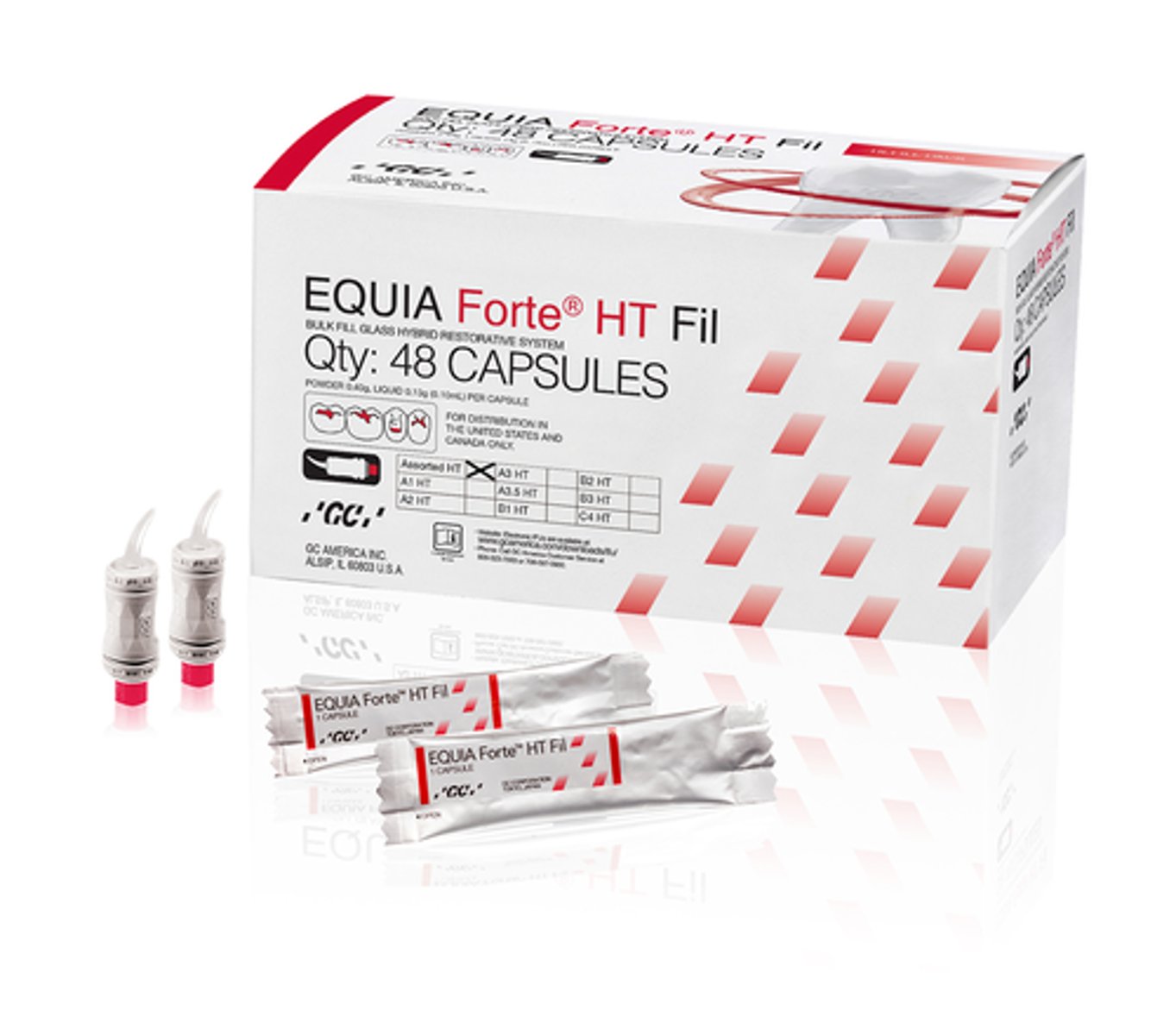
Equia Forte
Ketac Fil
Ketac Molar
These are ____ ____ ____ ____
Fuji II LC
Photac Fil
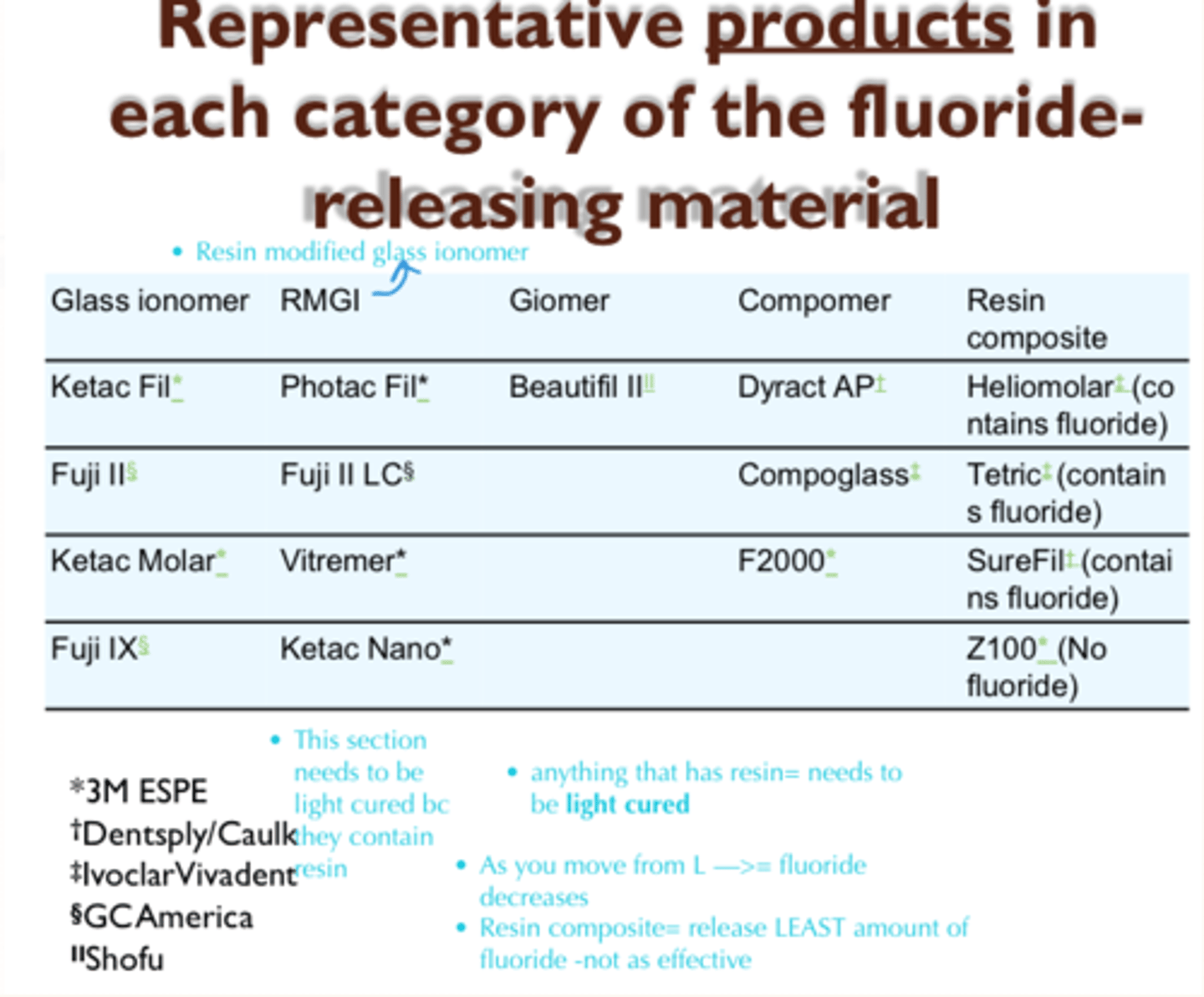
Glass Ionomers
- Fuji II and Fuji IX showed comparable marginal adaptation. Fuji II restorations showed better results regarding anatomic form, secondary caries and marginal discoloration when compared to Fuji IX.
These are _____ ___
Fuji Triage (pink)
Fuji II
Fuji IX
Equia Forte
Ketac Fil
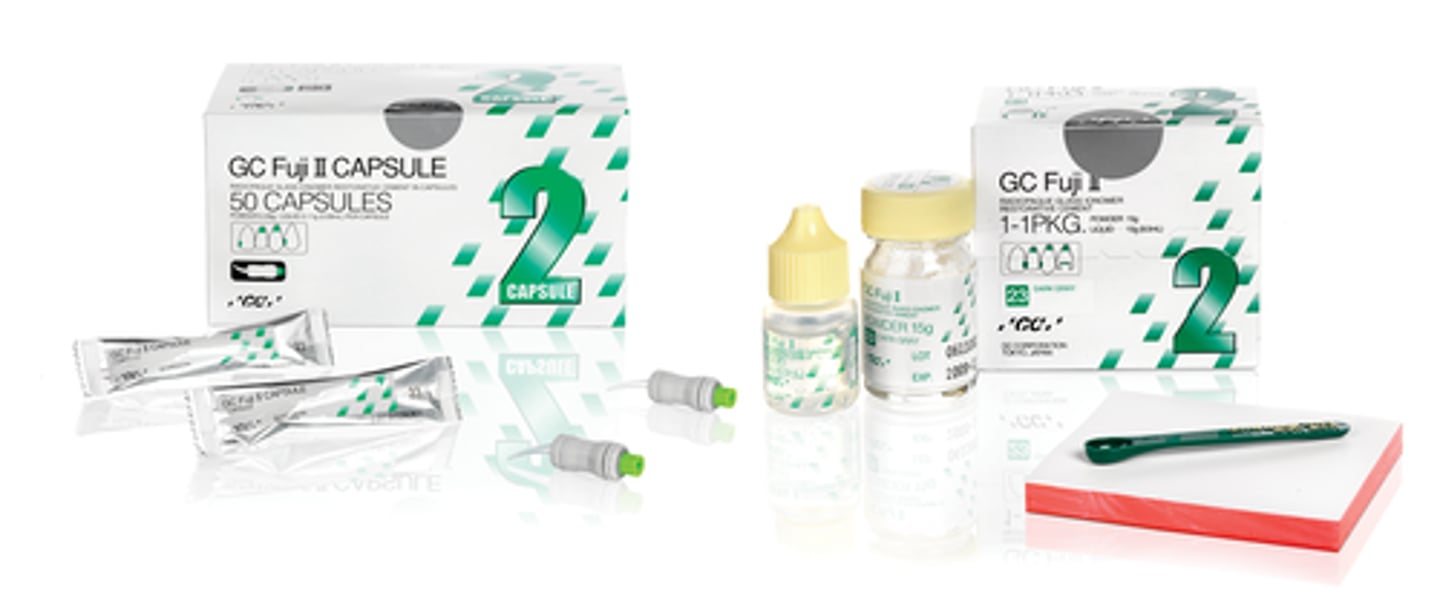
Resin Modified Glass Ionomers
These are ____ ____ ____ ____
Fuji II LC
Photac Fil
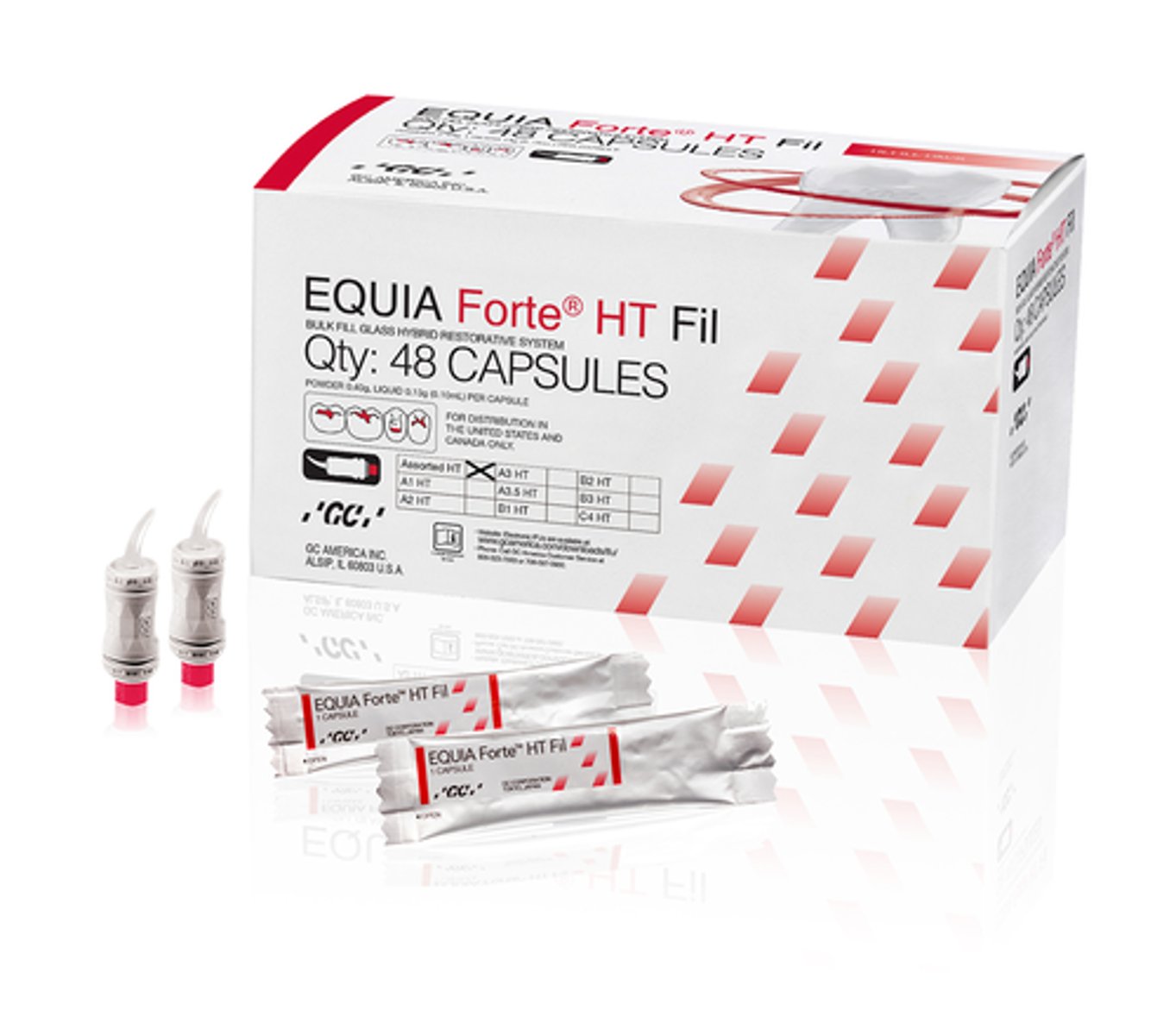
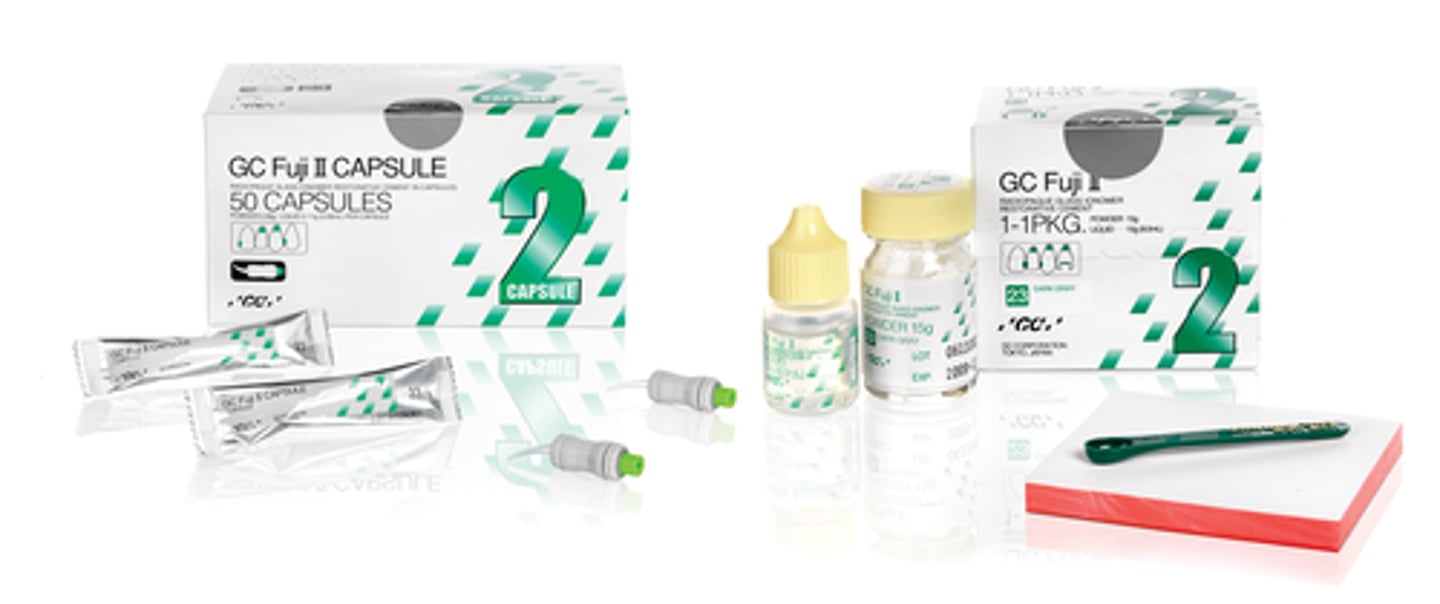
Fuji II GI photo
Fuji Triage (pink)
Fuji II
Fuji IX
Equia Forte
Ketac Fil
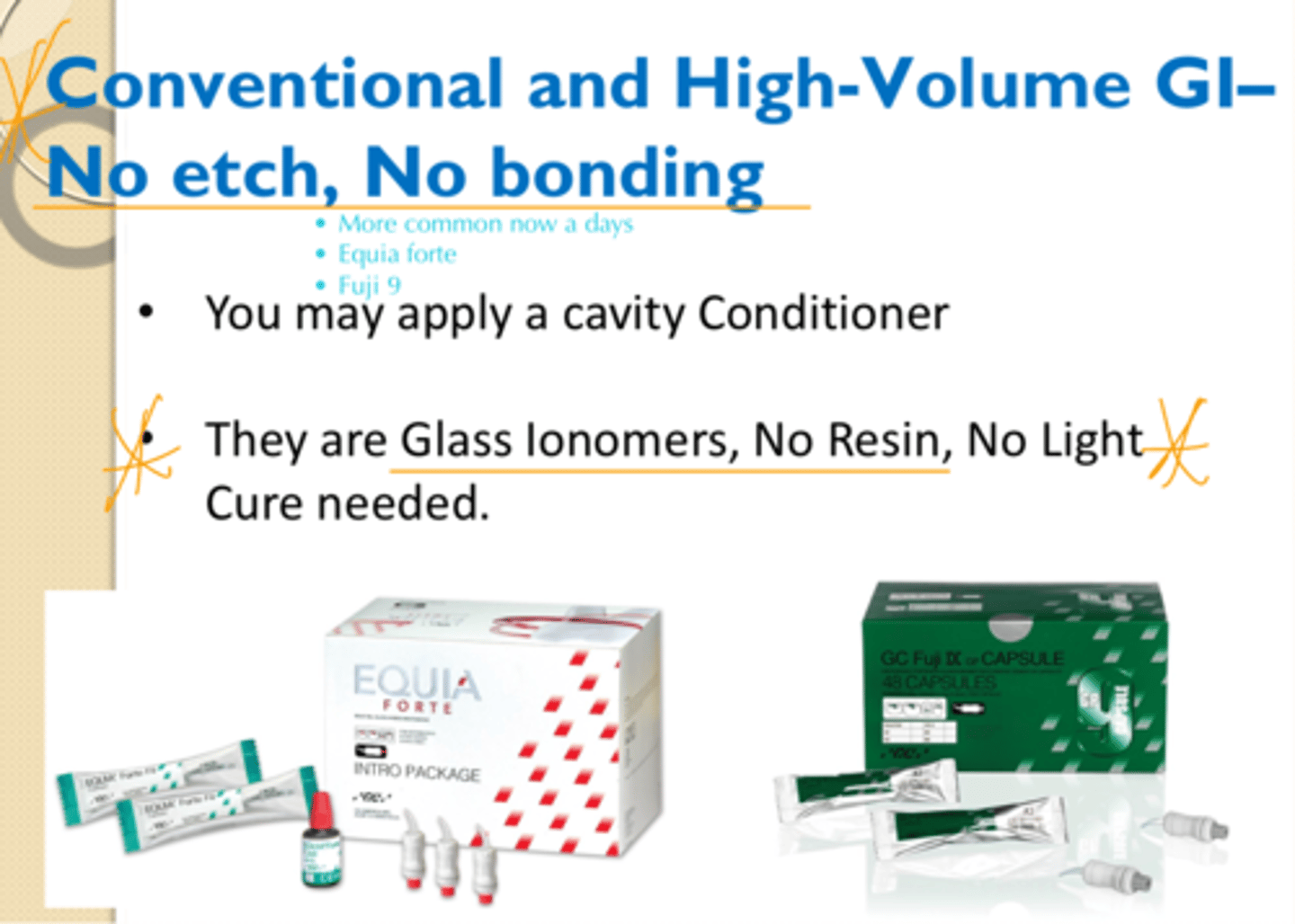
GI= No etch, bond OR light curing
Fuji II LC
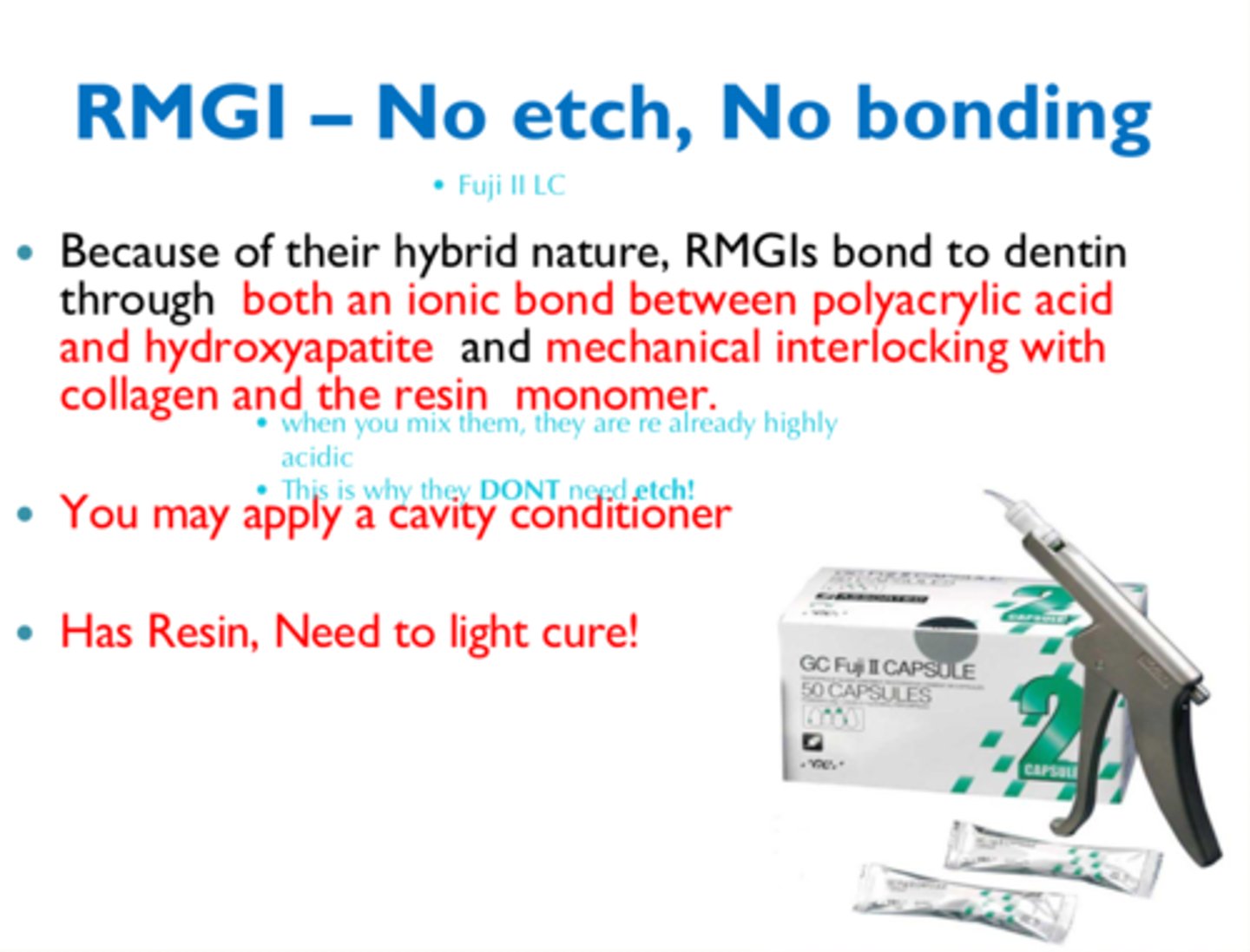
RMGI= NO etch, bone, YES light cure
List 4 Glass Ionomers
List 1 RMGI's
Fuji Triage (pink)
Fuji II
Fuji IX
Equia Forte
Ketac Fil
List 4 Glass Ionomers
- Release the MOST Fluoride
- Root caries/not moisture sensitive
- NO ETCH
- NO BOND
- NO LIGHT CURE (no resin)
- NEED CAVITY/DENTIN CONDITIONER
- Cavity conditioner= 10s
- Dentin condiitoner= 20s
Fuji II LC
List 1 RMGI's
- Release the MOST Fluoride
- Root caries/not moisture sensitive
- NO ETCH
- NO BOND
- NO LIGHT CURE (no resin)
- NEED CAVITY/DENTIN CONDITIONER
- Cavity conditioner= 10s
- Dentin condiitoner= 20s
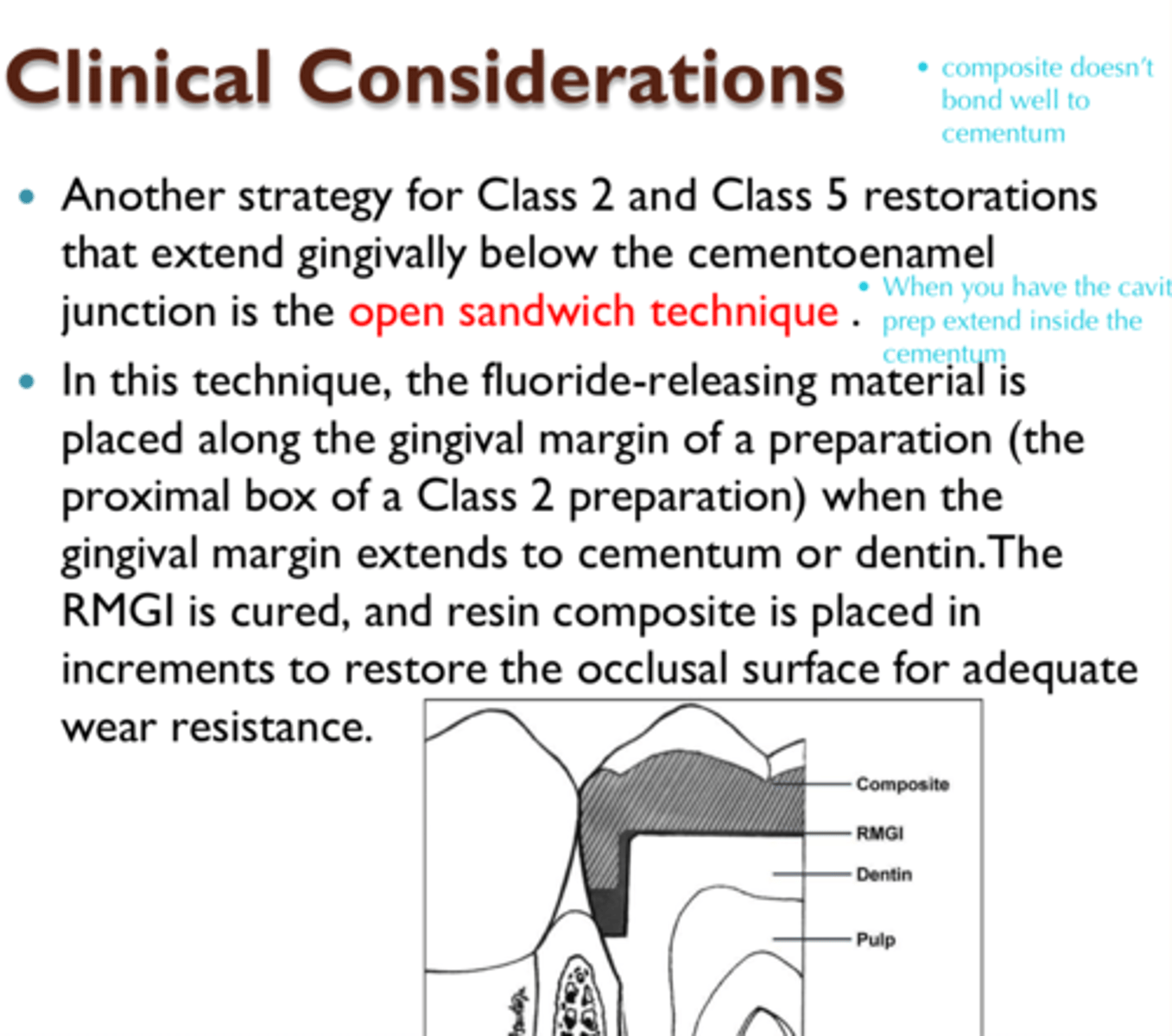
Review Open sandwich technique
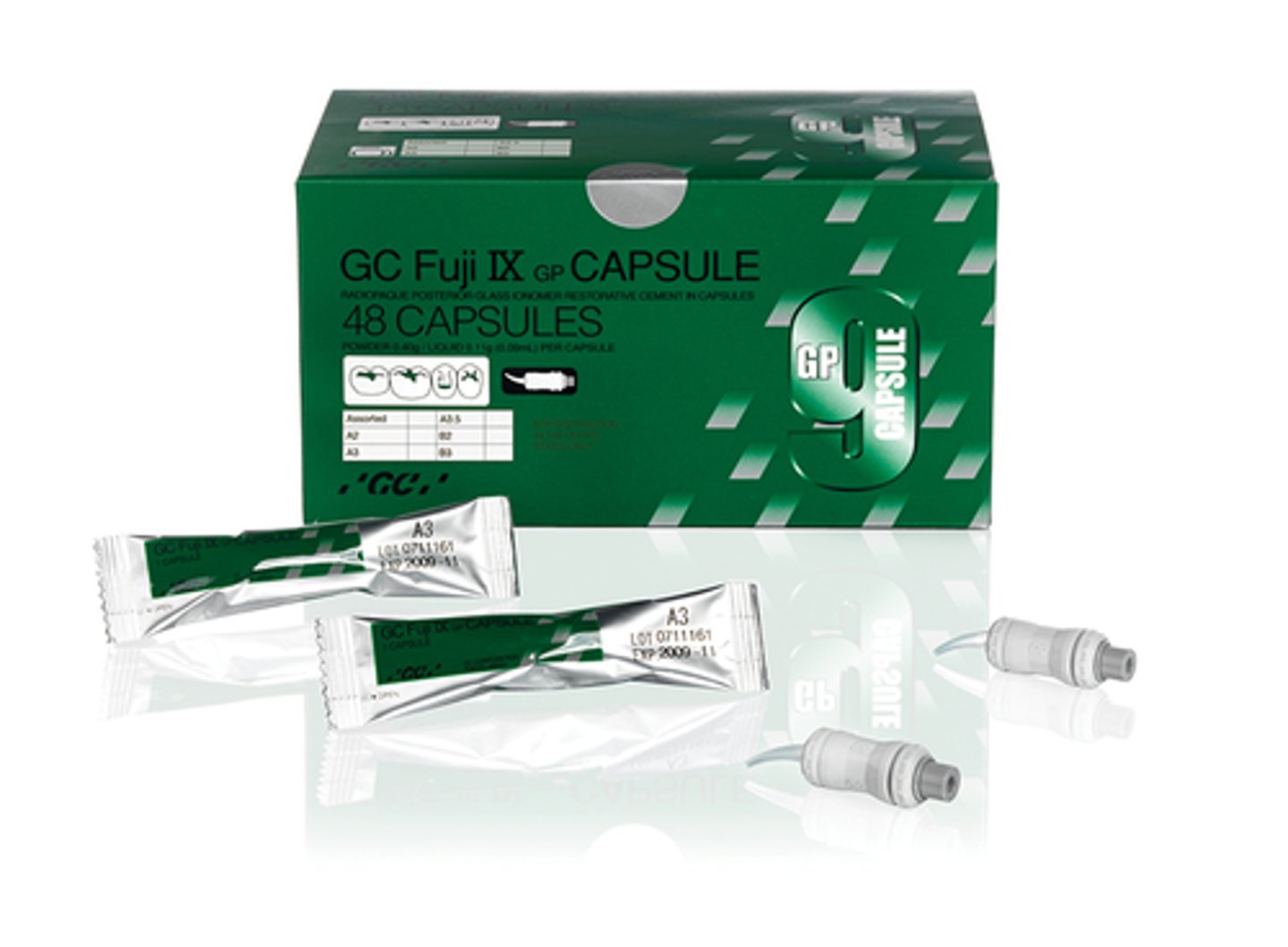
Fuji IX GI photo
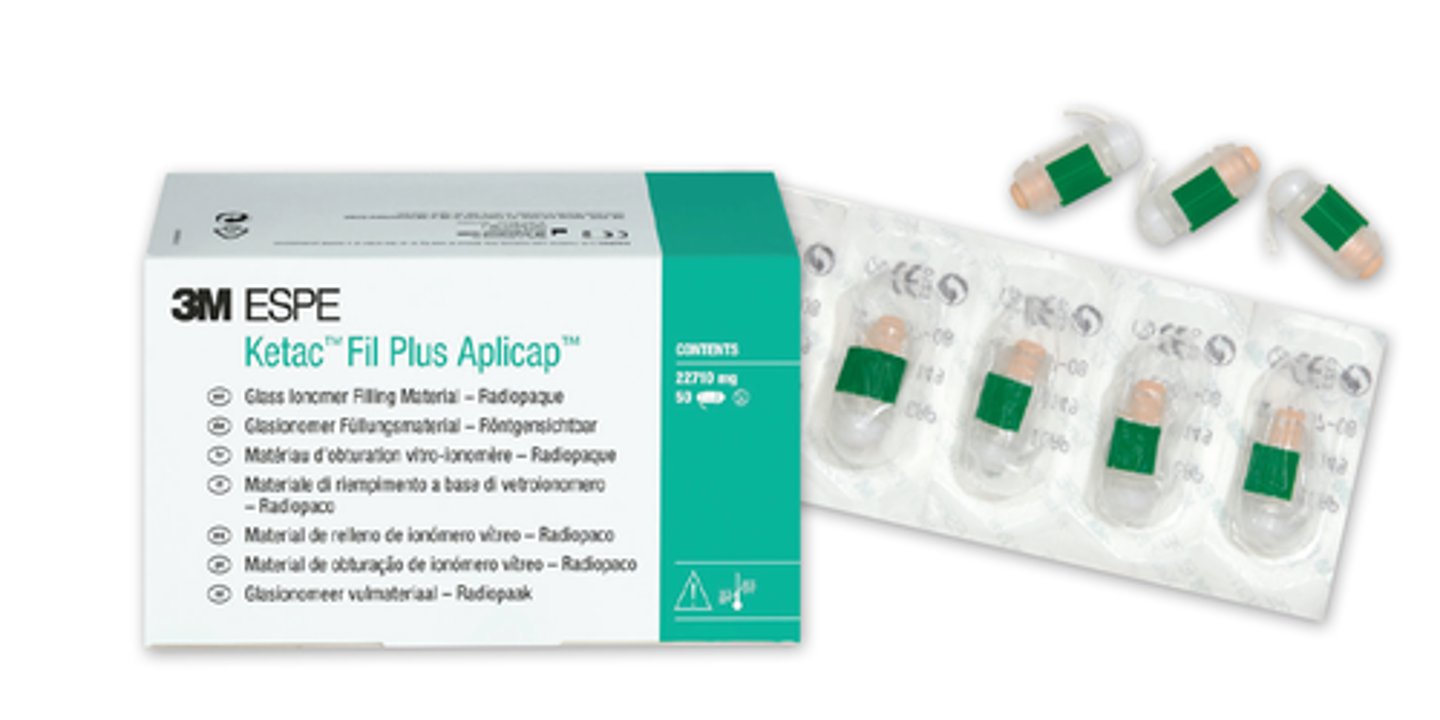
Ketac Fil GI photo
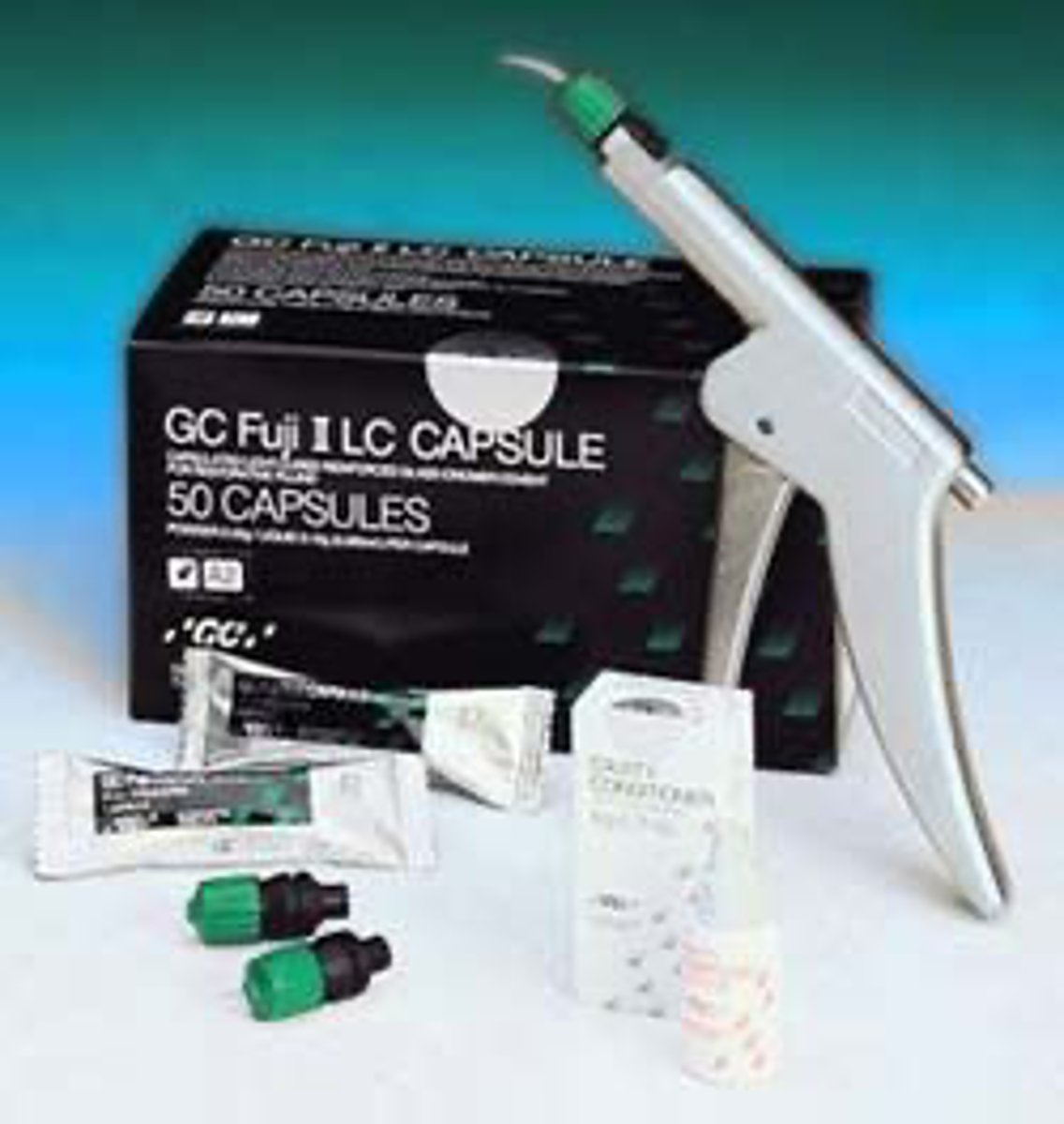
Fuji II LC RMGI photo
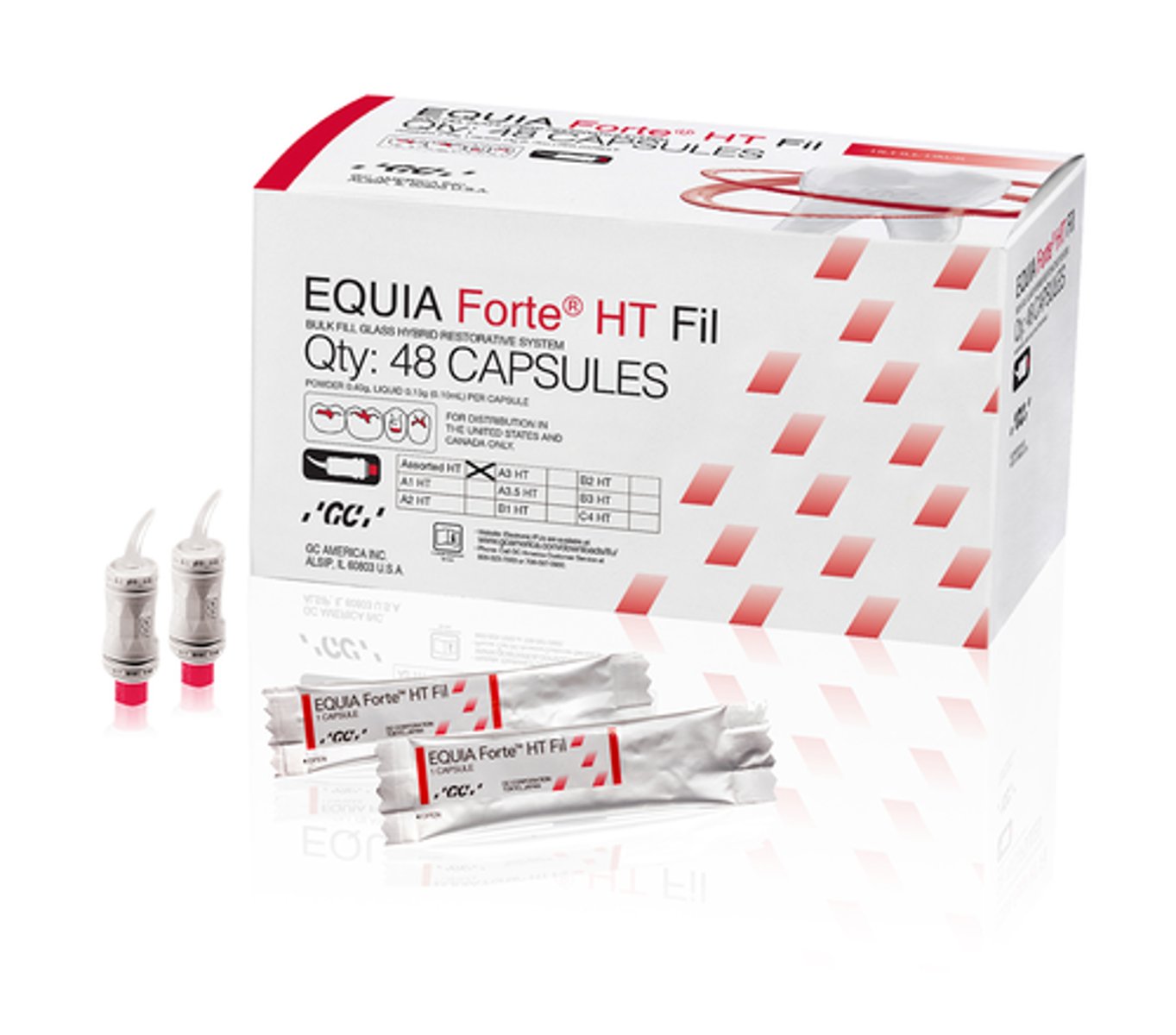
Equire Forte RMGI photo
Glass Ionomers
Fuji II
Fuji IX
Equia forte
Ketac Fil
Ketac Molar
Indications
● Closed/open sandwich technique with flowable/composite above it
● Lining class II amalgam
● Preventative restoration
● Atraumatic restorative treatment (ART)
● High caries risk
● Class III or class IV
● Cores or buildups when >1⁄2 tooth remains
● Root surface caries where ideal isolation cannot be obtained
Contraindications
● Anterior restorations (esthetics), high occlusal loading area
Advantages
● No etch/bond
● Less polymerization shrinkage stress
● Coefficient of thermal expansion similar to enamel/dentin
● Fluoride release- antimicrobial, more than RMGI fluoride
● Easy to use/manipulate
● More working time than RMGI
● Can be recharged with more fluoride
Disadvantages
● Wear resistance inferior to composites
Ex:
Fuji II
Fuji IX
Ketac Fil
Ketac Molar
Resin Modified Glass Ionomer
Fuji II LC
Photac Fil
Indications
● High caries risk
● Class III or V
● Cores or buildups when >1⁄2 tooth remains
● ART
● Sealants (erupting teeth)
Contraindicaitons
● Same as GI, NOT to be used for pulp capping
Advantages
● Can be recharged with fluoride
● No etch/bond
● Less polymerization shrinkage stress
Disadvantages
● Wear resistance inferior to composites
Ex:
Equia Forte
Fuji II LC
Photac Fil
False
- NOT safe for pulp capping
- Equia= NOT safe either
T/F: RMGI's such as Fuji II LC can be used for Direct Pulp Capping.
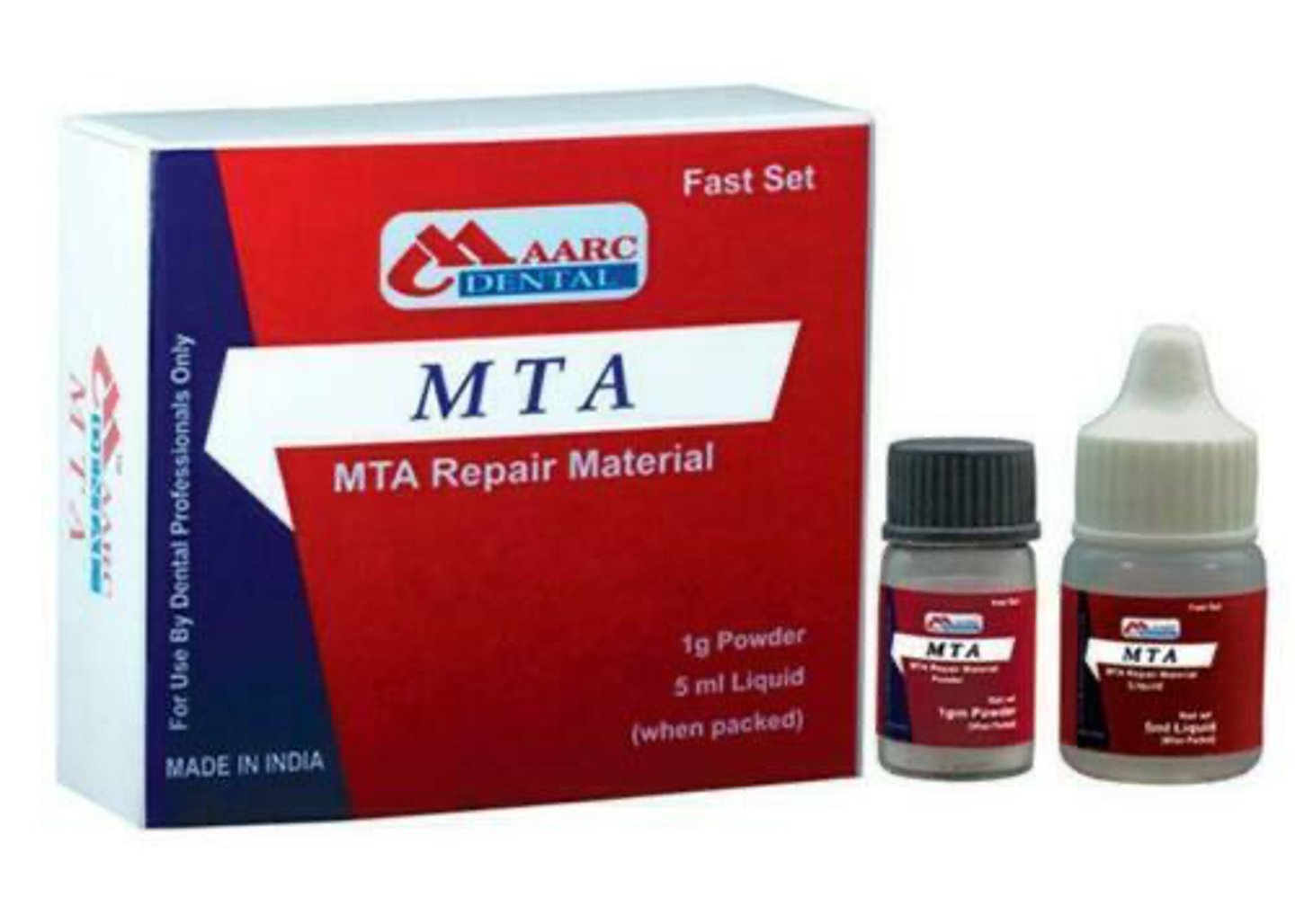
MTA
- Mineral Trioxide Aggregate
GOLD STANDARD material for Vital Pulp Therapy (Pulp Caps)
DIRECT PULP CAPS
MTA
Theracal (resin) or Vitrebond
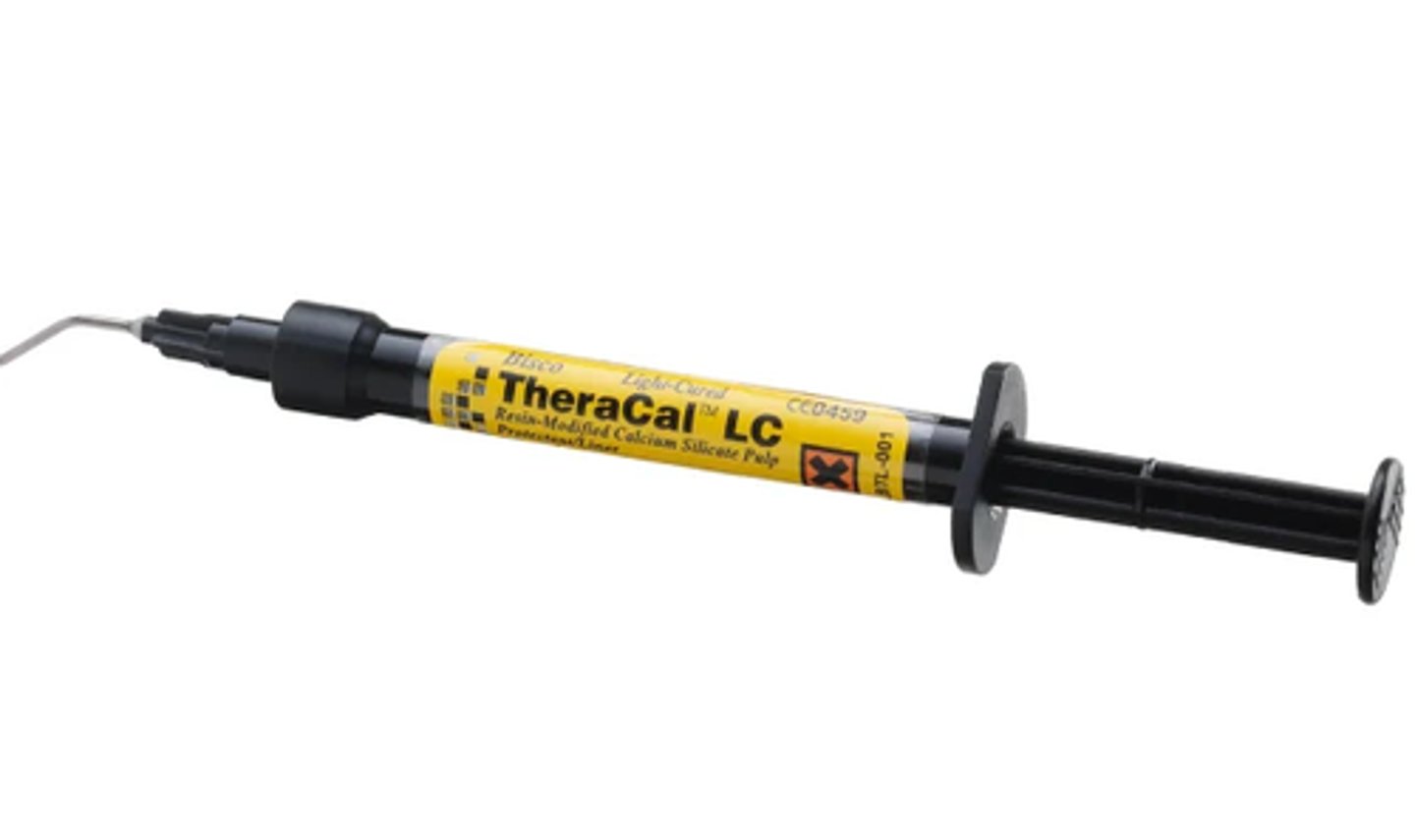
- TheraCal LC is a light-cured, resin-modified calcium silicate filled liner designed for use in direct and indirect pulp capping and as a protective liner under composite, amalgam or other restorations
Direct Pulp Cap=
Indirect Pulp Cap=
-know
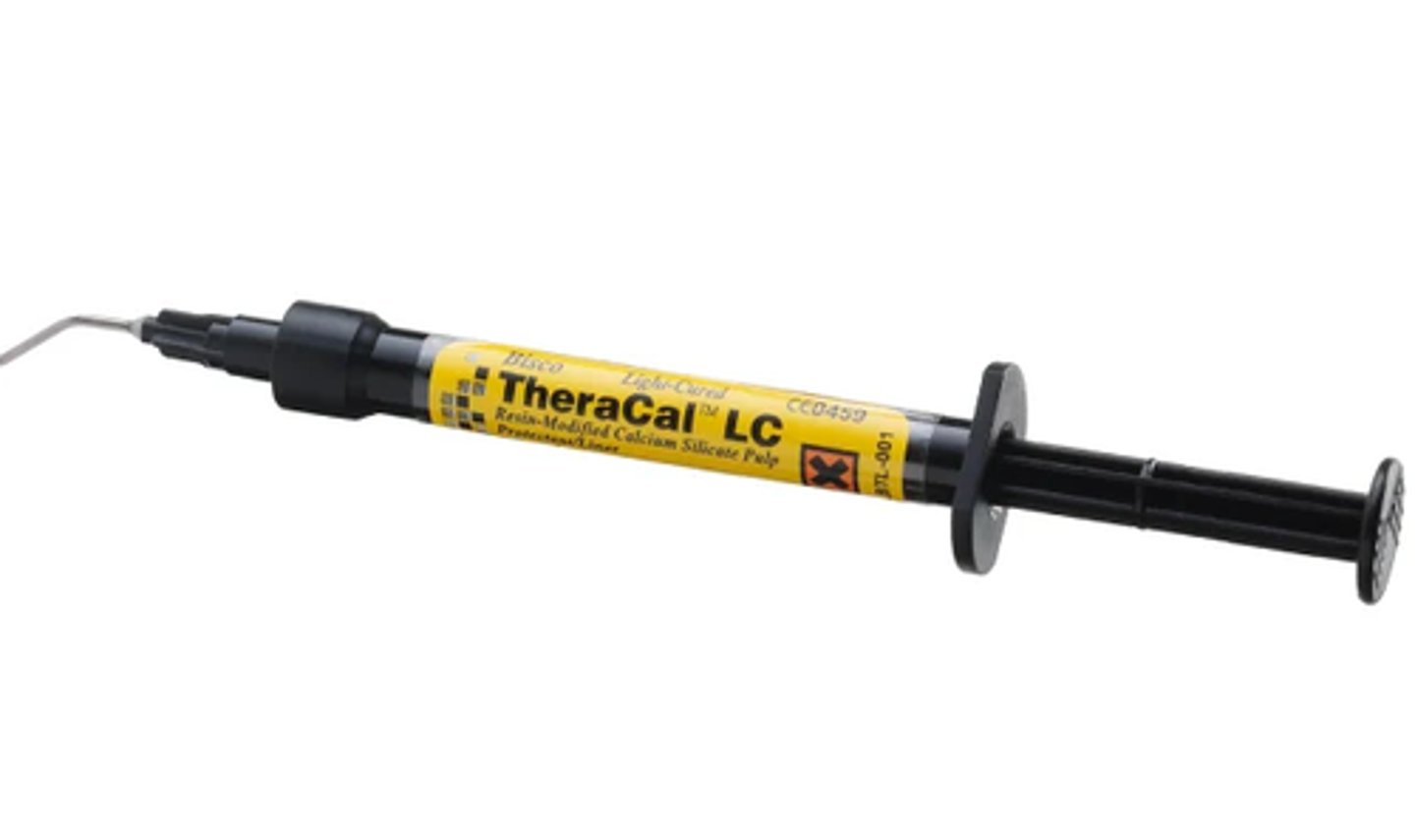
its a filler liner used for indirect pulp capping as a protective liner under composite, amalgam or other restorations
- direct pulp cap= MTA
What is Theracal used for?
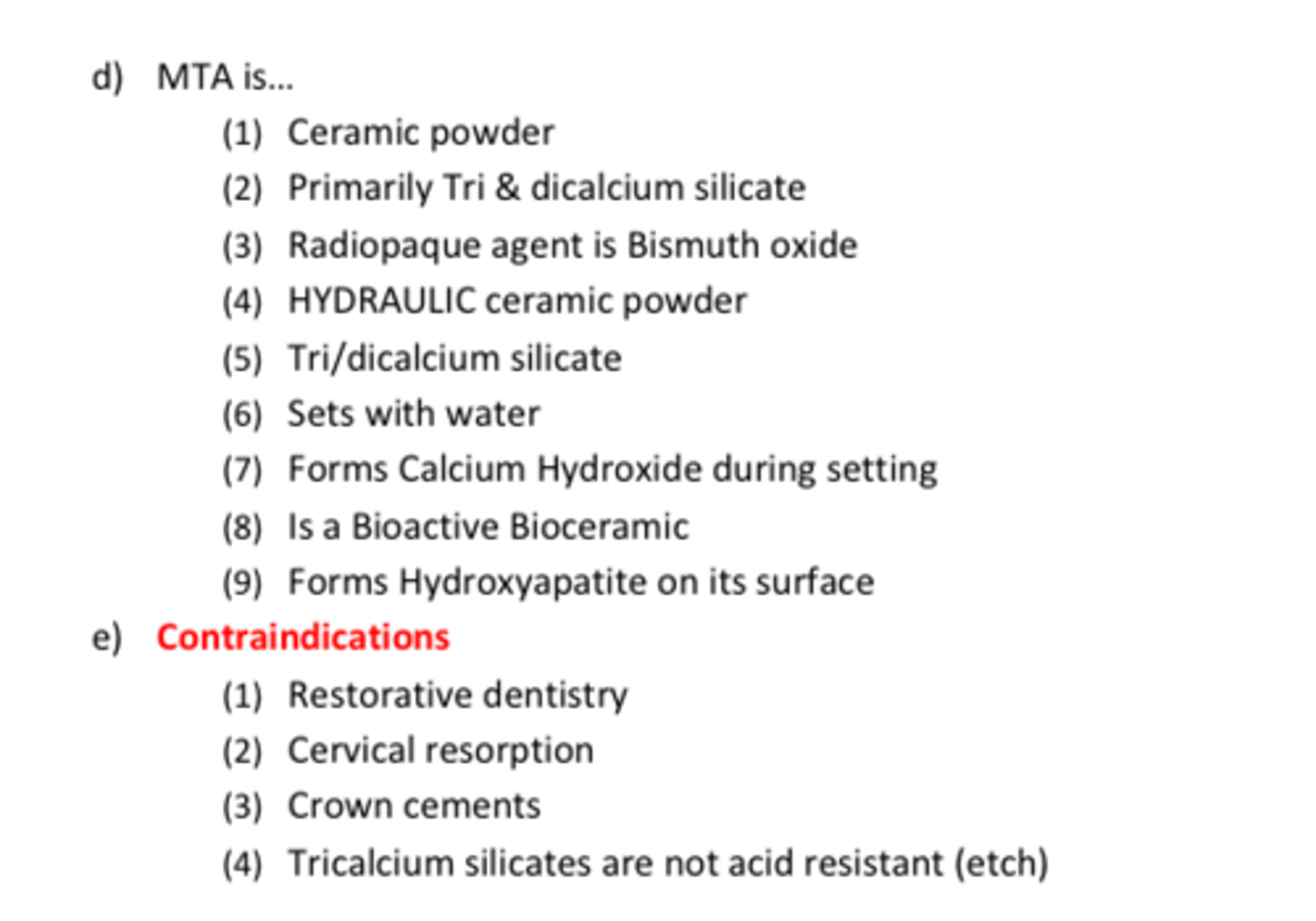
MTA (mineral trioxide aggregate)
_____ is superior to ZOE, calcium hydroxide & formocresol – MTA is the gold standard.
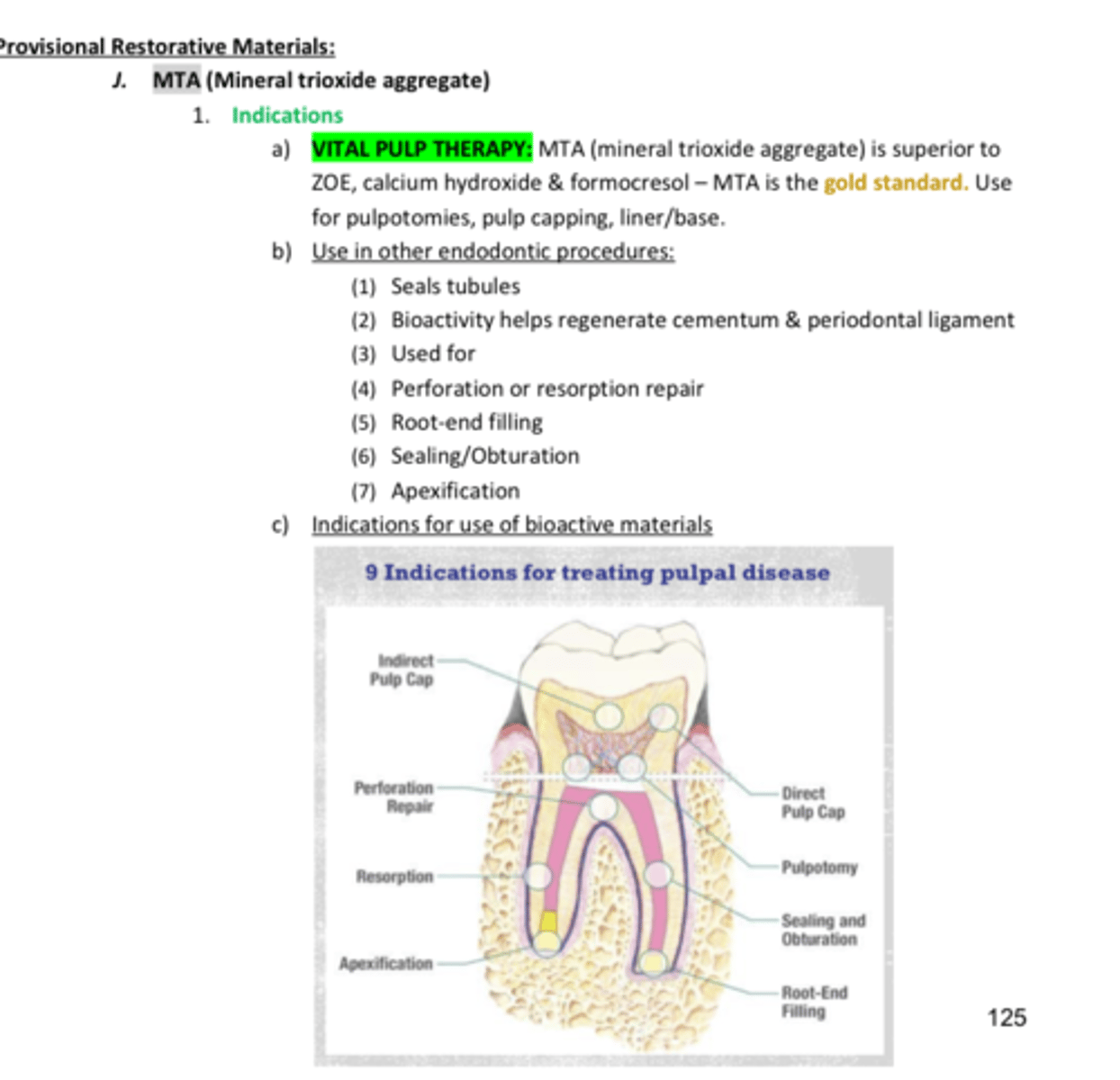
Use for pulpotomies, pulp capping, liner/base
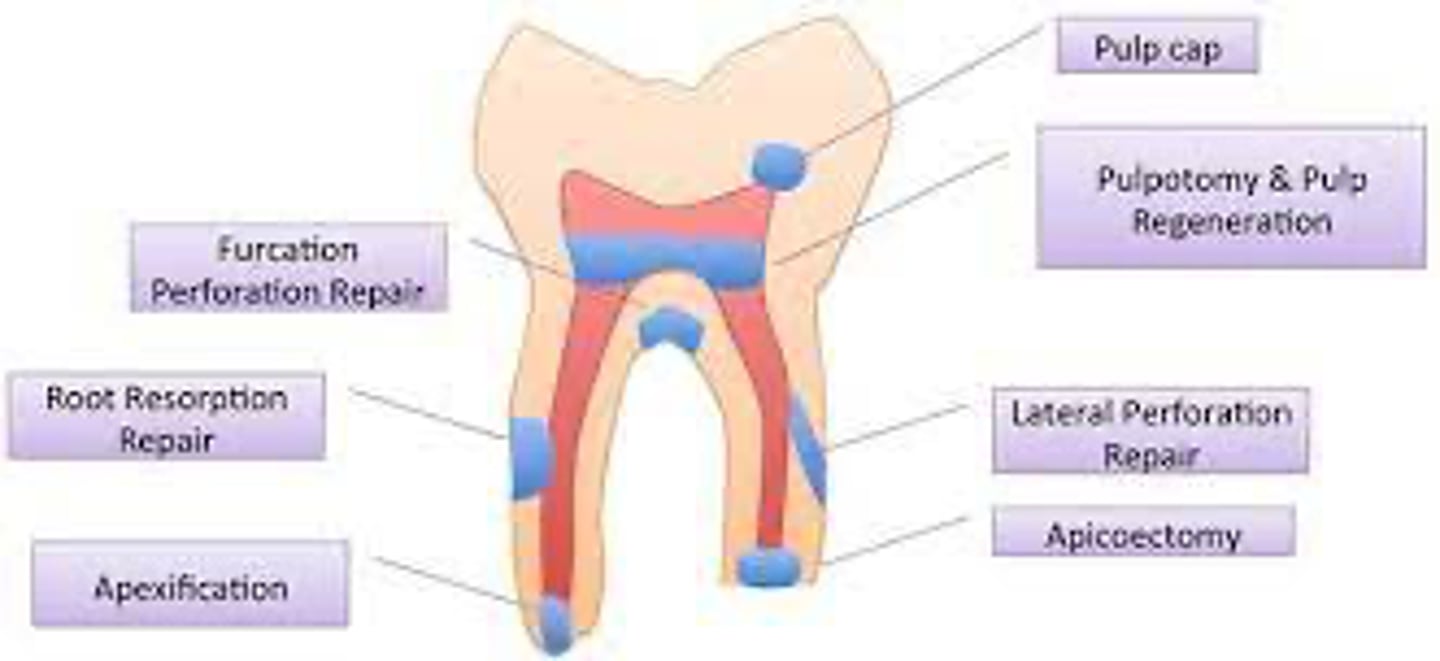
- review photo for other uses of MTA
MTA
Temporary
These are _____ restorative materials
IRM (Intermediate restorative material)
CAVIT
Fuji Triage (PINK)
Equia Forte Fil
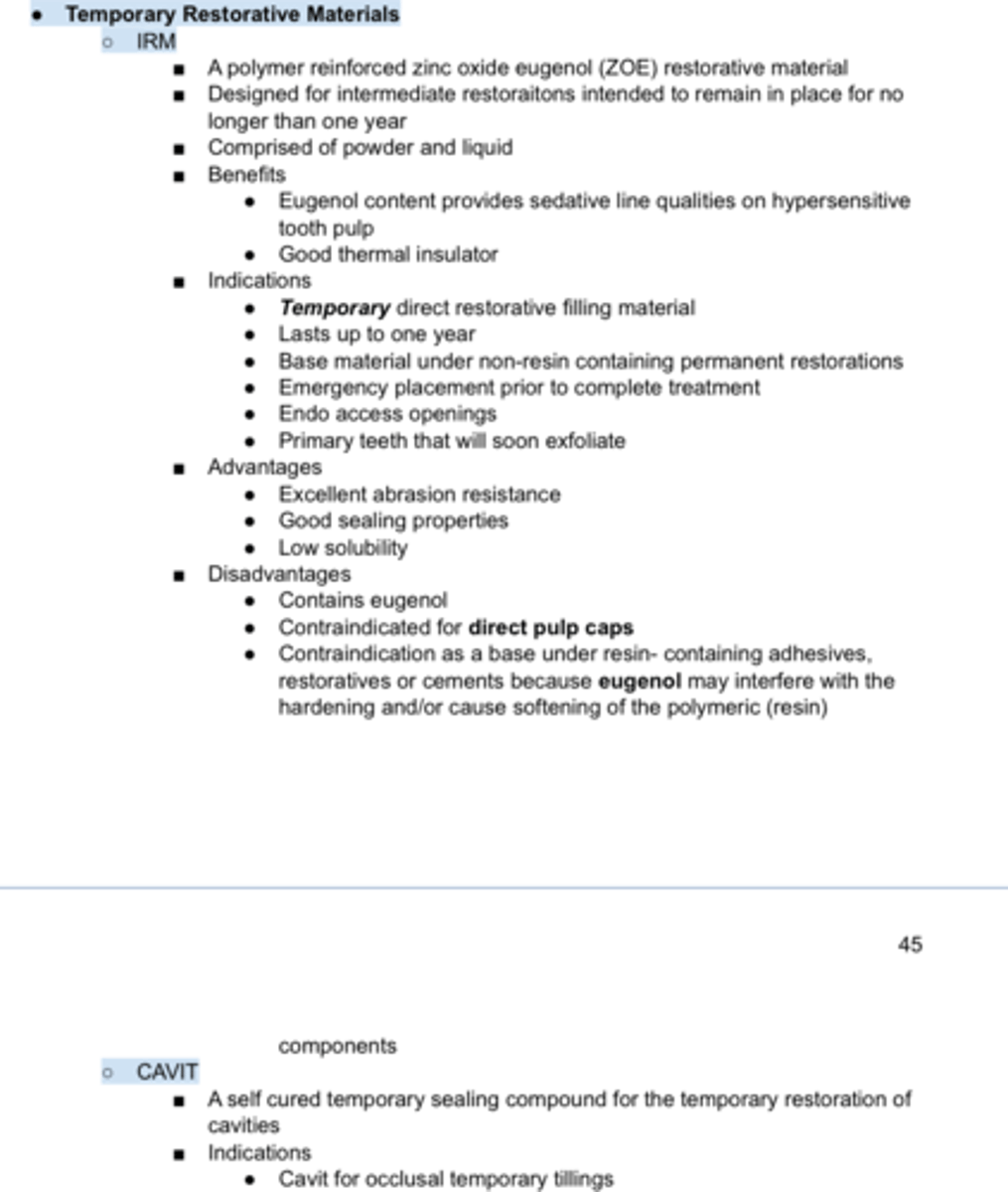
IRM (Intermediate restorative material)
- zinc oxide eugenol (ZOE) restorative material
- Designed for intermediate restoraitons intended to remain in place for no
longer than one year
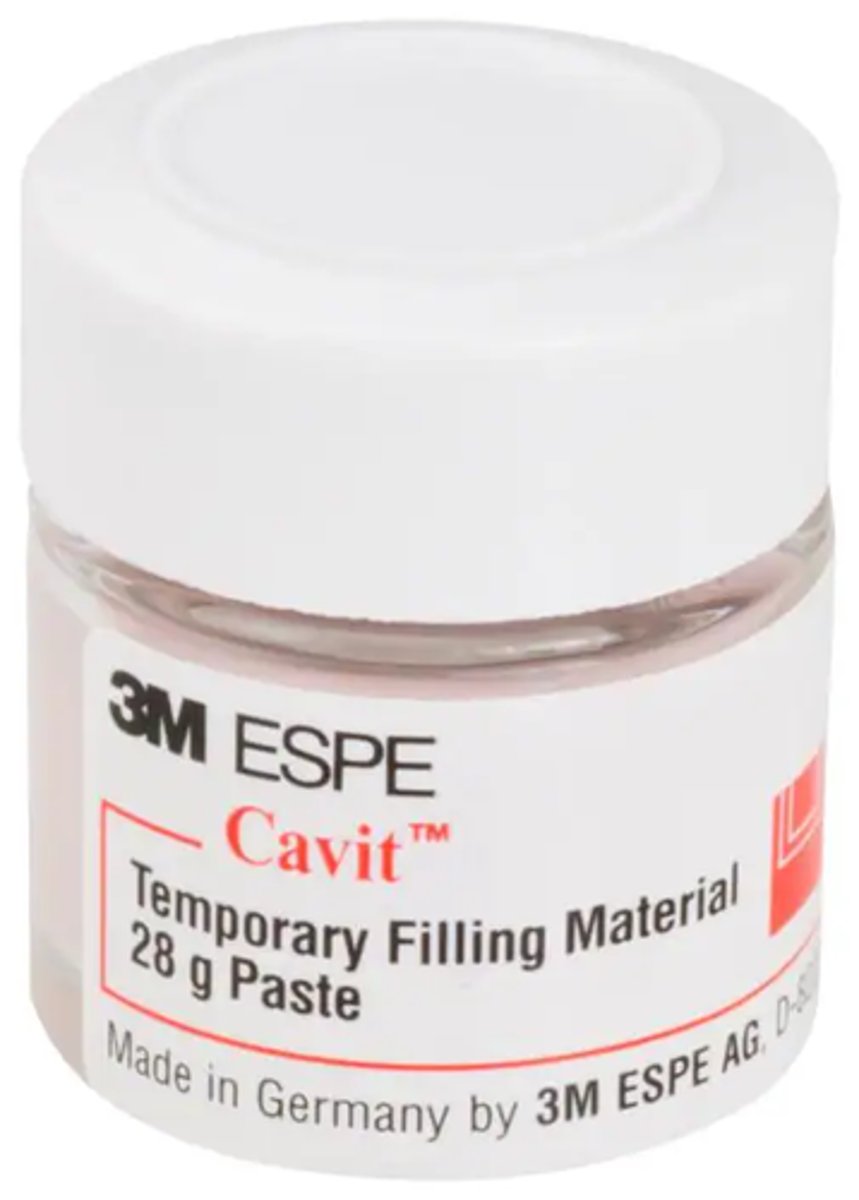
CAVIT
- A self cured temporary sealing compound for the temporary restoration of cavities
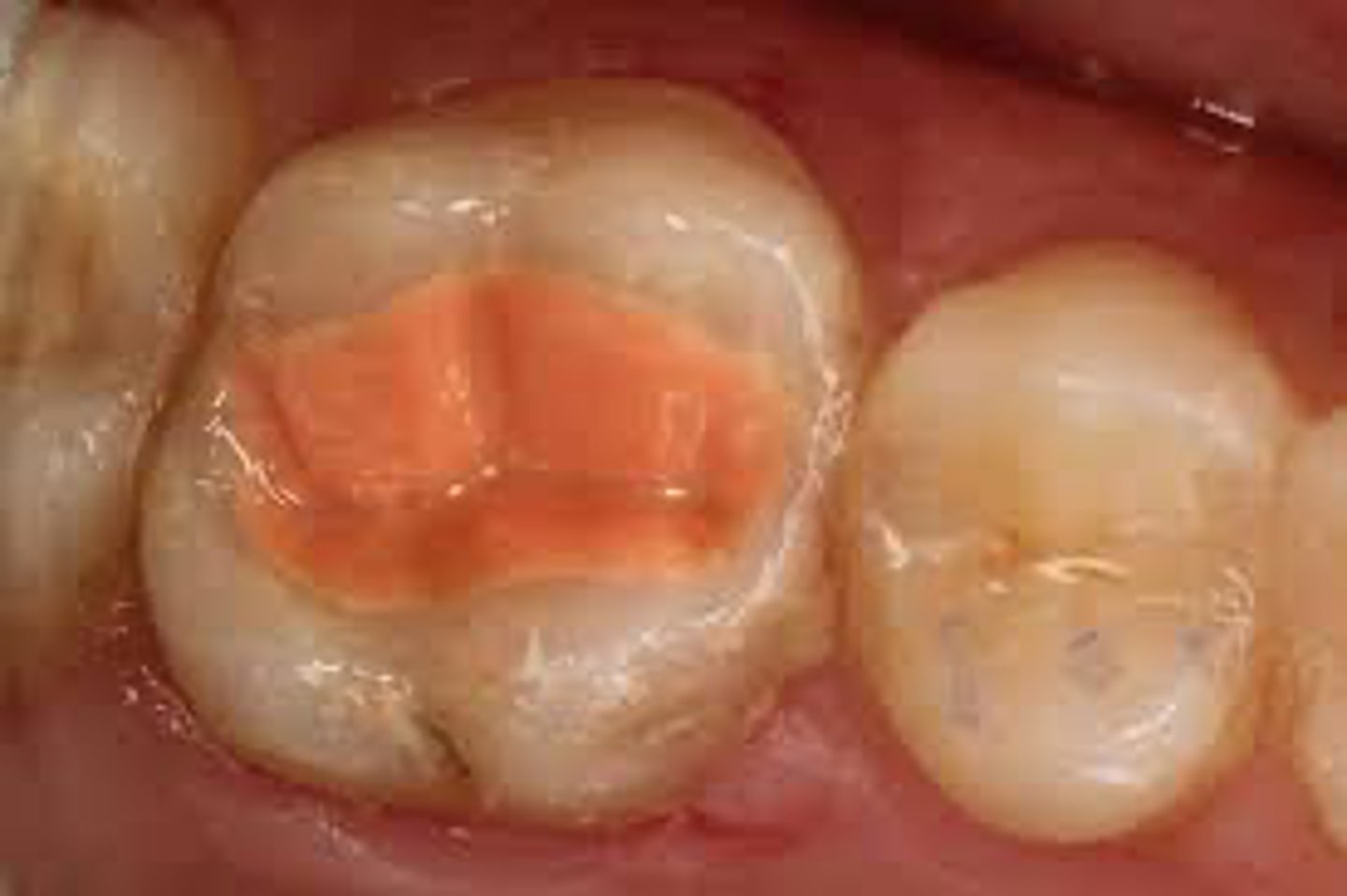
Fuji Triage (PINK)
- GI sealant that does NOT require isolation
- used as temp rest inbetween 2 endo appts!!
- NO ETCH or BONE
- NEEDS Cavity Conditioner
Equia Forte Fil
- RMGI that is very strong & also esthetic
- NO ETCH or BONE
- NEEDS Cavity Conditioner
Temporary Restorative materials:
IRM (Intermediate restorative material)
CAVIT
Fuji Triage (PINK)
Equia Forte Fil
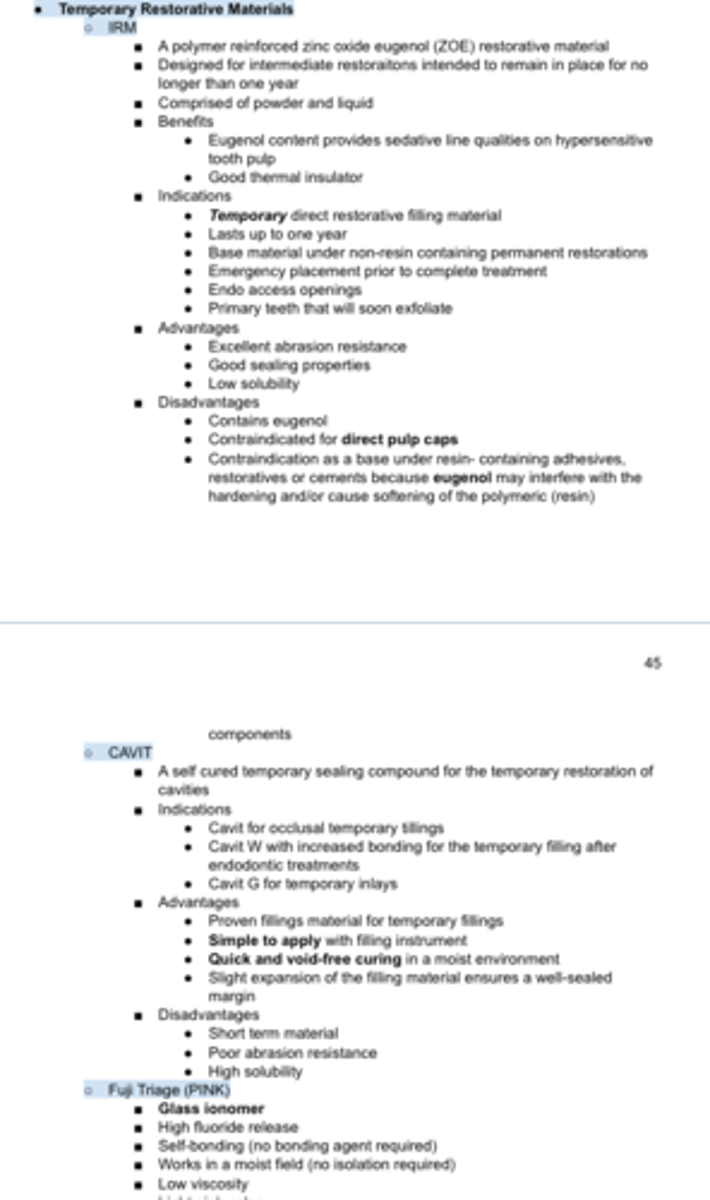
IRM (Intermediate restorative material)
CAVIT
Fuji Triage (PINK)
Equia Forte Fil
List 4 Temporary Restorative Materials
Ex:
Temporary filling
Endo btw appts
IRM
A polymer reinforced zinc oxide eugenol (ZOE) restorative material
Designed for intermediate restoraitons intended to remain in place for no longer than one year
Comprised of powder and liquid
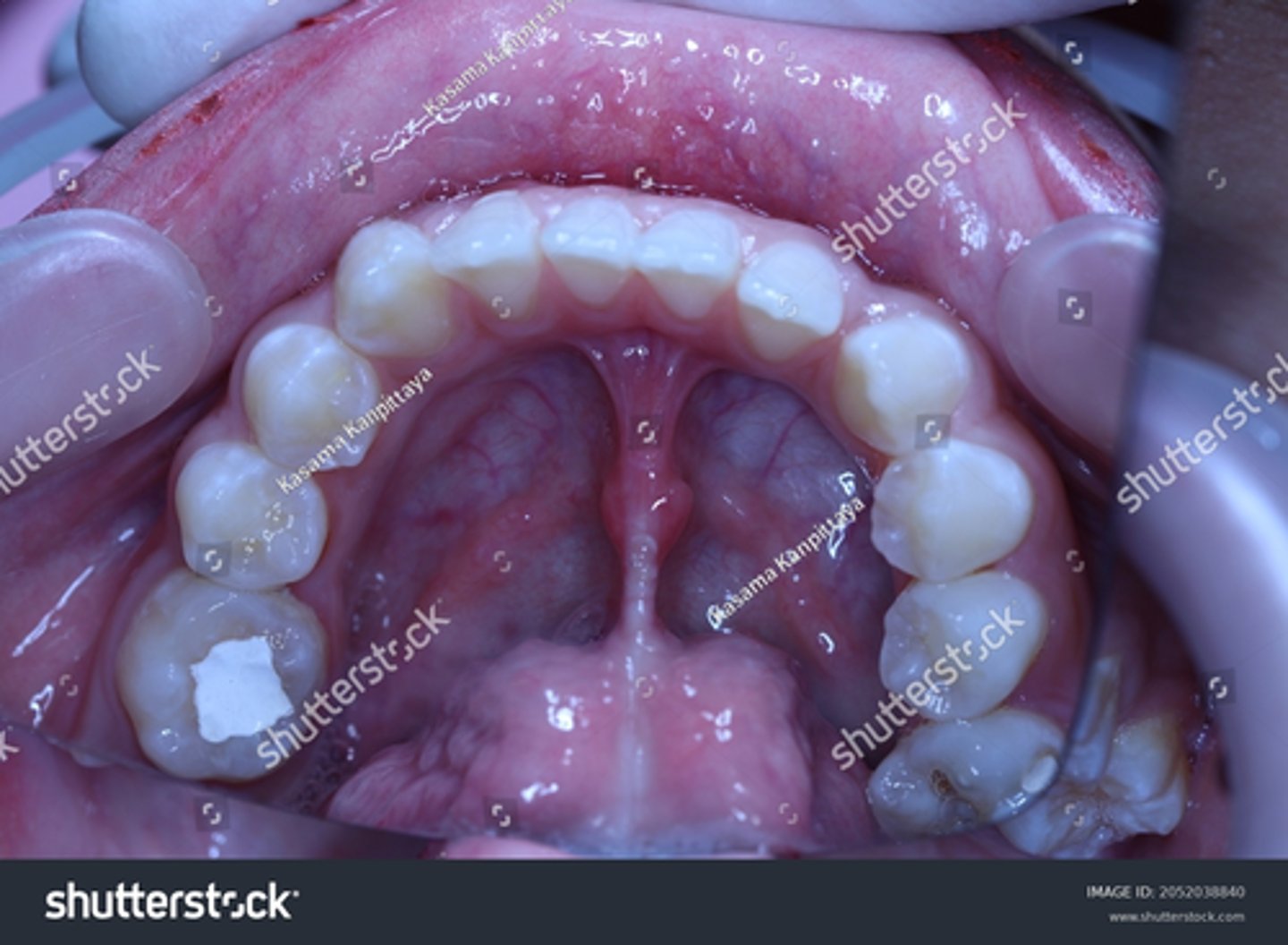
zinc oxide eugenol (ZOE)
- Only good for ONE year
IRM is made of _______
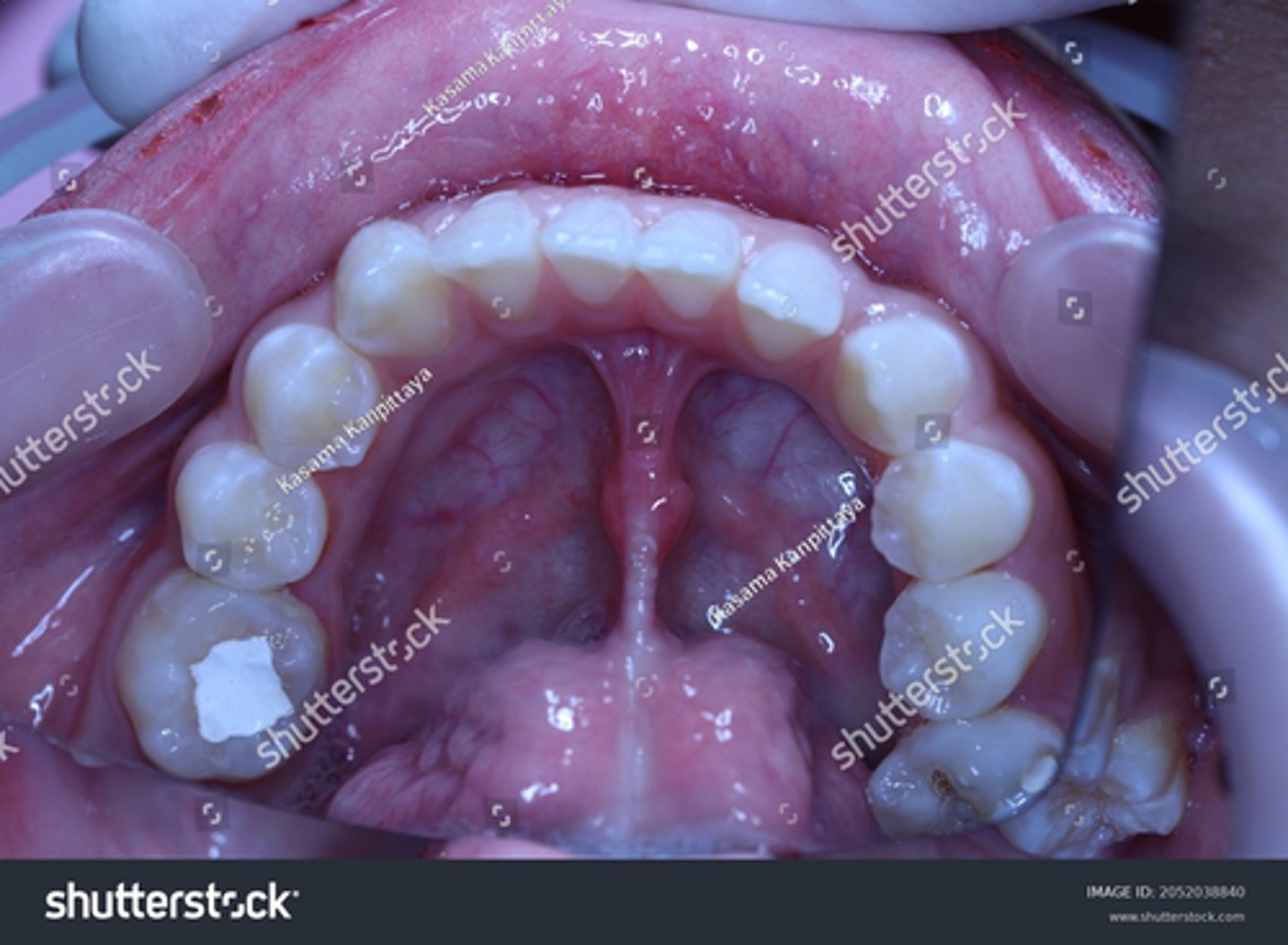
IRM
Benefits
● Eugenol content provides sedative line qualities on hypersensitive tooth pulp
● Good thermal insulator
Indications
● Temporary direct restorative filling material
(Lasts up to one year)
● Base material under NON-resin containing permanent restorations
(the eugenol interfered w resin bonding!!)
● Emergency placement prior to complete treatment
● Endo access openings
● Primary teeth that will soon exfoliate
Advantages
● Excellent abrasion resistance
● Good sealing properties
● Low solubility
Disadvantages
● Contains eugenol
● Contraindicated for direct pulp caps
● Contraindication as a base under resin- containing adhesives, restoratives or cements because eugenol may interfere with the hardening and/or cause softening of the polymeric (resin)
FALSE
- contains Eugeonl= therefore CANNOT be used under resin comp filings
- interferes w bonding & hardening
T/F: IRM does not contain Eugenol (sedative to the pulp) & therefore can be used under resin composite filings.
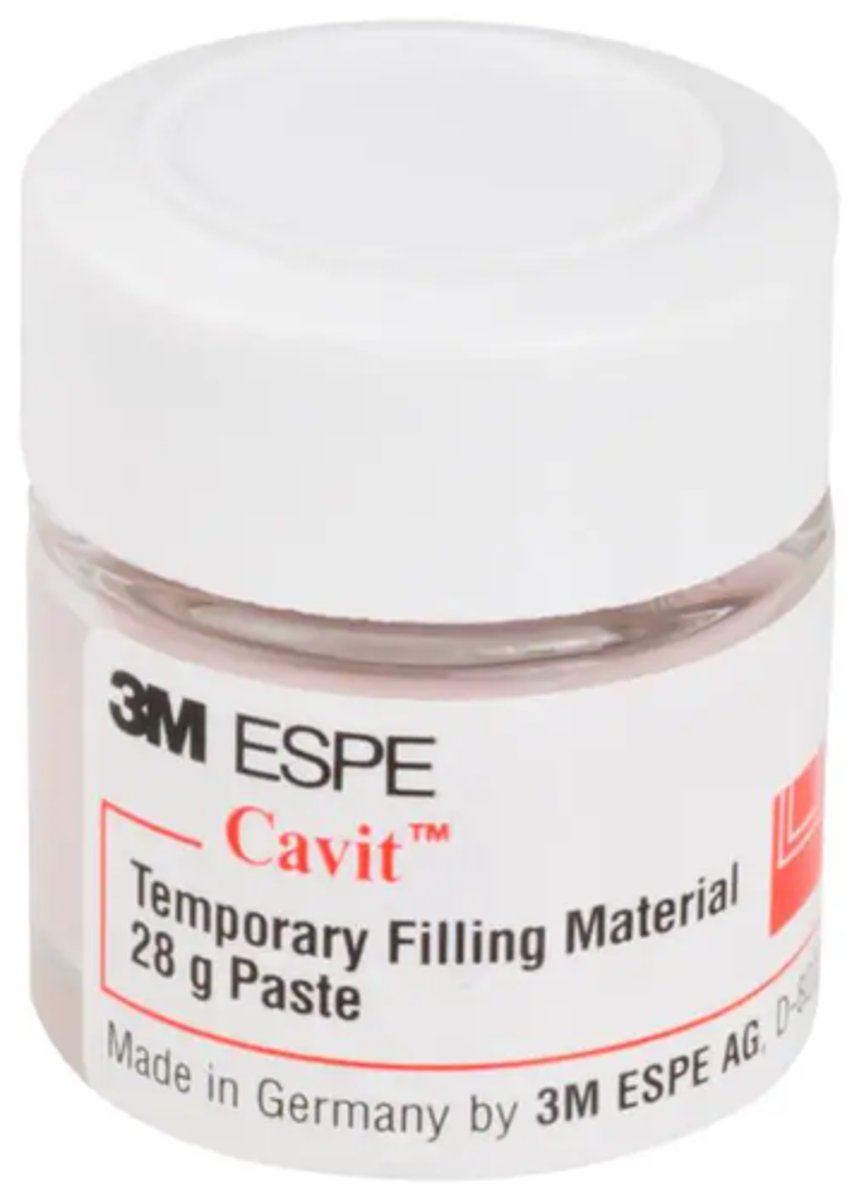
CAVIT
A self cured temporary sealing compound for the temporary restoration of cavities
CAVIT
Indications
● Cavit For occlusal temporary fillings
● Cavit W with increased bonding for the temporary filling after Endodontic treatments
● Cavit G for temporary inlays
Advantages
● Proven fillings material for temporary fillings
● Simple to apply with filling instrument
● Quick and void-free curing in a moist environment
● Slight expansion of the filling material ensures a well-sealed margin
Disadvantages
● Short term material
● Poor abrasion resistance
● High solubility
True!!!
T/F: The GI Fuji Triage (PINK) works well in a moist field & does NOT require isolation