Chapter 2 - Cells Make up the human body
 Studied by 0 people
 Call Kai
 Learn
Learn Practice Test
 Spaced Repetition
 Match
Match Flashcards
 Knowt Play
1/62

There's no tags or description
Looks like no tags are added yet.
Name | Mastery | Learn | Test | Matching | Spaced | Call with Kai |
|---|
No analytics yet
Send a link to your students to track their progress
63 Terms
Cells
This means that cells are the basic structural and functional units of all living organisms, including plants and animals
Cell theory
all organisms are made of cells, which are the basic unit of life and arise from pre-existing cells.
blood in an adult human
6000 mL
Cell Structure
Memorise
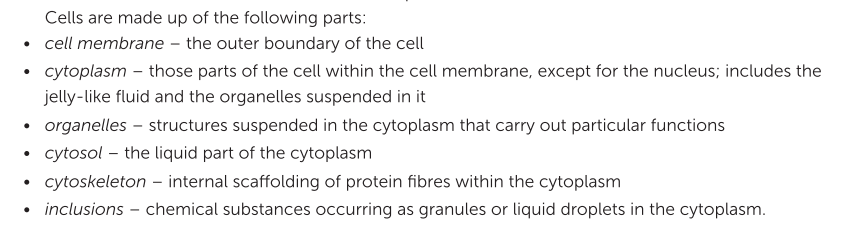
The cell membrane, or plasma membrane
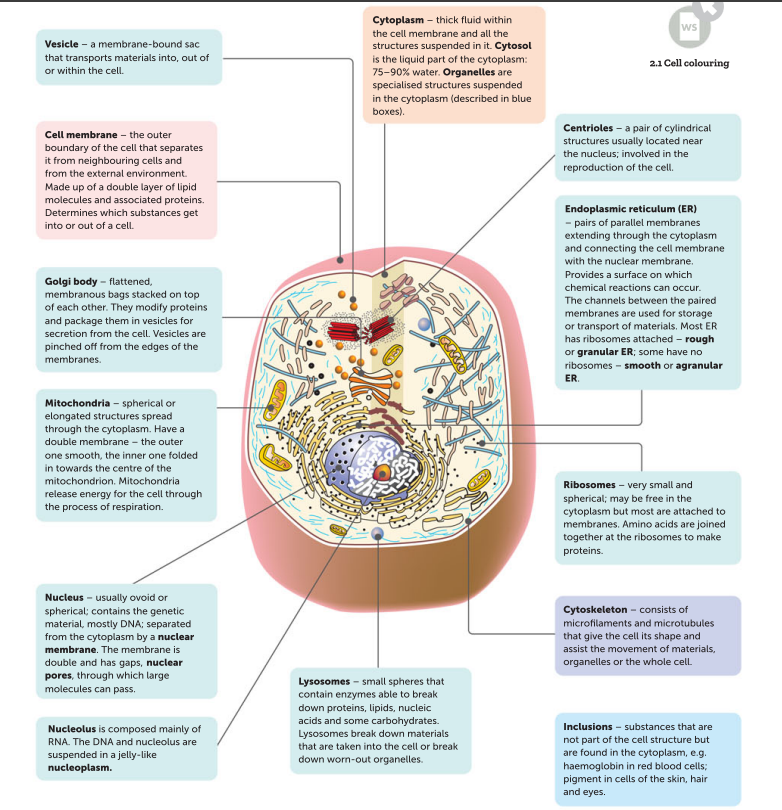
separates the cell contents from the environment outside the cell and from neighbouring cells. It encloses the contents of the cell and controls what is able to enter and leave
Cytoplasm
Cytoplasm is the jelly-like or watery material inside the cell that fills all the space between the nucleus and the cell membrane. It is made up of the cytosol and organelles.
Cytosol
The cytosol is the liquid part of the cytoplasm. It is 75% to 90% water, with a complex mixture of dissolved substances such as salts and carbohydrates. Other compounds, such as proteins and fats, do not dissolve but are suspended in the watery fluid. The cytosol is where most of the metabolic reactions occur. It also plays a role in controlling the osmotic pressure of the cell and the flow of chemicals into and out of the cell.
Organelles
The structures within a cell are called organelles. Different types of organelle are specialised for particular functions. Many of the organelles are formed by the cell’s internal membranes.
Liver cells
have two or more nuclei and mature red blood cells have no nucleus at all.
nuclear membrane
separates the nucleus from the cytoplasm. The nuclear membrane is actually a double membrane – two membranes separated by a space
nuclear pores
in the nuclear membrane allow large molecules, such as messenger RNA, to enter and leave the nucleus.
DNA
which contains inherited information
When the cell is not dividing
the DNA is in the form of long threads called chromatin. In a dividing cell, the threads thicken and coil to form chromosomes
DNA, controls the
structure of the cell and the way it functions.
nucleolus
plays a part in manufacturing proteins.
Ribosomes
Ribosomes are very small, spherical organelles. At the ribosomes, amino acids are joined together to make proteins. Ribosomes may be either free in the cytoplasm or attached to membranes within the cells such as the endoplasmic reticulum.
Endoplasmic reticulum
Pairs of parallel membranes extend through the cytoplasm of the cell from the cell membrane to the nuclear membrane. The network of channels formed by the parallel membranes is called the endoplasmic reticulum, or ER. It is thought that the membranes of the endoplasmic reticulum provide a surface for chemical reactions, while the channels are for storing or transporting molecules.
rough endoplasmic reticulum,
when ribosomes are attached to the outside of some membranes
smooth endoplasmic reticulum
when there are no ribosomes attached to the outside. a
Golgi body
The Golgi body (sometimes called the Golgi apparatus) is a series of flattened membranes stacked one upon the other. Usually the Golgi body is positioned near the nucleus. Its function is to modify proteins and to package them for secretion from the cell. Proteins produced at the ribosomes pass through the channels of the endoplasmic reticulum to the Golgi body.
Vesicles
At the edges of the membranes of the Golgi body, small sacs of liquid containing proteins are formed. These sacs are surrounded by a membrane and are called vesicles.
Lysosomes
are small spheres, bound by a membrane, that are formed from the Golgi body. They contain digestive enzymes that are able to break down large molecules. When particles, or liquids, are taken into a cell they form vesicles in the cytoplasm. Lysosomes can join with these vesicles, and the digestive enzymes they contain break down the material inside the vesicle. Lysosomes also digest worn-out organelles in a similar way.
Cilia and flagella
If the projections are short and numerous, resembling tiny hairs, they are called cilia. If they are longer, and there is only one or two of them, they are called flagella. One place in which cilia occur is in the cells lining the trachea, where they move mucus and trapped particles towards the throat. In humans, only one type of cell – the sperm cell – has a flagellum; this enables the sperm to swim to the egg.
Cytoskeleton

Inclusions
are chemical substances that are not part of the cell structure but are found in the cytoplasm of the cell. Examples of inclusions include haemoglobin, the red pigment in red blood cells, and the pigment melanin in cells of the skin, hair and iris of the eye.
CELL REQUIREMENTS
The immediate environment of a cell is the fluid that surrounds it; the tissue fluid or extracellular fluid. Even cells that appear to be very close together when observed under a microscope have a thin layer of fluid between them. This fluid allows a continual exchange of materials into and out of cells.
For cells to carry out their functions
cells need to take in certain substances from the tissue fluid. As they process these substances, they produce materials that must then be removed from the cell.
During cellular respiration,
During cellular respiration, glucose and oxygen are used to produce carbon dioxide, water and energy. Therefore, cells need to be supplied with oxygen and glucose, while carbon dioxide and water are removed
WHat happens to cells created for elsewhere
Many cells also produce substances that will be used elsewhere in the body, such as hormones and enzymes. Other wastes, in addition to carbon dioxide, are also produced. All these products are released into the tissue fluid.
Structure and function of the cell membrane
Each cell is surrounded by a cell membrane that separates the internal and external environment. Substances that enter or leave the cell must pass through this membrane; therefore, it is very important in determining which substances will get into or out of a cell.
Functions of the cell membrane
• It acts as a physical barrier. The membrane separates the cell cytoplasm from the extracellular fluid around the cell. Isolation of the cytoplasm from the surrounding fluid is important because their compositions are very different.
• It regulates the passage of materials. The membrane controls the movement of materials into and out of the cell – for example, the entry of ions and nutrients, the removal of wastes and the release of secretions.
• It is sensitive to changes. The cell membrane is the first part of the cell affected by any changes in the extracellular fluid. It also has receptors that are sensitive to particular molecules in its immediate environment.
• It helps support the cell. The internal part of the cell membrane is attached to the microfilaments of the cell’s cytoskeleton (see Figure 2.2 on page 27), thus giving support to the whole cell. There are also connections between the membranes of adjacent cells, providing support to the whole tissue.
Passive processes
do not use energy, whereas active processes use the cell’s energy in the form of adenosine triphosphate (ATP).
Three basic processes result in transport of materials into or out of a cell:
• Simple diffusion – a passive process resulting from the random movement of ions and molecules; osmosis (also a passive process) is a special case of diffusion where water passes across the membrane.
• Facilitated transport – a process that requires special proteins in the cell membrane, either channel proteins or carrier proteins; it may be passive transport or active transport, depending on the exact nature of the mechanism.
• Vesicular transport – an active process in which materials are moved in membrane-bound sacs.
Simple diffusion
Diffusion is the spreading out of particles so that they are evenly distributed over the space available. It occurs in gases and liquids because the molecules of gases and liquids are constantly moving. They move in random directions and in straight lines until they hit another molecule or the wall of the container. A deflected molecule then continues in a straight line until it hits another obstacle. Molecules moving away from an area in which they are concentrated experience fewer collisions than those moving towards the area of higher concentration. They therefore stay on their straight paths longer and move out into areas where the concentration of those molecules is lower. In this way, the molecules become evenly spread over the space available. The random movement of molecules continues, but the chances of collision are the same in whatever direction the molecule is travelling. Figure 2.13 shows how a sugar cube dissolves in water and how the molecules of sugar spread out until they are evenly spread throughout the water. As the sugar dissolves, the sugar molecules near the cube are more concentrated than those near the surface of the water. The difference in concentration that brings about diffusion is called a concentration gradient, or diffusion gradient (Figure 2.14). The greater the difference in concentrations, the ‘steeper’ the diffusion gradient and the faster the rate of diffusion
Embedded in the phospholipid
Embedded in the phospholipid bilayer of the membrane are cholesterol and protein molecules. The cholesterol molecules are wedged between the phospholipids. These molecules are important for the function integrity and stability of the membrane. Cell membranes have a variety of protein molecules, including receptor proteins, channel proteins, carrier proteins and cell-identity markers. Some of these molecules extend from one side of the membrane to the other, while others are bound to the membrane surface. Only about 2% of the molecules in the membrane are proteins, yet they make up about 55% of the mass of the membrane. This is because proteins are very large molecules.
net diffusion
The movement of liquid or gas molecules from places of higher concentration to places of lower concentration, along a concentration gradient, is more correctly called net diffusion.
This type of diffusion is referred to as simple diffusion.
• Oxygen diffuses into cells because it is continually used up inside the cell for respiration. The concentration of oxygen inside the cell is therefore lower than the oxygen concentration outside the cell. Because of this concentration difference, there is net diffusion of oxygen into the cell. Diffusion Watch an animation of diffusion. Osmosis Watch an animation of osmosis.
• Carbon dioxide is continually produced inside the cell by respiration. The higher concentration of carbon dioxide inside the cell means that there will be net diffusion of carbon dioxide out of the cell.
Water-soluble substances are unable to pass directly through the lipid portion of the membrane and hence require other modes of transport that are discussed in the next section.
Osmosis
Osmosis is a special type of diffusion: the diffusion of a solvent through a differentially permeable membrane in order to balance the concentration of another substance. The water will move from an area where a solute such as sugar is in low concentration to an area where the solute is in high concentration
Facilitated transport
In facilitated transport, proteins in the cell membrane allow molecules to be transported across the membrane. These proteins are channel proteins, which form protein channels, and carrier proteins, which allow carrier-mediated transport.
Protein channels
To diffuse across a cell membrane, water-soluble molecules must pass through protein channels in the membrane, allowing facilitated diffusion. These channels provide a pathway for the hydrophilic particles to travel through to cross the cell membrane without coming in contact with the hydrophobic inner portion.
Carrier-mediated transport
carrier proteins are only open on one side of the membrane at a time. When the specific substance binds to the binding site within the protein, the protein changes shape and opens to the other side. The substance can then be released on the side opposite to where is entered
Some important characteristics of carrier-mediated transport are as follows:
The carrier proteins are specific; they will only bind to a particular molecule. For example, the carrier that transports glucose cannot transport any other molecules, even simple sugars that are very similar to glucose.
• Carriers can become saturated. Once all the available carriers are occupied, any increase in the concentration of molecules to be transported cannot increase the rate of movement.
• Carrier activity is regulated by substances such as hormones. Hormones are important in coordinating the activities of carrier proteins.
There are two main types of carrier-mediated transport.
1 Facilitated diffusion occurs when substances are transported through a protein along the concentration gradient, from a higher concentration on one side of the membrane to a lower concentration on the other. This is a passive process, as it does not require the input of energy. During carrier-mediated facilitated diffusion, the molecule to be transported, such as glucose, attaches to a binding site on the specific carrier protein. The protein changes shape and the molecule is released on the other side of the membrane.
2 Active transport requires energy in the form of ATP because substances are transported across the membrane against the concentration gradient, from lower to higher concentration. The process of active transport is similar to that of facilitated diffusion via carrier proteins, but its big advantage is that it does not depend on a concentration gradient. Using active transport, a cell can take in or pass out substances regardless of their concentrations inside or outside the cell.
Vesicular transport
Vesicular transport is the movement of substances across the cell membrane in membranous sacs called vesicles. This is an active process, because energy from the cell is needed to form the vesicles
Endocytosis
is taking liquid or solids into the cell by vesicular transport. The cell membrane folds around a droplet of liquid or a solid particle until the droplet or particle is completely enclosed. The vesicle formed then pinches off and is suspended in the cell’s cytoplasm.
Taking liquids into the cell in this way is called
pinocytosis
phagocytosis
when the vesicles contain solid particles it is called
Exocytosis
is when the contents of a vesicle inside the cell are passed to the outside. A vesicle that is formed inside the cell migrates to the cell membrane and fuses with the membrane. The contents of the vesicle are then pushed out into the extracellular fluid.
diffusion
is the spreading of particles so that they are evenly distributed over the space available. Thus, as molecules of a substance are used up in one part of the cell, other molecules will spread to take their place.
Microtubules
are very fine tubes that help to maintain the shape of the cell and to hold the organelles in place. They also act like railway tracks, guiding organelles or molecules to particular places within the cell. Microtubules are not permanent structures but are able to be broken down or built up as needed in the various parts of the cell.
Why are cells so small?
All the requirements and products of a cell must pass across the membrane that surrounds the cell. Thus, the relationship between the surface area of the cell and the volume is very important.
HOW CELLS MAKE A BODY
The body is organised on four structural levels.
1 Cells, the lowest structural level, are specialised to carry out different functions. Muscle cells are able to shorten in length; red blood cells are able to transport oxygen; cells of mucous membranes secrete mucus; and so on.
2 Cells with similar specialisations that carry out a common function are grouped together into tissues. For example, groups of muscle cells make up muscle tissue, groups of nerve cells make up nervous tissue, and groups of bone cells form bone.
3 Different types of tissues work together as organs. An organ is normally made up of two or more tissues. The stomach is an organ with epithelial tissue on the inside and muscular tissue in the wall; the heart is an organ made up of muscular tissue and nervous tissue.
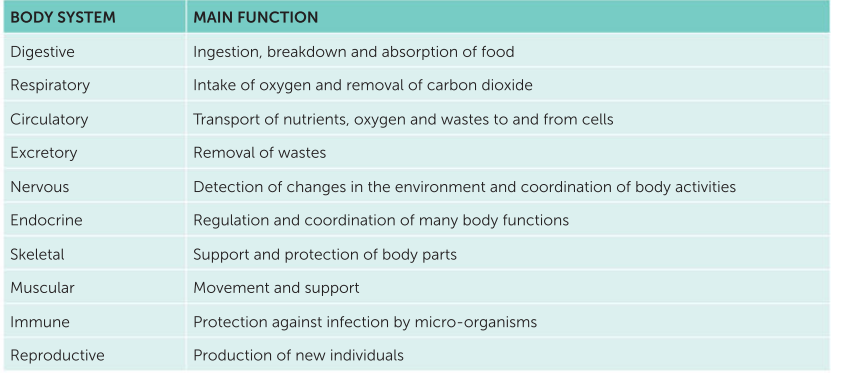
4 The highest level of organisation is the system. A system is a group of organs that work together for a common purpose. For example, the respiratory system supplies oxygen and removes carbon dioxide from the blood. Some of the organs that make up the respiratory system are the lungs, diaphragm, intercostal muscles between the ribs, trachea, larynx and nose. The body systems are all integrated into the one living thing, the organism.
Skeletal muscle
makes up the muscles that are attached to bones. These are the muscles that you can feel in your arms and legs. We have voluntary control over these muscles so that we can move parts of our bodies when necessary. Under a microscope, skeletal muscle fibres are seen to have stripes, or striations, across them, so another name for this muscle is striated muscle.
Smooth muscle
It is found in the walls of the stomach and intestines, in the walls of blood vessels, in the iris of the eye, in the uterus and many other organs. We cannot contract smooth muscle voluntarily, and hence it may also be called involuntary muscle
Cardiac muscle
When heart muscle contracts, it pumps the blood. Heart muscle cannot be voluntarily controlled.
Nervous tissue
Nervous tissue is made up of specialised nerve cells that are called neurons. Neurons have long projections from the body of the cell. When part of a neuron is stimulated, messages can be carried along these projections from one part of the body to another. Nervous tissue is found in the brain, the spinal cord and the nerves.
Organs
Organs are body structures that are made up of two or more types of tissue. The tissues of an organ work together to carry out a particular task. For example, the heart is mostly muscle tissue, but it is covered and lined with epithelium. It also contains nervous tissue to make the muscle contract. All these tissues work together to pump the blood, which is a connective tissue. Organs are distinct structures that usually have a recognisable shape. For example, you are probably familiar with the shape of the heart, the stomach, the lungs or the brain, all of which are organs. Some large organs have smaller organs within them. The skin is the largest organ in the body and within it are many smaller organs, such as the sweat glands, nerves, hair and nails.
Systems
The various organs are organised into body systems, sometimes called organ systems. A system is a group of organs that work together to carry out a particular task. For example, the role of the digestive system is to break down food and to absorb it into the blood. Some of the organs that work together t
The major systems of the body and their functions
The main structure of the membrane is composed of
The main structure of the membrane is composed of phospholipid molecules, which are lipid molecules containing a phosphate group. The phospholipids are arranged in two layers, known as a bilayer. Each phospholipid molecule has a head that is hydrophilic (water-loving), and a tail that is hydrophobic (water-hating). The phospholipids are arranged in the two layers with their heads on the outside and tails on the inside. They drift from place to place with their heads and tails moving, keeping the membrane fluid.
 Note
Note  Flashcards (101)