Bio1110 Gas Exchange
 Call Kai
 Learn
Learn Practice Test
 Spaced Repetition
 Match
Match Flashcards
 Knowt Play
1/40

There's no tags or description
Looks like no tags are added yet.
Name | Mastery | Learn | Test | Matching | Spaced | Call with Kai |
|---|
No analytics yet
Send a link to your students to track their progress
41 Terms
What are the inputs and outputs of cellular respiration and relate it to why animals with complex bodies need a respiratory system?
O2 and glucose = input and CO2 = output, we need a respiratory system because we need to get rid of waste (CO2) and bring in O2 fast enough to maintain cellular respiration, which cannot be done with diffusion given cells that are too far from the exterior environment
The respiratory system effectively brings …
the external environment inside - ventilation, allows O2 to diffuse into the blood, CO2 out of the blood, and handing everything off to the circulatory system for distribution
What is a respiratory medium?
the substance an organism uses to obtain CO2 and O2, we move the respiratory medium across the exchange surfaces, for animals on land its air and aquatic its water
The respiratory system includes what two basic parts?
moist exchange surface and ventilation
What does ventilation do for the respiratory system?
makes exchange of gases more efficient
The circulatory system includes …
circulatory fluid (blood - what move the resources), set of tubes, muscular pump (the heart), areas to onload and offload, pairs with respiratory, digestive, and excretory systems
What does the set of tubes do in the circulatory system?
its what the circulatory fluid moves through
What is partial pressure?
pressure exerted by a single gas within a mixture of gases (not the same as concentration)
What is a respiratory surface?
a thin, moist surface where gas exchange actually happens, where O2 diffuses in and CO2 diffuses out
What are common elements in the structure of respiratory surfaces that are important to their function?
thin = minimizes diffusion distance, often one cell layer, moist = gases must dissolve in water before diffusing, large SA:V = more space for O2 and CO2 to diffuse
What does the exchange surface need for gas exchange to occur?
moisture, steep concentration gradient, protection, large SA, a thin barrier
By what processes are gases taken and removed from the body?
Ventilation, movement of the respiratory medium into and out of the body, gases move by simple diffusion for gas exchange, circulation blood carriers O2 and CO2 (this is bulk flow)
What are capillaries?
the smallest thinnest blood vessels in the body, the primary site of gas exchange between blood and tissues, one cell layer thick and so small in diameter that red blood cells pass through in single file
How do capillaries play the part of an internal exchange area?
they are thin so gases can exchange easily, they slow blood flow so that gases have more time to exchange, they are in close proximity to ALL cells, they maintain a steep concentration gradient (tissues are low in O2 and high in CO2 while capillaries are the opposite, they connect the delivery and removal system
Define ventilation
process of moving air or water across the respiratory surface to supply fresh O2 and remove CO2, its a bulk flow process driven by partial pressure, not diffusion
External exchange includes what two things?
the surface in contact with the environment and the respiratory medium
Internal exchange includes …
capillaries, body fluid, and body cells
What connects the external and internal exchange surfaces?
the circulatory system
When an animal can hold its breath for a long time this means …
that they have a lower O2 requirement, ectotherms generally have a much lower one since they have a lower metabolism
What is a capillary bed?
a network of many capillaries branching together, like a dense web of tiny vessels
Capillaries are the only …
point of exchange within the circulatory system, this is simple diffusion
Partial pressure drives …
movement
Why do we breathe so often?
because we cannot pull O2 our of the air as efficiently, but ventilation helps with this
We exhale more CO2 then …
O2 we inhale, the system isn’t perfect(lungs aren’t the most efficient)
Gas exchange has to occur across _____ body surfaces
moist
If its not moist then the cells will …
collapse and gas exchange cannot occur
Do all organisms have a specialized organ/organs for the sole purpose of gas exchange?
No, lungs, gills, and tracheal systems are only found in animals that are large or metabolically active enough to need one, like worms their exchange surface is their skin(why its thin and flimsy)
What does the gastrovascular cavity have to do with gas exchange?
its where digestion takes place but also where gases and nutrients are exchanged, since animals with a GVC don’t have a circulatory system, the GVC acts as an internal exchange surface
Compare the O2 concentration in air vs in water
concentration of O2 in water is 3% of what concentration of O2 is in air, its hard for O2 to dissolve in water
The gills of a fish extend …
branches into the environment that act as the respiratory suface
What is the ventilation for gills?
the operculum moves water across the gills, they are the most efficient at getting O2 out of water, especially since water has way less O2 than air
What is the basic anatomy of a gill?
lamella(where exchange occurs) that is with capillaries, gill filaments(the branches), gill arch
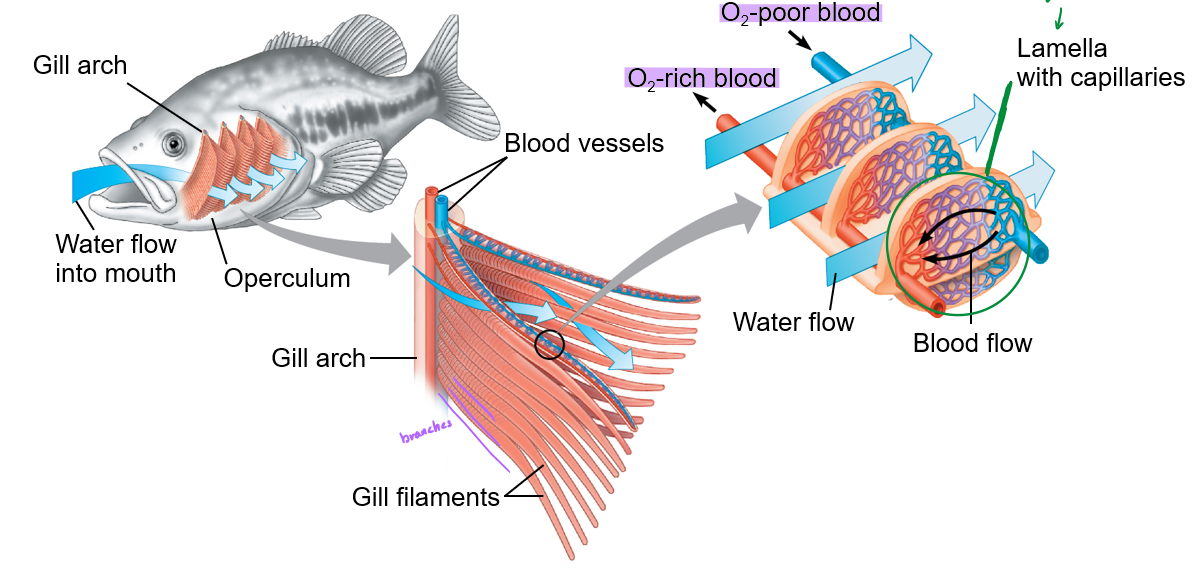
Why are gills the most successful at gas exchange?
large SA, thin diffusion distance, constant ventilation from fresh water, countercurrent exchange
What is countercurrent exchange?
blood and water flow in opposite directions, means that as the blood’s O2 concentration rises the O2 concentration from the water drops but is replaced by more fresh water, allows for more O2 to diffuse into the blood than if they were moving in the same direction
Concurrent is when …
blood and water run in the same direction, not as efficient
What are the benefits to breathing air?
air is less dense and has a higher concentration of O2
What is the drawback of breathing air?
the organism has to provide moisture, drying and water-loss must be overcome in air-based systems, has internal surfaces because exterior ones lose moisture quickly
Describe the major components of a tracheal system
spiracles(control airflow and prevent water loss), tracheae(tubes that branch from spiracles, strengthened with chitin rings, they carry air deep inside the body), tracheoles(thin walled tubes that branch from tracheae, reach individual cells, site of gas exchange is the tips), and air sacs(expandable regions, reduce body density for flight and aid ventilation)
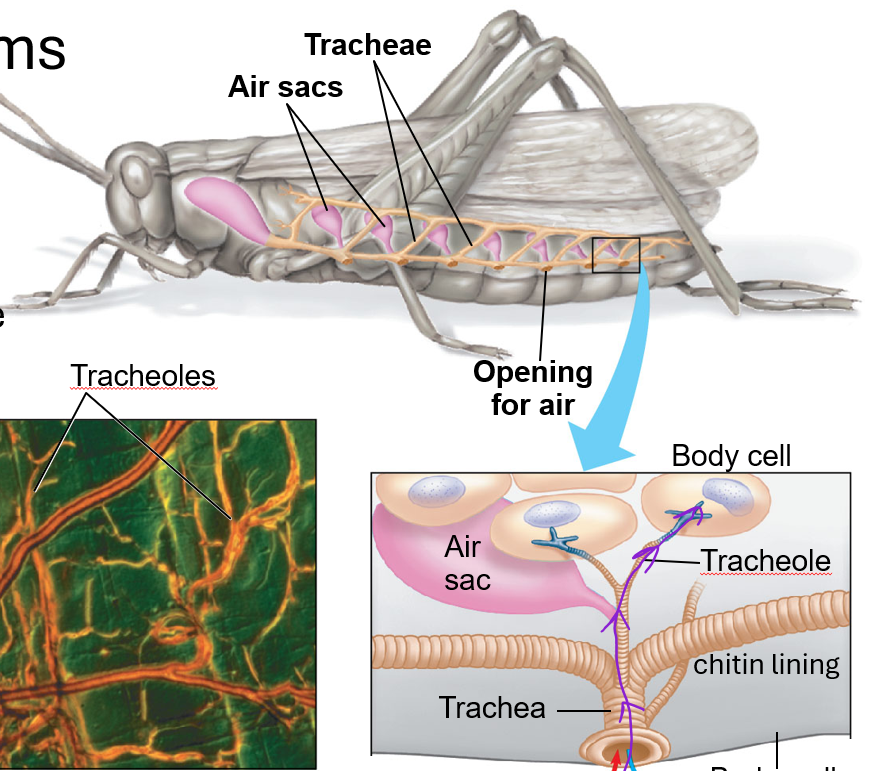
Do tracheal systems need circulatory fluid to move gases?
No, O2 never dissolves into a liquid, hemolymph doesn’t carry O2
How does ventilation occur in a tracheal system?
through body movement
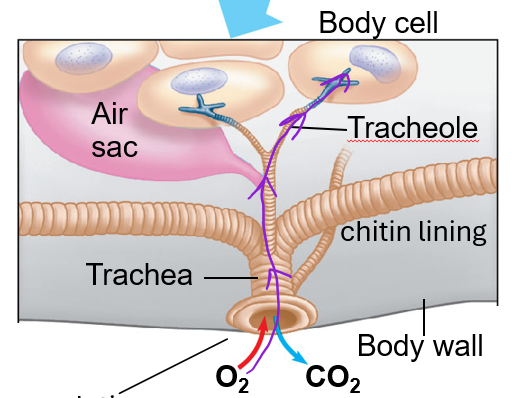
What kind of system is the tracheal system?
Decentralized - so gas exchange happens everywhere and there is no central respiratory organ/system

