Linear Models
 Studied by 0 people
 Call Kai
 Learn
Learn Practice Test
 Spaced Repetition
 Match
Match Flashcards
 Knowt Play
1/35

There's no tags or description
Looks like no tags are added yet.
Name | Mastery | Learn | Test | Matching | Spaced |
|---|
No study sessions yet.
36 Terms
Linear Models
Linear models are parameteric models that are characterized by having prediction functions.
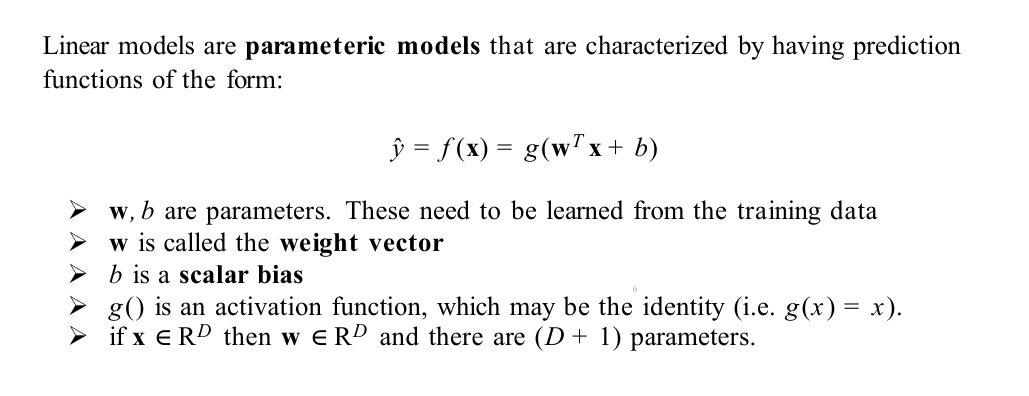
Classification with Linear Models
When using a linear model for classification, we are interested in which side of the line f (x) = c the target appears on.
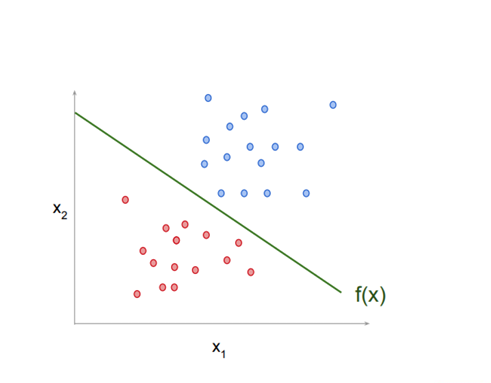
Regression with Linear Models
When using a linear model for regression, we simply output the value of y = wTx + b.
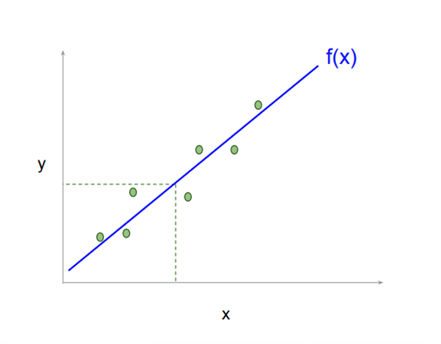
Why linear models?
Even if there is no linear relationship (or decision boundary), often possible to project data to a space in which relationship is linear.
If you have very little data, you need to make strong assumptions to fit a model. Low variance.
Occam’s razor (principle of parsimony). Simpler models that explain the data are better than more complicated ones.
Possible to build much more complex models using linear models as a building block. This is the basis of neural networks and deep learning.
Linear Regression (Ordinary Least Squares)
In linear regression, we would like to find parameters {w, b} such that the resulting line f (x) fits the training data well.
Loss (Cost) Function
A loss function measures how wrong a model’s prediction is for a single data point.
Normal Equations
The Normal Equations give a direct solution for finding the best-fit parameters in Linear Regression by minimizing Mean Squared Error.
Gradient Descent
An iterative optimization algorithm used to minimize a loss (cost) function by repeatedly moving in the direction of steepest decrease.
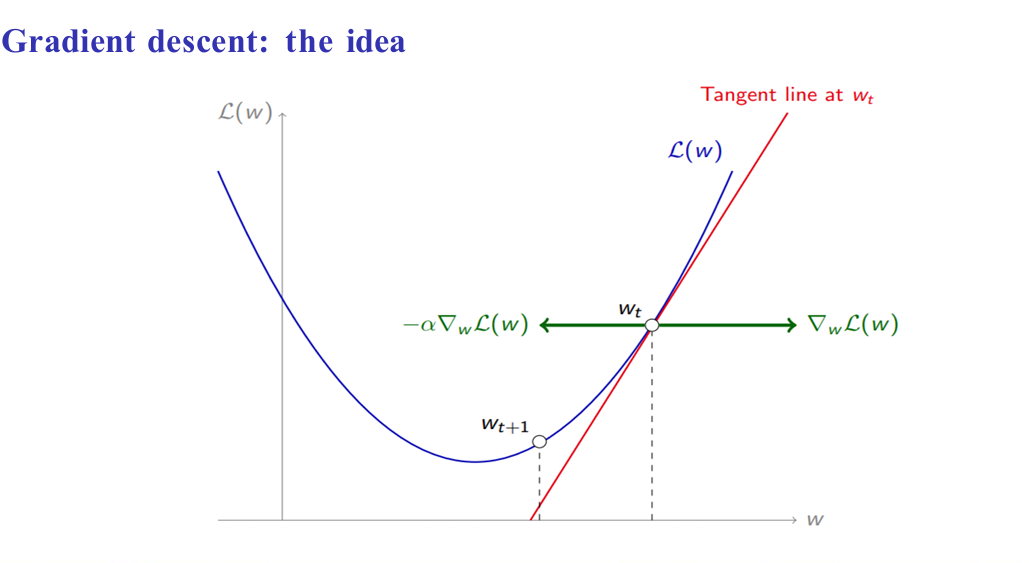
Gradient Descent: The Algorithm
Start with a random guess for the initial parameters θ0
While not converged:
Set θt+1 = θt − αt∇θL(θt)
Gradient Descent: When to Decide Convergence
The value of αt is called the learning rate. Decide convergence when:
The change in θ is small |θt+1 − θt| < T
Maximum number of iterations are reached.
Loss stops improving.
Properties of Gradient Descent
The learning rate αt :
Gradient descent will converge on convex functions as long as the learning rate αt keeps getting smaller over time.
Gradient descent may be very slow if αt is too small.
Gradient descent may diverge if αt is too large.
Gradient descent requires a full pass over the dataset each time it updates the parameters (weights and biases). Slow for large datasets.
Stochastic Gradient Descent (SGD)
Instead of computing the gradient of the loss for the full dataset, estimate it using a single randomly chosen example and then take step in that direction.
Properties of SGD
Usually much faster than batch gradient descent, since we update the weights every iteration instead of every epoch.
Can operate on large datasets, since we only need to process a single example at a time.
Important to shuffle training data to ensure the gradient estimates are unbiased (i.i.d.)
Cons of SGD
Gradient updates are noisy, since it is only an estimate of the full gradient.
Convergence may be slower as you near the optimum solution.
Assumptions of Linear Regression
Linear relationship between variates and covariate
All other variation can be modelled as zero mean Gaussian noise
If these assumptions are violated, then linear regression may be a bad model.
Implications of Linear Regression
Linear regression is sensitive to extreme outliers.
Linear regression may not be appropriate when the noise is not Gaussian.
Linear regression may not give good results if the relationship between the variates and covariates is not approximately linear.
Is it possible to use our linear regression model to do classification?
Sure, but it probably won’t work very well.
The relationship between the variates and covariates is not directly linear
We would like our outputs to be binary variables in {0, 1} (or probabilities in [0 . . . 1]), but linear regression produces arbitrary real numbers. We would need to do some post processing to map the values to the desired range.
Assumption of Gaussian noise is not true for binary outputs. So square error is inappropriate.
Logistic Regression
A supervised learning algorithm used for binary classification problems, where the output is either 0 or 1. It works by applying a linear model to the input features and then passing the result through the sigmoid function, which converts the output into a probability between 0 and 1. The model predicts class 1 if the probability is greater than or equal to 0.5, otherwise it predicts class 0.
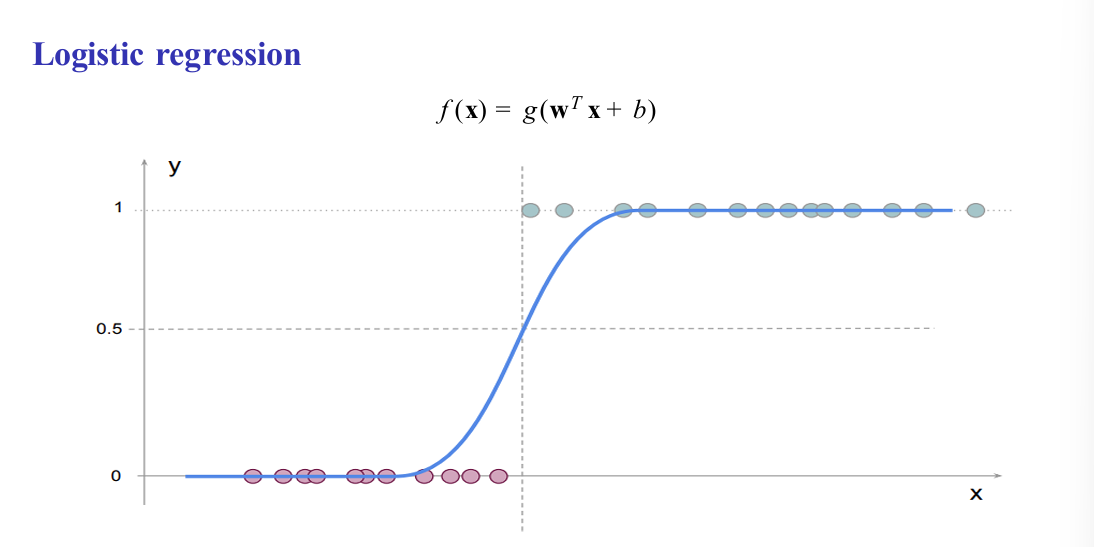
Components needed to specify the logistic regression algorithm?
An activation function (transfer function): the logistic sigmoid
An appropriate loss function (cross-entropy) derived using maximum likelihood
Logistic Regression: Loss Functions
To fit the parameters we would also like to use a more appropriate loss function than square loss:
Probability Distribution
Binary Cross Entropy Loss
Gradient Descent for Logistic Regression
Perform gradient descent (or SGD) using the usual update rule to find good parameters.
Linear regression: Fitting Polynomials
Possible to use linear regression for more than just fitting lines! Only needs for function to be linear in the parameters
! Feature Mapping Function φ(x)
Feature Engineering
Good features are often the key to good generalization performance.
Low dimensional: less likely for data to be linearly separable
High dimensional: possibly more prone to overfitting
Process of designing such functions by hand is called feature engineering, but it is notoriously difficult.
! Feature Learning
Learn features from the data directly.
Overfitting
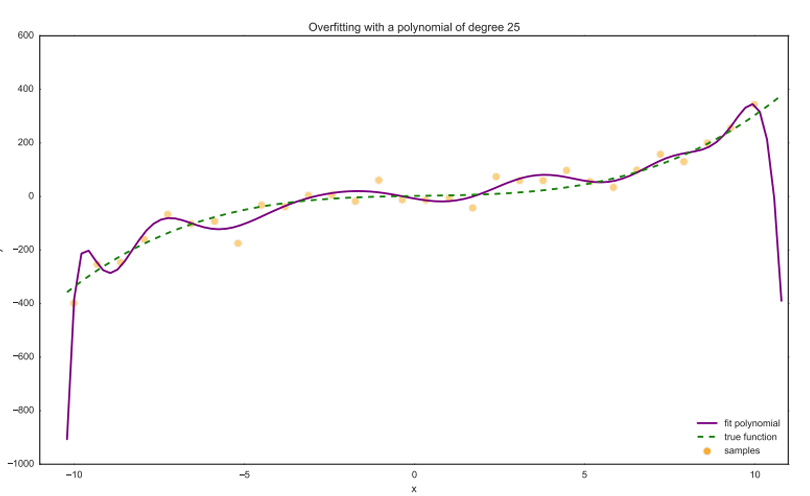
If the model has too many degrees of freedom, you can end up fitting not only the patterns of interest, but also the noise.
This leads to poor generalization: model fits the training data well but does poor on unseen data
Can happen when the model has too many parameters (and too little data to train on).
Curse of Dimensionality
Estimation: more parameters to estimate (risk of overfitting).
Sampling: exponential increase in volume of space.
Optimization: slower, larger space to search.
Distances: everything is far away.
Harder to model data distribution P(x1, x2, . . . , xD )
Exponentially harder to compute integrals.
Geometric intuitions break down.
Difficult to visualize
Blessings of Dimensionality
Linear separability: easier to separate things in high-D using hyperplanes
! Dimensionality
! Multiple Regression
Multi-Class Classification
Logistic regression is limited to binary outputs {0, 1}. Often, if we want to do multi-class classification: Output is one of K classes {1, 2, . . . , K}
How do we model Multi-Class Classification?
Two approaches:
One-vs-rest (OVR): aka one-vs-all
Softmax regression
! One-vs-Rest (OVR)
Idea: train K separate binary classifiers.
! Softmax regression
Direct extension of logistic regression to the multi-class case.
! Loss function for Softmax regression
categorical cross entropy
Regularisation
 Note
Note  Flashcards (46)