Carboxylic Acids and their Derivatives: General Exam Questions

0.0(0)
Studied by 0 people
call kaiCall Kai
learnLearn
examPractice Test
spaced repetitionSpaced Repetition
heart puzzleMatch
flashcardsFlashcards
GameKnowt Play
Card Sorting

1/11

encourage image

There's no tags or description

Looks like no tags are added yet.

Last updated 5:48 PM on 4/9/26
Name
Mastery
Learn
Test
Matching
Spaced
Call with Kai

No analytics yet

Send a link to your students to track their progress

12 Terms
1
New cards
term image

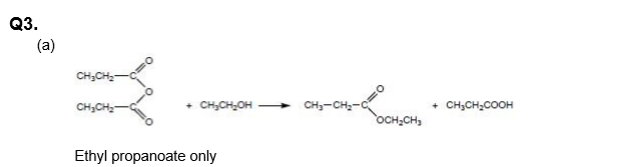
- Acid Anhydride + Alcohol → Ester + Carboxylic Acid
<p>- <strong>Acid Anhydride + Alcohol → Ester + Carboxylic Acid</strong></p>
2
New cards
term image
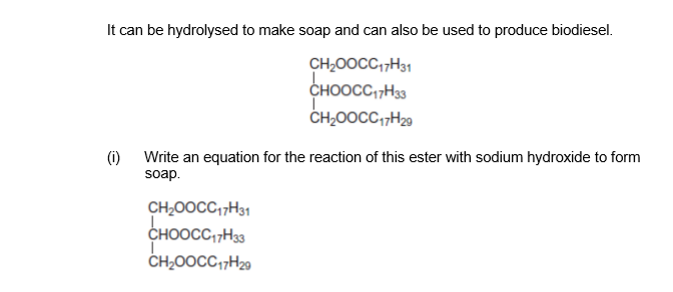
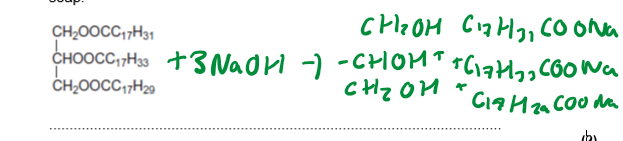
  • Triglyceride + 3NaOH → Glycerol + 3 Sodium Carboxylate

  • For saponification questions, remember it always reacts with 3NaOH,Glycerol stays the exact same, and the Carboxylate ions are of the longest of each chain (e.g.C17H33) but with an addition COONa

  • Biodiesels are the same but the Na switched for CH3

(methyl ester)
<ul><li><p>Triglyceride + 3NaOH&nbsp;→ Glycerol + 3 Sodium Carboxylate</p></li><li><p>For saponification questions, remember it always reacts with<strong> 3NaOH</strong>,<strong>Glycerol stays the exact same</strong>, and the Carboxylate ions are of the longest of each chain (e.g.C<sub>17</sub>H<sub>33</sub>) but with an <strong>addition COONa</strong></p></li><li><p>Biodiesels are the same but the <strong>Na switched for CH<sub>3</sub></strong></p></li></ul><p>(methyl ester)</p>
3
New cards
term image

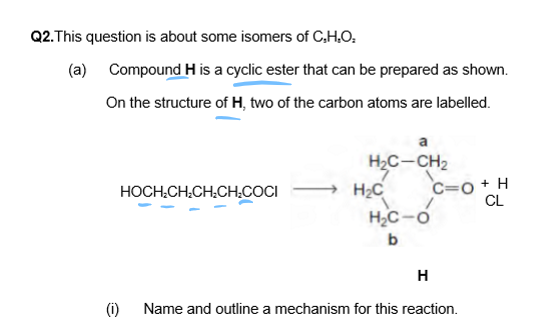
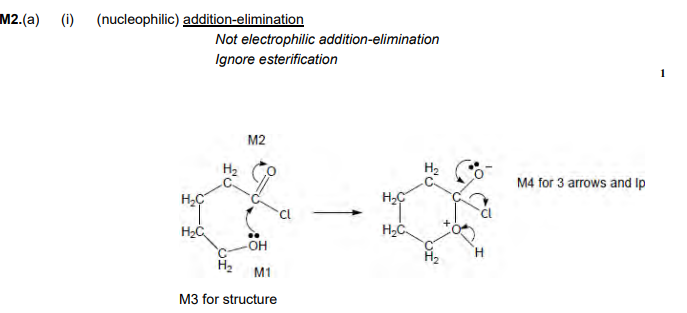
Nucleophilic Addition-Elimination

  • Cyclic compounds with OH react with themselves to form the compound, as shown here
<p>Nucleophilic Addition-Elimination</p><ul><li><p>Cyclic compounds with OH react with themselves to form the compound, as shown here</p></li></ul><p></p>
4
New cards
term image

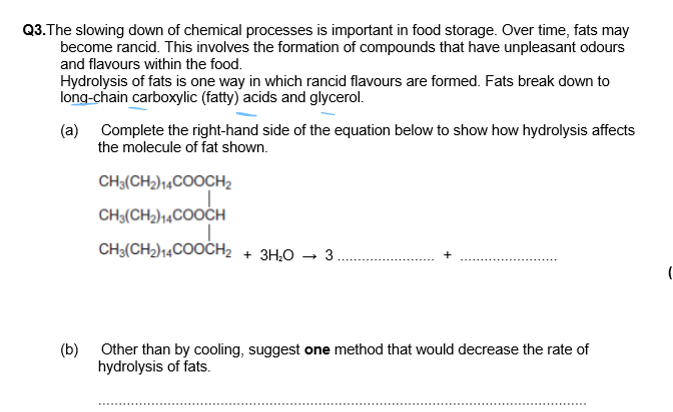
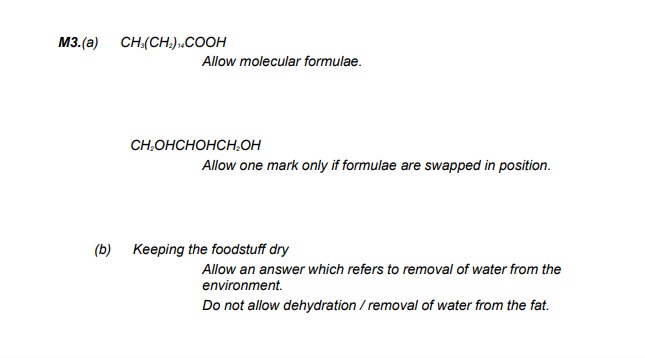
Ester + H₂O → Fatty Acid(Carboxylic Acid,RCOOH) + Glycerol(CH₂OHCHOHCH₂OH)

b)Keeping the foodstuff dry
<p>Ester + H₂O&nbsp;→ Fatty Acid(Carboxylic Acid,RCOOH) + Glycerol(CH₂OHCHOHCH₂OH)</p><p>b)Keeping the foodstuff dry</p>
5
New cards
term image
  • Anti-oxidants react with the free radicals, and are used up in the reaction, hence not being regenerated.
6
New cards
term image

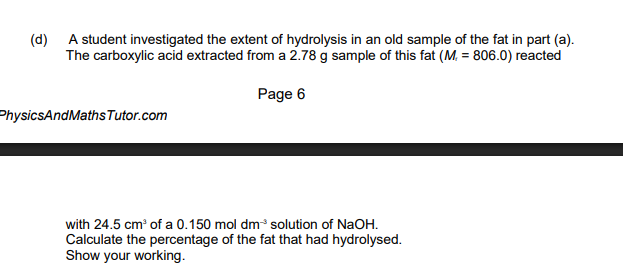
Titration Question

-Write out Equation in regards to NaOH, if not, usually a 1:1 MR

-Work backwards, always use ALL data provided
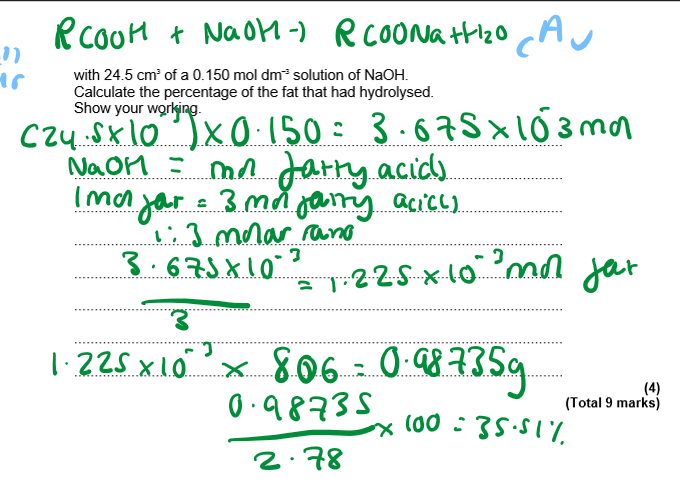
<p>Titration Question</p><p>-Write out Equation in regards to NaOH, if not, usually a 1:1 MR</p><p>-Work backwards, <strong>always use ALL data provided</strong></p>
7
New cards
<p>Name this compound.</p>

Name this compound.

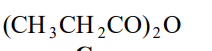
  • Propanoic Anhydride

8
New cards

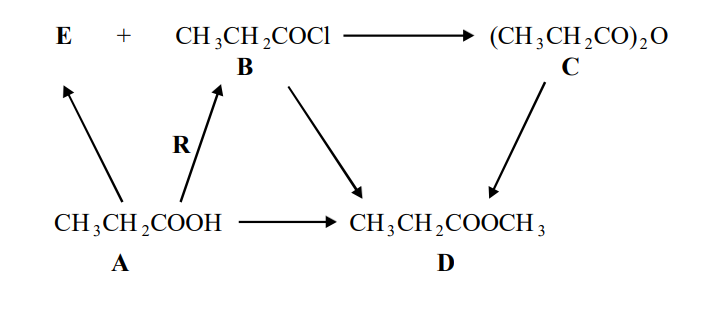
When (CH3CH2CO)2O is heated in water, it is hydrolysed to a carboxylic acid. Write the equation for the reaction that occurs

(CH3CH2CO)2O + H2O → 2CH3CH2COOH
9
New cards
<p>State the appropriate reaction conditions for the formation of compound D from each of the compounds A, B and C.</p>

State the appropriate reaction conditions for the formation of compound D from each of the compounds A, B and C.

  • A: In the presence of strong acid catalyst

  • B: Room temperature

  • C: Heat/reflux, not acid

10
New cards

What are the uses of esters?

  • Solvents

  • Flavourings

  • Fragrances

  • Plasticizers

11
New cards
term image

1. Equipment for Reagents

  • Propan-2-ol (10 cm³) & Ethanoic acid (10 cm³): Use a measuring cylinder. A pipette is too slow and unnecessary for this precision.

  • Concentrated Sulfuric acid (5 drops): Use a dropping/teat pipette.

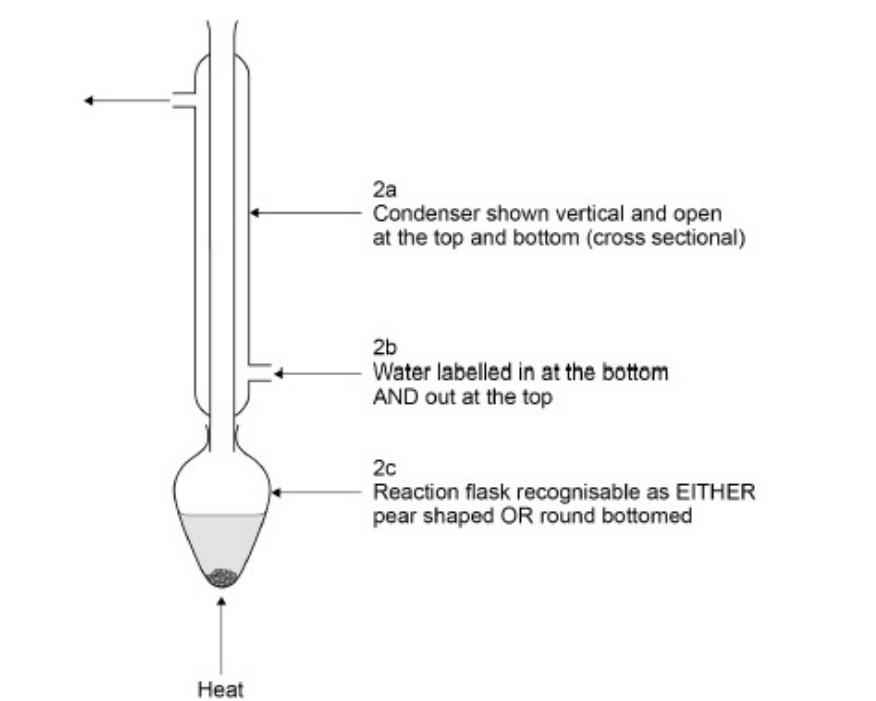
2. Reflux Diagram Checklist

To get full marks, your diagram must show:

  • Round-bottom or Pear-shaped flask containing the reaction mixture and anti-bumping granules.

  • Vertical condenser fitted into the flask (open at the top to prevent pressure build-up).

  • Water jacket with water entering at the bottom and exiting at the top.

  • Heat source: Use an electric heating mantle or water bath (propan-2-ol and ethanoic acid are flammable).

3. Safety Precautions (Non-eye)

  • Flammability: Use an electric heater/heating mantle instead of a Bunsen burner because the organic reagents are flammable.

  • Corrosivity: Wear gloves when handling concentrated $H_{2}SO_{4}$ as it is highly corrosive.
<p><strong>1. Equipment for Reagents</strong></p><ul><li><p><span style="line-height: 1.15;"><strong>Propan-2-ol (10 cm³) &amp; Ethanoic acid (10 cm³):</strong> Use a <strong>measuring cylinder</strong></span><span>. A pipette is too slow and unnecessary for this precision.</span></p></li><li><p><span style="line-height: 1.15;"><strong>Concentrated Sulfuric acid (5 drops):</strong> Use a <strong>dropping/teat pipette</strong></span><span>.</span></p></li></ul><p><strong>2. Reflux Diagram Checklist</strong></p><p>To get full marks, your diagram must show:</p><ul><li><p><strong>Round-bottom or Pear-shaped flask</strong> containing the reaction mixture and <strong>anti-bumping granules</strong>.</p></li><li><p><strong>Vertical condenser</strong> fitted into the flask (open at the top to prevent pressure build-up).</p></li><li><p><strong>Water jacket</strong> with water entering at the <strong>bottom</strong> and exiting at the <strong>top</strong>.</p></li><li><p><strong>Heat source:</strong> Use an <strong>electric heating mantle</strong> or water bath (propan-2-ol and ethanoic acid are flammable).</p></li></ul><p><strong>3. Safety Precautions (Non-eye)</strong></p><ul><li><p><span style="line-height: 1.15;"><strong>Flammability:</strong> Use an electric heater/heating mantle instead of a Bunsen burner because the organic reagents are <strong>flammable</strong></span><span>.</span></p></li><li><p><span style="line-height: 1.15;"><strong>Corrosivity:</strong> Wear <strong>gloves</strong> when handling concentrated $H_{2}SO_{4}$ as it is highly corrosive</span><span>.</span></p></li></ul><p></p>
12
New cards
term image

a) 1. Purpose of Sodium Carbonate

  • The Mark: To neutralise any unreacted/remaining acid (specifically the ethanoic acid and the sulfuric acid catalyst).

b) 2. Precaution

  • The Mark: Periodically open the tap/invert the funnel and vent/release the pressure while shaking.