Praxis II PLT Grades 7-12 (5624)
 Call Kai
 Learn
Learn Practice Test
 Spaced Repetition
 Match
Match Flashcards
 Knowt Play
1/109

There's no tags or description
Looks like no tags are added yet.
Name | Mastery | Learn | Test | Matching | Spaced | Call with Kai |
|---|
No analytics yet
Send a link to your students to track their progress
110 Terms
Bandura
Social CognitiveTheory/Observational Learning Theory-people can learn new information and behaviors by watching other people.
Bruner
Constructivist Theory- learning is an active process; learners construct new ideas or concepts based on their current/past knowledge.
Dewey
Learning by Doing- Learning occurs through experience.
Piaget
Genetic Epistemology- Developmental Stages of Child Development:
0-2 years: "sensorimotor"- motor development
3-7 years: "preoperational"- intuitive
8-11 years: "concrete operational"- logical, but non-abstract
12-15 years: "formal operations"- abstract thinking
Vygotsky
Social Development Theory & ZPD: Social interaction=critical for cognitive development
Zone of Proximal Development: theoretical basis for scaffolding
Kohlberg
Stages of Moral Development:
Pre-conventional- based on self-centered interests
Conventional- based on conformity to local expectations
Post-Conventional- based on higher principles
Bloom
Taxonomy- a hierarchy model; way to classify thinking according to six cognitive levels of complexity
Remembering
Understanding
Applying
Analyzing
Evaluating
Creating
Metacognition
awareness and understanding of one's own thought process
including monitoring and regulating one's own learning
Schema
both the category of knowledge as well as the process of acquiring that knowledge.
useful in organizing and interpreting information
As experiences happen and new information is presented, new _________ are developed and old _____________ are changed or modified.
Transfer
Information or skills related to one topic can sometimes either help or hinder the acquisition of information or skills related to another topic.
Self-Efficacy
the belief that one can master a situation and produce positive outcomes
Self-Regulation
Ability to monitor and control our own behavior, emotions, or thoughts, altering them in accordance with the demands of the situation.
Zone of Proximal Development
Vygotsky's concept that refers to the range of tasks that are too difficult for an individual to master alone
can be mastered with the guidance or assistance of adults or more-skilled peers
Classical Conditioning
Pavlov; altering another's behavior (dogs and bells)
Operant Conditioning
Rewards and punishments to teach proper behavior
Cognitive Domain
a collection of educational outcomes and learning objectives that focus on a student's knowledge and abilities
requires memory, thinking, and reasoning processes
Psychomotor/Physical Domain
focus on motor skills and perceptual processes
ranges from reflexes to skilled motions
Includes the ability to communicate through motion (dancing, miming)
Americans with Disabilities Act (ADA)
Prohibits discrimination against people with disabilities
Individuals with Disabilities Education Act (IDEA)
Protect rights of students with disabilities by ensuring everyone receives a free appropriate public education, regardless of ability.
Section 504, Rehabilitation Act
Protect rights of those with disabilities in programs and activities that receive federal financial assistance, including federal funds
Thorndike
Connectionism (Behaviorism): Learners form associations or connections between a stimulus and a response.
Through trial and error, rewarded responses would be strengthened.
Watson
Behaviorism: Proposed that most human learning and behavior was controlled by experience (not genetically predetermined).
Believed the only behaviors that should be studied are the "observable" ones.
Maslow
Hierarchy of Needs: Humans naturally strive to satisfy needs.
Lower levels must be satisfied before the individual can move on to satisfy higher level needs.
Physiological
Safety
Love/Belonging
Esteem
Self-Actualization
Physiological
1st tier on Maslow's Hierarchy of Needs
breathing, food, water, sex, sleep, homeostasis, excretion
Safety
2nd tier on Maslow's Hierarchy of needs
security of body, employment, resources, morality, family, health, and property
Love/Belonging
3rd tier on Maslow's Hierarchy of Needs
friendship, family, and sexual intimacy
Esteem
4th tier on Maslow's Hierarchy of needs
self-esteem, confidence, achievement, respect of others, and respect by others
Self-Actualization
5th tier on Maslow's Hierarchy of Needs
morality, creativity, spontaneity, problem-solving, lack of prejudice, and acceptance of facts
Skinner
Operant Conditioning: Learning is the result of changes in behavior.
As stimulus-response cycles are reinforced, individuals are "conditioned" to respond.
Individuals can initiate responses, not merely respond to stimuli.
Erikson
Socioemotional Development: "Eight Stages of Man;" describes series of crises individuals pass through at different ages.
Trust vs. Mistrust
1st Stage of Erikson's Psychosocial Development
Infancy-1 year
if needs are dependably met, infants develop a sense of basic trust
Autonomy vs. Shame and doubt
2nd of Erikson's Psychosocial Development
1-3 years (Toddlerhood)
Toddlers learn to exercise their will and do things for themselves, or they doubt their abilities
Initiative vs. Guilt
3rd of Erikson's Psychosocial Development
3-6 years (Preschool)
learn to initiate tasks and carry out plans, or they feel guilty about their efforts to be independent
Industry vs. Inferiority
4th of Erikson's Psychosocial Development
6 years-puberty
children learn the pleasure of applying themselves to tasks, or they feel inferior
Identity vs. Role Confusion
5th of Erikson's Psychosocial Development
Adolescence- teen years into 20s
work at refining a sense of self by testing roles and then integrating them to form a single identity, or they become confused about who they are
Intimacy vs. Isolation
6th of Erikson's Psychosocial Development
Young Adulthood-20's to early 40's
struggle to form close relationships and to gain the capacity for intimate love, or they feel socially isolated
Generativity vs. Stagnation
7th of Erikson's Psychosocial Development
Middle Adulthood-40s to 60s
people discover a sense of contributing to the world, usually through family and work, or they may feel a lack of purpose
Integrity vs. Despair
8th of Erikson's Psychosocial Development
Late Adulthood-60's and up
reflecting on his or her life, an older adult may feel a sense of satisfaction or failure
Self-Determination
A combination of skills, knowledge and beliefs that enable a person to engage in goal-directed, self-regulated, autonomous behavior
includes skills such as choice/decision-making, goal setting, problem-solving, self-evaluation, self-management, self-advocacy, and self-awareness
Attribution
in their effort to make sense of their own behavior or performance, individuals are motivated to discover its underlying causes
Extrinsic Motivation
external motivational factors such as rewards and punishments
Intrinsic Motivation
internal motivational factors such as self-determination, curiosity, challenge, and effort
Cognitive Dissonance
Discomfort felt at a mismatch between what you already know or believe and new information or interpretation.
Positive Reinforcement
presentation of a stimulus or event immediately after a response has been emitted
has the primary effect of increasing the occurrence of similar responses in the future
Negative Reinforcement
a response or behavior is strengthened by stopping, removing or avoiding a negative outcome or aversive stimulus
Information Processing Theory
individuals manipulate information, monitor it, and strategize about it
Social Learning Theory (3)
Basic Concepts:
Modeling,
Reciprocal Determinism,
Vicarious Learning
Modeling
the teacher's direct and indirect demonstration, by actions and words, of the behaviors expected of students
Reciprocal Determinism
the theory set forth by psychologist Albert Bandura that a person's behavior both influences and is influenced by personal factors and the social environment.
Bandura accepts the possibility of an individual's behavior being conditioned through the use of consequences
Vicarious Learning
learning that is derived from indirect sources such as hearing or observation, rather than direct, hands-on, instruction.
Constructivism (5)
Basic Concepts:
Learning as experience
Problem-based learning
Zone of Proximal Development
Scaffolding
Inquiry/discovery learning
Learning as Experience
learning by doing
Problem-Based Learning
a student-centered pedagogy in which students learn about a subject through the experience of solving an open-ended problem.
Students learn both thinking strategies and domain knowledge.
Scaffolding
the degree of support, guidance, and direction you provide students when they set out to complete the task
Inquiry/Discovery Learning
a constructivist based approach to education. It is supported by the work of learning theorists and psychologists Jean Piaget, Jerome Bruner, and Seymour Papert
Behaviorism (4)
Basic Concepts:
Conditioning
Intrinsic and extrinsic rewards
Reinforcement
Punishment
Intrinsic Rewards
An outcome that gives an individual personal satisfaction such as that derived from a job well done.
Extrinsic Rewards
an award that is tangible or physically given to you for accomplishing something.
It is a tangible recognition of ones endeavor.
Scope
The breadth and depth of content to be covered in a curriculum at any one time
All that you do in a given period.
Sequence
The order in which content is presented to learners over time
The order in which you do it.
Learning Domains (3)
Cognitive: mental skills (knowledge)
Affective: growth in feelings or emotional areas (attitude or self)
Psychomotor: manual or physical skills (skills)
Remediation
Giving students extra instruction to help increase proficiency in a particular skill area
Enrichment
Directed to creative and critical thinking skills; student shows exceptional performance and responsibility in the classroom. Find material to still challenge students who may be gifted and talented to keep them engaged and motivated.
Instructional Planning Partners (5)
-Special Education Teachers
-Library Media Specialists
-Teachers of the Gifted and Talented
-IEP Team Members
-Para Educators
Deductive Reasoning
Top-down approach; work from more general information to more specific
Ex: Every day, I leave for work in my car at eight o'clock. Every day, the drive to work takes 45 minutes I arrive to work on time. Therefore, if I leave for work at eight o'clock today, I will be on time.
Inductive Reasoning
Bottom-up approach; work from more specific observations to broader generalizations and theories
Ex: Today, I left for work at eight o'clock and I arrived on time. Therefore, every day that I leave the house at eight o'clock, I will arrive to work on time.
Direct Instruction Strategies (5)
-Explicit teaching
-Drill and practice
-Lecture
-Demonstrations
-Guides for reading, listening, viewing
Indirect Instruction Strategies (6)
-Problem solving
-Inquiry
-Case studies
-Concept mapping
-Reading for meaning
-Cloze procedures
Independent Instruction Strategies (5)
-Learning contracts
-Research projects
-Learning centers
-Computer mediated instruction
-Distance learning
Experiential and Virtual Instruction Strategies (6)
-Field trips
-Experiments
-Simulations
-Role play
-Games
-Observations
Interactive Instruction Strategies (6)
-Brainstorming
-Cooperative learning groups
-Interviews
-Discussion
-Peer Practice
-Debates
Verbal and Nonverbal Communication Modes (6)
-Body language
-Gesture
-Tone, stress, and inflection
-Eye contact
-Facial expression
-Personal space
Active Listening Strategies (6)
-Attending to the speaker
-Restating key points
-Asking questions
-Interpreting Information
-Providing supportive feedback
-Being respectful
Diagnostic Assessment
Gathering and carefully evaluating detailed data using students' knowledge and skills in a given learning area to diagnose strengths and areas of need in all students; use data to plan appropriate pedagogy and targeted learning
Assists teachers to gain...
1. understanding of current situation
2. knowledge about how to improve
3. required resources
Leads to action and improved learning outcomes
Formal Assessment
tests that systematically measure how well a student has mastered learning outcomes.
Informal Assessment
a procedure for obtaining information that can be used to make judgements about children's learning behavior and characteristics or programs using means other than standardized instruments
Formative Assessment
Evaluation of learning in progress
Summative Assessment
Assessment of learning after learning is completed
Assessment Tools (5)
-Rubrics
-Analytical checklists
-Scoring guides
-Anecdotal notes
-Continuums
Assessment Formats (6)
-Essay
-Selected response
-Portfolio
-Conference
-Observation
-Performance
Types of Standardized Tests (3)
-Achievement
-Aptitude
-Ability
Norm-referenced Scoring
Designed to compare and rank test takers in relation to one another; whether test takers performed better or worse than a hypothetical average student
Criterion-referenced Scoring
Designed to measure student performance against a fixed set of predetermined criteria or learning standards
Validity
the sounds of your interpretations and uses of students' assessment results
Reliability
the amount of consistency of assessment results
a limiting factor for validity
Raw Score
the number of points you assign to a student's performance on an assessment
points may be assigned based on each task, or points awarded on separate parts of the assessment
Scaled Score
a conversion of a student's raw score on a test or a version of the test to a common scale that allows for a numerical comparison between students.
Percentile
a norm-referenced score that tells the percentage of persons in a norm group scoring lower than particular raw score
Standard Deviation
an index of the spread of the scores in a distribution calculated by taking the square root of the mean squared deviation of the scores from the arithmetic mean of the scores
Mean
an average score found by summing all of the scores and dividing by their number
AKA the arithmetic mean
Median Score Method
a procedure for combining several component grades into a composite report card grade
all scores are converted to the same scale, usually a rubric or grade scale
the median mark is used as the composite grade
Mode
the most frequently occurring score in a distribution
Grade-Equivalent Scores
a norm-referenced growth scale score that tells the grade placement at which a raw score is average
reported as a decimal fraction
Ex 3.4- the whole number refers to a grade level and the decimal refers to a month of the school year within that grade level
Age-Equivalent Scores
a comparison of your child's performance compared to age groups whose average scores are in the same range
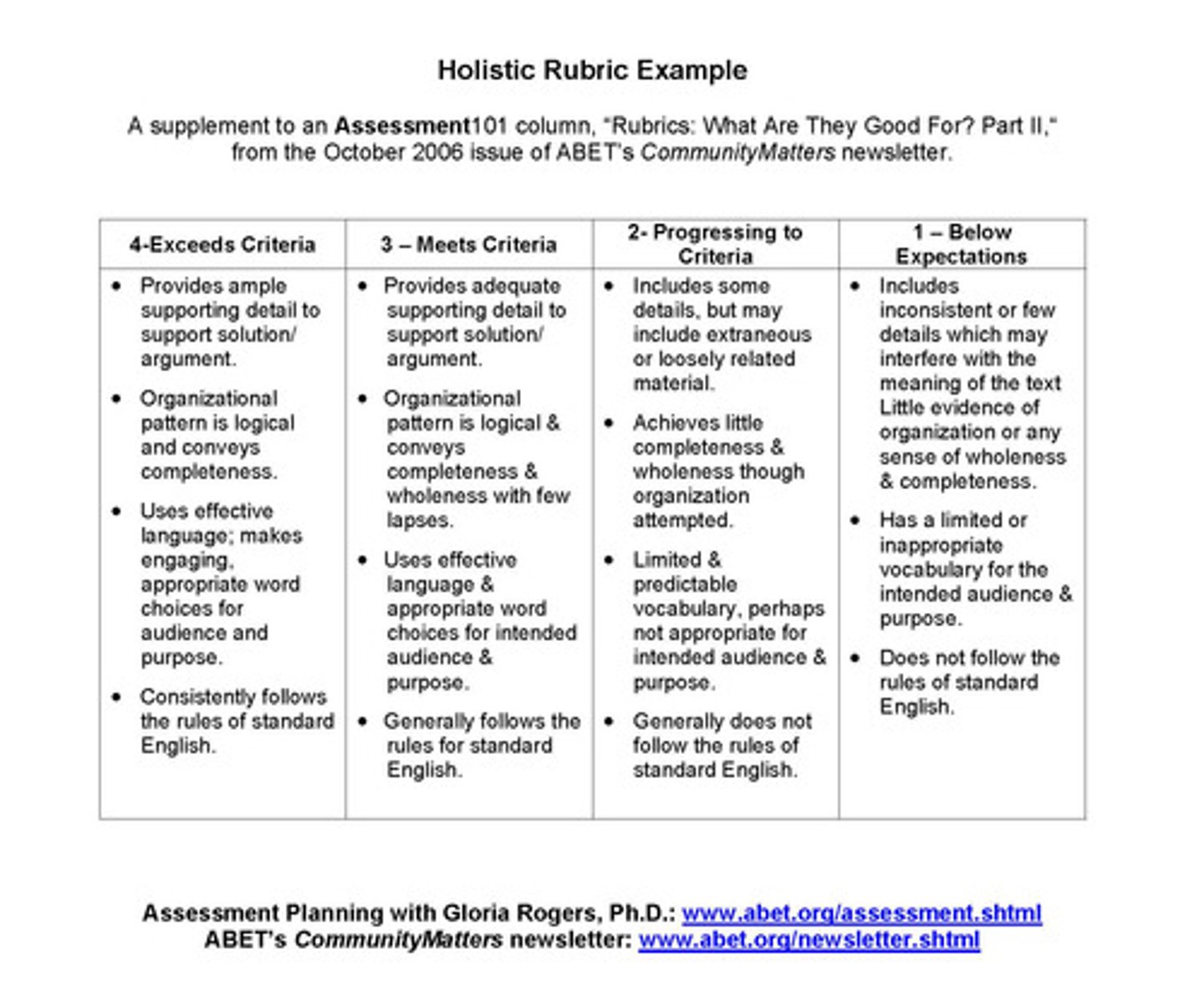
Holistic Scoring
Single scale
All factors are to be evaluated are identified together for each level of performance
a checklist, description of each attainable level of performance, etc.
Quicker to develop, learn, score, and find agreement among various evaluators
Analytical Scoring
Consists of multiple, separate scales, and therefore provides a set of scores rather than just one
lets students know exactly which areas to improve on
takes longer to learn well and longer to score
Reflective Practice
Continuous cycle of self-observation and self-evaluation; thinking to benefit of the individuals and communities being served; how to improve or knowing what works well
Equal Access
Prohibits public secondary schools that receive federal assistance and that maintain a limited open forum from denying equal access to students who wish to meet within the forum on the basis of the religious, political, philosophical, or other content of the speech at such meetings.
Due Process
No state shall deprive any person of life, liberty, or property, without due process of law
Obedience and Punishment
Pre-conventional Stage of Kohlberg's Moral Theory
Infancy
No difference between doing the right thing and avoiding punishment

