wawa test
 Call Kai
 Learn
Learn Practice Test
 Spaced Repetition
 Match
Match Flashcards
 Knowt Play
1/20

There's no tags or description
Looks like no tags are added yet.
Name | Mastery | Learn | Test | Matching | Spaced | Call with Kai |
|---|
No analytics yet
Send a link to your students to track their progress
21 Terms
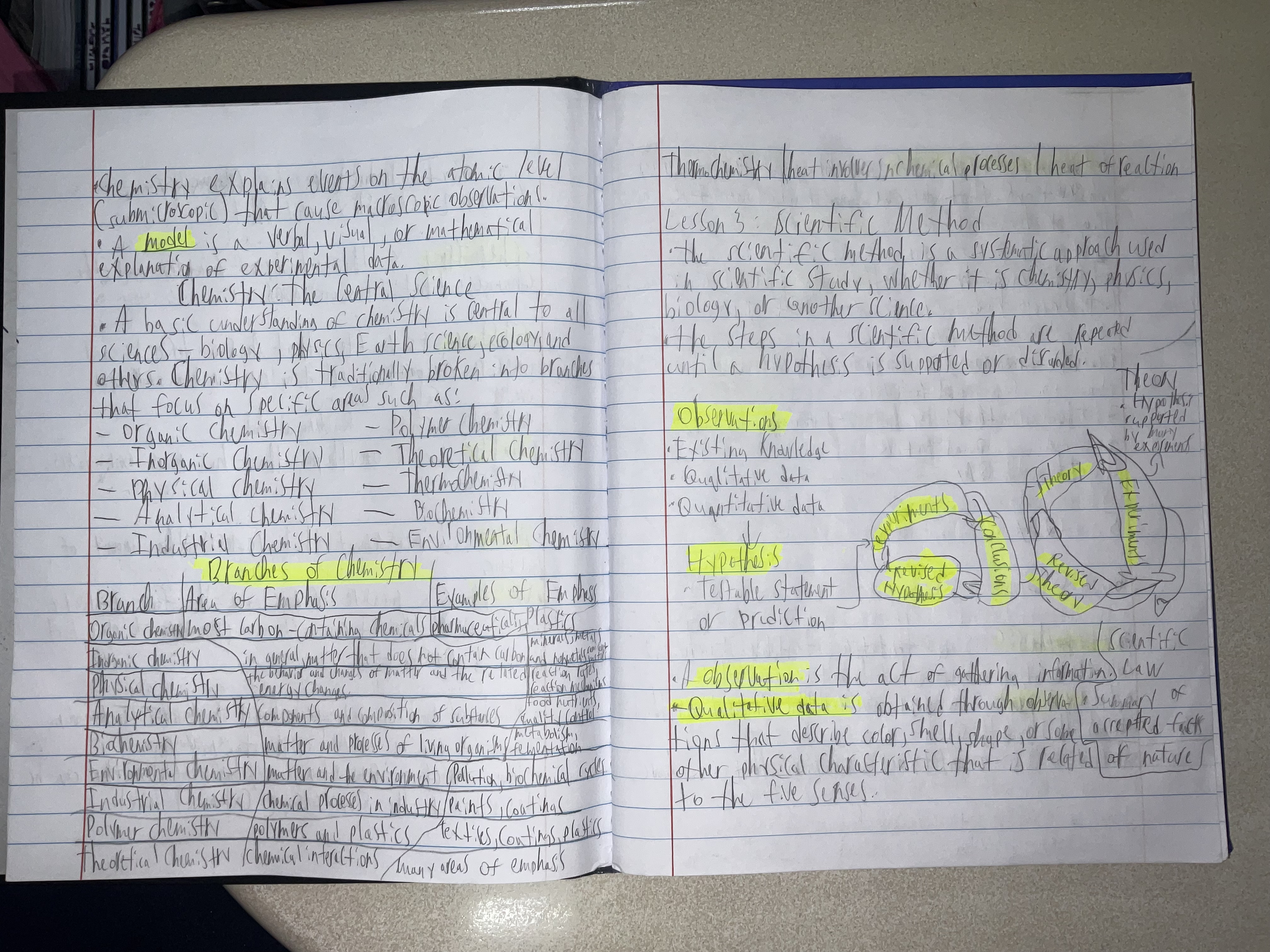
Organic Chemistry - Definition
Study of compounds that contain carbon/carbon containing chems.
Organic Chemistry - Examples
Examples: plastics, fuels, pharmaceuticals, carbohydrates, proteins.
Inorganic Chemistry - Definition
Study of compounds without carbon.
Inorganic Chemistry - Examples
Examples: metals, salts, minerals, ceramics.
Physical Chemistry - Definition
Studies the behavior and changes of matter and the related energy changes; applies physics to chemistry.
Physical Chemistry - Examples
Examples: reaction rates, thermodynamics, quantum chemistry.
Analytical Chemistry - Definition
Study of identifying substances and determining their composition.
Analytical Chemistry - Examples
Examples: blood tests, water quality testing, forensic analysis.
Biochemistry - Definition
Study of chemical processes in living organisms.
Biochemistry - Examples
Examples: DNA, enzymes, metabolism,fermentation .
Environmental Chemistry - Definition
Study of chemical processes in the environment.
Environmental Chemistry - Examples
Examples: air pollution, greenhouse gases, soil chemistry.
Industrial Chemistry - Definition
Study of large-scale production of chemicals and materials.
Industrial Chemistry - Examples
Examples: fertilizers, petrochemicals, paints, coatings.
Thermochemistry - Definition
Study of heat changes in chemical reactions and physical processes.
Thermochemistry - Examples
Examples: exothermic vs. endothermic reactions.
Theoretical Chemistry - Definition
Use of math and computer models to understand and predict chemical behavior/interactions.
Theoretical Chemistry - Examples
Examples: molecular modeling, simulations of reactions.
Polymer Chemistry - Definition
Study of polymers and plastics.
Polymer Chemistry - Examples
Examples: rubber, nylon, plastics, synthetic fibers,textiles.
scientific method
1.start with observations qualitative and quantitative data/your existing knowledge then 2. make a hypothesis aka your prediction then 3.make your experiment to get your conclusions and revise your hypothesis 4.then after that process you start making your theory(hypothesis supported by many experiments)make more experiments to revise your theory to 5.then create a scientific law if proven true