HIST 210 - Midterm Notes
 Studied by 8 people
 Call Kai
 Learn
Learn Practice Test
 Spaced Repetition
 Match
Match Flashcards
 Knowt Play
1/278

There's no tags or description
Looks like no tags are added yet.
Name | Mastery | Learn | Test | Matching | Spaced | Call with Kai |
|---|
No analytics yet
Send a link to your students to track their progress
279 Terms
What does Abya Yala mean?
“living land” / “land that flourishes”
Who lived in Abya Yala?
Kuna people (modern-day Colombia and Panama)
What did John Locke say in the Second Treatise?
For property to belong to someone they need to work the land
What was the Doctrine of Terra Nullius?
essentially makes land free for the taking
What are the three typologies?
Nomads and hunter gathers, semi-sedentary peoples, and sedentary peoples
What were the eventual patterns of conquest and colonial rule?
Colonialism aligned with the geography of settled, semi-settled, and hunter-gatherer societies.
What occered in early human settlement in the Americas?
People traveled through Beringia (the area between Russia and Canada). There were two ancient movements and after glaciation, two more.
During ancient settlement, who were the people in the territory? What did they do?
There were Paleo-”Indians” who were hunter-gatherers and were too good at hunting, which led to Pleistocene overkill.
What were one of the breakthrough that the earliest settlers used? Why was this important
They used fire which created games parks, reduced tree density, increased biodviersity and mammal population?
How is there evidence that the earliest settlers used fire?
Evidence from La Yeguada
What was the diets of the early hunter gathers?
Meat with plants (acorns and mesquite pods were used to make bread), their diet changed base off of ecosystem and season
What are two nomadic groups? What were they know for?
Chichimecans, north of Mesoamerican borderlands, war with Mexica (“Aztecs”); very difficult for Spanish to conquer and eventually control
Mapuche, southern Chile and Argentina. Also a 300-year front of indigenous resistance vs Spanish and 19th century republic
What group of nomadic people resisted Spanish rule?
The Chichimecans
What structure did nomadic groups have?
Small kin groups that travel in paths come together periodically for hunting, socializing, or creating non-hierarchical councils (although they struggle during war).
Terracing
Irrigation
What was the population of Tenochtitlan?
200-300k
What are the three sources that show evidence of Tenochtitlan?
Material artifacts (clothes, pottery, burial sites, architecture)
Oral tradition
Codices written before and also after European conquest
What are codices?
An elite specialized art form, painted on amatl bark paper that tells the stories of divinites. Skilled orators would perform them. After conquest, churches destoryed them. Some survived or were produced in the colonial period
How were codices legitimizing?
Ones produced in the colonial period would show ones lineage and they could leverage that to have a higher position in the new colonial order
What does the Xolotl codex depict?
the preconquest history of the Valley of Mexico, from the arrival of the Chichimeca under the king Xolotl in the year 5 Flint (1224) to the Tepanec War in 1427.
What gods did Mexica take up?
gods of Toltecs
Who were the gods of Toltecs?
Especially the cult to the god Tlaloc
Toltecs known across Mesoamerica as carriers of civilization: mythical ancestors who invent agriculture, crafts, privileged relationships with gods
Connecting to Toltecs was a way to create lineage/legitimacy for the previously marginal Mexica group
Why was the rise of Mexica seen as a turning point?
It showed a turn in Mesoamerican from theocratic to militaristic societies
What was the Great Assembly of 1427?
Aristocrats (pipiltin) and commoners (macehuales) at odds about whether to go to war against neighbors
Nobels wanted war, commoners wanted peace
What were the implications of the Battle of 1427?
Start of rapid expansion of Mexica empire across Mesoamerica. Early on there was the Triple Alliance but Mexica eventually turns on their allies and becomes incredibly brutal committing quazi genoicde of Huasteca people
Who were apart of The Triple Alliance?
Mexica
Texcoco
Tlateloco
What are some of the characteristics of Pre-Columbian Inca society?
More ethnically and linguistically diverse than Mesoamerica
an exchange economy without money
a culture without pictorial or alphabetic texts
Few urban centers
What are quiphu?
They are strings of accounting and narration: Incan mnemonic knots
What was andean agriculture?
Mixed agriculture: pastoralism + grain/potato cultivation + fruit/veg and all-important coca leaves (chewing and ceremonial)
Each community needed all of the above to survive, so they spread out its members so that the community encompassed different zones
What is an ayllu?
A community unit of 100 people, divide by lineage
They inhabit different landscapes.
What is a kuraka?
A elected elder who orgnaize collective labour (terracing, irrigation, planting, harversing) and the mita (tribute)
What are huacas?
These are sacred deities, which could be natural landforms or ancestral spirits, and they were worshipped, feasted upon, and served as key pilgrimage sites in indigenous Andean cultures
How did the Incas rise?
1438 war with Chanca peoples, who invade the Inca lands but Incas defend themselves
What was El Ruego?
A practice used by Pachacuti, a powerful Inca leader, where he would host elaborate feasts for the ayllus' kurakas (community leaders) who, out of honor and obligation, were then compelled to accept his request for labor or mita tribute, which was mandatory work duty.
Why did the El Ruego work?
This method included both a sense of reciprocity and an underlying threat of further violence if the request was denied.
What were the characteristics of reciprocity in the Inca empire?
The development of infrastructure, a gift-based economy, and the dispatch of royal servants (called yanayucus) to oversee labor contributions from allied ayllus, resulting in the creation of extensive infrastructure projects, such as terraces, roads, and bridges, and further increasing the Incas' influence and bargaining power.
What was the Al-Andalus?
The period before the Reconquista when the Moors expanded north into the Iberian Peninsula in 711 and ruled for nearly eight centuries, resulting in a significant cultural exchange and introducing important sciences and technology to Europe.
What was the reconquista?
A series of Christian kingdoms' efforts to push the Moors south in the Iberian Peninsula, marked by cycles of conquest, conversion, and coercion, ultimately leading to the formation of modern-day Spain and the defeat of the Moors in Granada in 1492, with the Portuguese kingdom consolidating earlier in the 1200s.
What contributed to European crusading mentality?
The expense of wars in Europe, religious conflicts such as Spain's Catholicism versus England's Protestantism, Portugal's trade focus, and the continuation of crusades from 1050 to 1300 AD.
When did Columbus arrive in the Caribbean?
October 12, 1494
What was the probanza de merito?
Iberian explorers wrote to their monarchs before the Americas' conquest, seeking rewards by exaggerating their deeds, leading to the myth of Spanish superiority and overlooking contributions of native and African allies.
How was early conquest histories justified?
They had a crusade mindset, seeking to bring civilization and Christianity, using speeches like the Requirement of Submission with severe threats for those who didn't comply.
What were the three ways Spain conqoured the Mexica?
Knowledge
Technology
Disease
How did knowledge help the Spainards conquest in Mexica?
They had extensive knowledge, their awareness of the empire's vast size and power, and their understanding of the local alliances, fault lines, and conflicts within the region.
How did technology help the Spainards conquest in Mexica?
They possessed advanced technology and weaponry such as sailing ships, attack dogs, large horses, cannons, steel swords, and body armor, which gave them a significant military advantage over the Mexica soldiers who primarily had stone weapons.
What was the Toxcatl massacre?
Emperor Moctezuma invites Cortés into Tenochtitlan, Cortés then takes Moctezuma hostage, and fighting continues
What material item did the conquistadors care for?
They cared for gold and precious metals, particularly after receiving gifts from the Mexica. Thye were described as treating gold with great reverence and greed, culminating in the burning and melting of valuable treasures upon their arrival in Tenochtitlan.
How did disease help the Spainards conquest in Mexica?
The introduction of deadly diseases like measles, smallpox, influenza, and others significantly reduced the population of Tenochtitlan by 40% in the first year of fighting.
When was the spanish conquest in Mexica completed?
1521
How did the conquest of the Incas begin?
In 1532, Francisco Pizarro initiated the conquest by deceiving Incan emperor Atahualpa with a meeting in Cajamarca. Pizarro's small group ambushed Atahualpa and held him hostage. They asked for a significant ransom before eventually killing him.
How is the conquest of the Incans completed?
Tupac Amaru’s death in 1572
What did Indigenous allyship in the conquest look like?
Mexica levied taxes and tribute on other Nahuatl-speaking city states.
The Tlaxcala sent thousands of men to fight alongside Cortés
Who was Malintzin?
A young woman enslaved and given to Cortés during the conquest, serving as his main translator due to her knowledge of Nahuatl, Maya, and quick acquisition of Spanish; she had a son with Cortés, was later given to one of his officers, had another son, and tragically died at the age of 21, with her role often seen as controversial and debated, sometimes being labeled a traitor for her pivotal role in the conquest.
What does Octavio Paz's 1950 work, "The Sons of Malinche," explore?
He explores the concept of the "chingada," associated with the violated Mother, linked to the Conquest and symbolized by Doña Malinche, who, despite her complex role, embodies the Indian women who were affected by the Spanish conquest, with her portrayal reflecting the conflicted feelings of Mexican identity and history.
Paz's interpretation of La Malinche as a symbol of fascination, violation, or seduction by the Spaniards highlights the conflicting feelings within Mexican culture regarding her role in history. While she played a pivotal role in the conquest, her legacy is one of complex emotions, including feelings of betrayal. Paz suggests that Mexican people have not forgiven La Malinche for her perceived betrayal, and she represents a stark contrast to the stoic and impassive image often associated with indigenous people.
Why did Malintzin become a symbol of new natioonhood in the Americas?
She symbolizes interracial relationships, and her legacy is intertwined with the concept of mestizaje, referring to the offspring of European men and indigenous women in the Americas, who, despite being considered second-class citizens, held more privileges than indigenous people, such as exemption from tribute.
Later on, during the struggle for independence, nationalists would highlight mestizaje as a symbol of newly formed nations, representing something new and deserving of self-rule.
What was colonial law and opinion of mixed people?
They were typically forbidden from holding responsible public offices and exempted from the labor-intensive work in mines.
Who were the conquistadoras?
European women who arrived before the conquest was complete and actively participated in the process.
Who was Isabel de Guevara?
She actively participated in the conquest of Argentina and Paraguay during the 1530s-40. In her probanza de mérito, she described how women, including herself, assumed essential roles during a famine, such as standing guard, managing fires, and aiding in military activities.
Who was Inés Suárez?
She traveled to the Americas in search of her husband but ended up becoming a partner of Pedro de Valdivia, the conquistador of Chile. She actively participated in the conquest, even beheading indigenous captives.. However, despite her contributions, she received no land or status in the new colony and was ultimately discarded by Valdivia.
What is the orthodox narrative of conquest?
Looks at the conquest as “great men history”
Conquistadores writing first drafts of these histories through their own probanzas de mérito
What is the unorthodox narrative of conquest?
Malintzin, who complicates story of “great men” history, along with other female conquistadores
Knowledge, technology, disease, and their contingent impacts, e.g. succession crisis in the Andes
What are the changes and continuities?
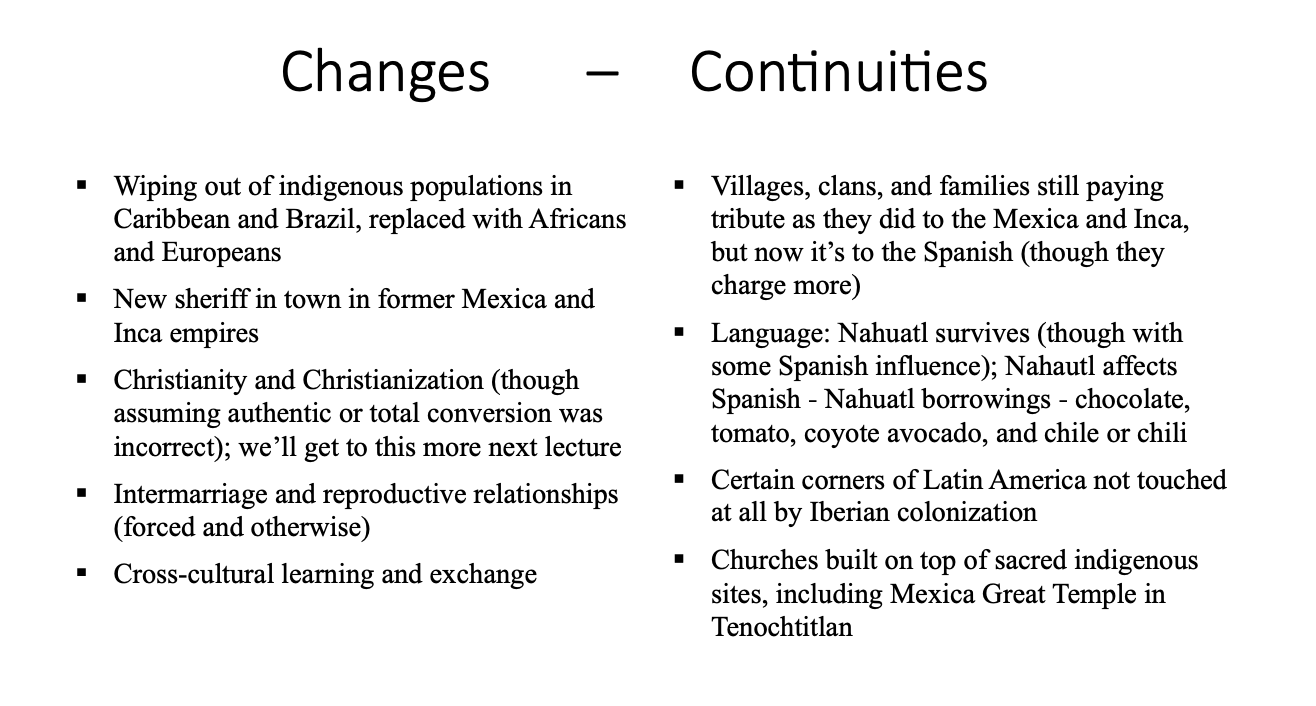
How did colonial administrative systems work?
There were Spanish Viceroyalties and Audiencias, Portuguese Captaincies, and some land grants with governing privileges, but their effectiveness varied, with successful ones continuing over time. While the colonial powers eventually reclaimed others, and indigenous governance structures like allyus in the República de Los Indios dwindled as colonial influence grew.
What was the Encomienda system?
It was the parceling of land and the entrusting of local indigenous people to Spanish landowners (encomderos), officially for Christianization, but often exploited for free labor
The system was inherited from the Reconquista and resembled a serf-like arrangement in which they gave labor and crops to Spanish nobles
Continuation of mita system
What were some tactics used by the church ?
convert the cacique
Mass baptisms —> performance of transfer of power
Not entirely different from Mexica and Inca empires
Build churches on sacred indigenous sites, e.g. destroy the great temple of Tenochtitlan and construct cathedral on the site
What was Jerónimo de Mendieta's "Historia eclesiástica Indiana"?
It highlights the arrival of Franciscan friars in New Spain, where they were warmly received by Governor Fernando Cortés and the indigenous leaders, with the governor and other Spaniards showing respect by kissing the friars' hands; the friars then suspected superficial compliance by the indigenous people, who continued their old rituals in secret, leading to the decision to destroy indigenous temples and idols. Mendieta also emphasized the friars' role in preserving indigenous populations, noting that they defended the Indians against exploitation by Spaniards and prevented their annihilation.
Who were the Humanitarian Chrisitians?
The "original twelve" Franciscans arrived in 1524 and contributed to the preservation of indigenous knowledge by assisting with the Florentine Codex, which contained pre-conquest history and extensive information about Mexica culture, written in Nahuatl.
Who was Bernardino de Sahagun?
He was a part of the Franciscan order. He acknowledged the superiority of Mexica family organization and childcare practices compared to those in Spain and organized the creation of the Florentine Codex in collaboration with his indigenous students.
Who was Toribio de Motolinia?
He was a part of the Franciscan order. He denounced Spanish abuses such as tributes, torture, and forced labor
What did the Jesuits do in Brazil?
They learned several variants of Tupi, and devised a grammar and vocabulary structure (“lingua geral”)
Who was Bartolomé de las Casas?
After witnessing the brutality of the encomienda system during 12 years as an encomendero, he joined the Dominican order in 1515, becoming an outspoken critic of Spanish exploitation of indigenous people and advocating for their rights.
However, it's worth noting that early on, he suggested using enslaved Africans as an alternative, though he later recanted this view.
He influences the people to issue a statement that Indigenous people are people not subhuman
He wrote the "Very Brief Account of the Devastation of the Indies" (1542) where he described the indigenous people as simple, obedient, and peaceful, highlighting the brutal actions of the Spanish conquerors
His book “A Brief Account of the Destruction of the Indies," (1552) became highly influential in Europe, particularly among Protestants (because it showed catholic cruelty) during religious wars
What was and what was the reaction to the “New Laws of the Indies for the Good Treatment and Preservation of the Indians" were enacted by Charles V?
It prohibited the enslavement and cruel treatment of indigenous people, ended the encomienda system, and offered protections for access to indigenous land and religious instruction.
Encomenderos rebelled against the New Laws, leading to their enforcement being stopped in New Spain. A violent revolt in Peru resulted in the death of the viceroy.
In 1545, Charles V officially revoked the New Laws, but they had a lasting impact, laying the groundwork for international human rights law and reflecting the influence of "humanitarian" Christians.
What were the two examples of colonial hegemony?
Religion and Patriarchy
How was religion used as a form of cultural hegemony?
Christianity's acceptance by indigenous and enslaved Africans marked them as newcomers under the rule of the "true believers," which was deemed to be superior.
The Church exercised its dominance through education, timekeeping, significant life events, and even place names.
How was patriarchy used as a form of cultural hegemony?
The Church having an all-male hierarchy
Iberian law granting husbands control over their wives and children
Women, especially indigenous and Afro-descendant individuals, were accused of heresy and witchcraft when practicing traditional medicine. However, these women also served as healers and providers of remedies, reflecting cultural adaptation and resistance to colonial norms.
What are examples of transculturation?
In the 1580s, black women singing in church choirs brought African influence to Cuban music.
Enslaved Africans also joined Catholic festivals and mixed their dances and songs with African rhythms..
Indigenous artists similarly integrated sacred plant and animal motifs, including rainbows in the Andes, into the mural paintings of Catholic cloisters.
Why is the Virgin of Guadalupe important?
Symbol of transculturation
The appearance of the Virgin of Guadalupe in 1531 on a sacred indigenous site led to the gradual acceptance of this figure as the patron saint of Mexico, bridging Spanish and indigenous religious traditions and increasing indigenous participation in the colonial faith.
What did Columbus notice about the indigenous people he encountered in the Caribbean?
Ssome indigenous people wore small bits of metal, indicating the presence of gold. He believed that there was a king with great quantities of gold to the south of the island.
How did the pursuit of gold affect the indigenous people, especially the Arawaks?
The pursuit of gold quickly exhausted the existing gold in the Caribbean, leading to the exploitation of the Arawaks and subjecting them to crushing physical labor.
What strategies and methods did the Spanish use to extract gold and silver from the colonies?
The Spanish employed various methods for mining, including the use of indigenous and African labor, particularly through the mita system. Mercury amalgamation was introduced as an efficient way to extract silver.
How were gold and silver transported to Spain?
Silver and gold were transported to Spain on Spanish fleets, known as the flotilla, which carried the precious metals from port cities in the colonies, such as Lima and Veracruz.
There were 50 ships that made two journeys a yeahr
What was the role of the royal fifth (real quinto) and how did it shape the development of the Spanish colonial state?
It was a 20% tax on mining, served as the primary source of revenue for the Spanish colonial state. The maintenance and administration of this tax led to the formation of territorial boundaries and the creation of viceroyalties responsible for enforcing it.
In 1540s, 65% of all royal revenues went to paying debts, mostly to foreign bankers (German, Genoese, Flemish, and Spanish)
Where were Indigenous tactics of mining used?
Potosi
So high in elevation, that agriculture was essentially impossible. Food and supplies brought up by mule, which then carried down the mined silver
At altitude, Spanish smelting techniques (using a bellows) did not work, so relied on indigenous techniques (channeling wind) in deep shaft mines.
What the colonial mita like?
So brutal that many flee their communities, giving up status as originarios (land rights but obligations to colonial state) to become forasteros, no communal rights.
Who was Felipe Guaman Poma de Ayala?
Andean nobleman and administrator in Viceroyalty of Peru
Wrote The First New Chronicle and Good Government in 1615 which was a history of the Incas and 1200 page letter to Spanish king
Wrote about abuses of encomenderos, corregidores (colonial administrators), and Church officials both in terms of their explotation of women but as their abuse of miners
What were Guama Poma’s recommendations?
Prohibit physical abuse
Keep food and water stored inside mines in case of trap
Only 20-years-old and up can work
Only healthy workers in mercury mines, and only for one day
Thieves, bandits, and convicted criminals of all races should be sent as slaves in mercury mines to live out their lives serving God and King
Why was Spain poor despite the wealth of their colonies?
In 1540s, 65% of all royal revenues went to paying debts, mostly to foreign bankers (German, Genoese, Flemish, and Spanish)
Wars against Protestantism, expulsion of Jews and Arabs (sending capital and expertise elsewhere), and failure to reinvest surplus (extravagant royalty).
What were the conditions like during the Middle Passage?
Enslaved Africans endured unspeakable suffering, including overcrowding, disease, starvation, and physical abuse. Approximately 15-20% of enslaved individuals would die during each passage, resulting in over one million deaths in total.
There are not many first-hand accounts of the Middle Passage due to its extreme brutality and low literacy rates
Who was Olaudah Equiano?
He was enslaved as a child at the age of 11, transported to the Caribbean, and eventually sold to a Royal Navy officer. He received some education while enslaved and later purchased his own freedom in 1766. Equiano settled in England and became an active abolitionist.
How did Olaudah Equiano describe his experience upon arriving at the coast and being taken on board a slave ship?
Olaudah Equiano described his initial experience upon arriving at the coast as filled with astonishment and terror. He was struck by the sight of a slave ship waiting for its cargo. When taken on board, he was subjected to examination and handling by the crew. The differences in complexion, appearance, and language of the Europeans on the ship added to his fear and belief that he had entered a world of "bad spirits." He expressed extreme horror and disorientation in that moment.
What characterized the plantation economy?
A large-scale, capitalist agricultural system characterized by features such as owner control over a coerced labor force from imported labor because population is not sustainable
Feudal feature —> owners control
Subject to control from europe
What were everyday forms of resistance by enslaved people?
Work slow-downs
Stealing
Culture: language, religion
Running away
What were quilombos?
Communities of runaway enslaved people in Brazil’s interior
What was an engenho?
A complex where sugar cane was milled and its juice boiled down into cakes for export
They were like mini cities, housing various facilities including a chapel, stables, storage areas, and slave quarters, often employing several hundred enslaved workers.
They played a significant role in the sugar production industry of the Americas, particularly in Portuguese-controlled territories, and had the effect of limiting the growth of urban centers in these regions.
Which regions in Brazil were particularly associated with sugar production?
Bahia and Pernambuco
What advantage did sugar production offer to new investors?
Had a “clean slate" advantage, meaning that new investors could provide fresh capital to innovate new technologies, leading to higher yields.
What was the significance of sugar production in the colonial Americas?
It required significant capital investment to manufacture molasses or sugar crystals on plantations.
The Americas, especially the northeastern region of Brazil, had red rich soils ideal for sugar cultivation.
Taxes on sugar exports played a crucial role in generating colonial revenue for the Portuguese crown.
How did the sugar industry evolve from the 11th to the 15th centuries in the Atlantic islands?
Sugar production migrated west across the Caribbean to Atlantic islands like Madeira, São Tomé, and the Canaries during this period.
 Note
Note  Flashcards (21)