Pleistocene Ice Ages
 Call Kai
 Learn
Learn Practice Test
 Spaced Repetition
 Match
Match Flashcards
 Knowt Play
1/34

There's no tags or description
Looks like no tags are added yet.
Name | Mastery | Learn | Test | Matching | Spaced | Call with Kai |
|---|
No analytics yet
Send a link to your students to track their progress
35 Terms
PQS9.1. IDENTIFY and EXPLAIN the primary trends and climate events of the past 65 million years based on oxygen isotope data
During an ice age, there is a lot of ice, which comes from precipitation, that is stored in ice sheets, and not returned to the ocean. What happens to S18O (isotope 18) the value of ocean water during this time?
It will increase because the ice takes away the light isotopes.
Because this "light" water is trapped on land and not returned to the sea, the remaining ocean water becomes proportionally enriched in the heavier isotope, 18O, causing its value to increase.
Higher s18O colder/warmer temperatures
Lower S18O colder/warmer temperatures
Higher s18O colder temperatures
Lower S18O warmer temperatures
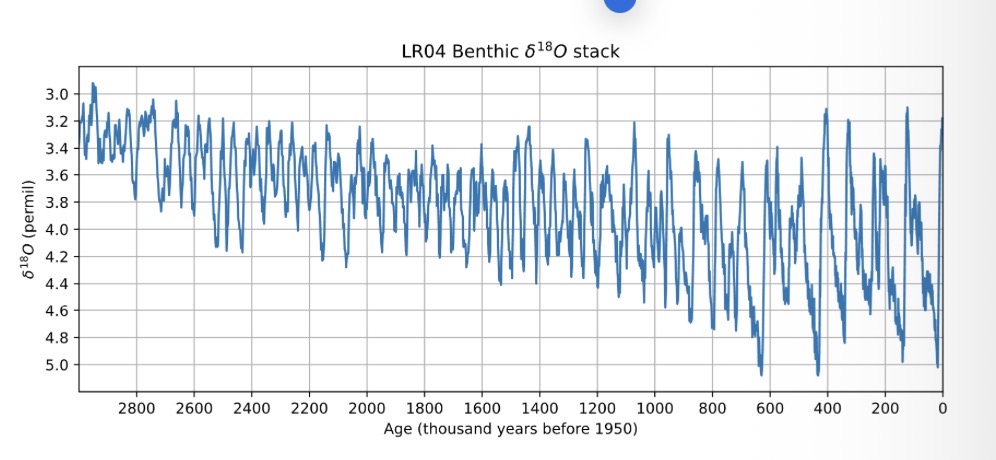
IDENTIFY and EXPLAIN the primary trends and climate events of the past 65 million years based on oxygen isotope data
Based on the benthic S18O record below, which of the following statements are TRUE? Choose all that apply.
The long-term temperature trends is such that temperature has become progressively colder for the past 3 million years.
The 4 most recent ice age cycles have a larger amplitude than earlier ones.
IDENTIFY and EXPLAIN the primary trends and climate events of the past 65 million years based on oxygen isotope data
Compare the oxygen isotopic composition of water in the ocean vs. ice in Greenland ice sheets.
The ocean is “heavier” than the ice on Greenland.
During colder periods (ice ages):
More ¹⁶O gets locked in ice sheets
Oceans become even more enriched in ¹⁸O (heavier)
This is why oxygen isotope ratios in ocean sediments are used to reconstruct past climate
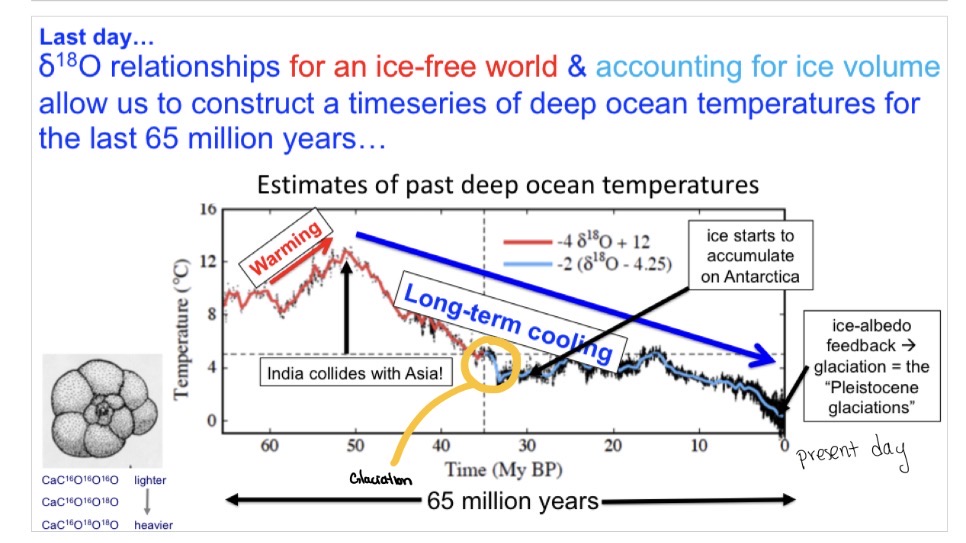
PQS9.4. IDENTIFY and EXPLAIN the primary trends and climate events of the past 65 million years based on oxygen isotope data
If you were interpreting a record of S18O measured from the shells of benthic forams and you saw a period of time during which the S18O value was exceptionally low (i.e. S18O was a low number), how would you interpret the data? During that time period_____.
either water temperature was relatively warm, there was not much ice was on land, or both.
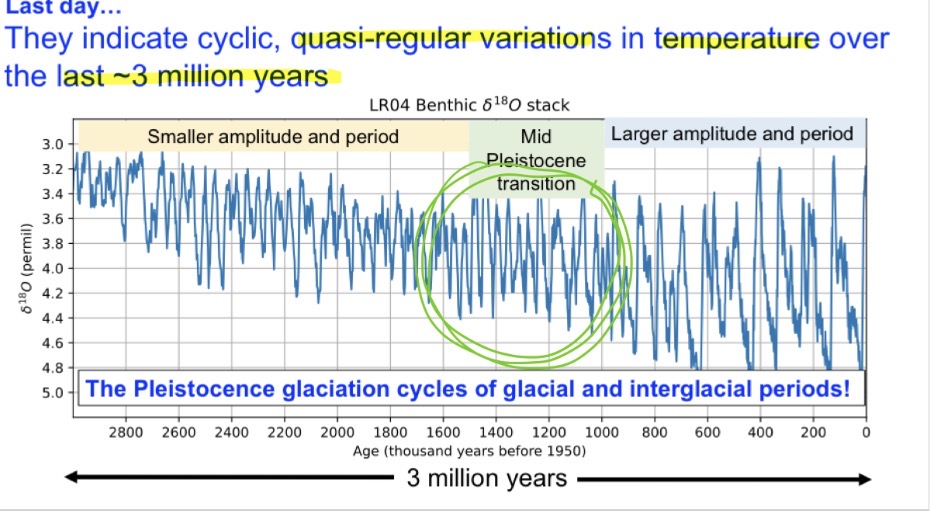
PQS9.5. EXPLAIN what evidence supports the orbital theory of recurring ice ages during the Pleistocene
How does the oxygen isotope record from the shells of forams support the orbital theory of recurring ice ages during the Pleistocene?
The oxygen isotope cycles occur at the same periodicities as the orbital cycles.
EXPLAIN what evidence supports the orbital theory of recurring ice ages during the Pleistocene
How does the temperature record inferred from marine oxygen isotope measurements compare to the temperature record inferred from atmospheric CO2 derived from ice cores?
The two records match very well, both in periodicities and amplitude.
COMPARE orbital configurations that favor glaciation versus those that favor deglaciation
What effect does Earth's precession have on the distribution of solar radiation at times when Earth’s orbit is circular?
Precession has no effect.
Precession only matters when eccentricity > 0 (elliptical orbit)
If the orbit were perfectly circular:
No perihelion/aphelion difference
No seasonal energy shift from precession
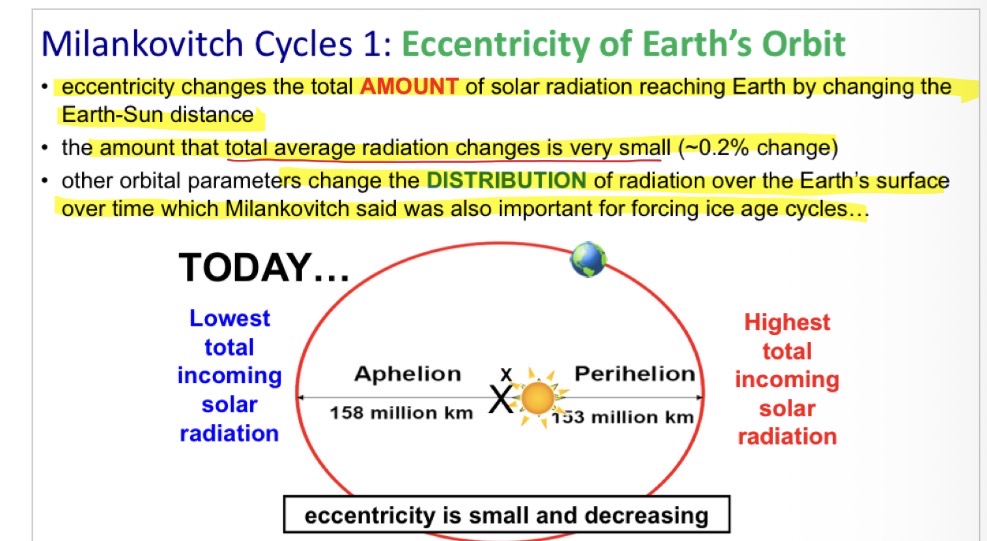
Eccentricity of Earth’s orbit around the sun
How circular vs. elliptical
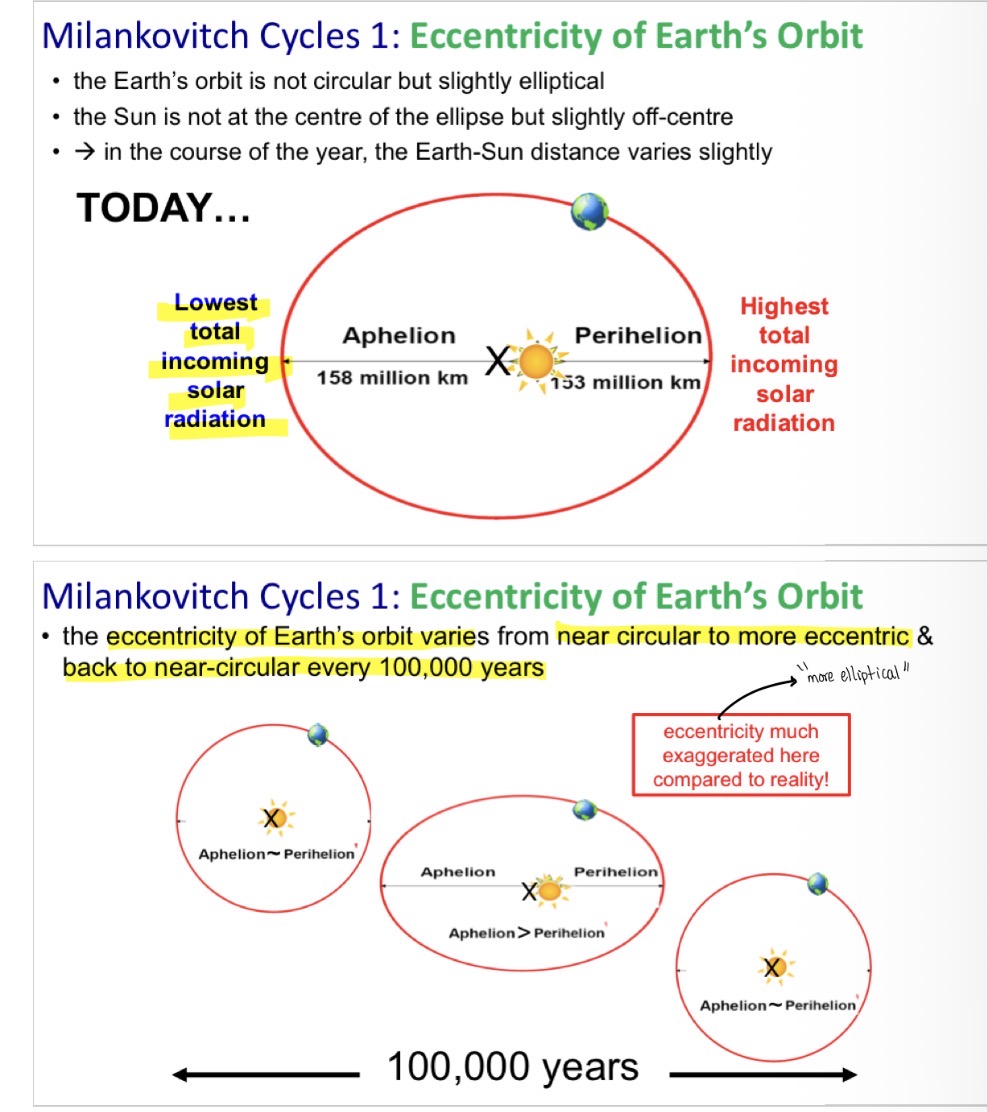
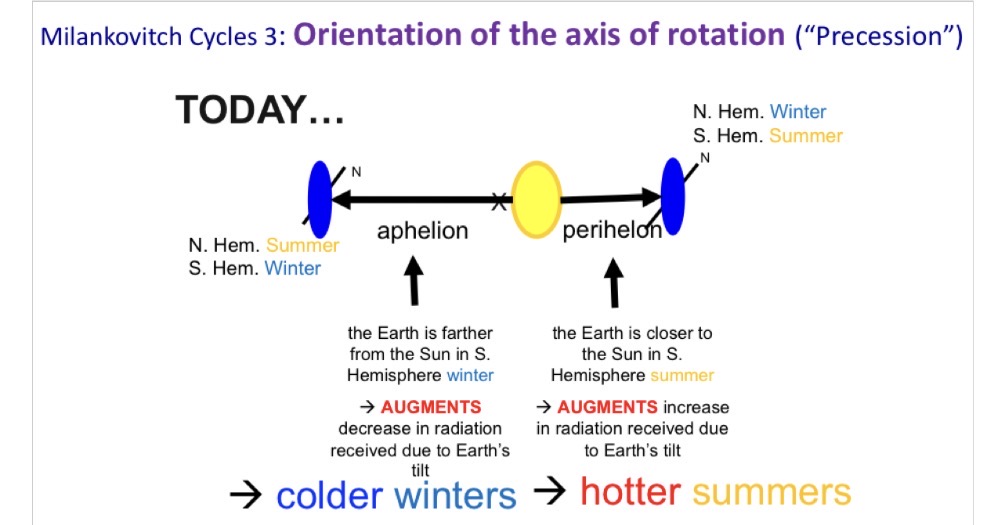
Aphelion
The point where Earth is farthest to the Sun
(Receives slightly less solar energy)
Seasons are milder
Summer at aphelion (closer to sun)
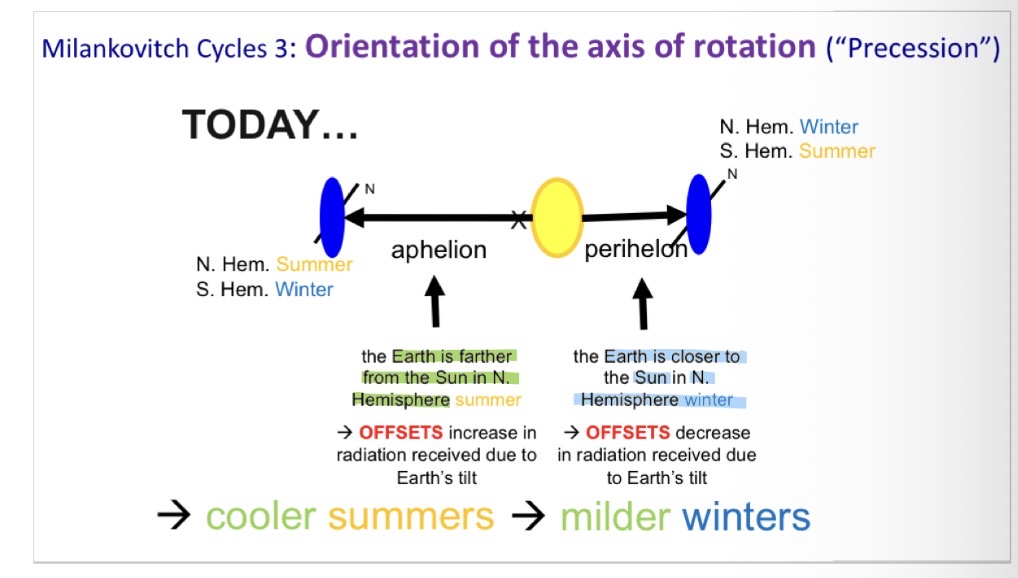
→cooler summers, milder winters
→lower seasonal contrast
For ice ages:
Cooler northern hemisphere summers at aphelion
→snow doesn’t melt → ice sheets grow (glaciation)
Perihelion
The point where Earth is closest to the Sun
Early Jan
→ Earth receives slightly more solar energy
→ can make seasons more intense
Summer at perihelion (closer to sun)
Hotter summers, cold winters
Greater seasonal contrast
Matters for ice ages
Warm northern hemisphere summers (at perihelion)
→ ice melts→ deglaciation
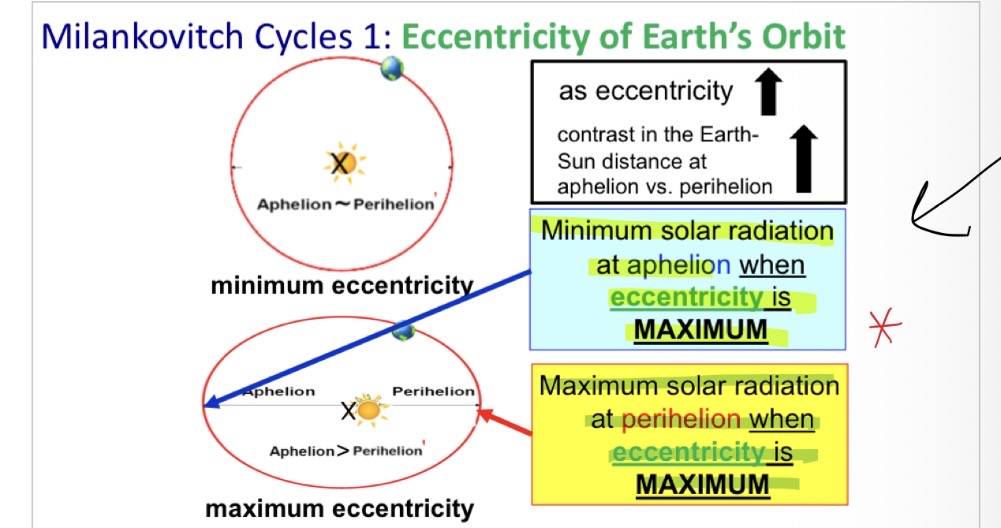
Eccentricity
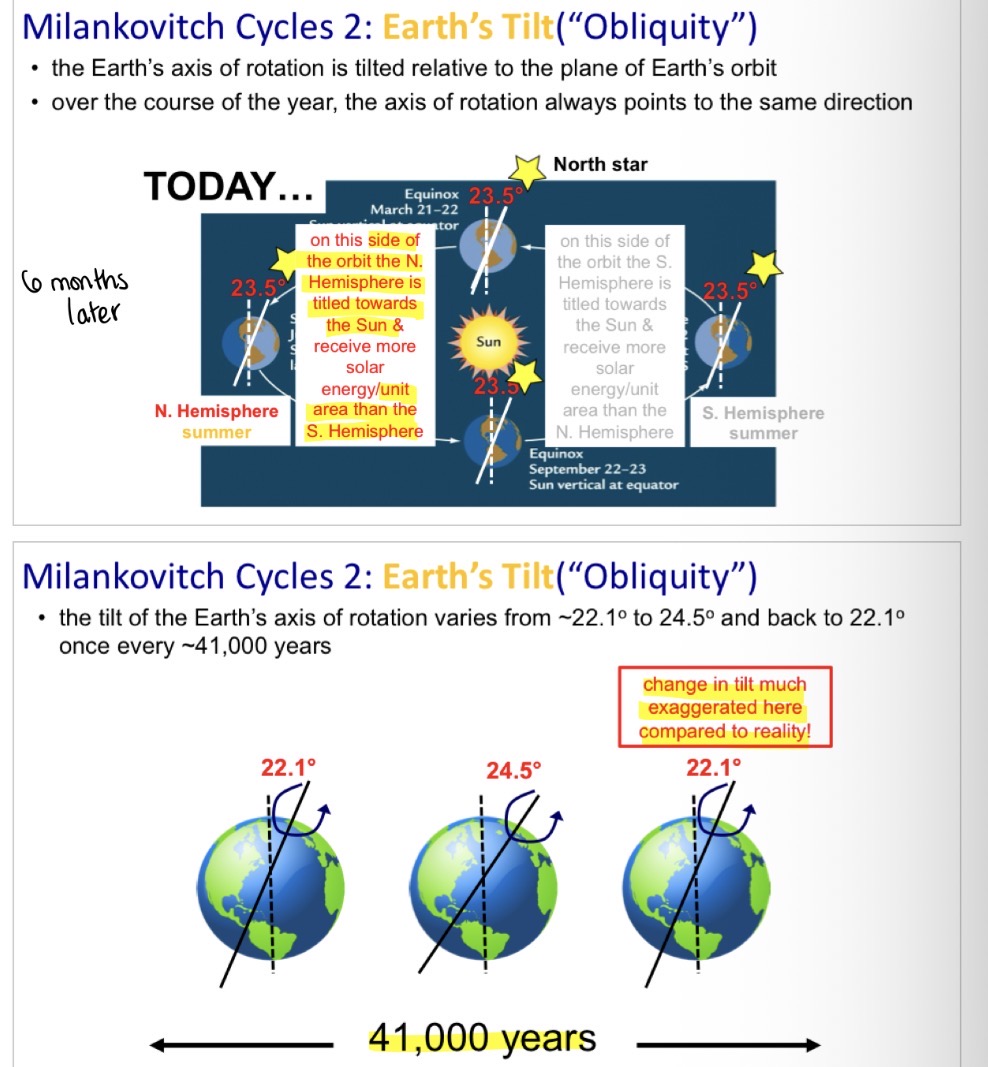
Magnitude of Earth’s tilt (earth’s obliquity)
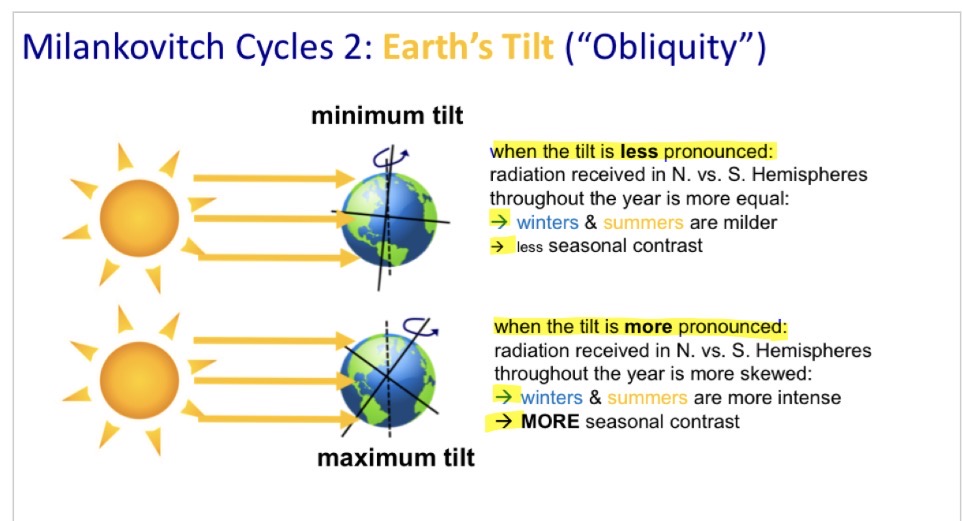
Magnitude of Earth’s tilt (earth’s obliquity)
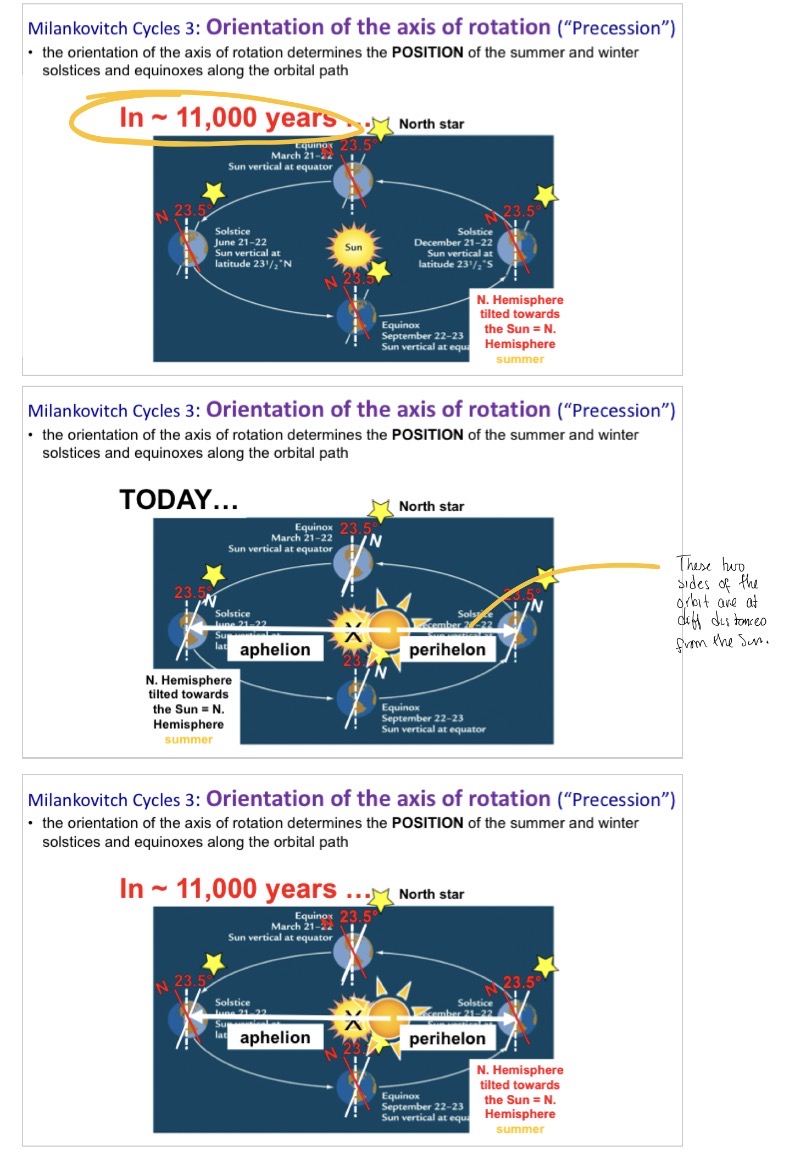
Orientation of the axis of rotation (precession)
PQS9.9. COMPARE orbital configurations that favor glaciation versus those that favor deglaciation
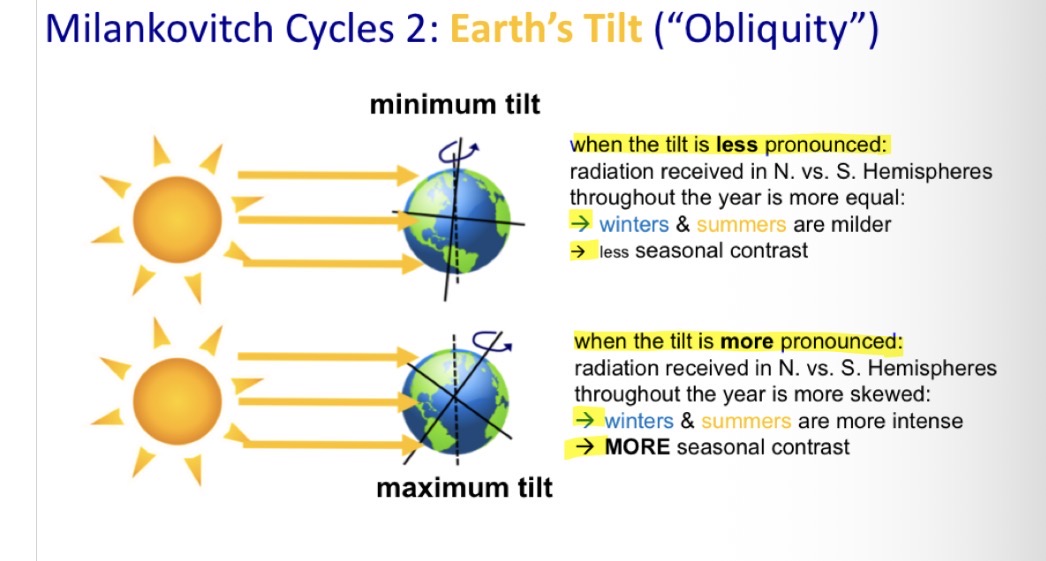
The tilt of the Earth’s axis of rotation (Earth's 'obliquity') varies between 24.5° and 22.1° every 41,000 years. When this tilt is maximum:
In winter the sun is higher/lower above the horizon.
In summer, the sun is higher/lower above the horizon
Wingers and summers are more/less extreme
In winter the sun is lower above the horizon.
In summer, the sun is higher above the horizon
Wingers and summers are more extreme
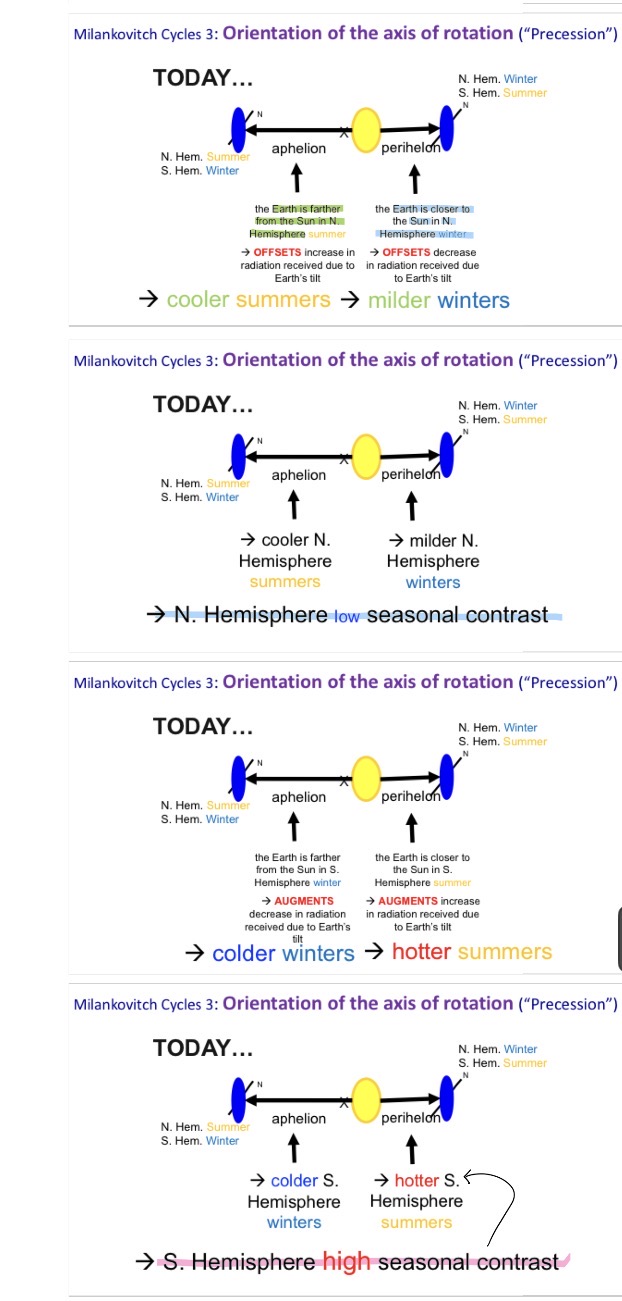
Precession
Orientation of the axis rotation.
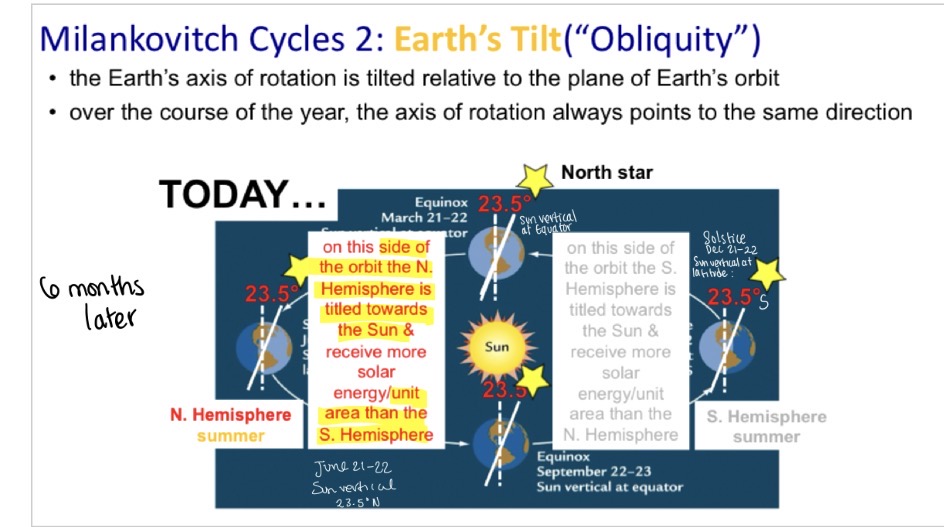
milankovitvh cycles: earth’s tilt
COMPARE orbital configurations that favor glaciation versus those that favor deglaciation
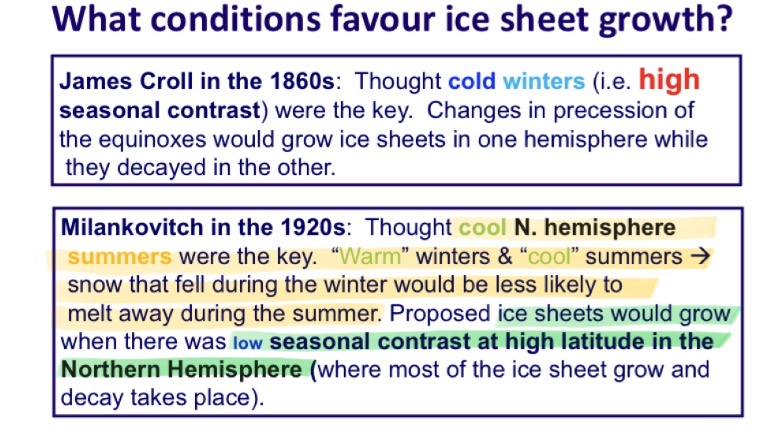
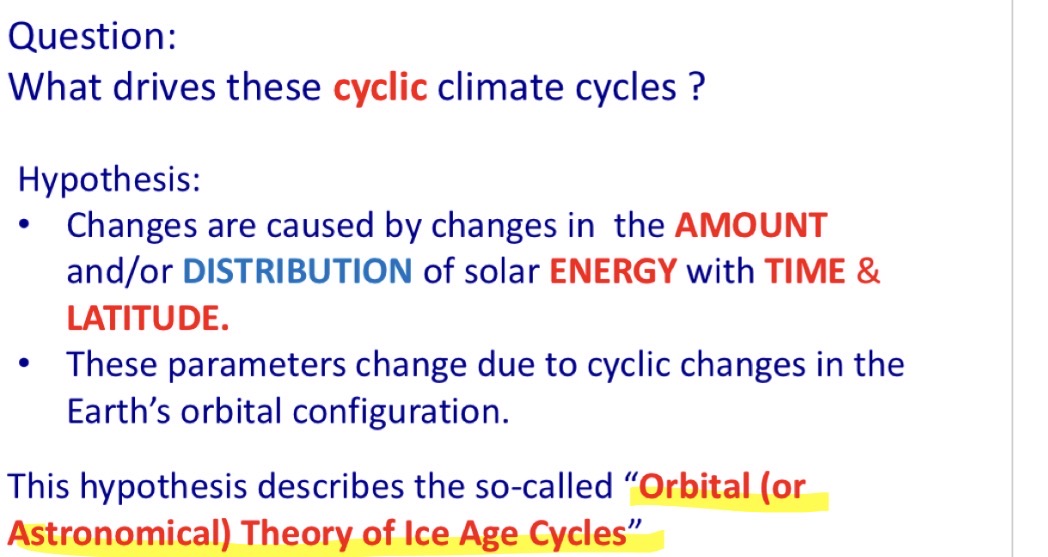
Initiation of an ice age requires:
(a)
harsh winters in the Northern Hemisphere.
(b)
mild summers in the Southern Hemisphere.
(c)
harsh winters in the Southern Hemisphere.
(d)
mild summers in the Northern Hemisphere.
d) mild summers in the Northern Hemisphere.
COMPARE orbital configurations that favor glaciation versus those that favor deglaciation
Variation in which of these orbital parameters can change the annual average amount of solar radiation received by Earth? How circular vs elliptical it is.
Eccentricity
The more eccentric the more elliptical
PQS9.11. COMPARE orbital configurations that favor glaciation versus those that favor deglaciation
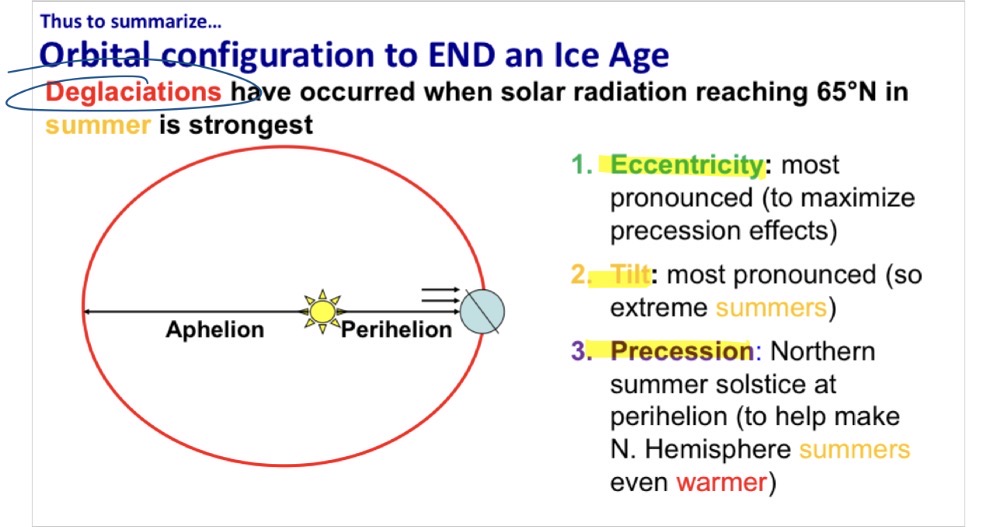
Which conditions of the Earth’s orbit would be best for deglaciation (melting of large continental ice sheets in the Northern Hemisphere)?
Eccentricity: high/low
Tilt (obliquity): high/low
Precession such that:
Which conditions of the Earth’s orbit would be best for deglaciation (melting of large continental ice sheets in the Northern Hemisphere)?
Eccentricity: high
Tilt (obliquity): high
Precession such that: Northern winter solstice is at aphelion
CONSTRUCT amplifying feedback loops that amplify Pleistocene climate cycles
Which of these statements describes a feedback loop between ice extent and temperature?
Warner temperature → ice melts/grows → higher/lower albedo → warmer/colder temperature
Warner temperature → ice melts/grows → higher/lower albedo → warmer/colder temperature
CONSTRUCT amplifying feedback loops that amplify Pleistocene climate cycles
During glacial maxima, atmospheric was lower because:
more was stored in Antarctic Bottom Water thanks to a weakening of the density-driven ocean circulation
is more soluble at cold temperature
the biological pump was more active
CONSTRUCT amplifying feedback loops that amplify Pleistocene climate cycles
Which of these statements describes an amplifying feedback loop involving that can help grow an ice sheet.
T decrease
less vegetation → more dusty planet → more active biological pump → decrease atmospheric CO2
colder ocean water → dissolve more CO2 in the ocean → decrease atmospheric CO2
weaker overturning circulation → more CO2 stored in the deep ocean → decrease atmospheric CO2
Greenhouse gas feedbacks
Solubility pump
The rate of deep ocean
The sea-ice lid
The biological pump
Greenhouse gas feedbacks
The solubility pump when water temp gets colder
When water temp gets colder → CO2 dissolves in the ocean → less CO2 in atmosphere = atmospheres less greenhouse warming
Greenhouse gas feedbacks
The solubility pump when water temp gets warmer
Solubility pump when water temp gets warmer→less CO2 dissolves in the ocean → more CO2 in atmosphere = more greenhouse warming
Greenhouse gas feedbacks
The rate of deep ocean overturning when circulation slows down → more CO2 stored in the deep ocean.
, the
The rate of deep ocean overturning when circulation slows down → more CO2 stored in the deep ocean.
Slow rate of circulation in deep ocean → increases the residence time of carbon in deep ocean → more CO2 accumulates in deep ocean → cooling → less CO2 in atmosphere → cooling
During the last last glacial maximum ,the density driven circulation was slower and shallower and cold CO2 rich water was stored in Antarctic Bottom Water which filled about half of the world ocean basins.
Greenhouse gas feedbacks
The rate of deep ocean overturning when circulation speeds up/becomes deeper → more CO2 stored in the deep ocean.
The rate of deep ocean overturning when circulation speeds up/becomes deeper → more CO2 stored in the deep ocean.
Deeper/rapid rate of circulation in deep ocean → decreases the residence time of carbon in deep ocean → less CO2 accumulates in deep ocean → warming → more CO2 in atmosphere → warming
Greenhouse gas feedbacks
The sea-ice lid when
CONSTRUCT amplifying feedback loops that amplify Pleistocene climate cycles
If the rate of the density-driven ocean circulation decreased, what would happen to atmospheric CO2 ?
(a)
Atmospheric CO2 would remain unchanged.
(b)
Atmospheric CO2 would decrease.
(c)
Atmospheric CO2 would increase.
Atmospheric CO2 would decrease.
Cooling → weaker circulation / more stratified oceans
More carbon stored in deep ocean → lower atmospheric CO₂
Lower CO₂ → further cooling

