The Endomembrane System and Protein Sorting
 Studied by 0 people
 Call Kai
 Learn
Learn Practice Test
 Spaced Repetition
 Match
Match Flashcards
 Knowt Play
1/86

There's no tags or description
Looks like no tags are added yet.
Name | Mastery | Learn | Test | Matching | Spaced | Call with Kai |
|---|
No analytics yet
Send a link to your students to track their progress
87 Terms
Each of the following is an endoplasmic reticulum function except
peptide folding. |
addition of carbohydrate to proteins to make glycoproteins. |
the export of protein that cannot be folded into the cytoplasm for destruction. |
the assembly of multimeric proteins. |
All are endoplasmic reticulum functions. |
All are endoplasmic reticulum functions.
In which of the following organelles would you expect to first find a protein destined to be secreted from a cell?
secretory vesicle |
lysosome |
Golgi apparatus |
endosome |
endoplasmic reticulum |
endoplasmic reticulum
smooth ER functions
lipid synthesis, calcium ion storage, and poison detoxification
rough ER functions
protein synthesis
Golgi apparatus functions
protein modification and sorting, and cisternal maturation
lysosomes functions
autophagy and macromolecule digestion
All proteins are synthesized by ribosomes in the cell. Some ribosomes float freely in the cytosol, while others are bound to the surface of the endoplasmic reticulum. Most proteins made by free ribosomes function in the cytosol. Proteins made by bound ribosomes either function within the endomembrane system or pass through it and are secreted from the cell.
Which of the following proteins are synthesized by bound ribosomes?
lysosomal enzyme |
ER protein |
actin |
DNA polymerase |
insulin |
ribosomal protein |
lysosomal enzyme, ER protein and insulin
Proteins that are secreted from a eukaryotic cell must first travel through the endomembrane system.
Drag the labels onto the diagram to identify the path a secretory protein follows from synthesis to secretion. Not all labels will be used.
Protein synthesis —> endoplasmic reticulum—> cis Golgi cisternae—> medial Golgi cisternae—→ trans Golgi cisternae—→ plasma membrane —→ extracellular space
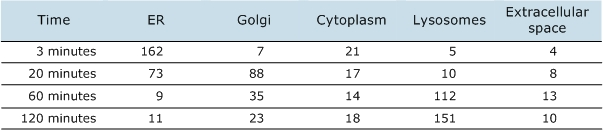
Scientists can track the movement of proteins through the endomembrane system using an approach known as a pulse-chase experiment. This experiment involves
the “pulse” phase: Cells are exposed to a high concentration of a radioactively labeled amino acid for a short period to tag proteins that are being synthesized.
the “chase” phase: Any unincorporated radioactively labeled amino acids are washed away and large amounts of the same, but unlabeled, amino acid are added.
Only those proteins synthesized during the brief pulse phase are radioactively tagged. These tagged proteins can be tracked through the chase period to determine their location in the cell. The data below were obtained from a pulse-chase experiment in which cells were examined at different times during the chase period. The numbers represent the radioactivity (measured in counts per minute) recorded at each of the indicated sites. The higher the number, the greater the radioactivity.
Based on these data, what is the most likely function of the cells in this experiment?
muscle contraction |
detoxification |
secretion |
phagocytosis |
phagocytosis
Exocytosis function’s part 1
secrets large molecules out of the cell
Exocytosis function’s part 2
requires fusion of vesicles with the plasma membrane
Exocytosis function’s part 3
increases the surface area of the cell
endocytosis functions part 1
form vesicles inward folding of the plasma membrane
endocytosis functions part 2
decreases the surface area of the cell
Both endocytosis and exocytosis part 1
requires cellular energy
Both endocytosis and exocytosis part 2
transported substances never physically crosses the plasma membrane
Options: endoplasmic reticulum, plasma membrane, cis-Golgi network (CGN), trans-Golgi network (TGN), and medial cisternae of the Golgi stack
Proteins destined for secretion are a common type of cargo that transits through the Golgi apparatus. These proteins begin in the____and are next routed to the___. From there, they pass through the____, then the____, and eventually are secreted at the____.
Proteins destined for secretion are a common type of cargo that transits through the Golgi apparatus. These proteins begin in the endoplasmic reticulum and are next routed to the cis-Golgi network (CGN). From there, they pass through the medial cisternae of the Golgi stack, then the trans-Golgi network (TGN), and eventually are secreted at the plasma membrane.
What type of movement decribes the transport of cargo between the trans-Golgi network and the cis-Golgi network in these two models?
cisternal movement |
secretory movement |
anterograde movement |
retrograde movement |
cytosolic movement |
retrograde movement
Why is retrograde movement through the Golgi stacks an important feature of the cisternal maturation model?
It describes the movement of the Golgi stacks as they mature. |
Enzymes that move forward through the Golgi as stacks mature need to be returned to earlier Golgi compartments. |
This movement is important for delivering enzymes to the Golgi from the endoplasmic reticulum. |
Proteins destined for secretion use this movement to move toward the plasma membrane. |
Retrograde movement is only important in the stationary cisternae model and NOT involved in the cisternal maturation model. |
Enzymes that move forward through the Golgi as stacks mature need to be returned to earlier Golgi compartments.
You find a way to fluorescently label the membrane of the medial Golgi stacks. Which experimental result would best support the stationary cisternae model?
The fluorescence remains in place at the medial cisternae. |
The fluorescent signal moves to the endoplasmic reticulum. |
The entire Golgi becomes fluorescent. |
The fluorescence moves to the trans-Golgi network and then disperses into vesicles. |
The fluorescence moves to the cis-Golgi network and then disperses into vesicles. |
The fluorescence remains in place at the medial cisternae.
Stationary cisternae model components (part 1)
Golgi enzymes remain in place in the stacks
Stationary cisternae model components (part 2)
Golgi stacks are fixed structures
Stationary cisternae model components (part 3)
cargo is moved through the Golgi in shuttle vesicles
Cisternal maturation model components (part 1)
cargo is moved through the Golgi in stacks themselves
Cisternal maturation model components (part 2)
Golgi stacks gradually change in composition as they move forward
Cisternal maturation model components (part 3)
Golgi enzymes must be continuously moved backward to return them to their proper site of action
Rough ER components part 1
usually consists of flattened sacs
Rough ER components part 2
has ribosomes attached to the outer (cytosolic) surface
Rough ER components part 3
is the site for the biosynthesis of secretory proteins
Rough ER components part 4
is the site for the folding of membrane-bound proteins
Smooth ER components Part 1
tends to form tubular structures
Smooth ER components Part 2
is involved in the breakdown of glycogen
Smooth ER components Part 3
is involved in the detoxification of drugs
Both rough and smooth ER component’s part 1
visible only by electron microscopy
Both rough and smooth ER component’s part 2
contains less cholesterol than the plasma membrane
In which of the following organelles would you expect to first find a protein destined to be secreted from a cell?
secretory vesicle |
lysosome |
Golgi apparatus |
endosome |
endoplasmic reticulum |
endoplasmic reticulum
Each of the following is part of the core oligosaccharide side chain in the ER except
erythrose. |
N-acetyl glucosamine. |
glucose. |
mannose. |
All are part of the core oligosaccharide. |
erythrose.
A protein that is N-glycosylated is expected to be
retained in the endoplasmic reticulum. |
secreted from the cell. |
imported into a cell by endocytosis. |
localized in the Golgi body. |
a peroxisome enzyme. |
secreted from the cell.
Explain why the carbohydrate groups of membrane glycoproteins are always found on the outer surface of the plasma membrane.
Outer monolayer originally faced the interior of the rough ER and Golgi, where the enzymes involved in glycosylation are located. |
Outer monolayer originally faced the exterior of the rough ER and Golgi, where the enzymes involved in glycosylation are located. |
Outer monolayer originally faced the interior of the rough ER and Golgi, where the enzymes involved in protein hydrolysis are located. |
Outer monolayer originally faced the exterior of the rough ER and Golgi, where the enzymes involved in protein hydrolysis are located. |
Outer monolayer originally faced the interior of the rough ER and Golgi, where the enzymes involved in glycosylation are located.
What assumption did you make about biological membranes in order to answer the queston before this one?
Membrane asymmetry is maintained throughout the rough ER, Golgi, and plasma membrane. |
Membrane asymmetry is maintained throughout the smooth ER, Golgi, and plasma membrane. |
Membrane asymmetry is not maintained throughout the rough ER, Golgi, and plasma membrane. |
Membrane asymmetry is not maintained throughout the rough and smooth E |
Membrane asymmetry is maintained throughout the rough ER, Golgi, and plasma membrane.
Describe the synthesis and glycosylation of glycoproteins of the plasma membrane.
Options: fatty acid exterior, Golgi complex, smooth ER, interior, rough ER, oligosaccharide
Integral membrane proteins are synthesized on the 1._____, with 2.____ side chains added in part on the lumenal side of the 3._____ (core glycosylation) and in part on the lumenal side of the 4.____ (terminal glycosylation). Side chains therefore face the 5. _____ of both organelles as well as the 6.____ of transport vesicles and become oriented toward the 7._____ of the cell when the vesicles fuse with the plasma membrane.
integral membrane proteins are synthesized on the rough ER, with oligosaccharide side chains added in part on the lumenal side of the rough ER (core glycosylation) and in part on the lumenal side of the Golgi complex (terminal glycosylation). Side chains therefore face the interior of both organelles as well as the interior of transport vesicles and become oriented toward the exterior of the cell when the vesicles fuse with the plasma membrane.
Cotranslational insertion of proteins into the ER component
requires cytosolic SRP
Posttranslational insertion of proteins into mitochondria
relies heavily on chaperones proteins
Both Cotranslational insertion and Posttranslational insertion part 1
utilizes a petidase
Both Cotranslational insertion and Posttranslational insertion part 2
uses a signal sequence
Both Cotranslational insertion and Posttranslational insertion part 3
has a membrane-bound receptor and pore-forming complex for protein entry
Which of the following organelles does not receive proteins by posttranslational import of proteins synthesized on cytoplasmic ribosomes?
Lysosome |
Mitochondria |
Peroxisomes |
Chloroplast |
Nucleus |
Lysosome
Ribosomes that do not anchor on the surface of the rough endoplasmic reticulum during translation most probably
have a signal peptidase error. |
are synthesizing cytoplasmic proteins. |
have a defect in ribosomal proteins that allow attachment to the surface. |
do not make the appropriate anchor protein. |
All of the above are probable reasons. |
are synthesizing cytoplasmic proteins.
When a membrane protein is radioactively labeled during synthesis and followed through the various organelles in the secretory pathway, all the radioactivity is concentrated in the cis-Golgi apparatus six hours after the protein synthesis. This suggests that the protein
has a mannose-6-phosphate tag. |
has a membrane-spanning domain length equals the thickness of the cis-Golgi membrane. |
is misfolded and being degraded in the cis-Golgi. |
contains a KDEL sequence near its C-terminus. |
was imported directly into the cis-Golgi posttranslationally. |
has a membrane-spanning domain length equals the thickness of the cis-Golgi membrane.
BiP is found in high concentration in the lumen of the ER but is not present in significant concentrations elsewhere in the cell. How do you think this condition is established and maintained?
BiP contains a tripeptide sequence RXR, causing it to be retained in the ER. |
BiP is synthesized by the ER-bound ribosomes into the lumen of the ER. |
BiP contains a KDEL sequence, causing it to be retained in the ER. |
BiP moves from the Golgi apparatus to the lumen of the ER via transition vesicles. |
BiP contains a KDEL sequence, causing it to be retained in the ER.
If the gene encoding BiP acquires a mutation that disrupts the protein's binding site for hydrophobic amino acids, what kind of impact might this have on the cell?
BiP could no longer bind to unfolded and misfolded polypeptides. The exposed hydrophobic regions of these polypeptides would give them an opportunity to properly fold. If the polypeptides fold incorrectly, their hydrophilic regions become buried that can trigger disruptions in cell function and may even lead to cell death. |
BiP could no longer bind to unfolded and misfolded polypeptides. The exposed hydrophobic regions of these polypeptides would cause them to aggregate, forming insoluble deposits that can trigger disruptions in cell function and may even lead to cell death. |
BiP binds to hydrophilic regions of unfolded and misfolded polypeptides giving them an opportunity to properly fold. If the polypeptides fold incorrectly their hydrophobic regions become buried that can trigger disruptions in cell function and may even lead to cell death. |
BiP binds to hydrophilic regions of unfolded and misfolded polypeptides. The exposed hydrophilic regions of these polypeptides would cause them to aggregate, forming insoluble deposits that can trigger disruptions in cell function and may even lead to cell death. |
BiP could no longer bind to unfolded and misfolded polypeptides. The exposed hydrophobic regions of these polypeptides would cause them to aggregate, forming insoluble deposits that can trigger disruptions in cell function and may even lead to cell death.
Anterograde movement of transition vesicles is from __________.
the rough ER to the trans Golgi |
the trans Golgi to secrete at the plasma membrane |
the cis Golgi to the trans Golgi |
the rough ER to the cis Golgi |
the rough ER to the cis Golgi
Maturation of a lysosome occurs when __________.
acid hydrolases are packaged into vesicles and bud off the trans Golgi |
material is digested and sorted and buds off the lysosome |
late endosomes acidify to activate the acid hydrolases |
early endosomes fuse with endocytosed vesicles |
late endosomes acidify to activate the acid hydrolases
What types of substances would move retrograde to the rough ER?
rough ER retention tags |
amino acids from the lysosomes to be used in protein synthesis |
proteins with a KDEL retrieval tag |
proteins with the amino acid sequence R-X-R |
proteins with a KDEL retrieval tag
What process involves proteins in vesicles being held at the plasma membrane until the cell is signaled to release them?
exocytosis |
early endosome packaging |
regulated secretion |
constitutive secretion |
regulated secretion
Imagine that you are a cellular biologist studying the processing of a lysosomal protein. When you mutate a specific amino acid in its sequence, the protein accumulates in the trans cisternae of the Golgi complex and is NOT transported to the lysosome. What is a possible cause of this?
A glycosylation site has been removed. |
The mutation has created an ER retrieval tag. |
The protein is being recognized as misfolded by the ERAD system. |
The cells lack an enzyme to phosphorylate mannose residues. |
A glycosylation site has been removed.
Which of the following statements is false regarding phagocytosis?
It involves the projection of pseudopods. |
It is mediated by clathrin at the plasma membrane. |
It is used by macrophages and neutrophils to ingest bacteria. |
It is used by amoebae to ingest food. |
It can ingest large particles. |
It is mediated by clathrin at the plasma membrane.
Addition of the drug colchicine to cultured fibroblast cells inhibits movement of transport vesicles.
Colchicine is a drug that prevents microtubule assembly, thereby disrupting microtubule-based functions. |
Colchicine is a drug that prevents endocytosis, thereby disrupting phagocytic functions. |
Colchicine is a drug that prevents intermediate filament assembly, thereby disrupting intermediate filaments-based functions. |
Colchicine is a drug that prevents microfilament assembly, thereby disrupting microfilament-based functions. |
Colchicine is a drug that prevents microtubule assembly, thereby disrupting microtubule-based functions.
Certain pituitary gland cells secrete laminin continuously but secrete adrenocorticotropic hormone only in response to specific signals.
This finding suggests that the pathways for constitutive and regulated secretion, though separate, can occur simultaneously in the same cell. |
This finding suggests that the pathways for spontaneous and regulated secretion can occur asynchronously in the same cell. |
This finding suggests that the pathways for spontaneous and regulated secretion, though separate, can occur simultaneously in the same cell. |
This finding suggests that the pathways for constitutive and unregulated secretion can occur asynchronously in the same cell. |
This finding suggests that the pathways for constitutive and regulated secretion, though separate, can occur simultaneously in the same cell.
Certain adrenal gland cells can be induced to secrete epinephrine when their intracellular calcium concentration is experimentally increased.
This result suggests that exocytic secretion may be triggered in vivo by an elevation of the intracellular Ca2+ concentration. |
This result suggests that exocytic secretion may be inhibited in vivo by an elevation of the intracellular Ca2+ concentration. |
This result suggests that endocytic secretion may be inhibited in vivo by an elevation of the intracellular Ca2+ concentration. |
This result suggests that endocytic secretion may be triggered in vivo by an elevation of the intracellular Ca2+ concentration. |
This result suggests that exocytic secretion may be triggered in vivo by an elevation of the intracellular Ca2+ concentration.
Cells expressing a temperature-sensitive form of dynamin do not display receptor-mediated endocytosis after a temperature shift, yet they continue to ingest extracellular fluid (at a reduced level initially, and then at a normal level within 30-60 minutes).
This observation indicates that dynamin is essential for receptor-mediated endocytosis. However, there are also dynamin-independent pathways for ingesting extracellular fluid. When receptor-mediated endocytosis is inhibited, the rate of ingestion of extracellular fluid by other endocytic pathways increases. |
This observation indicates that dynamin is essential for receptor-mediated endocytosis. However, there are also dynamin-dependent pathways for ingesting extracellular fluid. When receptor-mediated endocytosis is induced, the rate of ingestion of extracellular fluid by other endocytic pathways decreases. |
This observation indicates that dynamin is essential for receptor-mediated endocytosis. However, there are also dynamin-independent pathways for ingesting extracellular fluid. When receptor-mediated endocytosis is induced, the rate of ingestion of extracellular fluid by other endocytic pathways increases. |
This observation indicates that dynamin is essential for receptor-mediated endocytosis. However, there are also dynamin-mediated pathways for ingesting intracellular fluid. When receptor-mediated endocytosis is inhibited, the rate of ingestion of extracellular fluid by other endocytic pathways decreases. |
This observation indicates that dynamin is essential for receptor-mediated endocytosis. However, there are also dynamin-independent pathways for ingesting extracellular fluid. When receptor-mediated endocytosis is inhibited, the rate of ingestion of extracellular fluid by other endocytic pathways increases.
Brefeldin A inhibits cholesterol efflux in adipocytes (fat cells) without affecting the rate of cellular uptake and resecretion of apolipoprotein A−I in adipocytes.
Because brefeldin A disrupts COPI-mediated vesicle transport, the results show that cholesterol efflux by exocytosis requires COPI-containing vesicles. Also, the results show that endocytosis and resecretion of apolipoprotein A−I does not require COPI, and that altered trafficking of apolipoprotein A−I cannot be the reason for the block in cholesterol efflux. |
Because brefeldin A disrupts COPII-mediated vesicle transport, the results show that cholesterol efflux by exocytosis requires COPII-containing vesicles. Also, the results show that endocytosis and secretion of apolipoprotein A−I does not require COPII, and that altered trafficking of apolipoprotein A−I cannot be the reason for the block in cholesterol afflux. |
Because brefeldin A disrupts COPI-mediated vesicle transport, the results show that cholesterol efflux by endocytosis requires COPI-containing vesicles. Also, the results show that endocytosis and resecretion of apolipoprotein A−I does not require COPI, and that altered trafficking of apolipoprotein A−I cannot be the reason for the block in cholesterol afflux. |
Because brefeldin A disrupts COPII-mediated vesicle transport, the results show that cholesterol efflux by exocytosis requires COPII-containing vesicles. Also, the results show that exocytosis and secretion of apolipoprotein A−I does not require COPII, and that altered trafficking of apolipoprotein A−I cannot be the reason for the block in cholesterol efflux. |
Because brefeldin A disrupts COPI-mediated vesicle transport, the results show that cholesterol efflux by exocytosis requires COPI-containing vesicles. Also, the results show that endocytosis and resecretion of apolipoprotein A−I does not require COPI, and that altered trafficking of apolipoprotein A−I cannot be the reason for the block in cholesterol efflux.
Which organelle plays a role in intracellular digestion?
Golgi apparatus |
plasmodesma |
ribosome |
lysosome |
chloroplast |
lysosome
What protein does the term coated vesicle refer to?
the adaptor proteins surrounding the vesicle |
the ligand bound to the receptor |
the receptors in the membrane of the vesicle |
the clathrin that forces the vesicle to invaginate |
the clathrin that forces the vesicle to invaginate
What is the trigger for the invagination of the vesicle?
ligands binding to the receptors |
the activity of dynamin |
polymerization of clathrin |
occupied receptors accumulating in the coated pits |
occupied receptors accumulating in the coated pits
What is the initial fate of an uncoated vesicle?
The internalized ligands are separated from the receptors and sorted. |
It fuses with an early endosome. |
It fuses with a lysosome. |
The receptors are recycled to the membrane. |
It fuses with an early endosome
Once of the processes linked to receptor-mediated endocytosis is transcytosis. When might this mechanism be useful?
to expose receptors to the opposite side of the cell |
in immune cell transport of invading viruses |
in transporting antibodies from mother’s milk from an infant’s stomach into the bloodstream |
to expel substances from lysosomes that are indigestable |
in transporting antibodies from mother’s milk from an infant’s stomach into the bloodstream
How is receptor-mediated endocytosis (RME) different from pinocytosis and phagocytosis?
Unlike pinocytosis, RME is specific; unlike phagocytosis, RME is for small particles. |
Unlike pinocytosis, RME is for dissolved particles; unlike phagocytosis, RME is specific. |
RME does not require energy. |
Unlike pinocytosis and phagocytosis, RME is not a saturable process. |
Unlike pinocytosis, RME is specific; unlike phagocytosis, RME is for small particles.
Endocytosis moves materials _____ a cell via _____
into ... facilitated diffusion |
into ... membranous vesicles |
out of ... membranous vesicles |
out of ... diffusion |
into ... a transport protein |
into ... membranous vesicles
You can recognize the process of pinocytosis when _____.
a receptor protein is involved |
the cell is engulfing a large particle |
the cell is engulfing extracellular fluid |
the cell is engulfing extracellular fluid
A white blood cell engulfing a bacterium is an example of _____.
phagocytosis |
exocytosis |
facilitated diffusion |
receptor-mediated endocytosis |
pinocytosis |
phagocytosis
A COPII-coated vesicle has all of the following except
Sec 23/34. |
AP-2. |
v-SNARE. |
Sar1. |
Sec 13/31. |
AP-2.
On which of the following intracellular locations does clathrin organize a coat and form vesicles?
inner membrane of mitochondria |
lysosomes |
endoplasmic network |
trans-Golgi complex |
regulated secretory vesicles |
trans-Golgi complex
What protein complex or complexes provide initial recognition of the vesicle with the target membrane?
t-SNAREs and v-SNAREs |
Rab GTPase |
multisubunit tethering proteins and coiled-coil tethering proteins |
NSF and SNAPs |
multisubunit tethering proteins and coiled-coil tethering proteins
What is the role of Rab GTPase in the process?
Rab GTPase helps to disconnect t-SNARE and v-SNARE after fusion has occurred. |
Rab GTPase locks the t-SNARE and v-SNARE together, facilitating fusion of the vesicle. |
Rab GTPase facilitates the initial binding of t-SNARE to v-SNARE. |
Rab GTPase causes the fusion of the vesicle to the target membrane |
Rab GTPase locks the t-SNARE and v-SNARE together, facilitating fusion of the vesicle.
Botulinum toxin blocks neuromuscular transmission, causing paralysis. How does it do this?
Botulinum toxin inhibits NSF, blocking the regeneration of SNAREs. |
Botulinum toxin cleaves the t-SNARE, blocking fusion of the vesicle. |
Botulinum toxin blocks the GTPase activity of Rab. |
Botulinum toxin cleaves the tethering proteins, inhibiting accumulation at the membrane. |
Botulinum toxin cleaves the t-SNARE, blocking fusion of the vesicle.
Consider the mechanism of Botulinum toxin. Is this toxin reversible?
Yes, it will reverse when the concentration of Botulinum toxin decreases. |
Yes, however the cell must regenerate new t-SNAREs. |
No, Botulinum toxin causes permanent damage to the nerve terminal. |
No, Botulinum toxin damage results in atrophy of the neuron and neuron death. |
Yes, however the cell must regenerate new t-SNAREs.
What is another likely role of the SNARE mechanism of vesicle fusion, in addition to secretion of material?
segregation of acid hydrolases into early endosomes |
sorting of material into secretory vesicles |
insertion of membrane proteins into the plasma membrane |
endocytosing material via pinocytosis |
insertion of membrane proteins into the plasma membrane
Each of the following is a component involved in the SNARE hypothesis model mechanism except
Rab GTPase. |
v-SNARE. |
tethering complex. |
NSF protein. |
All are involved. |
All are involved.
The ER and Golgi work together to package and glycosylate proteins for secretion, incorporation into the plasma membrane, or deposition in other organelles of the endomembrane system. If a researcher were to add a nonhydrolyzable analog of GTP (cannot be hydrolyzed to GDP) intracellularly, which of the following processes would most likely be impacted?
vesicular fusion for exocytosis at the plasma membrane |
COPI- and COPII-dependent transport between the ER and Golgi |
clathrin uncoating of vesicles |
oligosaccharide synthesis on glycoproteins in the ER and Golgi |
COPI- and COPII-dependent transport between the ER and Golgi
Explain how accumulating a high solute concentration within the vacuole prevents plants from wilting.
This creates a hypotonic environment, forcing water to enter by active transport. |
This creates an isotonic environment, causing water to both enter and leave by osmosis. |
This creates a hypotonic environment, forcing water to leave by osmosis. |
This creates a hypertonic environment, forcing water to leave by osmosis. |
This creates a hypotonic environment, forcing water to enter by osmosis. |
This creates a hypotonic environment, forcing water to enter by osmosis.
Which of the following cellular processes may be inhibited in tumor cells?
autophagy |
N-linked glycosylation |
caveolae uptake |
LDL degradation |
catalase activity |
autophagy
The low pH of lysosomes is established by
ATP-dependent proton pumps. |
superoxide dismutases. |
catalases. |
\betha-glucuronidases. |
acid hydrolases. |
ATP-dependent proton pumps.
How do you think the fibers get into the lysosomes?
The fibers or particles are probably taken up by endocytosis, followed by transport via a heterophagic lysosome to early and late endosomes. |
The fibers or particles are probably taken up by endocytosis, followed by transport via early and late endosomes to a heterophagic lysosome. |
The fibers or particles are probably taken up by exocytosis, followed by transport via early and late endosomes to a heterophagic lysosome. |
The fibers or particles are probably taken up by pinocytosis, followed by transport via early and late endosomes to a heterophagic lysosome. |
The fibers or particles are probably taken up by endocytosis, followed by transport via early and late endosomes to a heterophagic lysosome.
What effect do you think fiber or particle accumulation has on the lysosomes?
The fibers or particles may chemically modify the lysosomal membrane, causing it to become leaky. |
The fibers or particles may physically abrade the lysosomal membrane, causing it to become leaky. |
The fibers or particles may chemically modify the lysosomal membrane, causing it to become firm. |
The fibers or particles may physically mitigate the lysosomal membrane, causing it to become firm. |
The fibers or particles may physically abrade the lysosomal membrane, causing it to become leaky.
How might you explain the death of silica-containing or asbestos-containing cells?
Cell death is probably due to the digestion of cellular components by acid hydrolases that escape from damaged lysosomes. |
Cell death is probably due to the adsorption of cellular components by acids that escape from damaged lysosomes. |
Cell death is probably due to the digestion of cellular components by alkali that escape from damaged lysosomes. |
Cell death is probably due to the adsorption of acid hydrolases on damaged lysosomes. |
Cell death is probably due to the digestion of cellular components by acid hydrolases that escape from damaged lysosomes.
What do you think happens to the silica particles or asbestos fibers when such cells die?
The fibers or particles released on cell death presumably are available for ingestion by lymphocytes, with the same end result. |
The fibers or particles released on cell death presumably are available for ingestion by eosinophils, with the same end result. |
The fibers or particles released on cell death presumably are available for ingestion by basophils, with the same end result. |
The fibers or particles released on cell death presumably are available for ingestion by macrophages, with the same end result. |
The fibers or particles released on cell death presumably are available for ingestion by macrophages, with the same end result.
 Note
Note  Flashcards (100)