MANGROVES
 Studied by 5 people
 Call Kai
 Learn
Learn Practice Test
 Spaced Repetition
 Match
Match Flashcards
 Knowt Play
1/9

Earn XP
Description and Tags
watchu know ab mangorves lil bro 😛😛. study 4 chapter 3
Name | Mastery | Learn | Test | Matching | Spaced | Call with Kai |
|---|
No analytics yet
Send a link to your students to track their progress
10 Terms
What are mangroves?
Coastal forests of salt-tolerant plants (halophytes) found in tropical & subtropical tidal zones. They act as transitional ecosystems between land and sea.
(Halophytes: Plants adapted to grow in salty, waterlogged soils)
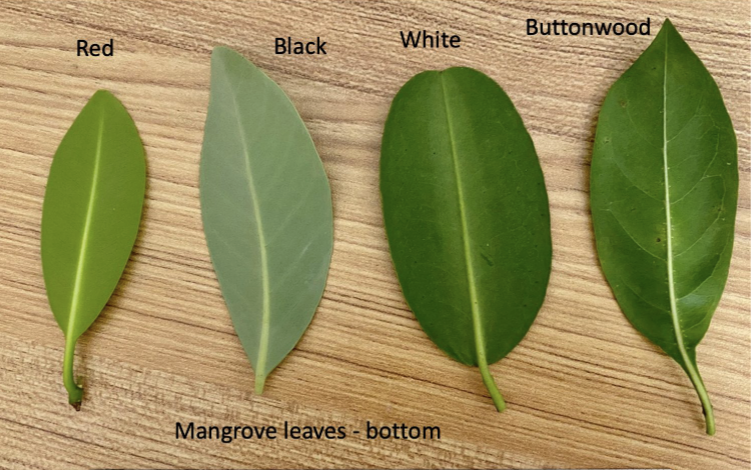
What are the major mangrove species in Florida?
Red Mangrove – Rhizophora mangle
Black Mangrove – Avicennia germinans
White Mangrove – Laguncularia racemosa
How do halophytes (like mangroves) survive salty, waterlogged soils?
Tolerate high salt & low oxygen
Manage salt via exclusion, excretion, or storage
Have thick cuticles, succulent leaves, and air-conducting tissues
How does the red mangrove adapt to salty, waterlogged soils?
Prop roots: stabilize tree & help oxygen reach roots
Salt exclusion: roots filter out most seawater salt
How does the black mangrove survive?
Pneumatophores: vertical “snorkel” roots for gas exchange
Salt excretion: leaf glands remove salt; crystals visible
Sacrificial leaves: old leaves store salt, then drop off
How does the white mangrove survive?
Salt glands: excrete salt at leaf bases
Succulent, waxy leaves: conserve freshwater under high salinity
What adaptations do all mangroves share?
Osmotic control: high internal solutes help water uptake
Aerenchyma: air channels carry oxygen to submerged roots
Hydrophobic root barriers: block unwanted salt
Lenticels: pores in bark/roots allow gas exchange
How do mangroves reproduce and spread?
Vivipary: seeds grow into propagules while still attached to parent
Buoyant dispersal: propagules float to suitable sediment
Rapid rooting: helps them survive in shifting tidal areas
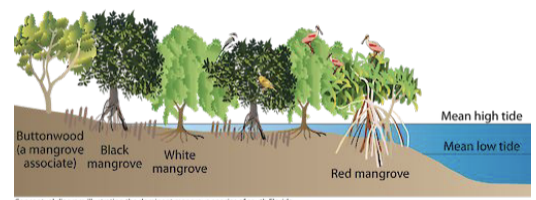
What is structural zonation in mangroves?
Zones reflect decreasing tidal immersion
Root types adapt to oxygen & salt stress
Creates layered habitats for diverse aquatic & terrestrial life
How do mangroves protect coastlines and reduce flooding?
Dense roots slow waves & currents, reducing storm energy
Trap sediment, raise coastal elevation, prevent erosion
Fallen leaves & roots build peat/soil, stabilizing shorelines
Organic matter cycling supports ecosystem productivity
Forest expansion helps resist sea-level rise
 Note
Note  Flashcards (46)