Lumbar spine review and current concepts
 Studied by 0 people
 Call Kai
 Learn
Learn Practice Test
 Spaced Repetition
 Match
Match Flashcards
 Knowt Play
1/59

There's no tags or description
Looks like no tags are added yet.
Name | Mastery | Learn | Test | Matching | Spaced | Call with Kai |
|---|
No analytics yet
Send a link to your students to track their progress
60 Terms
IVD
-bean shaped
-more fluid in youth
-more fibrous with age
what is the area of theIVD that is most vulnerable to degeneration
-posterolateral
Anterior facet joint capsule is the
-ligamentum flavum
posterior facet joint capsule blends with
-multifidus
____________ are present in the capsule
-intra-articular meniscoids
what structure may play a role in preventing central disc bulge
-posterior longitudinal ligament (PLL)
_______________ may prevent joint capsular entrapment
-ligamentum flavum
Entrapment and hypertrophy of the ligamentum flavum may contribute to
-degenerative stenosis
iliolumbar ligament restrains
-all motions at L5-S1 (level with most shear forces)
-most frequently strained bc of multiple attachments
thoracolumbar fascia is _____________ (elastic/non-elastic)
-non-elastic
TLF envelopes
-musculature
hypertrophy of muscles ______________ (tensions/slackens) fascia
-tensions
working out and hypertrophy of larger muscles can
-create spinal stability
t/f TLF has multiple attachments to the spine and other ligaments
-T
TLF has attachments to
-lats
-TVA (TrA)
TLF facilitates work of core muscles because
-it communicates to several structures
what muscle must you address in someone w/ LBP
-multifidus
multifidus
-are major arthrokinematic controllers
-responsible for 2/3 of lumbar spine stiffness
-active during almost all antigravity activities
multifidi are __________ (increased/reduced) in size in pts w/ LBP
-reduced
-reduction persists after pain has resolved
-may be restored w/ specific strengthening
multifidi are innervated how
-segmentally
-medial branch of primary posterior rami
multifidi are impaired how
-segmentally
-one level doesn't work, but levels above and below do work
multifidi are the
-rotator cuff of the lumbar spine
-when one side is acting concentrically the other is acting eccentrically
TVA (TrA)
-thought to play vital role in stability by creating a rigid cylinder and enhancing lumbar stiffness via its attachments to the TLF
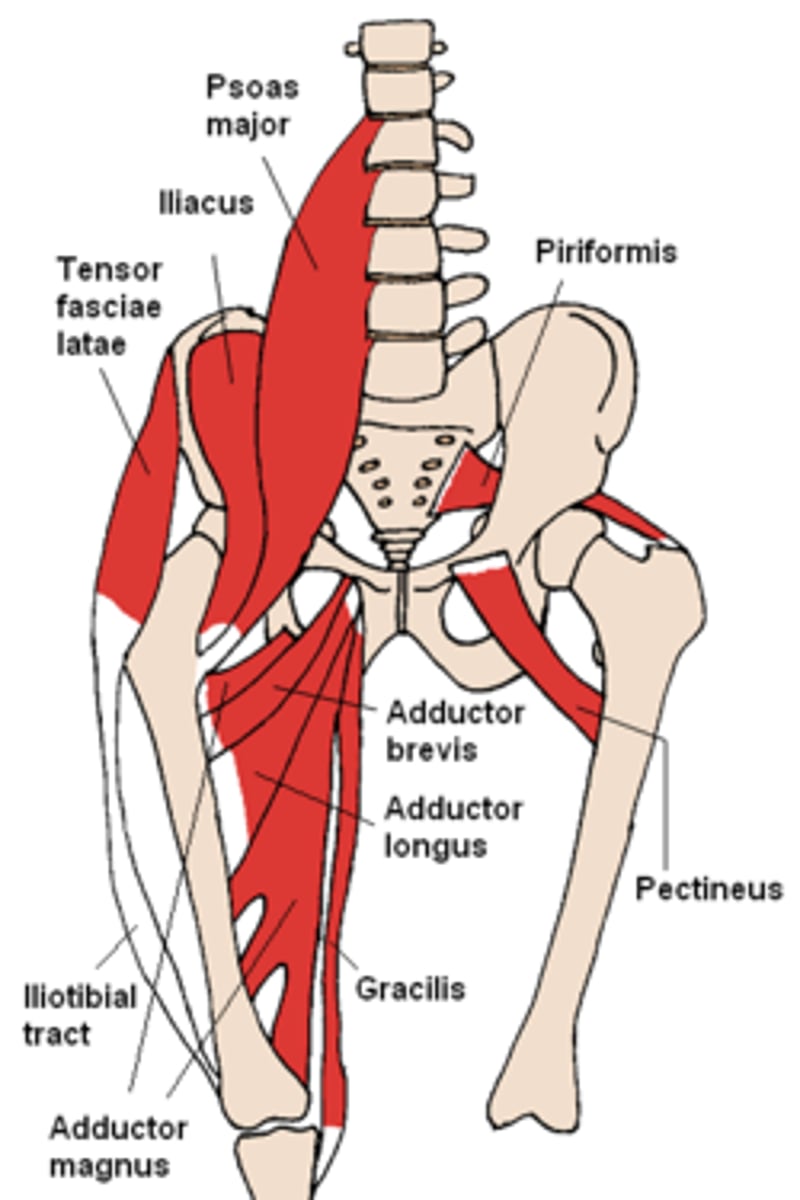
iliopsoas
-has extensive attachments to bodies, discs, and TVPs of lumbar spine
-can create compression, may increase lordosis and anterior shear
-may act as stabilizer
_______________ (flexion/extension) is the predominant motion available at the lumbar spine and most commonly used in everyday activities
-flexion
full flexion usually results in a _____________ (flattening/rounding) of the lordosis w/ a slight reversal of lordosis in some cases
-flattening
in flexion
-vertebral body rocks anteriorly, w/ slight anterior glide
-inferior facets of sup vertebrae glide superiorly and anteriorly
-anterior disc is compressed
-posterior disc is tensioned
in full flexion there is
-minimal facet joint contact
in flexion excessive anterior translation is prevented by
-facets and capsule
-multifidus
-erector spinae
-ligaments
-disc
in flexion intervertebral foraminal space and spinal canal space are
-increased
in extension
-vertebral body: rocks posteriorly
-facets: glide inferiorly
-posterior disc is: compressed
-anterior disc is: tensioned
in extension intervertebral foraminal space and spinal canal space are
-reduced
in extension the ligamentum flavum may ____________ if degenerated
-bunch
in extension facet joints are
-close packed
extension is limited by
-bony contact
-ability of disc to allow tension anteriorly and compression posteriorly
sidebending occurs with flexion kinematics on the
-contralateral side
sidebending occurs with extension kinematics on the
-ipsilateral side
in sidebending coupled motions of rotation to the ____________side may occur
-opposite
rotation compresses the _________facet
-contralateral
rotation decompresses the ________facet
-ipsilateral
rotation does what to the interverterbral foraminal space
-nothing
rotation coupled w/ ______________ (flexion/extension) allows increased rotation and may injure disc
-flexion
rotation is limited by _______________
-facet joint
excessive rotation in the case of trauma may injure
-the facet joint
excessive compression may result in
-loss of disc height and
-degenerative changes
with degeneration forces are transferred to the facet joints. Abnormal loading causes
-facet joint hypertrophy
-loss of intervertebral foraminal space
lumbar spine distraction
-rarely occurs in everyday life in symmetrical fashion
-primarily limited by annulus fibrosis
-allows increase in imbibition of fluids by the disc
-most often employed therapeutically
neutral zone is
-a region of laxity around neutral resting position of the spine
stability depends on what systems
-active
-passive
-CNS
role of ___________system is essential throughout ROM for stability to occur
-active
active system
-spinal muscles
passive system
-spinal column
CNS
-neural
active system 2
-trunk muscles classified as mobilizers and stabilizers
-mobilizers move trunk through space
-stabilizers maintain general trunk stiffness
-stabilizers classified as global and local stabilizers
local mobility
-speaks to pathokinesiolgy which considers how tissue dysfunction can lead to mvmt impairment
global stability
-means lumbar spine muscles and regions around it can generate isolated activation taht can be coordinated w/ various joint movements and incorporated into ADLs
-speaks to kinesiopathology which considers how mvmt impairment can lead to tissue dysfunction
spinal stability exercises should
-strengthen trunk muscles so they can produce sufficiently large forces and active stiffness
-increase endurance of trunk muscles so the force output of the muscles doesn't deteriorate
-incorporate sound motor learning principles to address impaired motor control strategies
-utilize manual therapy to address any impaired mobility of the nn, joints, and soft tissues to enhance mvmt control
global stabilizers
-rectus abdominis
-int and ext obliques
-lateral fibers of QL
-thoracic part of lumbar iliocostalis
global stabilizer functions
-increase general trunk stiffness
-have no segmental influence
-eccentrically decelerate momentum and control gross rotation of trunk
local stabilizers
-lumbar multifidus
-TVA (TrA)
-posterior fibers of internal oblique
-medial fibers of QL
-lumbar portions of iliocostalis and longissimus thoracis
 Note
Note  Flashcards (62)